Topics (384k) Articles (398k) Users (410) Discussions (242) Comments (383) Files (13k) New article
The topological spin is the phase produced by a rotation of anyon , equivalently its self-exchange phase in an Abelian anyon theory. The two-dimensional spin-statistics relation is .
Zeeman splitting is the separation of energy levels or mode frequencies by a background magnetic field. In atomic physics, the magnetic field couples to a magnetic dipole moment, lifting quantum degeneracy. Transitions between the shifted quantum states can turn one spectral line into several. A split level and a split spectral line are different objects: the emitted photon measures the difference between two level energies, and the electric-dipole selection rule determines which differences appear.
The Stern-Gerlach experiment also probes magnetic dipole moments, through beam deflection in a magnetic field gradient. Here the readout is a spectral line.
The pattern makes an invisible magnetic field visible through spectroscopy. It also reveals angular momentum and magnetic dipole moments inside chemical atoms. Zeeman slowers exploit a changing resonance frequency to keep moving chemical atoms absorbing laser photons; a magneto-optical trap combines position-dependent shifts with electromagnetic polarization and laser cooling. Related mode shifts occur in Zeeman splitting of an antiferromagnetic spin wave.
The spin-wave velocity is the slope of a linearly dispersing spin wave. For the leading square-lattice Heisenberg antiferromagnet continuum theory, .
An axial vector transforms as under an orthogonal matrix . It agrees with a polar vector under a proper rotation matrix and has the additional determinant sign under an orientation-reversing transformation. Angular momentum and angular velocity are axial vectors.
Conservation of angular momentum says that total angular momentum stays fixed when the net external torque about the chosen fixed inertial origin vanishes. Individual angular momenta and angular velocities can change. The radius change at constant angular momentum below makes this distinction visible: pulling two rotating point masses inward lowers the moment of inertia, raises the angular velocity, and supplies work that increases the kinetic energy.
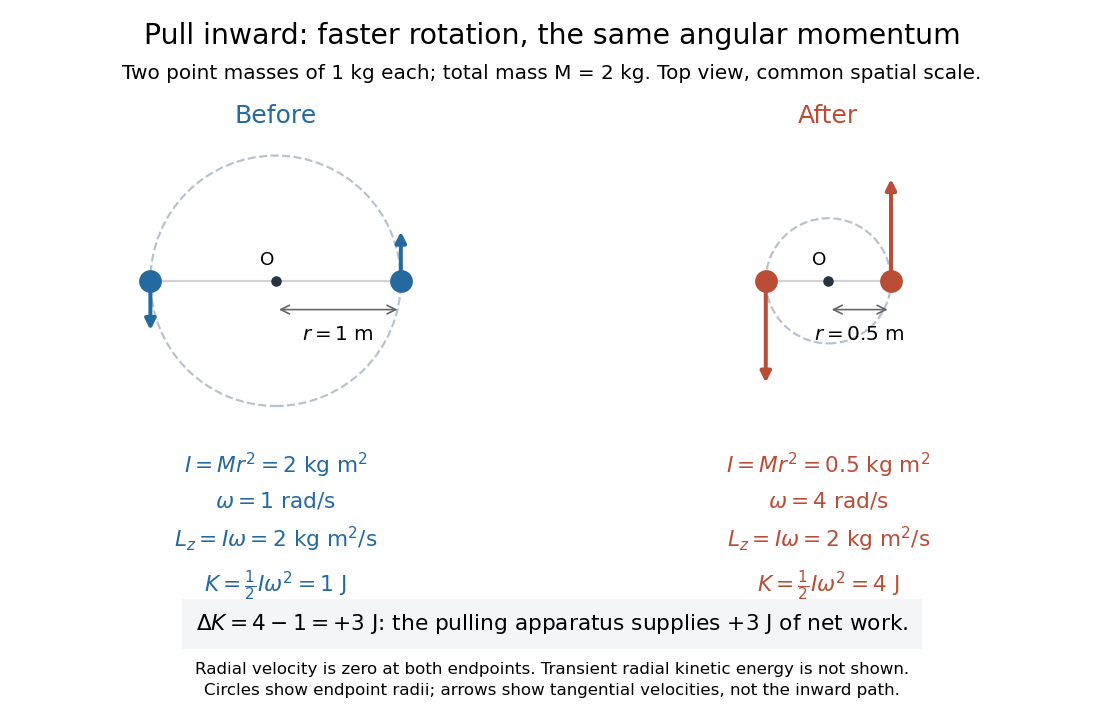
Follow the same constant-mass point masses throughout, in an inertial frame, with all positions measured from a fixed origin . If the internal pair forces are opposite and central, meaning directed along each pair's separation, thenThus zero net external torque throughout an interval implies constant total angular momentum throughout that interval. A vanishing external torque component, such as , conserves the corresponding even when the other components change. This is the balance law for a fixed collection; angular-momentum flux must also be accounted for when matter crosses its boundary. [ref]
The central qualification is essential. Write for the internal force on member from member . Under Newton's third law, , but the sum of their torques isThis vanishes when is parallel to . Equal-and-opposite forces alone do not suffice: two opposite transverse forces with separated lines of action form a couple with nonzero torque. Cancellation of the internal pair torques, together with Newton's second law, proves the total balance above.
For one point mass under a central force about , gives . The force may still change the speed and kinetic energy; its zero torque preserves angular momentum. With nonzero , keeps the motion in a fixed plane. Choosing the axis perpendicular to that plane, governs its angular progress. This removes an unknown from the central-force radial turning point calculation and helps reduce the Kepler orbit to a radial problem.
There is a historical geometric version of this result. In Book I, Section II, Proposition I of the Principia, Newton proves that motion under a central force toward a fixed centre stays in a plane and sweeps equal areas in equal times, using successive central impulses and equal triangle areas. [ref]
https://en.wikisource.org/wiki/The_Mathematical_Principles_of_Natural_Philosophy_(1846)/BookI-II. Newton, Principia, Book I, Proposition I, Motte translation, 1846 edition
In the modern notation above, constant areal velocity is : the old geometric proof and the angular momentum calculation express the same invariant.The cubic Landau amplitude equationwith describes saturation through a supercritical pitchfork bifurcation when a reflection symmetry permits both signs of .
The Albanese variety of a smooth projective variety is the universal abelian variety receiving a morphism from after a base point is chosen. Over the complex numbers its dimension is .
For a smooth projective variety over the complex numbers, its plurigenera are , where is the canonical line bundle of a smooth variety. If every vanishes for , define . Otherwise, is the largest dimension of the image of a rational map defined by a complete linear system of a divisor. Equivalently, there are positive constants such thatfor all sufficiently large, sufficiently divisible . Restricting to divisible matters because some plurigenera can vanish periodically.[ref]
Kodaira dimension of algebraic varieties by Mihnea Popa. Sections 1.2–1.3, Definition 1.2.1, Proposition 1.2.4 and Definition 1.3.1
For a smooth projective curve, genus zero, one and at least two give , respectively. For smooth projective surfaces, , a product of two elliptic curves, the product of an elliptic curve with a curve of genus at least two, and the product of two such higher-genus curves realize . The plurigenera, hence , are invariant under birational between smooth projective varieties, making this growth rate useful for classification.[ref]
An elliptic surface is a smooth projective surface equipped with a surjective morphism to a smooth curve whose generic fiber is a smooth curve of genus one.
A complex K3 surface is a compact, simply connected complex surface with trivial canonical bundle. For projective algebraic surfaces, one can equivalently require a trivial canonical bundle and . Nonprojective complex K3 surfaces are also included, which is essential for the full moduli space of Ricci-flat K3 metrics.
An exceptional curve of the first kind is a smooth rational curve on a smooth surface with . It can be contracted to a smooth point.
This is precisely the curve contracted by the Castelnuovo contraction criterion.
Intersection pairing on the Picard group of a surface by  Codex 0 Created 2026-09-28 Updated 2026-10-05
On a smooth projective surface, two line bundles are represented by divisors and , and their intersection is the degree of the zero-cycle obtained after moving them into proper position. It is a symmetric bilinear form on the Picard group, and equals the degree of restricted to when is an integral curve not contained in .
A semi-additive category has a commutative-monoid enrichment and finite products in a category and coproducts in a category. Composition preserves addition and zero in each variable. Every finite product in a category is canonically a coproduct in a category and conversely, producing finite biproducts. Some authors use "semi-additive structure" for the commutative-monoid enrichment alone; that weaker convention also permits one-object categories without finite products in a category.
A preadditive category instead has abelian-group-valued hom sets. Semi-additivity alone does not require additive inverses.
An additive functor between additive categories induces a group homomorphism on every hom-group. It therefore preserves zero morphisms and finite biproducts.
Pinned article: Introduction to the OurBigBook Project
Welcome to the OurBigBook Project! Our goal is to create the perfect publishing platform for STEM subjects, and get university-level students to write the best free STEM tutorials ever.
Everyone is welcome to create an account and play with the site: ourbigbook.com/go/register. We belive that students themselves can write amazing tutorials, but teachers are welcome too. You can write about anything you want, it doesn't have to be STEM or even educational. Silly test content is very welcome and you won't be penalized in any way. Just keep it legal!
Intro to OurBigBook
. Source. We have two killer features:
- topics: topics group articles by different users with the same title, e.g. here is the topic for the "Fundamental Theorem of Calculus" ourbigbook.com/go/topic/fundamental-theorem-of-calculusArticles of different users are sorted by upvote within each article page. This feature is a bit like:
- a Wikipedia where each user can have their own version of each article
- a Q&A website like Stack Overflow, where multiple people can give their views on a given topic, and the best ones are sorted by upvote. Except you don't need to wait for someone to ask first, and any topic goes, no matter how narrow or broad
This feature makes it possible for readers to find better explanations of any topic created by other writers. And it allows writers to create an explanation in a place that readers might actually find it.
Figure 1. Screenshot of the "Derivative" topic page. View it live at: ourbigbook.com/go/topic/derivativeVideo 2. OurBigBook Web topics demo. Source. - local editing: you can store all your personal knowledge base content locally in a plaintext markup format that can be edited locally and published either:This way you can be sure that even if OurBigBook.com were to go down one day (which we have no plans to do as it is quite cheap to host!), your content will still be perfectly readable as a static site.
- to OurBigBook.com to get awesome multi-user features like topics and likes
- as HTML files to a static website, which you can host yourself for free on many external providers like GitHub Pages, and remain in full control

Figure 2. You can publish local OurBigBook lightweight markup files to either OurBigBook.com or as a static website.
Figure 3. Visual Studio Code extension installation.
Figure 5. . You can also edit articles on the Web editor without installing anything locally. Video 3. Edit locally and publish demo. Source. This shows editing OurBigBook Markup and publishing it using the Visual Studio Code extension. 
- Infinitely deep tables of contents:



All our software is open source and hosted at: github.com/ourbigbook/ourbigbook
Further documentation can be found at: docs.ourbigbook.com
Feel free to reach our to us for any help or suggestions: docs.ourbigbook.com/#contact