
Past exam of the mathematics course of the University of Cambridge 2011 ii Paper 1 8E Solution Created 2026-09-24 Updated 2026-10-14
At , both denominators are nonzero because ; they remain nonzero for every real . The integrand is therefore bounded on each finite interval. At infinity its terms decay respectively as and , so gives absolute convergence.
Set . The two integrals becomeBy the Euler integral for the hypergeometric function and the Gamma function recurrence, for and the indicated unit-circle values . HenceThe Gauss hypergeometric functions here use their continuation from the Euler integral, so no pole crosses the integration interval.
Past exam of the mathematics course of the University of Cambridge 2011 ii Paper 1 7C Solution Created 2026-09-24 Updated 2026-10-14
The fixed points are and . The Jacobian matrix isAt the origin its eigenvalues are and , so it is a saddle equilibrium for every allowed . At either nonzero fixed point the characteristic polynomial is , givingThus both are stable nodes for and stable focuses for . At equality the repeated eigenvalue is and the matrix is not scalar, so there is only one independent eigenvector: the fixed point is a stable improper node.
The stable manifold of the origin is , exactly: there . Conversely, a trajectory converging to the origin with would eventually have , which precludes convergence of to zero.
For the local unstable manifold, write . Reflection symmetry makes even, and the invariance equation for a graph requiresComparing quadratic and quartic terms gives and . Therefore
Past exam of the mathematics course of the University of Cambridge 2011 ii Paper 1 6B Solution Created 2026-09-24 Updated 2026-10-14
The equation is a conservation law with diffusive flux . For positive density, insects move down the density gradient, with effective diffusion coefficient : dispersal is stronger in low-density regions. This is logarithmic diffusion, since the equation is .
Put and . A self-similar solution conserves total number when . Its width shrinks to zero as ; for an integrable nonnegative , changing variables in the integral against a bounded continuous function proves convergence to times the Dirac delta distribution at the origin.
Substitution givesMatching powers for a nonstationary profile forces . The profile equation integrates to . For a centred even profile, , and integration of gives . Normalization requires , henceThis is times a Cauchy distribution density with scale . It is positive, has total mass , and directly satisfies the nonlinear diffusion equation for .
Past exam of the mathematics course of the University of Cambridge 2011 ii Paper 1 5J Solution Created 2026-09-24 Updated 2026-10-14
Write for the single-observation score function. Differentiating the normalization of the probability density function givesFor discrete observations, use a sum instead. The allowed interchange of differentiation and integration is the usual regular-model assumption with common support. Adding these identities gives .
Let be the joint density. Because is an unbiased estimator with no explicit dependence on the parameter, differentiating givesThe scores are independent random variables with mean zero, so variance additivity for independent random variables gives . The Cauchy-Schwarz inequality applied to the centred estimator and the score now gives the Cramér-Rao lower bound:The denominator is the sample Fisher information. This bound concerns regular models with positive finite information; the preceding covariance identity explains why a small estimator variance requires a sufficiently informative score.
Past exam of the mathematics course of the University of Cambridge 2011 ii Paper 1 4G Solution Created 2026-09-24 Updated 2026-10-14
Use binary search: maintain the interval of possible integers and ask whether is at least the first integer in its upper half. Each answer reduces the number of possibilities to at most its previous number divided by two, rounded up. After questions at most possibilities remain. Since , twenty questions suffice.
A yes/no decision tree of depth twenty has at most leaves, whereas the possible finishing orders number . Thus twenty questions cannot identify the finishing order of fifteen horses, assuming no ties. With unrestricted yes/no questions, the exact minimum for horses is : the leaf count is a lower bound, and repeatedly partitioning the remaining permutations into two nearly equal sets attains it. In particular fifteen horses require 41 questions.
By Stirling's formula,so the leading number of questions is . These questions may ask about whole sets of possible orders; restricting them to pairwise comparisons is a different model.
Past exam of the mathematics course of the University of Cambridge 2011 ii Paper 1 40A iii Created 2026-09-24 Updated 2026-09-24
Past exam of the mathematics course of the University of Cambridge 2011 ii Paper 1 40A ii Created 2026-09-24 Updated 2026-09-24
Past exam of the mathematics course of the University of Cambridge 2011 ii Paper 1 40A i Created 2026-09-24 Updated 2026-09-24
Past exam of the mathematics course of the University of Cambridge 2011 ii Paper 1 3G Solution Created 2026-09-24 Updated 2026-10-14
Each nonidentity element of the special orthogonal group is a rotation fixing exactly the two unit vectors along its axis. Since is a finite group, is finite. If is fixed by and , then is fixed by . Hence acts on by a group action.
Let , let be the number of orbits of a group action, and choose representatives with stabilizer subgroups of orders , each at least two. Count pairs with and . Counting by gives . Counting by group orbits and using the orbit-stabilizer theorem givesEvery summand is at least , so : there are at most three orbits. For the trivial group, is empty and the assertion also holds.
For the rotation group of a regular dodecahedron, . The three group orbits are the unit vectors towards the 12 face centres, 20 vertices and 30 edge midpoints, whose stabilizer subgroup orders are respectively . Rotations about these axes exhaust the nonidentity rotations. Consequently the orbit sizes are
Past exam of the mathematics course of the University of Cambridge 2011 ii Paper 1 39B Solution Created 2026-09-24 Updated 2026-10-14
Use an acoustic velocity potential with and . It obeys the wave equation . The rigid walls require zero normal velocity, hence Neumann boundary conditions on the transverse variables. Separation givesDefine . The dispersion relation, phase velocity and group velocity for positive areFor a dispersive mode, , decreases from infinity to , and increases from zero to . The mode has and : it propagates without dispersion.
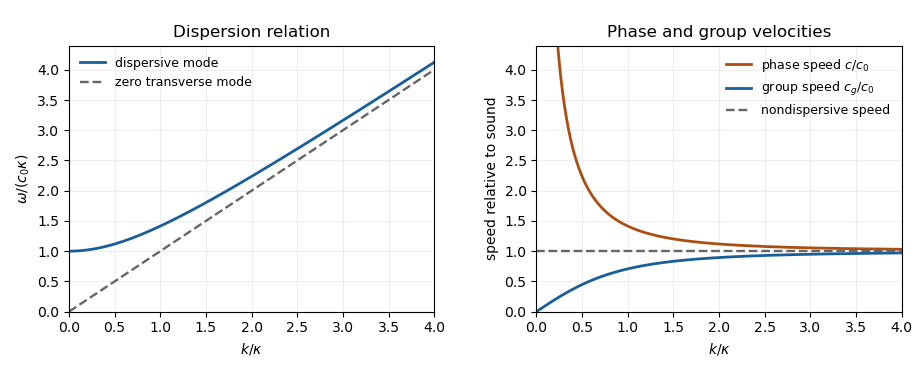
Acoustic waveguide dispersion and velocities; a nonzero transverse wavenumber is compared with the nondispersive mode
. Details. 
Let be the cross-sectional area. The appropriate time and cross-sectional average at fixed isWrite for the product of cosines and . Its transverse eigenvalue and wall conditions give by integration by parts. The kinetic energy density and compressive acoustic energy density are and . Time averaging each squared real oscillation contributes a factor , soThis holds for every dispersive mode, and also for the zero mode.
For localized smooth initial data, a dispersive mode contains integrals of the form along . When , a stationary point exists at . It is nondegenerate because . The stationary phase method therefore gives an oscillatory amplitude for each excited dispersive mode, and for their sum under sufficient mode summability.
At , no dispersive mode has a finite stationary wavenumber; with smooth localized data these contributions decay, while the nondispersive right-moving pulse retains its original amplitude. Thus a general disturbance with nonzero zero-mode component has an undiminished pulse on the sound-speed ray. If that component is absent, this surviving contribution is absent too. For , finite propagation speed puts a compactly supported initial disturbance outside this ray for all sufficiently large , so the field is eventually zero. Rapidly localized, rather than strictly compact, data give a correspondingly negligible tail instead.
Past exam of the mathematics course of the University of Cambridge 2011 ii Paper 1 38B Solution Created 2026-09-24 Updated 2026-10-14
The outer fluid is at rest, so its pressure is independent of and . Using incompressibility, the longitudinal boundary-layer equation becomes the conservative momentum equationIntegrating across the jet and using and at both transverse infinities givesPut . The momentum-flux scaling gives , while balancing longitudinal convection with transverse viscous diffusion gives . Eliminating or yields
Choose the precise width convention and take to be the centre-line velocity. For the self-similar solution with streamfunction , ,The terms cancel in , leaving . Since , the dimensionless profile equation isFor a symmetric jet choose its streamfunction zero at the axis. The boundary and amplitude conditions are , , , and as , with bounded and . The momentum normalization isIt determines the dimensional constants in ; one should not independently impose after fixing both the centre-line and width conventions.
Past exam of the mathematics course of the University of Cambridge 2011 ii Paper 1 37D Solution Created 2026-09-24 Updated 2026-10-14
Using the affine parameter and the normalization requested for the geodesic Lagrangian,The coordinate is cyclic. Its Euler-Lagrange equation gives . The transverse coordinate equations give and . For the remaining coordinate,Its Euler-Lagrange equation, after using , isCompare with . With indices , the complete list of nonzero Christoffel symbols, including symmetry of the lower indices, isAll contracted symbols vanish. For , the first derivative term in the supplied Ricci tensor formula is , since is independent of . The second derivative term vanishes because the trace symbols vanish. The third term vanishes for the same reason, and every possible product in the last term requires a zero symbol with upper index or a lower , so it also vanishes. ThusThe Vacuum Einstein equations with zero cosmological constant require , and therefore . The wave profile of this plane-fronted gravitational wave is harmonic in the transverse plane for each fixed .
Past exam of the mathematics course of the University of Cambridge 2011 ii Paper 1 36C Solution Created 2026-09-24 Updated 2026-10-14
In the Landau-Ginzburg theory functional, is the magnetic field energy density; the covariant-gradient term is the carrier kinetic energy including phase gradients and electromagnetic coupling. The terms give the local condensation energy. With the normalization in the question, is the carrier density.
For a uniform field-free equilibrium, minimize over . Stability for large requires , and a nonzero minimum requires . ThereforeThe factor two follows from the question's quartic coefficient , rather than a convention using .
Let . Under the gauge transformation,Its squared magnitude is unchanged, is unchanged, and is unchanged. Thus the full energy has gauge invariance.
For uniform , write . The kinetic density is . Varying with compactly supported variations and integrating the magnetic term by parts givesAt a minimum its coefficient vanishes, giving the London equationTaking another curl, using and a smooth phase so , yieldsFor a planar surface this has the decaying solution inside the material; the growing solution is excluded by boundedness in the bulk. Hence magnetic fields penetrate only a surface layer of thickness and vanish deep in the macroscopic bulk, the Meissner effect. This conclusion uses the uniform-density, smooth-phase setting; a vortex has a singular phase and a nonuniform core and is outside those assumptions.
Past exam of the mathematics course of the University of Cambridge 2011 ii Paper 1 35D Solution Created 2026-09-24 Updated 2026-10-14
The microcanonical ensemble describes an isolated system at fixed energy, volume and particle number. The canonical ensemble describes fixed particle number and volume with heat exchange at a prescribed temperature. The grand canonical ensemble additionally allows particles to exchange with a reservoir, prescribing temperature, volume and chemical potential. Their respective equilibrium probabilities are uniform on the accessible energy shell, proportional to , and proportional to . For stable short-range systems in the thermodynamic limit, concentration of relative energy and particle-number fluctuations and concavity of entropy make their bulk predictions equivalent; phase coexistence or nonadditive interactions require care.
For the microcanonical case restrict the allowed states to the fixed-energy shell of size , imposing outside it. Maximize the Gibbs entropy subject to . A Lagrange multiplier gives on the shell, soFor the canonical case impose both normalization and . Stationarity of gives . ThusThe last identification follows from . Entropy is strictly concave in the probabilities, so these stationary distributions are maxima.
For the independent three-level particles, put and . The full partition function is because the particles occupy labeled lattice sites. Differentiation givesThe heat capacity also equals , confirming positivity. As , the three occupations become equal:As , all particles occupy their unique lowest state:
A negative temperature is possible because the total energy is bounded above. An equilibrated population inversion has more particles at than at . For example probabilities correspond to and mean energy . This is a macroscopic occupation pattern; an isolated individual microstate is not itself assigned a temperature. At the positive zero-temperature limit the ground state is unique, so the entropy tends to zero: the system obeys the third law of thermodynamics. The negative-temperature branch likewise approaches the unique highest-energy state as ; it does not introduce residual ground-state entropy.
Past exam of the mathematics course of the University of Cambridge 2011 ii Paper 1 34E Solution Created 2026-09-24 Updated 2026-10-14
With outgoing-channel index first, the scattering matrix convention is as . An even potential commutes with parity, so its incoming even and odd channels remain separate: .
For the odd channel, on write , while on its prescribed normalization is . A delta potential keeps the wavefunction continuous and imposes , with . Thus the exterior logarithmic derivative is . Matching givesMultiplying numerator and denominator by and using exponential forms yieldsFor real , the numerator of the fraction is the complex conjugate of its denominator, and the prefactor has modulus one. Hence , conservation of probability flux in this single elastic parity channel. In particular the minus sign built into makes the free odd-channel matrix element equal to one.
For an odd bound state, continue to , . A pole means the outgoing solution is exponentially decaying on both sides. Its denominator vanishes whenThe function rises strictly from to infinity: differentiation reduces positivity to . Thus there is exactly one positive solution if , and none otherwise. The numerator does not vanish at that solution, so the pole is genuine. ConsequentlyAt equality the zero-energy threshold solution is not square integrable.
For repulsive strong barriers put and . The pole equation is . Since , multiplication by gives . Iterating in yieldsThis lower-half-plane resonance pole is an odd standing wave trapped between the barriers and slowly leaking by tunnelling. Its complex energy is , with . The factor then decays rather than grows; encodes the positive escape rate.
Past exam of the mathematics course of the University of Cambridge 2011 ii Paper 1 32A Solution Created 2026-09-24 Updated 2026-10-14
A Hamiltonian system on a -dimensional symplectic manifold is Liouville integrable when it has first integrals, including the Hamiltonian, whose differentials are independent on a dense regular region and which pairwise have zero Poisson bracket. The Arnold-Liouville theorem states that a compact connected regular common level set is a -torus; near it there are action-angle variables in which the Hamiltonian depends only on and the motion is , . Without compactness, the torus conclusion needs modification.
Here is a cyclic coordinate, so is conserved and . The Hamilton equations areThe differentials are independent away from the circular-orbit critical set, establishing integrability. Put ; on a fixed angular-momentum level,For a bounded noncollision orbit require and . Its two turning radii areThey are positive and , and . In terms of and the angular coordinate, eliminating time gives . ThusAfter an angular change of the phase-space state returns to itself, and the elapsed time is finite because is bounded away from zero and infinity. This proves periodicity; a torus alone would only guarantee quasiperiodic motion. At the orbit is circular and remains periodic. For the allowed radial motion is unbounded. The collision case reaches the excluded boundary and is not a periodic orbit in the given phase space.
With the usual action convention , the angular cycle gives , and the two radial legs giveFor completeness, substitute to evaluate the integral as . Therefore and . The two frequencies have equal magnitude, consistent with the closed Kepler orbits. The circular limit has and .
Past exam of the mathematics course of the University of Cambridge 2011 ii Paper 1 31A Solution Created 2026-09-24 Updated 2026-10-14
The asymptotic expansion means that for every fixed integer ,It concerns the successive finite truncations; the infinite series need not converge. Because the assertion holds at every order, one may equivalently bound the remainder after order by .
Put and . For integer , and . Two integrations by parts giveRepeating exactly times givesAll derivatives are integrable on this compact interval. The Riemann-Lebesgue lemma says their oscillatory integrals tend to zero, proving the expansion at every order, including . Since is even, its odd derivatives vanish at zero. Now and , soThe restriction to integer is essential to this even-power endpoint expansion: otherwise the first integration by parts has a generally nonzero boundary term.
Past exam of the mathematics course of the University of Cambridge 2011 ii Paper 1 30A iv Created 2026-09-24 Updated 2026-09-24
Past exam of the mathematics course of the University of Cambridge 2011 ii Paper 1 30A iii Created 2026-09-24 Updated 2026-09-24
Past exam of the mathematics course of the University of Cambridge 2011 ii Paper 1 30A ii Created 2026-09-24 Updated 2026-09-24
There are unlisted articles, also show them or only show them.