
Past exam of the mathematics course of the University of Cambridge 2010 ii Paper 3 21H Solution Created 2026-09-24 Updated 2026-10-14
The real Stone-Weierstrass theorem states that if is compact Hausdorff and is a subalgebra containing the constants and separating points, then is uniformly dense in . Let be its uniform closure, still an algebra over a field. If and , scale the permitted polynomial approximation of absolute value on to . Applying these polynomials to proves . Thereforebelong to : it is a lattice.
Fix and . For every , point separation and an affine adjustment give with and ; if , a constant suffices. For fixed , the open sets where cover . Select finitely many and take their maximum . Then everywhere and . By continuity, on some neighborhood of . Choose finitely many covering and take the minimum of the corresponding . The result satisfies everywhere. Since is closed and arbitrary, . Thus , proving the theorem.
Past exam of the mathematics course of the University of Cambridge 2010 ii Paper 3 20H Solution Created 2026-09-24 Updated 2026-10-14
Cover the circle by two open arcs whose intersection has two components, and take their products with . Both members of this cover retract onto , while their intersection retracts onto . The Mayer–Vietoris sequence has the mapafter consistent identifications of the two overlap components. Its kernel and cokernel are each . Exactness therefore suppliesThis splits because the last group is free abelian: lift a basis and extend linearly. With , the result isStarting from a point and iterating this decomposition, Pascal's identity yields
Past exam of the mathematics course of the University of Cambridge 2010 ii Paper 3 1G ii Created 2026-09-24 Updated 2026-10-14
Past exam of the mathematics course of the University of Cambridge 2010 ii Paper 3 19F Solution Created 2026-09-24 Updated 2026-10-14
We use the standard facts that finite complex representations are completely reducible, irreducible characters are orthonormal, the regular character is , and the number of irreducible characters equals the number of conjugacy classes. We also use Schur's lemma, Sylow's theorem and the nontrivial center of a nontrivial finite -group.
For an irreducible character of degree , a conjugacy-class sum acts as the scalar by Schur's lemma and taking traces. This scalar is an algebraic integer: class sums form an integral basis of the center of the integral group algebra, their multiplication has integer structure constants, and multiplication by satisfies its monic integer characteristic polynomial. That same polynomial annihilates its image in any irreducible representation. Character values are also algebraic integers, since they are sums of roots of unity. Character orthogonality now givesThis is a rational algebraic integer, hence an integer. Therefore divides .
The Burnside's pa qb theorem states that every finite group of order is soluble. We prove its character-theoretic ingredient. If a class has size coprime to , integers with givean algebraic integer. Every algebraic conjugate of this number is the average of roots of unity and has modulus at most one. If it is nonzero, its algebraic norm is a nonzero integer of absolute value at least one; since every factor has modulus at most one, all must have modulus one. In particular . Equality in the triangle inequality for the unit-modulus eigenvalues implies that is scalar. Thus if , either or is scalar.
Suppose a group of order were nonabelian simple, with both primes present. Choose a nonidentity in the center of a Sylow -subgroup. Its centralizer contains that Sylow subgroup, so its class size is a power of . Every nontrivial irreducible representation is faithful by simplicity. If it sent to a scalar, faithfulness would make central in the group, impossible in a nonabelian simple group. The ingredient above therefore gives for every nontrivial character with degree coprime to . Evaluating the regular character at givesThe right side is an algebraic integer, but is not, a contradiction. A group of prime-power order cannot be nonabelian simple either, by its nontrivial center. Induct on the order: every nonsimple group has a proper nontrivial normal subgroup, and that subgroup and the quotient have smaller orders with at most these two prime divisors. By induction both are soluble; their derived-series extensions make the original group soluble. Simple abelian groups have prime order and start the induction. This proves Burnside's theorem.
For the final divisibility, let be odd and let be its number of conjugacy classes. All irreducible degrees are odd by the divisibility just proved. We use the standard Frobenius-Schur indicator theorem: is zero precisely for an irreducible character not equal to its conjugate, and is otherwise. Squaring is a bijection on an odd-order group: for each , its unique square root is , since every element order divides . For every nontrivial irreducible character, orthogonality to the trivial character consequently gives . The nontrivial characters therefore occur in distinct conjugate pairs of equal odd degree. Since an odd square is one modulo eight,is a sum of pairs , each divisible by sixteen; the trivial character contributes zero. Hence
Past exam of the mathematics course of the University of Cambridge 2010 ii Paper 3 18H ii Created 2026-09-24 Updated 2026-09-24
Past exam of the mathematics course of the University of Cambridge 2010 ii Paper 3 18H i Created 2026-09-24 Updated 2026-09-24
Past exam of the mathematics course of the University of Cambridge 2010 ii Paper 3 17F ii Created 2026-09-24 Updated 2026-09-24
Past exam of the mathematics course of the University of Cambridge 2010 ii Paper 3 17F i Created 2026-09-24 Updated 2026-10-14
Past exam of the mathematics course of the University of Cambridge 2010 ii Paper 3 16G Solution Created 2026-09-24 Updated 2026-10-14
The cumulative hierarchy is defined by transfinite recursion:The rank of a set is , equivalently the least such that . The standard hierarchy properties give , so every ordinal occurs as a set rank; the ordinal itself is another example of rank .
Let be transitive of rank , and fix . The supremum formula gives an element of whose rank is at least . Choose such an element of least possible rank. If , the same supremum formula gives with rank at least . Transitivity gives , and membership strictly decreases rank, contradicting the choice of . Thus contains an element of every rank below .
A nonempty finite set has rank the maximum of finitely many successor ordinals, hence a successor ordinal; the empty set has rank zero. Conversely, for any , the singleton has rank . ThusA finite transitive set of rank contains, by the proved property, distinct elements of every rank . Finiteness therefore forces . Every finite ordinal is itself a finite transitive set of that rank. Consequently
Past exam of the mathematics course of the University of Cambridge 2010 ii Paper 3 15D Solution Created 2026-09-24 Updated 2026-10-14
For a nonrelativistic particle, . The Gaussian integral yieldsIndeed , which combines with to give the prefactor. For the two species this givesChemical equilibrium imposes . If the two massless bath species have zero chemical potentials, then ; their masses alone do not imply this chemical-potential condition.
Weak reactions such as , with leptons treated as relativistic, interconvert neutrons and protons. Negligible lepton chemical potentials give approximately , since their degeneracies and masses are nearly equal. Equilibrium favors protons increasingly as temperature falls. But the weak reaction rate decreases faster than the expansion rate and eventually falls below it: cosmological weak freeze-out prevents the ratio from following its equilibrium exponential to zero. Free neutrons subsequently decay, reducing the frozen ratio further.
In Big Bang nucleosynthesis, cooling eventually makes deuterium survive photodissociation. Nuclear reactions then build helium through deuterium and the light intermediate nuclei, locking almost all surviving neutrons into stable helium-four. Neglecting binding-energy corrections and taking , each helium nucleus uses two neutrons and two protons, so andFor example gives a helium mass fraction , with the remaining baryons predominantly hydrogen.
Past exam of the mathematics course of the University of Cambridge 2010 ii Paper 3 14D Solution Created 2026-09-24 Updated 2026-10-14
For parameter-dependent centre manifold theorem, append . At the eigenvalues are : the direction is strongly stable and span the extended centre directions. An extended centre manifold for a parameter is an invariant graph of a function tangent to ; nearby trajectories approach its reduced dynamics along stable fibers. The stable eigenvalue remains separated from zero, so local bifurcation and stability are governed by this reduction. This is the parameter-extension content of the requested stable/centre-manifold discussion.
The centre-manifold invariance equation isReflection symmetry permits an invariant graph of a function with and . At quadratic order the left side vanishes and the right side is , giving . More explicitly its first mixed coefficient is , found by equating the terms. The reduced equation isThus the origin is locally asymptotically stable for , becomes a saddle for , and creates two stable equilibria , . This is a supercritical pitchfork bifurcation. The exact nearby nonzero branches provide a check: the equilibrium equations givewhich are real and nonzero for small positive . The omitted branch is not near the origin. At the leading also attracts, although at an algebraic rather than exponential rate.
Past exam of the mathematics course of the University of Cambridge 2010 ii Paper 3 13A Solution Created 2026-09-24 Updated 2026-10-14
Introduce dimensionless quantities , , and . Substitution and cancellation of give the stated spatial SIR model withDrop tildes. A travelling wave with obeysAt the leading edge , the infective equation linearizes to . For an invading epidemic the susceptible level must exceed the removal threshold, . A nonoscillatory decaying tail has exponentsIf the discriminant is negative, a nonzero real tail oscillates in sign, violating nonnegative infective density. Thus for a right-moving waveThis is a necessary admissibility condition from the leading-edge calculation, not by itself a global existence proof.
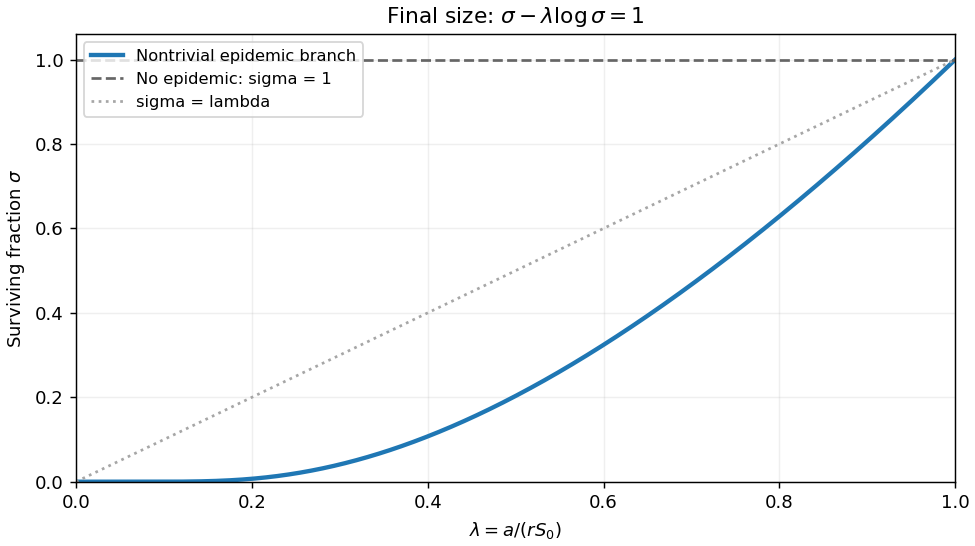
To derive the final size relation for an epidemic, use and integrate the infective ODE across the wave. The tails have , givingThereforeFor a nontrivial epidemic . The function is strictly convex, minimized at . For it has the trivial root and one further root . For , it exceeds one for every , so only the no-epidemic root remains; this also proves the necessity of . On the nontrivial branch,It rises from as to as . The sketch distinguishes this branch from the always-present trivial root.

Past exam of the mathematics course of the University of Cambridge 2010 ii Paper 3 12F iv Created 2026-09-24 Updated 2026-09-24
Past exam of the mathematics course of the University of Cambridge 2010 ii Paper 3 12F iii Created 2026-09-24 Updated 2026-09-24
Past exam of the mathematics course of the University of Cambridge 2010 ii Paper 3 12F ii Created 2026-09-24 Updated 2026-09-24
Past exam of the mathematics course of the University of Cambridge 2010 ii Paper 3 12F i Created 2026-09-24 Updated 2026-09-24
Past exam of the mathematics course of the University of Cambridge 2010 ii Paper 3 11G ii Created 2026-09-24 Updated 2026-09-24
Past exam of the mathematics course of the University of Cambridge 2010 ii Paper 3 11G i Created 2026-09-24 Updated 2026-10-14
Past exam of the mathematics course of the University of Cambridge 2010 ii Paper 3 10D Solution Created 2026-09-24 Updated 2026-10-14
For a comoving fluid volume, and . The first-law relation gives . Since , the cosmological perfect-fluid continuity equation isFor the Newtonian energy argument, assume negligible pressure, spherical homogeneity, Newtonian gravity and constant enclosed mass. A test particle at physical radius has constant specific energyDivide by and set to obtain the Friedmann equationHomogeneity makes independent of the chosen comoving shell. In the relativistic interpretation it specifies the spatial-curvature sign: positive, zero or negative gives closed spherical, flat or open hyperbolic spatial geometry, with a conventional rescaling allowing . Newtonian mechanics itself derives the energy constant, not the spatial metric. When pressure is appreciable, the general relativistic equations still have the displayed Friedmann form, but the constant-mass Newtonian test-particle derivation cannot be applied without that qualification.
Past exam of the mathematics course of the University of Cambridge 2010 ii Paper 2 9D Solution Created 2026-09-24 Updated 2026-11-05
For and , where the matrices are symmetric and constant, the Euler-Lagrange equations give . A normal mode therefore solves .
A string segment of horizontal length has extension . Multiplying by the tension and using and , the quadratic kinetic energy and potential energy areThus and . Taking , , gives the three eigenvalues , . The normal mode frequencies are
There are unlisted articles, also show them or only show them.