
Past exam of the mathematics course of the University of Cambridge 2010 ii Paper 4 13J Solution Created 2026-09-24 Updated 2026-10-14
A natural grouped-binomial logistic regression assumes independentwhere is beer intake and indicate Weird and Relaxed expressions. This uses the logit link. Independence of the individual throws conditional on the day's predictors gives the binomial sampling model; extra within-day dependence would instead produce overdispersion. The interactions let the beer slope depend on facial expression, rather than requiring one common slope. With the data frame named darts, R code is
darts$Expression <- relevel(factor(darts$Expression), ref = "Mad")
barney <- glm(cbind(BullsEye, 100 - BullsEye) ~ Beer * Expression, family = binomial, data = darts)
Mad is the baseline category. Its intercept and beer slope are already represented by the first two coefficients; including all three category indicators together with an intercept would make the design matrix rank deficient. For three beers and Weird expression,The fitted probability is , approximately 0.347.
The Weird intercept and interaction are individually nonsignificant, suggesting that Mad and Weird might be combined. The Relaxed beer interaction is significant, so dropping all interactions would discard supported structure. A candidate reduced model retains only the Relaxed indicator and its interaction:
reduced <- glm(cbind(BullsEye, 100 - BullsEye) ~ Beer * I(Expression == "Relaxed"), family = binomial, data = darts)
anova(reduced, barney, test = "Chisq")
This fits without changing the data file. The joint likelihood-ratio test, rather than the two separate coefficient p-values alone, decides whether the simplification is supported. Also inspect regression residuals and the ratio of residual deviance to residual degrees of freedom for overdispersion or lack of fit; a quasibinomial analysis may be appropriate if the binomial variance is inadequate.
Past exam of the mathematics course of the University of Cambridge 2010 ii Paper 4 12F Solution Created 2026-09-24 Updated 2026-10-14
The Poincare ball model has ideal boundary the Riemann sphere. To construct the hyperbolic extension of a Möbius transformation, conjugate the ball to the upper half-space model with coordinates and metric . The generators of the Möbius group extend asandTranslations and similarities plainly preserve the metric; Euclidean inversion rescales both the squared Euclidean line element and by the same factor, proving the last case. Composition gives the unique orientation-preserving hyperbolic extension. Equivalently, for a determinant-one matrix its upper half-space formula is
An isometry fixing the ball origin acts on its tangent space by an orientation-preserving orthogonal transformation; radial geodesics then show that the whole map is that ordinary rotation. Conversely every rotation preserves the ball metric. On the sphere these are exactly the projective special-unitary mapsthe image of modulo its central signs.
A hyperbolic line is determined by its unordered pair of ideal endpoints. It is invariant precisely when that pair is preserved as a set. A nonidentity parabolic map has one fixed point, and its square also has one, so it cannot fix or interchange two distinct endpoints. Every nonparabolic nonidentity map has two fixed points, and their joining line is invariant.
More precisely, normalize the latter map to . Unless , any invariant pair must consist of zero and infinity: a swapped pair would be fixed pointwise by the square, whose only fixed points remain zero and infinity when . This proves uniqueness for every nonidentity map except an elliptic half-turn. For , every pair is also invariant, giving infinitely many additional lines, besides the fixed-point axis. The identity preserves every line. ThusHere the uniqueness statement includes hyperbolic translations, genuine loxodromic maps and elliptic rotations through angles other than a half-turn.
Past exam of the mathematics course of the University of Cambridge 2010 ii Paper 4 11G Solution Created 2026-09-24 Updated 2026-10-14
Write and associate the symmetric matrix . Define the left group action of by ; using instead describes the same equivalence classes. The transformed matrix is , so its determinant is unchanged. Hence the discriminant of a binary quadratic formis invariant under proper equivalence of binary quadratic forms.
A proper representation here means with . Such a vector extends to the first column of an integer determinant-one matrix by Bezout identity. After that change of variables the form has leading coefficient , and discriminant , so its middle coefficient satisfies . Conversely, such a congruence gives the positive definite integral formwhich represents at . It is primitive: a common divisor of all three coefficients would have its square dividing the squarefree discriminant 35.
For clarity, enumerate all the proper equivalence classes at this discriminant. Substitutions first arrange ; if , the determinant-one substitution makes the leading coefficient smaller. Repeating terminates because this coefficient is a positive integer. Thus every class has a reduced representative with . From it follows that , giving . Checking , with odd, yieldsThe two signs in the first pair are equivalent by replacing with , and in the second pair by the determinant-one swap. Thus the two forms in the question exhaust the classes.
The primitive representation criterion at discriminant minus thirty-five now follows. For odd prime to 35, the congruence modulo is solvable exactly when is a square modulo every prime divisor of . Necessity is immediate. For sufficiency, a nonzero root modulo each odd prime lifts to all required prime powers because its derivative is invertible; combine the lifts by the Chinese remainder theorem, also imposing . This gives the modulus-four condition since . We concludeBy quadratic reciprocity, the symbol equals . In particular each prime divisor must be a quadratic residue at both 5 and 7, or a nonresidue at both. The condition is on each prime divisor, not merely on the product Jacobi symbol of .
Past exam of the mathematics course of the University of Cambridge 2010 ii Paper 4 10D Solution Created 2026-09-24 Updated 2026-10-14
The Jeans wavenumber in physical coordinates is . With wavelength defined as , the Jeans length isPressure opposes gravitational growth on physical wavelengths shorter than this; on longer wavelengths the gravitational term wins. Expansion also provides the damping term , so the actual growth is not generally the exponential growth of a static medium.
For the pressure-free, spatially flat matter solution, and the Friedmann equation gives . The perturbation equation becomesSubstituting gives . ThusThe growing mode scales as and permits the formation of structure; the decaying mode becomes negligible at late times. This is a linear result, valid while the density contrast remains small.
Past exam of the mathematics course of the University of Cambridge 2010 ii Paper 3 9D Solution Created 2026-09-24 Updated 2026-10-14
The quadratic first integrals of the torque-free Euler equations for a torque-free rigid body areDifferentiation and substitution of all three Euler equations make each derivative vanish: the coefficients respectively sum to and . At either endpoint these constants are , , proving .
Eliminating the other squared components gives, with ,Hence and the second Euler equation gives , where increases with . The specified orbit goes from to , so its sign must be negative. The sign in the original PDF's reduced equation is therefore inconsistent with its endpoint conditions. The corrected heteroclinic satisfiesIntegrating by separation gives this family for ; the integration constant is a time translation. The printed positive-sign equation instead has the increasing solutions and cannot meet the stated endpoints. For completeness its other real solutions are and the branches on intervals avoiding their pole. These latter branches are excluded by the conserved-energy constraint . The scalar heteroclinic is unique up to translation. For the full angular-velocity vector there are two sign-related branches: simultaneously reversing and preserves all three Euler equations and both endpoints. Full-vector uniqueness therefore also requires choosing one of those branches.
Past exam of the mathematics course of the University of Cambridge 2010 ii Paper 3 8E Solution Created 2026-09-24 Updated 2026-10-14
For , differentiate the absolutely convergent geometric series to obtainIf , the sum of integrals of absolute values isThus Fubini theorem permits termwise integration, even for complex . The substitution and the definition of the Gamma function giveThe missing terms cancel in the difference of the two Riemann zeta functions.
Past exam of the mathematics course of the University of Cambridge 2010 ii Paper 3 7D Solution Created 2026-09-24 Updated 2026-10-14
Use binary expansions ending in zeros at dyadic rationals. The doubling map shifts the expansion left:In ordinary coordinates it is on and on . The branches are continuous; the left limit at is while its value and right limit are . This is its only discontinuity in the half-open interval.
For every , the repeating binary block givesIts least period is : a shorter repeating block would make more than one digit equal to one in a length- period. The orbit avoids the discontinuity, and its multiplier is , so these periodic orbits are repelling and unstable. The same multiplier argument applies to every periodic orbit, with the endpoint fixed point treated one-sidedly.
In the two-branch horseshoe formulation of Glendinning chaos, disjoint subintervals are each mapped onto the same interval by an iterate. Here , and already satisfy . Their inverse branches and realize every binary itinerary. This is a horseshoe for a piecewise continuous map; on the circle the endpoint jump disappears. The symbolic explanation also shows dense periodic points, by repeating any prescribed finite prefix, and topological transitivity, because an iterate maps any sufficiently small dyadic cylinder onto . Finally every neighborhood contains points sharing an arbitrarily long prefix but with different subsequent digits; an appropriate iterate separates their images by a fixed amount, for instance more than . This proves sensitive dependence on initial conditions as well. The binary shift has full two-symbol chaotic dynamics.
Past exam of the mathematics course of the University of Cambridge 2010 ii Paper 3 6A Solution Created 2026-09-24 Updated 2026-10-14
With no chemotaxis, the stationary oxygen equation is . Symmetry and the two prescribed surface values giveBy Fick's first law, the vertical oxygen flux is . Thus each face supplies an inward flux per unit area, and the total influx is , equal to the integrated consumption across the layer. The profile is physically nonnegative only if ; otherwise the constant-consumption approximation must be modified.
For bacteria retained in the fluid, impose zero bacterial flux at the faces. The stationary bacterial equation says that is constant, hence zero. Integrating gives , with fixed by the total bacterial population. Substitution into the oxygen equation provesZero bacterial through-flux is the boundary assumption behind this equilibrium relation.
Past exam of the mathematics course of the University of Cambridge 2010 ii Paper 3 5J Solution Created 2026-09-24 Updated 2026-10-14
Assume , the ordinary nonsaturated Gaussian linear model. The log likelihood is, up to a constant,The normal equations and full column rank give the least-squares estimator . Write and , an orthogonal projection of rank . Maximizing in yieldsSince , the residual sum of squares is . Expanding its expectation uses only :This does not use Cochran's theorem. It proves bias and givesIn the saturated case , residuals vanish identically, the likelihood is unbounded as the positive variance tends to zero, and the unbiased residual estimator is unavailable. Thus the usual variance-estimation request requires .
Past exam of the mathematics course of the University of Cambridge 2010 ii Paper 3 4H Solution Created 2026-09-24 Updated 2026-10-14
A linear code of length over is a linear subspace . A parity-check matrix satisfies . Its minimum distance of a code is the least Hamming distance between distinct codewords, equivalently the least Hamming weight of a nonzero word, because differences remain in the code.
For the usual binary bar product of binary linear codes, take equal-length binary codes with and defineIt is linear, of length and dimension , since the parametrization is injective. If and the word is nonzero, its weight is . If , coordinatewise . The words with of minimum nonzero weight and with of minimum weight achieve the two candidate bounds. ThusFor a word , membership is equivalent to and . Consequently a parity-check matrix of a bar product isThe same distance argument actually needs only equal block lengths and a common field, not nesting. Over a general field replace the second row block by , so it tests . The displayed binary construction uses the conventional nesting.
Past exam of the mathematics course of the University of Cambridge 2010 ii Paper 3 3F Solution Created 2026-09-24 Updated 2026-10-14
Let be the open hyperbolic half-plane beyond , opposite the central region . These three half-planes have disjoint closures in the disk, and hyperbolic reflection exchanges and its complementary half-plane. In particular and when . A reduced nonempty reflection word therefore sends an interior point of into the half-plane corresponding to its first letter. It cannot be the identity. This ping-pong lemma argument proves that the reflection group isThe usual reflection tiling makes a fundamental domain for : successive reflection across an offending side reduces a point to , and the disjoint-side configuration yields locally finite tiles. Equivalently this is the disjoint-geodesic case of the reflection fundamental-domain theorem; there are no vertex relations because the sides never meet.
The orientation-preserving subgroup consists of even words. Every pair can be expressed in and : the other nontrivial pairs are their inverses and , . Thus it is exactly . A fundamental set is , with one representative chosen on each paired side; its interior is a fundamental domain. To see there are no relations between , the reflection-word tree has vertices the reduced words and edges joining to . The even subgroup acts freely on this tree; its quotient has two vertices joined by three edges. Choosing the edge as a spanning tree leaves two independent loops, represented by and . Reduced loops in a graph form a free group, soThe quotient is the double of the central three-sided region along its geodesic sides: an orientable pair of pants, topologically a sphere with three points removed. Its three ends are hyperbolic funnels, not cusps, because the sides are ultraparallel and the peripheral transformations have positive translation lengths. The compact convex core has three geodesic boundary circles; the complete quotient itself has no boundary.
Past exam of the mathematics course of the University of Cambridge 2010 ii Paper 3 39A Solution Created 2026-09-24 Updated 2026-10-14
Take the boundary-fitted grid and assume the standard consistency of a numerical method hypothesis with bounded fourth partial derivatives. Taylor expansion along each coordinate, including a bounded fourth-order remainder, gives the five-point Laplacian truncation errorThe numerical equation and exact grid values therefore imply , where with zero boundary values. Its discrete sine transform eigenvectors are , , and its eigenvalues areThe one-dimensional sine vectors form an orthogonal basis, hence so do their tensor products. The least eigenvalue occurs at . Since for , , so the Euclidean operator norm of is at most . There are residual components, and , givingThe factor matters: pointwise second-order consistency of a numerical method becomes first order in the unweighted Euclidean grid norm.
The PDF does not explicitly impose regularity on the exact solution. Without such a hypothesis its unrestricted error claim is false. Here is a counterexample, with a classical solution smooth in the open square and continuous with zero boundary values:The sampled numerical solution separates as . Its error solves , where and . The one-dimensional residual is . At the first node,The leading coefficient is strictly negative. Moreover on , so the triangular-average formula for the second difference and concavity of give . Thus the positive part of every residual is at most . The matrix has a nonnegative inverse, and its first diagonal inverse entry is at least , as follows from the nonnegative Neumann expansion of its tridiagonal matrix. The discrete comparison principle bounds the inverse image of the residual's positive part by , while the negative first residual gives . Hence for small . Since , the full Euclidean error is bounded below by a positive constant. It cannot be . Thus the boxed estimate holds for the intended smooth solution class; a regularity condition is genuinely necessary.
Past exam of the mathematics course of the University of Cambridge 2010 ii Paper 3 38A Solution Created 2026-09-24 Updated 2026-10-14
Substitute into the mixed-derivative equation. Its left side is , so for the dispersion relation, phase velocity and group velocity areThe graph of a function for each velocity is symmetric about , singular at zero, and approaches the horizontal axis as grows. Energy packets travel right while their crests travel left.
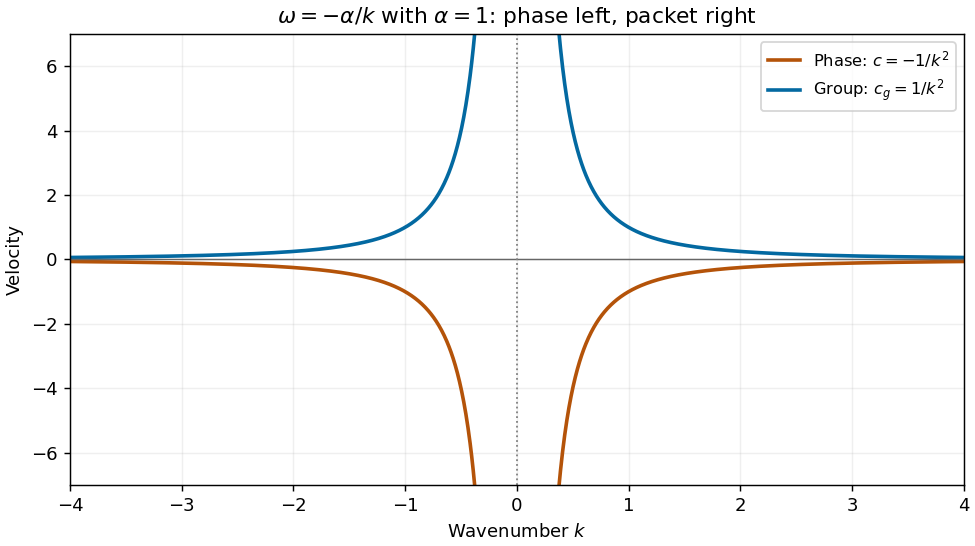
At a distant fixed observer , stationary components obey , so . As time increases their wavelength decreases and their frequency magnitude decreases; the crests pass toward decreasing .
For the given initial spectrum the solution isThe value of a regular spectrum at the single point is irrelevant to this integral; a nonzero spatially constant mode is incompatible with the PDE. For asymptotic calculation assume the usual smooth localized spectrum, with sufficient integrability for the following stationary-phase steps.
At , , the phase has stationary points , . Their values are and their second derivatives are . Expanding quadratically and using the oscillatory Gaussian integral gives the stationary phase leading termFor real data this is twice the real part of the positive-frequency term. If a stationary coefficient vanishes, the formula instead asserts that its contribution has smaller order. At , the phase derivative is , so there is no real stationary point and no corresponding wave packet. For smooth compactly supported spectra away from zero, repeated integration by parts gives decay faster than any power of . More general spectra require endpoint/tail control; absence of stationary points alone does not justify that stronger rate for arbitrary .
Past exam of the mathematics course of the University of Cambridge 2010 ii Paper 3 37A Solution Created 2026-09-24 Updated 2026-10-14
The proposed stream function gives and . Since , , the vorticity equation terms areFor , . Divide by (or compare coefficients at by continuity) to obtainThe planes move normally with velocities and have zero tangential velocity. No-slip boundary conditions therefore requireThese ensure both normal impermeability relative to the moving planes and tangential no slip.
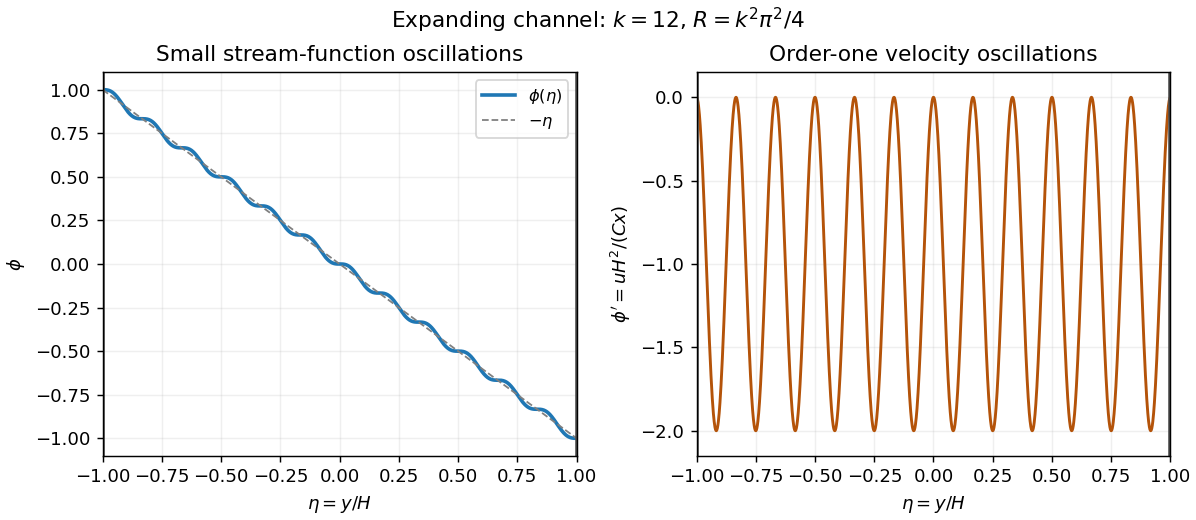
Put , and . Its derivatives are , , and . The sine vanishes at both walls and , verifying all four boundary conditions. In the ODE, the sine-cosine products from and cancel, leavingThus each displayed profile is an exact solution when .
For large , stays within of , but the tangential velocity factor continues to oscillate between and , and its shear grows like . The sketch shows both effects; a nearly straight stream-function profile does not mean nearly uniform velocity. Such fine oscillatory branches occur at special discrete large Reynolds numbers and require specially prepared flow. Their many inflection points and strong shear permit instability, so generic disturbances are unlikely to preserve them. This is a physical plausibility discussion, not a proved stability classification.


Past exam of the mathematics course of the University of Cambridge 2010 ii Paper 3 36B Solution Created 2026-09-24 Updated 2026-11-05
Use units , consistent with comparing directly to , and metric signature . For an arbitrary worldline parameter , an action for a charged relativistic particle isThe first term has variation in its momentum, and the coupling gives . The Euler-Lagrange equations therefore readWhen is proper time, has , giving the covariant Lorentz forceWith and , put , , for nonzero charge. The velocity equations becomeThus , with , . Integrating with , gives , and . Integrate once more from the origin:For zero charge the trajectory is simply rest, , with all spatial coordinates zero. The charged trajectory oscillates in while drifting in the negative direction, the direction of . Its displacement-to-time ratio over a proper-time period is . A boost at that drift velocity removes the electric field and leaves circular magnetic motion; in the original frame the orbit has repeating cycloidal cusps where the particle is momentarily at rest. Energy oscillates rather than growing indefinitely because . In SI units the corresponding magnetic-dominated condition is .
Past exam of the mathematics course of the University of Cambridge 2010 ii Paper 3 35C iii Created 2026-09-24 Updated 2026-09-24
Past exam of the mathematics course of the University of Cambridge 2010 ii Paper 3 35C ii Created 2026-09-24 Updated 2026-09-24
Past exam of the mathematics course of the University of Cambridge 2010 ii Paper 3 35C i Created 2026-09-24 Updated 2026-09-24
Past exam of the mathematics course of the University of Cambridge 2010 ii Paper 3 34B Solution Created 2026-09-24 Updated 2026-10-14
The Bloch theorem says that for a translation-invariant lattice Hamiltonian, eigenstates can be chosen as , or with periodic of period . The localized site orbitals are translates, and . In the tight-binding model, neglect intersite overlap and useProjecting the Schrödinger equation onto each localized orbital gives its onsite energy times its own coefficient, plus the four stated neighbor matrix elements. ThusFor the Bloch amplitudes, set . The coefficient eigenproblem isso the two energy bands areA first Brillouin zone is ; wavevectors differing by are equivalent. Put , . Each band is nonincreasing as a function of , because . HenceThe extrema occur at and at the zone edge; they may be nonunique when , in which case the gap vanishes. In the trial wavefunction, replacing by and reindexing produces exactly the factor , verifying Bloch theorem directly.
An electrical conductor has available nearby unoccupied states in a partially filled band or overlapping bands. A band insulator has filled lower bands separated from empty higher bands by a large gap. A semiconductor has the same filled-band structure with a smaller gap, so thermal excitation or doping supplies mobile electrons and holes. Band filling and carrier availability, not just the existence of two bands, determine which description applies.
Past exam of the mathematics course of the University of Cambridge 2010 ii Paper 3 33C Solution Created 2026-09-24 Updated 2026-10-14
The canonical commutation relations are (in several dimensions , with the position-position and momentum-momentum commutators zero). For Hermitian , the commutator is anti-Hermitian, just as is; there is no conflict with their self-adjointness. The annihilation operator and its adjoint obeyThus the quantum harmonic oscillator Hamiltonian is . The commutators , and the normalized ground state constructNormalization follows inductively from . Positivity of and repeated lowering exclude a noninteger eigenvalue: lowering it until it becomes negative would produce a nonzero vector of negative eigenvalue. Every eigenstate therefore lowers to the unique ground state, so these normalized ladder states exhaust the oscillator eigenstates.
For two independent oscillators, the tensor products have . The level has degeneracy . In its degenerate subspace the perturbation reduces tosince terms that raise or lower both numbers leave the subspace. For its matrix is zero. For , in , it is . For , in , it is . Their eigenvalues giveThe states are the symmetric and antisymmetric combinations. At , the shifted states are , and the zero-shift state is .
There are unlisted articles, also show them or only show them.