
Magnetic-field cancellation between oppositely driven coaxial loops Created 2026-09-24 Updated 2026-09-24
On-axis magnetic field of a circular current loop Created 2026-09-24 Updated 2026-10-18
A circular loop of radius carrying electric current has, on its axis,where the sign of is fixed by the right-hand rule. At its centre, .
Put the loop in the plane, centered at the origin, with positive electric current counterclockwise when viewed from . The right-hand rule then gives the central magnetic field along . Parameterize source positions by the angle and observe at :Here without bold type is the loop radius, whereas is the source-to-observer displacement. Their cross product isThe denominator is constant around the loop. The integrals of sine and cosine over a full turn vanish, while the axial contribution adds to . Substitution into the Biot-Savart law proves the on-axis formula. Symmetry cancels transverse components; it does not cancel the axial components.
For an original one-turn example in the same vacuum approximation, choose and . With ,At , the source-to-observer distance is , so and . At , the magnetic field has the same magnitude and still points along . The point has crossed the loop plane, but the loop's electric current has not reversed. Reversing the electric current reverses the magnetic field on both sides.
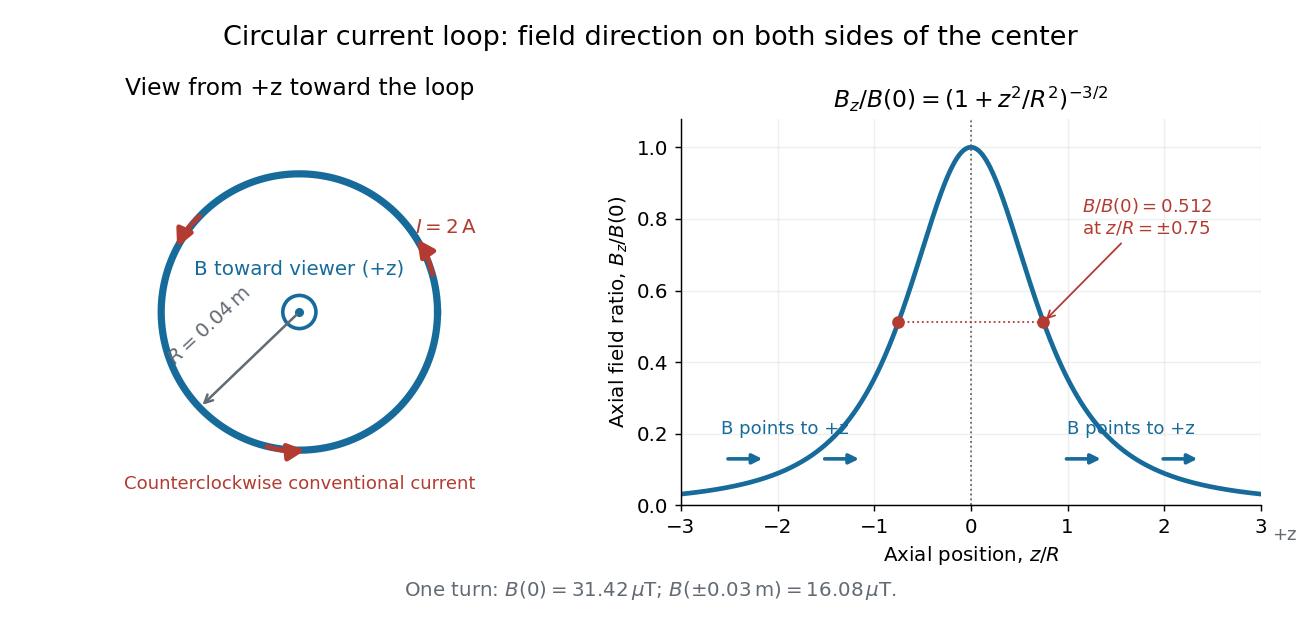
Circular-loop magnetic field: axial reinforcement and equal direction on both sides
. Original electric current loop schematic and normalized on-axis calculation. The left view looks from , with counterclockwise electric current and a central field directed toward the viewer. In the right panel, the arrows along the axis point toward even for ; the calculated points at have normalized field . No experimental data are plotted. Details.
For , a Taylor expansion gives : the center is a smooth maximum, with zero first derivative. For ,This is the axial magnetic dipole field of magnetic dipole moment .[ref]
The Feynman Lectures on Physics, Volume II by Richard Feynman and others. II.14–5, equations (14.33)–(14.36): current times loop area and magnetic dipole field
A compact closed loop has an inverse-cube axial far field, in contrast to the inverse-distance field of the infinite straight wire. The SI units of the exact loop formula are , hence tesla.For coincident turns carrying the same electric current, the superposition principle multiplies the ideal result by . A real coil has radial width and axial length: if those are not negligible, integrate or sum over its individual turns. This is why a single measured coil diameter and a turn count may not determine the full spatial magnetic field precisely. A collection of loops becomes a solenoid; integrating their axial contributions gives the on-axis magnetic field of a finite solenoid.
Euler buckling of an elastic filament Created 2026-09-24 Updated 2026-11-05
Worm-like chain Created 2026-09-24 Updated 2026-11-05
The worm-like chain models an inextensible filament with bending energy and thermal tangent fluctuations.
Resistive-force theory Created 2026-09-24 Updated 2026-11-05
Resistive-force theory approximates the local viscous force on a moving slender elastic filament by separate drag coefficients along and across its tangent. Let be the unit tangent and the material velocity relative to the ambient fluid. The force per unit length on the elastic filament isThe positive parallel and perpendicular drag coefficients of a slender filament are defined per unit length; for a sufficiently slender isolated body, their leading logarithmic ratio is .
The directional difference can generate propulsion. For example, take a straight element with and impose transverse velocity . Direct substitution givesA transverse motion of a tilted element therefore has an axial force component. In a propagating flagellum deformation, the correlation of tilt and transverse velocity can produce nonzero mean thrust. For a freely swimming body, the unknown translation and rotation follow by imposing zero total external force and torque, including the resistance of the head if present.
This is a local Stokes flow approximation. It neglects the nonlocal hydrodynamic interactions retained by slender-body theory, so nearby boundary conditions, tightly spaced elastic filaments and detailed end effects can require a more complete model.
Cytoplasmic streaming Created 2026-09-24 Updated 2026-11-05
Cytoplasmic streaming is directed cytoplasmic flow within a cell, often driven by molecular motors acting along the boundary and used to enhance intracellular transport.
Microcirculation Created 2026-09-24 Updated 2026-11-05
Microcirculation is blood flow through arterioles, capillaries, and venules, where vessel dimensions are comparable with cellular length scales.
Binomial theorem Created 2026-09-24 Updated 2026-10-20
For a nonnegative integer and commuting quantities ,In expanding the factors, obtain by selecting the positions that contribute . There are such choices. For example,The coefficients are row five of Pascal's triangle, in reverse order under the displayed convention; the row is symmetric. Setting gives , the number of subsets of a five-element set. Each member has two inclusion choices, agreeing with the rule of product and the cardinality of the power set.
Multinomial coefficient Created 2026-09-24 Updated 2026-09-24
For nonnegative integers with , the multinomial coefficientcounts arrangements of a multiset containing copies of symbol .
Central binomial coefficient Created 2026-09-24 Updated 2026-11-05
The central binomial coefficientcounts the -element subsets of a -element set. It is the middle and largest coefficient in the binomial expansion of , by unimodality of binomial coefficients. For , the row has central value six.
Equivalently, counts binary strings of length with exactly ones. Dividing by the total gives the probability of exactly successes in independent fair Bernoulli trials. The normalized central binomial coefficients therefore connect a simple counting sequence to balanced random outcomes.
Combinatorial number system Created 2026-09-24 Updated 2026-11-05
At a fixed positive integer level , the combinatorial number system writes each positive integer uniquely asChoose as large as possible with , subtract that term and repeat at level , stopping when the remainder is zero. For example, at level three,Pascal's identity gives , so the remainder after choosing the level- term is smaller than . The next top index is consequently strictly smaller. Hockey-stick identity also bounds the sum of all lower admissible terms by . Thus those terms cannot replace a larger level- choice, proving uniqueness. The zero integer has the empty representation. This correspondence is useful for ranking and unranking fixed-size subsets.
Unimodular reduction of a discriminant-minus-four form to two squares Created 2026-09-24 Updated 2026-11-05
Reduced positive definite binary quadratic form Created 2026-09-24 Updated 2026-11-05
An integral binary quadratic form with and negative discriminant of a binary quadratic form is reduced whenwith the additional convention whenever or . These inequalities bound the polynomial coefficients without changing the represented integers.
Every proper equivalence class of positive definite forms has exactly one reduced representative with this boundary convention. For primitive binary quadratic forms, this is the classical reduction theorem; the general case follows by dividing by the common content, which is invariant under proper equivalence.[ref]
Binary Quadratic Forms and the Ideal Class Group by Seth Viren Neel. §2.2, Definition 1 and Theorem 2.3, printed p. 5: primitive positive definite reduction and uniqueness
The sign rule removes actual duplicates. A shear takes to , and the determinant-one rotation takes to . Keeping the nonnegative middle polynomial coefficient chooses one boundary copy. For example, is not reduced; the reduction algorithm for a positive definite binary quadratic form takes it back to .
Discriminant of a binary quadratic form Created 2026-09-24 Updated 2026-11-05
The discriminant of a binary quadratic form is . For integer polynomial coefficients, is congruent to zero or one modulo four. Completing the square givesThus for real polynomial coefficients with , positive definiteness holds exactly when . For the form is an indefinite quadratic form, taking values of both signs; for it is degenerate. For example, has , whereas has .
Over the real numbers, use the symmetric matrix . Its determinant is . An integer coordinate change gives , soIn particular unimodular matrices preserve , proving its invariance under proper equivalence. Changes with other determinants can change the discriminant. For instance, replacing by takes to and multiplies by four. The chosen half-coefficient matrix convention matters in this calculation.
Primitive binary quadratic form Created 2026-09-24 Updated 2026-11-05
An integral binary quadratic form is primitive when . This condition concerns its polynomial coefficients, rather than the values of a particular representing pair. For example, is primitive, while has a common divisor two and represents only even integers.
Primitivity is invariant under proper equivalence. Expanding an integer change of variables expresses every new polynomial coefficient as an integer linear combination of the old ones, so every common divisor of the old coefficients divides the new ones. The integer inverse gives the converse. Their greatest common divisor, called the content, is therefore unchanged.
A primitive representation separately means in . Even a primitive form can have nonprimitive representations: for . A representation of a prime number, however, must use a coprime pair, since a common divisor would force to divide that prime. This observation drives the discriminant criterion for prime representation by a binary quadratic form.
Proper equivalence of binary quadratic forms Created 2026-09-24 Updated 2026-11-05
Integral binary quadratic forms and are properly equivalent ifThe matrix has integer entries and determinant one. Its inverse also has integer entries, so the change is a bijection of the integer lattice. Consequently and represent the same integers, and the discriminant of a binary quadratic form is unchanged.
Allowing determinant minus one as well gives the broader equivalence under unimodular matrices. Proper equivalence retains orientation. For example, the shear is proper and takes to . The reflection instead has determinant minus one and takes to ; those two forms need not be properly equivalent. This distinction matters when counting the class number of a negative discriminant.
Primordial helium mass fraction Created 2026-09-24 Updated 2026-09-24
Deuterium bottleneck Created 2026-09-24 Updated 2026-09-24
Light nuclei cannot accumulate until cooling makes deuterium sufficiently resistant to photodissociation, delaying nucleosynthesis after weak freeze-out.
Cosmological weak freeze-out Created 2026-09-24 Updated 2026-09-24
Neutron-proton chemical equilibrium Created 2026-09-24 Updated 2026-10-13
There are unlisted articles, also show them or only show them.