
For two equal-mass particles with orthonormal coordinates confined to , the Hamiltonian is the sum of two width- infinite square well Hamiltonians. Exchange preserves and reverses . The relative-coordinate box mode is even for odd index and odd for even index . Pure spatial bosonic exchange symmetry therefore allows odd , while pure spatial fermionic exchange symmetry allows even .
The bosonic ground mode is , while its first excited mode is degenerate in energy with the fermionic ground mode . Angular spin degrees of freedom, if present, must be included in the full exchange symmetry rather than assigned the spatial rule automatically. The mean relative distance is in the lowest even mode and in the lowest odd mode, obtained by integrating the normalized squared cosine and sine. Multiplication by gives the particle separation.
Let be finite and let have index , the smallest prime divisor of . The group action on left cosets gives , with . The image order divides both and . By the choice of , the only possible nontrivial prime factor common to these orders is , and contains only one factor of . Thus the image order is or . The action is transitive on cosets, so its image is nontrivial and has order . The first isomorphism theorem gives , hence . A kernel of a group homomorphism is a normal subgroup, proving the claim. For example, every subgroup of order in a group of order is normal.
Independence of the Abelian group axioms 2026-10-31
The usual associative, identity, two-sided inverse and commutativity axioms form an independent axiom set. A three-element commutative unital operation with self-inverses can fail associativity; a constant-zero operation can satisfy the other three axioms while failing the identity condition; natural-number addition fails the inverse condition; and a noncommutative group fails commutativity. Each example must be checked against all three retained axioms.
Absolutely convergent improper integral 2026-10-31
An improper integral whose absolute-value integral is finite. The triangle inequality for an integral bounds each truncated tail by the corresponding tail of , so the Cauchy criterion for an improper integral gives ordinary convergence. Absolute convergence is stronger than a Cauchy principal value, which may exist only because two divergent sides cancel. The continuous sine-product integrand has a removable value at zero and an integrable tail; its auxiliary complex contour integrand can nevertheless require a principal value.
Cauchy criterion for an improper integral 2026-10-31
For a locally integrable real or complex function, the displayed tail condition is equivalent to ordinary convergence of its improper integral at infinity. Apply the Cauchy criterion for a function limit to its truncated integrals, using completeness of the real or complex numbers. The necessity follows by subtracting two nearby-to-limit truncations; sufficiency follows by first taking a convergent sequence of truncations and then bounding all other late truncations against it. The analogous criterion applies at a finite singular endpoint. Bounding the modulus of every tail by its absolute-value integral proves that an absolutely convergent improper integral converges ordinarily.
Sine power kernel integrability 2026-10-31
For , the function is Lebesgue integrable on exactly when . Near zero, , so absolute integrability is equivalent to that of , which requires . At infinity, gives the upper bound . For , on each interval ,and the corresponding P-series diverges.
The signed improper integral nevertheless converges for every : near zero the same local comparison applies, and at infinity the Dirichlet test for improper integrals uses the bounded antiderivative of sine and the decreasing factor . Thus gives conditional convergence, while gives absolute integrability. In particular, substituting turns into the divergent tail .
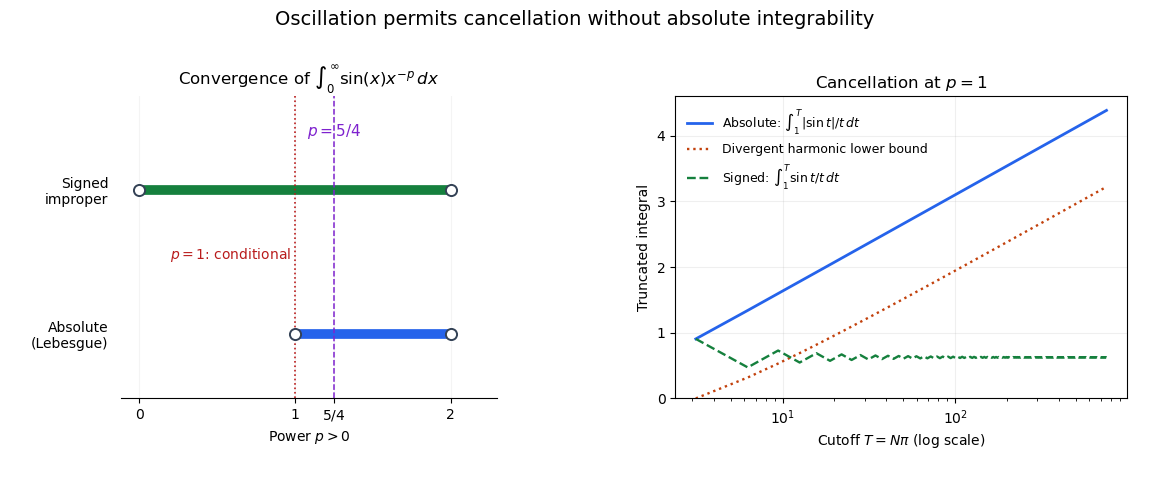

Let be measurable, integrable over a positive period , and have mean zero there. Its positive and negative parts have equal integrals . On the -th period the signed integral of has absolute value at mostThis follows by bounding the positive and negative weighted integrals between and . The bounds are summable, so the integrals at period endpoints converge. A leftover partial period has absolute integral at most , tending to zero, which proves convergence for arbitrary upper endpoints too.
In contrast, each full-period integral of is at least . It diverges in total unless , equivalently almost everywhere. Thus a nonzero mean-zero periodic function gives a convergent improper integral here but no Lebesgue integrability.
In the half-plane with an impermeable wall, place a point vortex of circulation in the background velocity , where . The image vortex at a plane wall has circulation at the reflected location and contributes horizontal velocity . Excluding the vortex's own singular velocity gives the displayed motion equations.
Put . Their first integral is , since its time derivative is . The explicit trajectory is and . These formulas show how image-induced drift changes the hyperbolic trajectories of the background flow while preserving a modified stream-function-type invariant.
Logarithmic characteristic coordinates 2026-10-31
For the Euler-type operator , set on either half-plane . The chain rule gives and . The operator becomes . Its characteristic coordinates , reduce it further to . Thus the constant-forcing equation has solutions , with arbitrary sufficiently differentiable functions . The logarithmic change of variables cannot by itself describe smooth passage across .
On , the linear partial differential equation has characteristic curves . The change of variables , has Jacobian determinant . The chain rule givesThus its canonical form of a second-order partial differential equation is , and its general twice differentiable solution is . The first derivative term exactly cancels the derivatives of the coordinate coefficients.
More generally, for positive differentiable , choose with . Then the same cancellation givesThe characteristic coordinates are . The quadratic example is , , with both coordinates multiplied by two.
This partial differential equation has discriminant , so it is a hyperbolic partial differential equation above and an elliptic partial differential equation below it. In its hyperbolic region the displayed characteristic coordinates have Jacobian determinant . The chain rule givesThe first derivative terms arise from differentiating the coordinate coefficients and cannot be discarded. The coordinate change degenerates at the line where the two characteristic directions merge.
Finite-tuple homogeneity 2026-10-31
A first-order structure has finite-tuple homogeneity when any two finite tuples of the same parameter-free complete type are related by an automorphism. For countably infinite first-order structures this agrees with extension of finite partial elementary maps to automorphisms. Countable atomic models have this property by a back-and-forth method using isolating logical formulas. Uncountable atomic models can fail it.
Uniform half-circle balance for independent Bernoulli variables Created 2026-10-31 Updated 2026-11-05
Let be even and let be independent Bernoulli variables with parameter , arranged on a circle. The probability that some consecutive half-circle has is at most . For a fixed , the variable has the binomial distribution , and the signed imbalance is . Apply Hoeffding inequality to this single binomial variable, then take a union bound over the at most intervals. Consequently suffices for uniform balance with probability tending to one whenever .
Right-angle free-streamline hodograph map Created 2026-10-31 Updated 2026-11-05
For an inviscid irrotational unit-speed layer turning through a right angle, the complex potential of a two-dimensional potential flow occupies the strip and its complex velocity occupies a fourth-quadrant quarter disk. The maps , and take this disk to the upper half-plane, sending upstream velocity one, corner stagnation zero, and downstream velocity to . The map has the same normalization, proving the displayed relation.
Finite-reservoir-head draining free streamline Created 2026-10-31 Updated 2026-11-05
A semi-infinite horizontal plate at unit height and a floor at zero give a velocity potential strip of height and an upper unit semicircle in the complex velocity . Their matching half-plane maps give . Along the fluid free boundary put , . Then and . Its downstream limit is , which must equal the downstream depth . Thus the contraction is exactly one half.
A unit-speed free layer turning downward around a reentrant wall corner has complex velocity in the first-quadrant exterior of the unit disc. Upstream , downstream , and the corner has infinite speed because its fluid angle is . Squaring , applying , and squaring again maps this domain to the upper half-plane with upstream, corner and downstream at . The potential strip map has the same normalization, proving the formula. The sign of the turn and the fluid corner angle determine whether the relevant hodograph is an exterior or interior quarter disc.
Holding probabilities cancel from hitting-probability equations Created 2026-10-31 Updated 2026-11-05
Outside a target set, first-step analysis for a Markov chain gives . Moving the holding term and dividing gives the displayed average over the next distinct state. Thus inserting or removing self-loops preserves eventual hitting probabilities, provided the state is not made absorbing and the relative probabilities of its exits are unchanged. Boundary values are one on the target and zero in closed classes unable to reach it. The waiting time changes, but the sequence of distinct visited states does not.
Let be a twice continuously differentiable local diffeomorphism, and suppose . The chain rule gives the displayed transformation of the Hessian matrix: terms containing second partial derivatives of are multiplied by first partial derivatives of and vanish at the critical point. By Sylvester's law of inertia, the numbers of positive, negative and zero eigenvalues are unchanged. Independently of nondegeneracy, the local diffeomorphism preserves the critical point's status as a local minimum, local maximum or saddle point of a scalar function, because it maps neighbourhoods to neighbourhoods.
Inner product determined by a basis 2026-10-31
Each basis of a finite-dimensional complex vector space determines a unique complex inner product making that basis orthonormal. In coordinates it is , with the first argument linear. The formula is sesquilinear, has conjugate symmetry, and satisfies , which is positive unless . Expanding any inner product in the given basis proves uniqueness. Its codomain is the complex numbers; only its diagonal values are necessarily real. The resulting identification with the dual space is conjugate-linear, not complex-linear.
There are unlisted articles, also show them or only show them.