
Bile canaliculus Created 2026-10-31 Updated 2026-11-05
A bile canaliculus is a small bile-collecting channel formed at adjacent hepatocyte surfaces. It begins the biliary flow pathway before the larger duct system. Its lumen is separate from the nearby sinusoidal blood space.
Bile duct Created 2026-10-31 Updated 2026-11-05
Portal vein Created 2026-10-31 Updated 2026-11-05
The portal vein carries blood from major splanchnic drainage territories to the liver. Its branches distribute this blood into hepatic microvascular pathways. A portal vein connects two vascular beds in sequence, rather than returning its entire flow directly to the heart.
Portal venous blood Created 2026-10-31 Updated 2026-11-05
Portal venous blood reaches a second capillary-type vascular bed through a portal route before returning to the main venous circulation. In hepatic physiology it carries intestinal and other splanchnic outflow toward the liver. Its composition reflects upstream absorption and metabolism.
Enterohepatic circulation 2026-10-31
Recovery of substances secreted into the intestine and their return to the liver through portal venous blood; bile salt recycling is a major example.
Liver failure Created 2026-10-31 Updated 2026-11-05
Liver failure is inadequate hepatic function severe enough to disrupt major physiological tasks. Impaired synthesis, metabolism and clearance can contribute differently. It is therefore broader than one abnormal biochemical concentration or an isolated structural change in the liver.
Paul Ehrenfest Created 2026-10-31 Updated 2026-11-05
Paul Ehrenfest connected quantum expectation values with classical-looking equations of motion. For suitable quantum states evolving under the Hamiltonian , the Ehrenfest theorem gives and . Here is potential energy. The mean force need not equal the force evaluated at the mean position. If is a quadratic function, it does; for more general potential energy functions, a sufficiently narrow wave packet can justify an approximation. The theorem therefore states precisely which comparison between quantum mechanics and classical mechanics is exact and which step needs another assumption.[ref]
Bemerkung über die angenäherte Gültigkeit der klassischen Mechanik innerhalb der Quantenmechanik by Paul Ehrenfest. 1927 original expectation-value relations and narrow-wave-packet discussion; modern notation
A physicist associated with the Ehrenfest theorem and, with Tatyana Afanasyeva-Ehrenfest, the Ehrenfest model.

Portrait of Paul Ehrenfest
. Historical photograph by an unknown photographer, held by the Noord-Hollands Archief. Listed as public domain by Wikimedia Commons. Source. Leopoldo Nobili Created 2026-10-31 Updated 2026-11-05
Leopoldo Nobili developed an astatic galvanometer for detecting small electric currents. A mechanically linked pair of nearly opposing magnetic dipoles reduces the torque from the approximately uniform geomagnetic field, while the coil geometry retains sensitivity to the current being measured. A many-turn coil increases the response and a scale makes the deflection observable. The preserved Nobili-pattern instrument used by Carlo Matteucci connects these design choices with measurements of weak physiological currents.[ref]
Astatic Galvanometer, Nobili Pattern by Museo Galileo. Inventory 1417, needle suspension, many-turn coil, scale and Matteucci provenance

Portrait of Leopoldo Nobili
. Historical portrait, with source provenance from the Smithsonian scientific-identity collection; public-domain reproduction hosted by Wikimedia Commons. Source. Hans Christian Ørsted Created 2026-10-31 Updated 2026-11-05
Hans Christian Ørsted showed that an electric current can deflect a nearby compass needle. His 1820 announcement emphasized that the electric circuit had to be complete in these experiments and described repeating the observations with a more powerful battery. The compass needle supplied a mechanical readout connecting the electric current with magnetism. The wire's arrangement relative to the compass made this a direct experiment on the magnetic field associated with an electric current.[ref]
Experiments on the Effect of a Current of Electricity on the Magnetic Needle by Hans Christian Ørsted. 1820 announcement, opening experiments and complete-circuit requirement

Portrait of Hans Christian Ørsted
. Portrait by Christian Albrecht Jensen, 1842; public-domain reproduction hosted by Wikimedia Commons. Source. Carlo Matteucci Created 2026-10-31 Updated 2026-11-05
Carlo Matteucci investigated electric currents associated with muscle using sensitive galvanometers. Museo Galileo preserves an instrument marked for his muscle-current work in 1840: an astatic galvanometer with suspended needles, many turns of fine wire and a readable scale. The apparatus connects a weak electrical signal with a mechanical deflection, illustrating why instrument sensitivity and suppression of the background geomagnetic field mattered for early physiological measurements.[ref]
Astatic Galvanometer, Nobili Pattern by Museo Galileo. Inventory 1417, inscription and documented muscle-current use

Portrait of Carlo Matteucci
. Historical photographic portrait of Carlo Matteucci; photographer not identified. Public-domain image hosted by Wikimedia Commons. Source. Gustav Kirchhoff Created 2026-10-31 Updated 2026-11-05
A physicist who, with Robert Bunsen, developed spectrum analysis as a method of chemical identification. Their 1860 apparatus put a salt sample in a hot, weakly luminous flame and passed its light through a slit, a collimating telescope and a prism. A second telescope revealed characteristic bright lines. Comparing these lines made it possible to recognize an element even when its light was mixed with that of other substances, connecting laboratory spectroscopy with the analysis of distant light sources.[ref]
Chemical Analysis by Observation of Spectra by Gustav Kirchhoff and Robert Bunsen. Opening discussion and apparatus description: flame, slit, two telescopes and carbon-disulfide prism

Portrait of Gustav Kirchhoff
. Source. John Lekner Created 2026-10-31 Updated 2026-11-05
A physicist whose 2012 analysis of two charged conducting spheres gives a striking limit to the rule that like charges repel. Charges redistribute over each conducting surface, so sufficiently close spheres can attract even when their total charges have the same sign. The exceptional charge ratio is the one obtained by bringing the spheres into electrical contact. His exact analysis connects this attraction with the spheres’ capacitance coefficients.[ref]
Electrostatics of Two Charged Conducting Spheres by John Lekner. Abstract and introduction: near-contact attraction, exceptional charge ratio and capacitance coefficients
André-Marie Ampère Created 2026-10-31 Updated 2026-11-05
André-Marie Ampère investigated the mutual mechanical action of electric currents. Parallel currents in the same direction attract, while reversing one reverses the force; changing the circuit geometry provides further tests. James Clerk Maxwell's contemporary account distinguishes Ampère's experimental facts from the assumption used to model the interaction between individual current elements. The contribution therefore links an observable force between complete electrical circuits with a mathematical description of the interaction, rather than identifying the model's smallest parts directly with separately measured forces.[ref]
A Treatise on Electricity and Magnetism by James Clerk Maxwell. Volume II, Part IV, Chapter II, sections 502 onward, experimental facts and current-element assumptions


Wilhelm Eduard Weber Created 2026-10-31 Updated 2026-11-05
Wilhelm Eduard Weber developed a description of magnetization in which the microscopic magnets already exist and respond to an applied magnetic field. James Clerk Maxwell's treatise contrasts this with a model in which the field induces molecular magnetism. The distinction matters because changing the orientation of persistent magnetic dipoles can change the bulk magnetization without creating each magnetic moment from zero. A material can therefore have a small net magnetic response even when its microscopic magnetic contributions are individually nonzero.[ref]
A Treatise on Electricity and Magnetism by James Clerk Maxwell. Volume II, chapter VI, section 442, Weber’s pre-existing molecular magnets and the induced-magnetization comparison

Wilhelm Eduard Weber, portrait by Gottlieb Biermann, 1885
. Portrait source. Gottlieb Biermann; scanned by Michael Schönitzer in November 2008 from Die großen Deutschen im Bilde (1936). Public-domain artwork; faithful photographic reproduction, PD-Art / Public Domain Mark.

Tatyana Afanasyeva-Ehrenfest 2026-10-31
A mathematician and physicist associated with statistical mechanics and the Ehrenfest model with Paul Ehrenfest.

Portrait of Tatyana Afanasyeva-Ehrenfest
. Historical photograph by an unknown photographer, from the Dibner Library portrait collection. Listed as public domain by Wikimedia Commons. Source.
Ernst Zermelo 2026-10-31

Ernst Zermelo in the 1900s
. Unknown photographer, Mondadori archive; Wikimedia Commons lists the photograph as public domain. Source.
Marc Lackenby Created 2026-10-31 Updated 2026-11-05
Marc Lackenby works in topology, geometry and group theory. His research includes knot theory, bounds on Reidemeister moves between knot diagrams, and hyperbolic geometry of link complements. These topics connect the geometric shape of three-dimensional spaces with the computational difficulty of recognizing and simplifying their descriptions.[ref]
https://www.maths.ox.ac.uk/people/marc.lackenby. Oxford Mathematical Institute, Research interests and Highlighted publications

Portrait of Marc Lackenby in 1997
. Crop of a photograph by George Bergman, hosted by Wikimedia Commons. Original photograph and credits; CC BY-SA 4.0. Crop details are on the linked source file page. Source.

Otakar Borůvka 2026-10-31
A mathematician whose 1926 work introduced a component-merging method for the minimum spanning tree problem, now called Borůvka's algorithm.[ref]
O jistém problému minimálním by Otakar Borůvka. Original article, 1926, pp. 37–58

Portrait of Otakar Borůvka in 1981
. Via Wikimedia Commons; the linked file page provides image credits and usage information. Source.
John Pollard (mathematician) Created 2026-10-31 Updated 2026-11-05
John Pollard is a mathematician whose work in number theory includes Pollard's rho algorithm and Pollard's p-1 algorithm for integer factorization. His retrospective explains how collision ideas related to the birthday paradox lead to the rho method, and distinguishes its factorization and discrete logarithm applications.[ref]
https://sites.google.com/site/jmptidcott2/50-years-of-the-rho-method. Author's retrospective, 50 Years of the rho method
Homepage: sites.google.com/site/jmptidcott2/
Johann Radon 2026-10-31
A mathematician whose work includes Radon's theorem, Radon measures, the Radon-Nikodym theorem and the Radon transform.
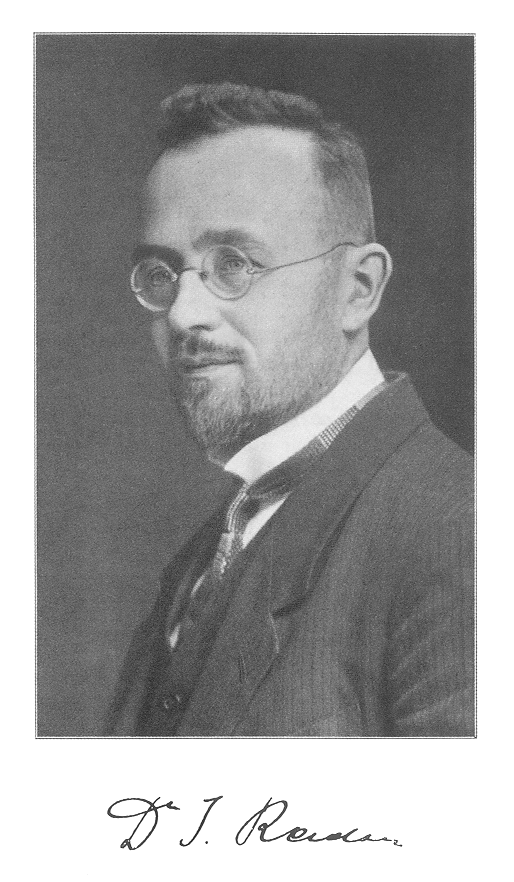
Portrait of Johann Radon around 1920
. Source. 
There are unlisted articles, also show them or only show them.