
Let be the real-space area and use , with . There is one state per momentum cell, since the fermions are spinless. An annulus between and contains states. Near the Fermi surface, the quasiparticle dispersion relation has , so the total density of states isThe density of states per unit area and the occupied-state count are, respectively,In particular, . No factor of two for spin degeneracy is present. This counts Landau quasiparticle levels, so it is not multiplied by the quasiparticle residue of the microscopic particle Green's function.
For a uniform continuum gas with pair interactions depending on relative positions, a Galilean boost changes every particle momentum by and leaves the interaction energy unchanged. Write . The transformed many-body Hamiltonian operator isThe resting ground state has , so the Galilean boost energy of an interacting gas isThe mass here is the bare particle mass, because this is an exact transformation of the microscopic kinetic energy. Substituting the Fermi-liquid effective mass would omit the change in interaction energy encoded by the Landau quasiparticle energy functional. This conclusion requires the Principle of Galilean relativity; a gas in a lattice or a fixed external potential energy landscape need not obey it.
The printed identity has the wrong sign for the specified relative phase. Differentiating the energy found above and evaluating the operator commutator giveThus the phase derivative of a two-mode condensate energy isA concrete counterexample to the printed sign is , , and : its left side is , whereas its printed right side is , independently of and .
There is also a direct derivation without inserting the Hamiltonian operator. Since , differentiating this unitary operator gives . Conservation of the total particle number, , then supplies the minus sign for the left well.
By the Heisenberg equation of motion, . Define the bosonic Josephson junction particle current from left to right as . The corrected identity meansThe energy slope with respect to the relative phase drives particle transfer; an extremum with respect to that phase has zero instantaneous particle current. The printed sign would work with in the right-well orbital, or with in place of .
The normalized Hartree product state and its equivalent second quantization form areThe product is already symmetric under exchanging bosons; no additional belongs in the coordinate wavefunction. The factor in the second quantization expression instead normalizes repeated creation operators acting on the vacuum state. This is a fixed-number two-mode condensate, with every boson in the same normalized orbital.
Set and . Its binomial distribution of occupations givesThe expectation value of the Hamiltonian operator is thereforeKeeping rather than replacing it by retains the exact pair count of the trial quantum state. Equivalently, with , its interaction contribution is and its one-particle contribution is .
Choose the nonredundant parameter range , with modulo . For , minimizing over the relative phase gives . Putting , the remaining nonconstant energy is , which decreases with for the repulsive coupling . HenceThe optimal orbital is the symmetric . Both the quantum tunnelling term and the repulsive interaction favor this balanced occupation within the Hartree product state family. This result uses a variational method: for strong repulsion relative to quantum tunnelling, the true many-body ground state can have smaller occupation fluctuations than this fixed-number two-mode condensate.
The two-mode approximation for a Bose gas retains the real localized orbitals:It is valid when the lowest doublet is well separated from higher energy levels, and the temperature and interaction-induced changes of the orbitals are small on that separation. More explicitly, if is the energy gap to discarded orbitals, sufficient low-energy conditions are , where . A deep double-well potential suppresses interwell interaction overlaps. Large alone does not justify the truncation: increasing at fixed coupling can violate the interaction condition.
Let and use the even and odd eigenfunctions to evaluate the projected one-particle Hamiltonian operator:ThusThe same quantum tunnelling matrix element is . Reflection symmetry makes . Neglecting mixed contact interaction integrals leavesThe last step is the normal-ordered boson pair count, following from the canonical commutation relation. Consequently the two-site Bose-Hubbard model has precisely the requested coefficientsandHere is the coefficient obtained by rewriting the fixed-particle number Hamiltonian operator, rather than an independently prescribed thermodynamic chemical potential. Adding a reservoir term would replace it by .
The negligible-overlap instruction applies to the mixed contact interaction integrals while the small quantum tunnelling matrix element is retained. Exactly disjoint smooth orbitals for a local would also give ; setting every overlap-related matrix element identically to zero would discard the physical splitting one is trying to describe.
The quantized field expansion in the complete orthonormal basis of orbitals isThe complex conjugation in the creation operator expansion is essential for complex orbitals. Indeed, creates the wavefunction . The resolution of the identity in an orthonormal basis givesrecovering the canonical commutation relation and the spatial Dirac delta function.
Write for the one-particle Hamiltonian operator. The second quantization of the kinetic energy, external potential energy and repulsive contact interaction isThe factor counts each unordered particle pair once. Normal ordering excludes self-interaction: the interaction acts on two distinct bosons. The fixed particle number sector has . In three dimensions, this contact interaction is understood as a regulated low-energy interaction with a matched coupling, as in renormalization of a three-dimensional dilute-gas contact coupling; the finite-mode calculation below uses its projected matrix elements.
Past exam of the quantum field theory course of the University of Oxford 2025 3 e Solution 2026-10-25
The corrected expression in d is a vacuum two-point function, or Wick contraction, of the free Dirac field. It equals the negative spinor transpose of the usual Dirac propagator with reversed spacetime arguments. It supplies the internal fermion lines in Feynman diagrams, rather than a position-space detection probability.
For , creates an antiparticle and annihilates it. The term describes positive-energy antiparticle propagation from to . For , creates a particle and annihilates it. The term describes positive-energy particle propagation from to , with the minus sign required by exchanging the odd operators in fermionic time ordering. Neither term describes a physical negative-energy excitation.
The Heaviside step functions select these chronological alternatives. The factors are on-shell plane waves with , and is the positive-energy Lorentz-invariant phase-space measure. The sum over includes the two spin states. With standard relativistic spinor normalization, the fermion spin sums areThey encode the spinor structure and solve the corresponding on-shell Dirac equations. In particular, the corrected answer can also be writtenThe Feynman i-epsilon prescription specifies the temporal boundary conditions of the Green function; its positive- and negative-frequency residues reproduce the two terms and their relative minus sign. With defined in d,The contact term is fixed by the equal-time canonical anticommutation relations. Choosing a value for does not change the unequal-time sign demonstrated above.
Finally, microcausality requires field anticommutators to vanish at spacelike separation; the time-ordered vacuum two-point function itself need not vanish there. These facts are compatible with relativistic causality. The plus-plus expression printed in the paper lacks the fermionic sign needed for this standard Dirac propagator interpretation.
Past exam of the quantum field theory course of the University of Oxford 2025 3 d Solution 2026-10-25
Put and . The Dirac adjoint of the printed mode expansion of a Dirac field isThe Fock vacuum is annihilated by . The canonical anticommutation relations therefore give the two non-time-ordered vacuum expectation valuesIn the first line, the only surviving contraction is ; in the second it is . Both of these unordered contractions have positive coefficients.
However, fermionic time ordering includes a minus sign when it interchanges two odd fields:Thus the result following from the stated canonical anticommutation relations and standard time ordering isThe second term printed with a plus sign is not correct for standard fermionic time ordering. Its plus-plus expression would be an ungraded chronological product. The missing minus cannot be absorbed by a phase choice for or , since each spin sum contains a spinor and its adjoint.
For comparison with the conventional Dirac propagator, define and let denote this free Dirac field's mass. ThenThe exchange of the spinor indices is essential: is the component of , not its component.
Past exam of the quantum field theory course of the University of Oxford 2025 3 c Solution 2026-10-25
For , interchange the entries in slots while preserving the order of all intermediate fermionic creation operators. Move left through factors, then move right through the remaining intermediate factors. The canonical anticommutation relations give the overall fermionic signHenceMore generally any permutation givesThe sign of a permutation is independent of its decomposition into adjacent interchanges. Thus the -particle sector is an exterior power of the one-particle state space, the defining antisymmetry of fermionic Fock space. Repeated complete mode labels make the state zero, so they satisfy the same identity trivially.
Past exam of the quantum field theory course of the University of Oxford 2025 3 b Solution 2026-10-25
The canonical anticommutation relations give , where each label includes both momentum and spin. ThereforeThus exchanging the complete labels of the two identical fermions changes the sign of their state. If the labels coincide, ; the state vanishes, which is the Pauli exclusion principle. A negative state vector describes the same isolated physical ray, but its relative sign matters when exchange alternatives interfere.
Past exam of the quantum field theory course of the University of Oxford 2025 3 a Solution 2026-10-25
For three odd fermionic operators, the identityconverts the commutator with a quadratic Hamiltonian into the given canonical anticommutation relations. Writing a mode label as , this yieldsThe opposite-species number terms commute with each fermionic creation operator or fermionic annihilation operator, because two anticommutations give a positive sign. Restoring the continuous normalization, the Dirac delta distribution in the mode brackets cancels . ConsequentlySubstitute these into the mode expansion of a Dirac field. The result isSince and , this is exactlyThe Heisenberg equation of motion uses an ordinary commutator with the even Hamiltonian, despite the odd fermionic operators obeying anticommutators among themselves.
Past exam of the quantum field theory course of the University of Oxford 2025 2 e Solution 2026-10-25
For , the invariant scattering amplitude from the tree-level Feynman diagram in i has a pole at . The intermediate heavy antiparticle can go on shell and live for a time of order its mean lifetime. Near this scattering resonance, inserting a single self-energy is no longer a uniformly small correction. Dyson resummation gives, to leading accuracy in a narrow decay width,Here is understood as the renormalized resonance mass; the real self-energy shifts the original pole position. The imaginary term removes the unphysical divergence of the fixed-order invariant scattering amplitude.
For equal incoming and outgoing light masses, the two-body momentum ratio cancels in the cross section. The angle-independent invariant scattering amplitude, integrated over the full solid angle with the identical final-state symmetry factor , gives . Thus the Breit-Wigner resonance cross section isAt it reproduces . At the resonance peak,This is also for , the elastic identical-boson S wave partial-wave unitarity limit when this is the only open decay channel. The approximation assumes and a resonance sufficiently far from threshold for the width to vary slowly across it.
If one mechanically uses the unsymmetrized from d, the same displayed Breit-Wigner resonance cross section would have that doubled width and predict a peak . This is the literal-width substitution, rather than the consistent physical result: the given high-energy cross section already includes the identical-final-particle factor that the printed decay width integral omits.
Past exam of the quantum field theory course of the University of Oxford 2025 2 d Solution 2026-10-25
For an allowed decay channel in iii, . Integrating the spatial Dirac delta distribution in the printed Lorentz-invariant phase-space measure sets . With and , its remaining value isThe positive root is , where , and the Dirac delta distribution contributes the Jacobian determinant . HenceIt follows that the literal printed integral evaluates toThe printed integration ranges count each final configuration twice, once as and once in the opposite order. For two identical final bosons, the physical decay width therefore requires an additional identical final-state symmetry factor :There is one allowed decay channel per heavy particle, not an extra factor of two from summing the two charge-conjugate heavy species. Both expressions vanish below the two-body decay threshold , and the limiting value at threshold is zero. For the literally forbidden labels , the decay width is instead zero because its decay amplitude vanishes, as explained in iii.
Past exam of the quantum field theory course of the University of Oxford 2025 2 b Solution 2026-10-25
The nonzero free scalar propagators join a field to its adjoint:Contractions , and mixed-species contractions vanish. With all momenta incoming, the Feynman vertices areThe two identical light legs cancel the in each cubic interaction vertex; there is no remaining factor in its Feynman rule. Multiply each Feynman vertex by , and integrate an internal unconstrained four-momentum with .
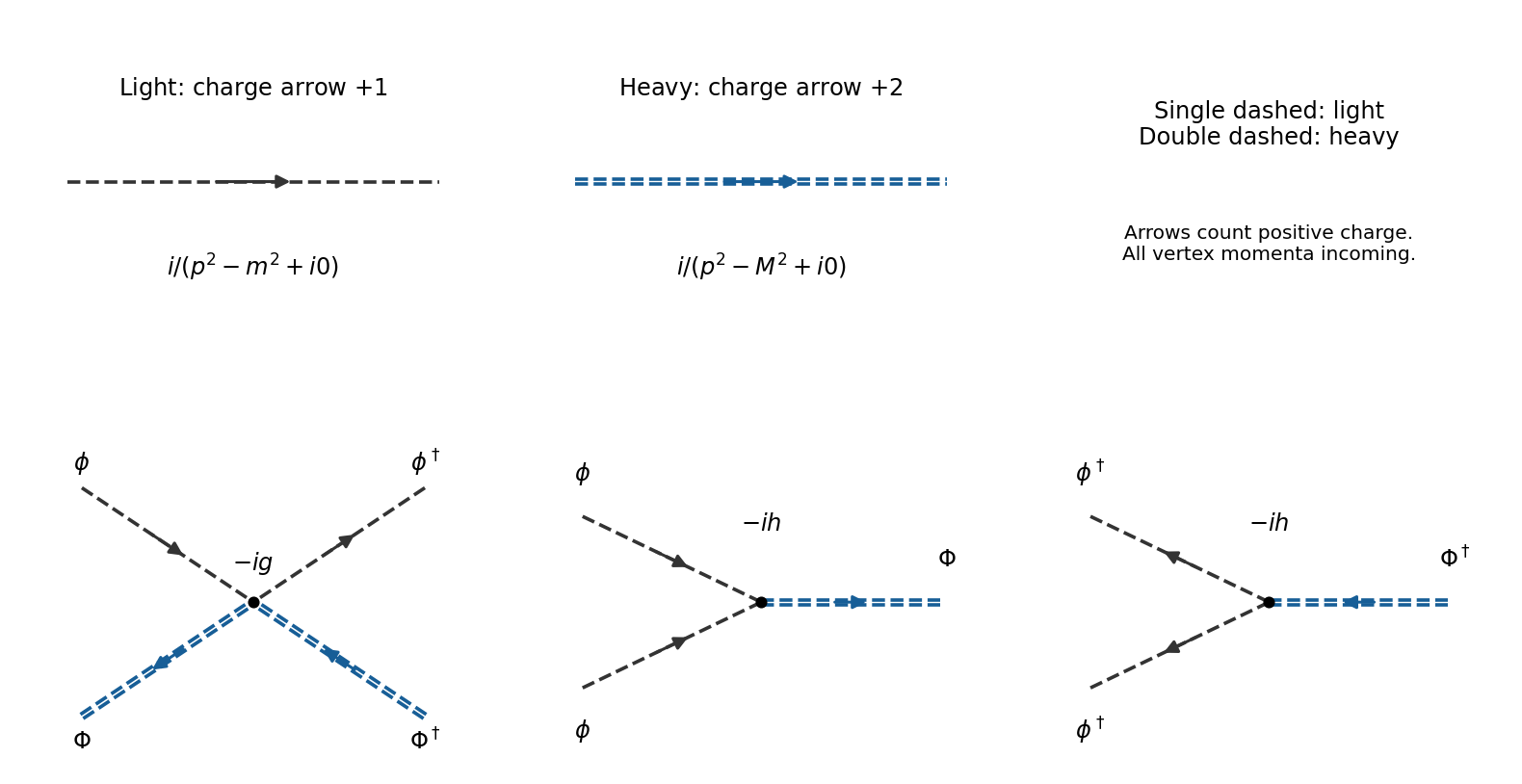
Charged scalar propagators and vertices, with arrows following positive conserved charge and heavy arrows carrying two units
. Details. 
The arrows in the figure follow positive Noether charge: a light arrow carries one unit and a heavy arrow two. Consequently a heavy particle travels opposite its charge arrow, whereas its antiparticle travels along it. At a Feynman vertex, two unit-charge arrows enter and a two-unit arrow leaves; the conjugate Feynman vertex reverses every arrow. The quartic Feynman vertex has one incoming and one outgoing arrow of each weight. These rules prevent attaching a propagator between two unconjugated fields.
Past exam of the quantum field theory course of the University of Oxford 2025 2 a Solution 2026-10-25
Independent global phase symmetries would rotate and . The cubic interaction vertex preserves only modulo . The continuous internal symmetry of a classical field theory is therefore the circle groupNormalize the Noether charge so that . Then , and . The Noether current iswhere . For example, the Euler-Lagrange field equations givewhich cancel with the relative coefficient . The quartic interaction vertex separately preserves both original phase rotations.
There is also a discrete charge conjugation symmetry for these real couplings. Including it, the internal symmetry is , with charge conjugation reversing the Noether charge. The connected symmetry and its conserved current are the above.
Past exam of the quantum field theory course of the University of Oxford 2025 1 d Solution 2026-10-25
Writing , the standard parity transformation of a Dirac field isSince , the fermion bilinear changes sign. Invariance of the pseudoscalar Yukawa interaction therefore requiresThus is a pseudoscalar, despite having the usual scalar-form kinetic term and mass term. In this convention , but is Hermitian because of the additional in the Dirac adjoint. A real is consequently consistent with a Hermitian Lagrangian density.
In perturbation theory about the parity-invariant vacuum state, renormalization can preserve this non-anomalous parity symmetry in quantum field theory. Every local counterterm must then be parity even, at every loop order. The allowed terms are precisely in b; all coefficients in are zero. In particular, no or counterterm is generated, whereas is allowed and required. The one-point and three-point pure-boson vertices also vanish to all orders: a parity-odd Lorentz scalar cannot be formed from their at most two independent external four-momenta. This last reasoning is specific to these low-point vertices; it does not assert that parity symmetry in quantum field theory is an independent internal symmetry with the fermions held fixed.
There are unlisted articles, also show them or only show them.