
Assume is differentiable along the ray, with sufficient regularity for the following variation, and fix the endpoints. Fermat principle makes the travel time stationary:For the variational integrand , the Euler-Lagrange equation isExpanding the derivative and multiplying by givesand thereforeEquivalently, the Beltrami identity gives . Mere continuity of , as stated in the wording, does not by itself justify the appearance of ; the displayed classical ray equation requires this additional differentiability.
The origin is an ordinary point. Substitute into the equation and collect the coefficient of :Hence the recurrence relation isThere are two free initial coefficients. The independent even and odd power series beginThe general solution is . As a useful independent check, the substitution reduces the equation to . ThusFor a nonterminating parity series, , so the ratio test in gives . The regular singular points at explain the natural obstruction.
There is an important exception to an unconditional radius-one answer. If for an integer , the series of parity terminates at degree and is a multiple of a Chebyshev polynomial. Its radius of convergence is ; the other independent parity solution still has radius one. For the even solution is constant. Any nonzero combination containing the nonterminating solution has radius one. These are the full power series of the Chebyshev differential equation, including the terminating cases.
The Wronskian isSuppose constants satisfy throughout the interval. Differentiating gives . At , these form the homogeneous linear systemIts determinant is nonzero by hypothesis, so . This is exactly linear independence of the two functions on the interval. No differential equation is needed for this implication; the converse for arbitrary differentiable functions would require additional hypotheses.
For the normalized second-order equation, is an ordinary point if both coefficient functions and are holomorphic near . If it is singular but and are holomorphic there, it is a regular singular point. Thus may have at most a simple pole and at most a double pole.
The distinction tells us which local series method is justified. At an ordinary point, two independent solutions are represented by ordinary Taylor series. At a regular singular point, the Frobenius method uses ; the indicial equation determines the exponents, and logarithmic terms may appear in a second solution. Singularities worse than these are irregular and need not have this Frobenius form.
A complex function is holomorphic at a point if it is complex differentiable throughout some open neighbourhood of that point. Writing and , a convenient sufficient and necessary criterion under continuously differentiable real components is the Cauchy-Riemann equationsThey must hold throughout an open neighbourhood, rather than at an isolated point. Merely having partial derivatives that satisfy these equalities at one point is not enough without an appropriate differentiability hypothesis. For the composition , holomorphy of and on the relevant open sets suffices; the additional condition is needed when using a local inverse conformal map, not for holomorphy of the composition itself.
Use the full matrix in the original PDF; the transcription has dropped its middle column. For either matrix, the three-dimensional characteristic polynomial is . Both have zero trace and zero determinant, while and . ConsequentlyFor , a useful check isfor every value of . Thus is a nonzero nilpotent matrix for all ; for example its second column never vanishes. By the preceding result, .
For , the three eigenvalues are distinct and real, so their eigenvectors are linearly independent. An explicit eigenbasis isWith , and . Hence .
A repeated root of the characteristic polynomial alone would not settle diagonalizability; for it is the nonzero nilpotence that completes the argument.
Taking determinants of gives , so is singular and has the eigenvalue zero. More strongly, if with , then , so every eigenvalue is zero.
If the nilpotent matrix were diagonalizable, write . Then , hence each diagonal entry of has zero th power and is zero. Thus and . Conversely the zero matrix is diagonal. ThereforeThe conclusion is valid over and also over .
A square matrix is diagonalizable over a specified scalar field if an invertible matrix exists such thatEquivalently, the underlying vector space has a basis of eigenvectors of : those basis vectors are the columns of , and their eigenvalues are the diagonal entries of . Here the field is unless specified otherwise.
Let be the real orthogonal matrix. If for a nonzero complex eigenvector, then preservation of the complex Euclidean norm givesso . Its characteristic polynomial has real coefficients, hence nonreal eigenvalues occur in conjugate pairs. Such a pair is , and the remaining real eigenvalue is or .
If all three eigenvalues are real, each is ; two have the same sign and can be paired as with or . Thus in every case the spectrum has the formTheir product shows that .
The inverse is assumed to exist. First,By matrix commutation with an inverse, multiplying on both sides by givesAn equivalent calculation writes , so both products equal . No convergent infinite matrix series is needed.
At , the two continuous triangles overlap near zero. Their amplitudes add, giving a central plateau. Explicitly, write for the continuous part of :There are also the two carrier Dirac delta lines . The last panel of the preceding figure shows this spectrum and the retained central portion. The prescribed strict cutoff removes the carriers and keepsThe values of the ordinary function at individual endpoints do not affect its inverse transform. To handle the carrier lines, one must additionally assign zero filter gain to those lines, as the carrier-rejecting prescription indicates. A discontinuous mask has no canonical product with a Dirac delta at its discontinuity; a different physical boundary gain would leave a corresponding multiple of .
The retained spectrum is real and even. Its inverse Fourier transform isIntegrating the linear factors yieldsThe removable value is , obtained either by expansion or by integrating . Because the carrier frequency is below the message bandwidth, this is Fourier filtering of overlapping amplitude-modulation sidebands; the usual picture of two isolated bands in single-sideband modulation does not apply without that qualification.
A direct way to avoid the singular transform of is to invert a triangular function. Evenness givesAt the limit is , so there is no singularity in the original signal. ThusAlternatively, the hint uses the Hadamard finite-part reciprocal-power distribution, whose distributional Fourier transform is ; combining its three translates gives , the same triangle. Treating as an ordinary integrable function would be invalid.
The message spectrum has height at zero, vanishing at . For , the modulated continuous spectrum consists of disjoint triangles of height , centred at , each with half-width one. In addition there is a Dirac delta carrier line of weight at each centre. These lines have specified area, not a finite height; arrows mark them schematically.
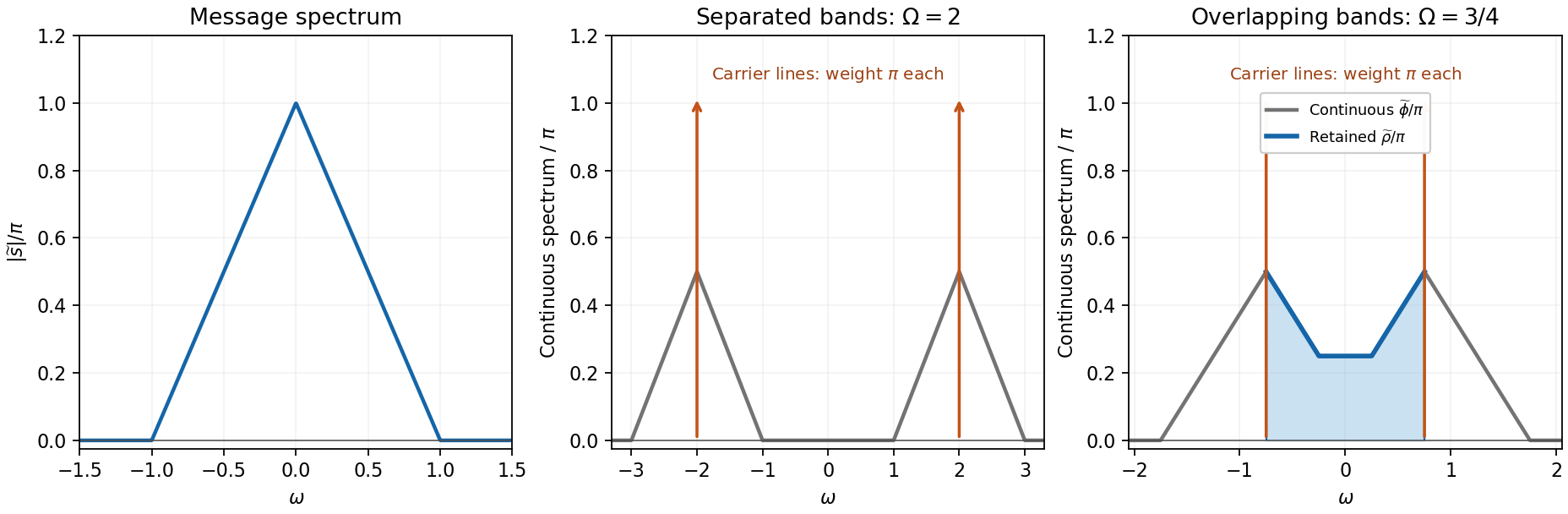

Use the Fourier transform conventionSince in distribution theory, the carrier has transformThe modulation property of the Fourier transform translates the message spectrum to the two carrier frequencies. ThereforeThe first term represents the unmodulated carrier wave; the other terms are the amplitude modulation sidebands.
There are unlisted articles, also show them or only show them.