
Supporting hyperplane 2026-10-18
For a convex set and , a supporting hyperplane has a nonzero normal vector such that for all . It touches while containing the set on one side.
Nonholonomic constraint Created 2026-10-18 Updated 2026-10-24
A nonholonomic constraint is a nonintegrable restriction on allowed velocities: it cannot locally be replaced by relations among generalized coordinates and time. In contrast, a velocity equation with constant radii integrates to a holonomic constraint . Rolling without slipping is therefore not automatically nonholonomic: planar rolling on a prescribed curve can be holonomic, whereas rolling with additional directional freedoms can impose nonintegrable velocity constraints. Unwrapped angles may be needed to record the winding of a rolling trajectory.
Work by Constantin Carathéodory 2026-10-18
Compton scattering experiment of 1923 Created 2026-10-18 Updated 2026-10-20
In Arthur Holly Compton's A Quantum Theory of the Scattering of X-rays by Light Elements (1923), pp. 494–495 and Figure 4 compare X-rays from a molybdenum target with rays scattered by graphite at right angles. Slits select the rays; a calcite crystal analyzes their wavelengths by Bragg's law. The plotted readout is scattered wave intensity against the crystal's glancing angle, distinct from the fixed photon deflection. The primary-beam comparison uses the same slits, crystal, and tube potential. First-order diffraction lines on both sides establish angular zero. The displaced spectral line supports a longer outgoing wavelength and hence photon energy transfer. The two curves use different vertical scales, so their heights cannot directly compare absolute wave intensities. The paper postpones a fuller apparatus description; it also states on p. 496 that recoil electrons from ordinary X-rays had not been observed. Thus this spectral test infers recoil through the conservation model rather than directly tracking an electron.[ref]
A Quantum Theory of the Scattering of X-rays by Light Elements by Arthur Holly Compton. Compton, Physical Review 21 (1923), pp. 494–496, Experimental Test, Figure 4 and opening of Velocity of recoil of the scattering electrons
Inverse Compton scattering Created 2026-10-18 Updated 2026-11-05
Inverse Compton scattering transfers energy from an energetic electron to a photon in a Compton scattering event. Transforming into the electron's rest frame blueshifts an approaching photon; scattering there and transforming back can produce a much more energetic outgoing photon.
For a head-on collision with an ultrarelativistic electron of Lorentz factor , the low-recoil limit gives an approximately forward maximum photon energy , where is the incident photon energy. This requires ; recoil limits the increase outside that regime.
A laboratory source overlaps a laser beam with an electron beam and selects scattered photons within an angular acceptance. Electron energy spread, beam divergence and collection angle affect the emitted bandwidth, so one photon-energy value does not characterize every collected event. [ref]
https://journals.aps.org/prab/abstract/10.1103/PhysRevAccelBeams.24.050701. Intense monochromatic photons above 100 keV from an inverse Compton source, 2021, source design and kinematic discussion
Compton recoil kinematics Created 2026-10-18 Updated 2026-10-20
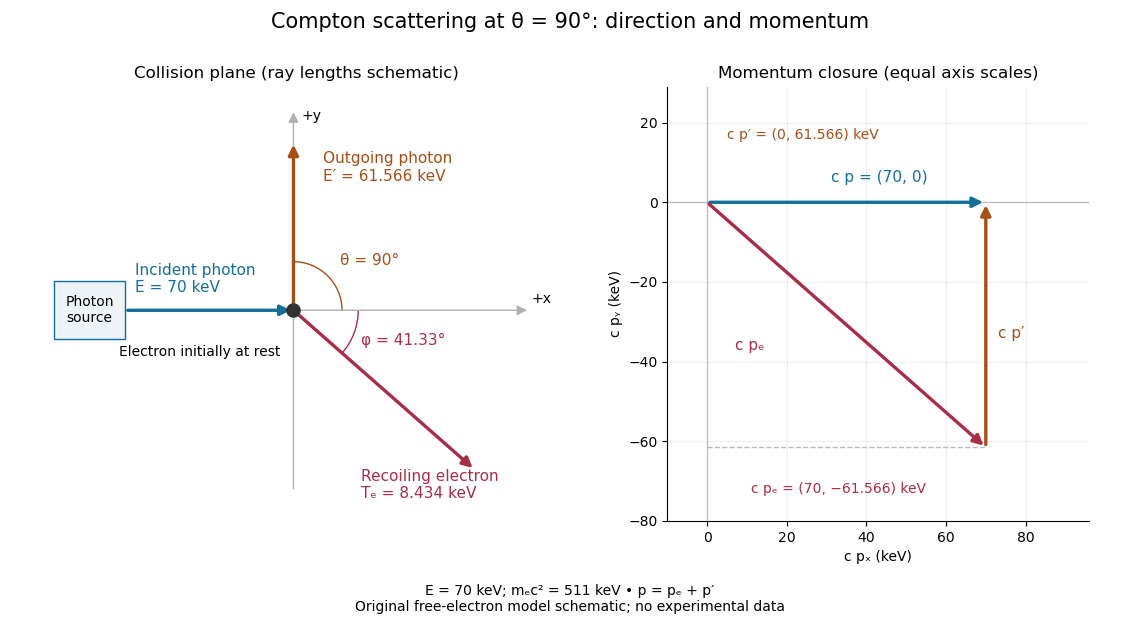
Choose the incident photon direction as and the plane of the collision as the plane, with the outgoing photon above the axis. The electron initially has zero momentum. Conservation of energy and momentum conservation, using the relativistic energy–momentum relation, giveSquaring the electron energy and the momentum magnitude in these two equations yieldsCancel common terms to obtain . Division by gives . Substitution of proves both Compton scattering formulas. Using the nonrelativistic approximation here would lose the exact relativistic result.
Let be the nonnegative electron recoil angle below the incident direction. For , the vector components above implyThis assumes exactly the same initially stationary free electron and single outgoing photon. At , the electron moves forward with ; at it stays at rest, so its recoil direction is undefined even though the limiting angle as is . At in the chosen example, and .
Bound-electron scattering without a Thomson frequency window Created 2026-10-18 Updated 2026-10-24
A classical Thomson scattering frequency window for a harmonically bound electron requires , with and recoil scale . There is no parametrically separated window if , equivalently . This is a scale comparison, not a prediction of a sharp transition between scattering mechanisms.
At that binding scale, an oscillator quantum has energy comparable with the electron rest energy. The nonrelativistic Lorentz oscillator model is then inadequate, so a physical cross-section requires a relativistic quantum description. Compton scattering itself does not switch on discontinuously at ; its recoil corrections become substantial near that scale and tend to the Thomson scattering limit at low photon energy for a free target.
Isothermal flow through molecular hydrogen formation Created 2026-10-18 Updated 2026-10-20
Across a thin steady transition with negligible external impulse, mass conservation and momentum conservation give the displayed relations. If the gas stays isothermal while neutral atomic hydrogen becomes molecular hydrogen, the mean particle mass doubles and for its isothermal sound speed. Let . The downstream subsonic branch has , , and .
For , the leading behavior is , and , at unchanged temperature. Radiation of the molecular binding energy prevents that released energy from necessarily heating the gas; it does not, by itself, establish an isothermal thermal closure. If temperature evolution is allowed, an energy balance and a cooling model are required to determine all four changes uniquely.
Power maps of a reciprocal-coordinate hyperbola Created 2026-10-18 Updated 2026-10-24
Let , and . The real and imaginary coordinates obey , a hyperbola. Put , which is strictly increasing. Then traces a horizontal line, and traces a parabola. Eliminating gives the displayed quadratic relation between real part and imaginary part. The value of fixes an orientation and determines which segment is traversed; the full real parabola is obtained as ranges over .
Phasor 2026-10-18
A phasor is a complex amplitude representing a sinusoid at one specified angular frequency: . Its modulus gives the peak amplitude and its complex argument gives the wave phase in this convention. Both may instead use root mean square magnitudes if that normalization is stated.
Coulomb excitation 2026-10-18
Excitation of an atomic nucleus by the electric field of a passing charged projectile. For suitable collision energies and separations, the electromagnetic interaction can populate collective states without requiring contact through the nuclear force. Electric quadrupole transition strengths connect excitation yields with collective charge motion; inferring a shape additionally assumes a nuclear model. Contributions from the nuclear force, competing transitions and the collision kinematics must be controlled before identifying a yield with a single quadrupole strength.
Nuclear quadrupole vibration 2026-10-18
A collective oscillation of the quadrupole shape coordinates of an atomic nucleus. Near spherical equilibrium, the ideal harmonic description has five components, corresponding to the five magnetic substates of angular momentum two. Each quantum carries ; it is an excitation of the many-nucleon system rather than an extra constituent. Its frequency is , and its energy spacing follows the quantum harmonic oscillator.
One quantum produces a level at . Two identical quadrupole quanta can couple to in a symmetric state, giving a degenerate multiplet at in the ideal model. Odd total would be antisymmetric under their exchange. Thus the first to first excitation ratio is , rather than the nuclear rotational band value . Real nuclear quadrupole vibrations can be anharmonic and their multiplets split: the ratio is a diagnostic of a limiting model, not a universal classification rule.
Hookean dumbbell in planar extension 2026-10-18
Represent one polymer by two beads joined by an ideal linear entropic spring, and stipulate a dimensionless conformation tensor with equilibrium value . The displayed model uses velocity gradient and positive polymer relaxation time . It omits finite chain extensibility, interactions with other chains, and feedback from the polymer onto the flow. It is a teaching model, not a fitted description of Keller's apparatus.
Define the Weissenberg number for this model as and dimensionless time . With an initially isotropic , the diagonal entries obeyBelow , both transverse and longitudinal responses approach positive finite steady values:For a chosen , and : the longitudinal mean-square separation is five times its quiescent value, while the transverse separation contracts. A root-mean-square length grows as the square root of a variance, so the longitudinal length factor is , not five. The anisotropy is an orientational indicator; converting it to measured birefringence requires an additional calibrated optical relation.
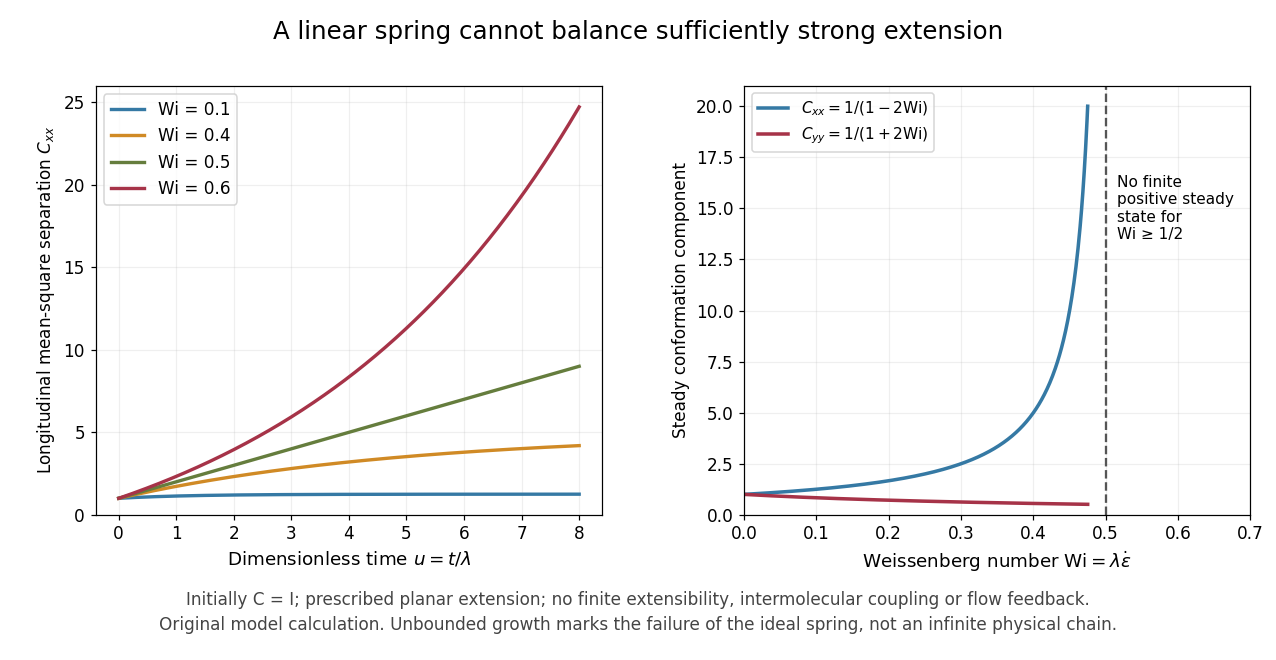
At , . Above that value, the growing homogeneous solution prevents a positive finite steady state. For instance, gives . Real chains have finite contour lengths, so this growth identifies the failure of the linear spring model. It does not establish a universal threshold for arbitrary flow histories, finite chains or other definitions of polymer relaxation time. Combining the growth equation with residence time in planar extension also explains why a large instantaneous Weissenberg number alone does not guarantee a strongly stretched exiting chain.
Keller four-roller polymer experiment 2026-10-18
Pierre-Gilles de Gennes's 1991 lecture describes Andrew Keller and collaborators using four rollers to deform a dilute polymer solution. A well-chosen exit trajectory kept coils under sustained extension. Above a threshold flow rate the solution became birefringent, revealing a change in chain orientation and conformation. The experiment connected an optical readout to a mechanically driven molecular response.[ref]
Soft Matter by Pierre-Gilles de Gennes. Printed p. 9: four-roller experiment and coil-stretch interpretation; text inspected in the Columbia reproduction
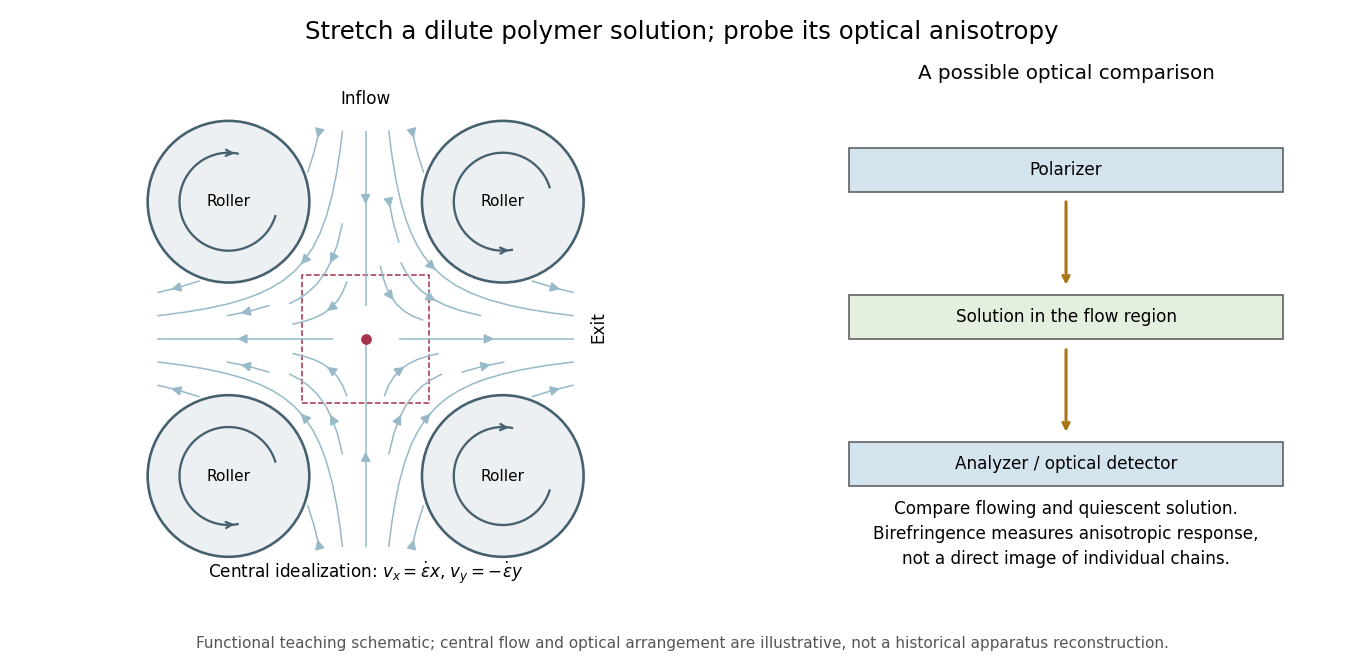


This original functional diagram shows a central flow idealization, rather than historical dimensions or a photograph. A probe of birefringence detects different optical responses along different directions; it does not directly photograph a chain or establish its extension without an optical model. Comparing a flowing solution with its quiescent state and controlling temperature and concentration are useful proposed checks, not an assertion that this is the complete historical protocol.
Coherent-state oscillator expectation values Created 2026-10-18 Updated 2026-11-05
A normalized oscillator coherent state obeys , so its mean occupation number is . Under the quantum harmonic oscillator Hamiltonian operator , its evolution is . Inserting and givesThese mean values obey the classical harmonic oscillator equations. The displacement amplitude is , whose classical orbit has energy . The full quantum mean energy has the additional zero-point energy . Indeed the variances are and , and their kinetic and potential contributions sum to .
Suddenly shifting a quantum harmonic oscillator equilibrium from zero to a signed position leaves the old ground state unchanged at the instant of the quantum quench. The new annihilation operator is , with , so . In the translated energy eigenstates , the expansion isThe sign follows by translating the old vacuum by before expanding it in the old Fock states. A Baker--Campbell--Hausdorff formula with central commutator separates the resulting exponential into creation and annihilation parts. Evolution with the shifted Hamiltonian preserves this coherent state, with . Its mean occupation is and its mean energy above the new potential minimum is . Omitting in favour of changes the state when .
Displacement operator Created 2026-10-18 Updated 2026-11-05
The displacement operator translates oscillator phase space. It is unitary and obeys and , a coherent state. The Baker--Campbell--Hausdorff formula with a scalar commutator givesThe conjugation on ensures that the exponent is anti-Hermitian for arbitrary complex displacement. For real , this becomes the spatial translation .
Cobalt-60 Created 2026-10-18 Updated 2026-11-05
Cobalt-60 is a radioactive cobalt isotope with twenty-seven protons and thirty-three neutrons. It beta-decays to excited states of nickel-60, followed by characteristic gamma emission.
That reproducible emission makes it useful as a radiation source in measurement and irradiation applications. Its decay concerns nuclear transitions; changing cobalt's chemical oxidation state does not turn one cobalt isotope into another.
Work by Clyde Edward Wiegand 2026-10-18
Work by Clyde Cowan 2026-10-18
There are unlisted articles, also show them or only show them.