
Let be a finite positive surface measure and . Expand and integrate against . The Fourier transform of a Gaussian turns the oscillatory kernel into , which is nonnegative. Taking absolute values of the bounded amplitudes gives an upper bound by the same moment with . This weighted positivity is valid even when is merely measurable; it transfers a scalar surface-decay estimate to a local bounded-density moment estimate.
Ewald sphere 2026-10-14
With , elastic scattering into a propagating wavevector samples Fourier transfer . These transfers satisfy the displayed shifted sphere relation. This reciprocal-space construction appears in crystallographic diffraction and the Fourier diffraction theorem.
Adler trace 2026-10-14
Integrate the formal pseudodifferential residue over a period, or over the real line when the integral converges and the relevant boundary terms vanish. More algebraically, apply a linear functional on the coefficient algebra that annihilates derivatives. For , and , the two residues are and . Since , integration by parts proves . For both residues vanish. Bounded orders ensure only finitely many monomial pairs contribute to the residue of a product.
When Stokes factors act on solution coefficient vectors, a full positive turn gives their ordered product equal to the inverse of formal monodromy for a polynomial system with no finite singularities. The true fundamental matrix is entire, so its actual monodromy is trivial, but its normalized formal branch changes by . Indeed, write ; then , whereas normalized continuation after the positive turn gives . Cancelling the invertible fundamental matrix proves the identity. The uncorrected product is identity only when . For a cubic-exponential two-by-two system with , the formal exponent is , so and the Stokes product is .
First-order associative deformation Created 2026-10-14 Updated 2026-11-05
The order- part of associativity is , so is a Hochschild cocycle. A change of coordinates changes to . Therefore equivalence classes of first-order associative deformations of a fixed underlying algebra are its second Hochschild cohomology. Unital deformations use normalized cochains.
Weyl deformation of a polynomial algebra in two variables Created 2026-10-14 Updated 2026-11-05
The algebra over defined by has ordered basis , by its differential Ore-extension construction. Its -adic completion is a formal associative formal associative deformation of . In characteristic zero its first-order multiplication term is . The cocycle is not a coboundary: a degree-two coboundary on a commutative algebra is symmetric, whereas .
With no forcing, the linear dispersion relation has positive phase velocity and group velocity three times this. A decaying permanent wave with instead obeys . For positive coefficients a nonzero homoclinic wave requires and is negative, travelling upstream. Its inverse width is . The opposite directions reflect the nonlinear amplitude-dependent propagation speed.
Small-speed compliant-plug lubrication asymptotics Created 2026-10-14 Updated 2026-11-05
For , small gives . In the large-domain limit its inverse-power integrals are , and . The force-free condition is , or . Expanding the root near proves the displayed minus sign and leading pressure drop. The absolute downstream pressure relative to the elastic reference pressure fixes and therefore closes the speed-pressure relation.
The amplitude equations , satisfy , , hence preserve the displayed first integral. For and , the centre equilibrium is with , while the two boundary saddle equilibria are with . The level contains the boundary connection and the arc joining the two saddle equilibria. Levels form closed periodic orbits. Adding an independent rotating phase turns these closed amplitude trajectories into invariant tori.
Confocal microscopy 2026-10-14
Confocal microscopy forms an image by scanning a localized illumination spot and preferentially detecting light from the same small region. In a thick specimen emitting fluorescence, a conventional fluorescence microscope also collects a haze from material away from the selected optical focus. Confocal optical sectioning suppresses that haze, revealing structure at a chosen depth without cutting the specimen. The useful idea is a paired selection: where excitation occurs, and which emitted photons reach the photodetector. [ref]
Introductory Confocal Concepts by Nikon Instruments Inc.. Introductory Confocal Concepts, opening paragraphs and Fig. 2: out-of-focus fluorescence and optical sections
The scope here is single-point, linear fluorescence imaging. Confocal microscopy can also use reflected light; its broader implementations need not all have the same scanning mechanism. The patent Microscopy apparatus, US3013467A, by Marvin Minsky describes a point source imaged onto a specimen, a second pinhole receiving its image, specimen scanning, and a synchronized display. It was filed on 7 November 1957 and published on 19 December 1961; the filing date should not be described as the grant date. This is evidence for that apparatus and those dates, rather than a claim that all later fluorescence instruments were already present in it. [ref]
Microscopy apparatus by Marvin Minsky. Front-page filing/publication metadata; description, Optical System, Fig. 1; Stage Scanning System
Fluorescence emission filter 2026-10-14
A fluorescence emission filter transmits the chosen emitted wavelength band while rejecting excitation leakage. Finite rejection, overlap of the fluorescence emission spectrum with excitation, and the photodetector's wavelength-dependent response can all affect the count. A darker filtered image alone does not establish a changed fluorescence lifetime or increased photobleaching.
Fluorescence excitation filter Created 2026-10-14 Updated 2026-10-20
A fluorescence excitation filter selects the illumination wavelength band reaching the specimen. Its finite transmission changes the absorbed photon rate and thus image brightness. Specify that band when interpreting a fluorescence excitation spectrum or comparing images.
Vector noise normalization in inertial Langevin dynamics Created 2026-10-14 Updated 2026-11-05
Let the physical viscous drag coefficient be inFor isotropic three-dimensional equilibrium Gaussian white noise, each force component has covariance . The random acceleration therefore satisfiesThe factor six is twice the three Cartesian components. It agrees with the equipartition theorem, , and with damping rate . A one-component variance has factor two; a vector dot-covariance is the trace and has factor six. Stating whether a coefficient is a drag or a damping rate avoids a further factor-of-mass error.
Invariant volume criterion for a smooth flow Created 2026-10-14 Updated 2026-11-05
For a volume form , define divergence by . The product rule for the Lie derivative gives . Consequently the flow preserves a smooth positive volume precisely when its divergence in any reference volume is a smooth flow coboundary. The displayed density has the minus sign dictated by this product rule.
Truncation toward zero 2026-10-14
Truncation toward zero removes the fractional magnitude of a real number, giving the integer obtained by applying the floor function to its absolute value and restoring the original sign; a magnitude below one gives zero. More precisely,The result is zero for . For example, and , whereas . Python's
math.trunc uses this towards-zero convention, so replacing it by math.floor changes calculations with negative noninteger inputs. [ref]https://docs.python.org/3.14/library/math.html#math.trunc. Python 3.14 math.trunc documentation: floor on positive inputs, ceiling on negative inputs
.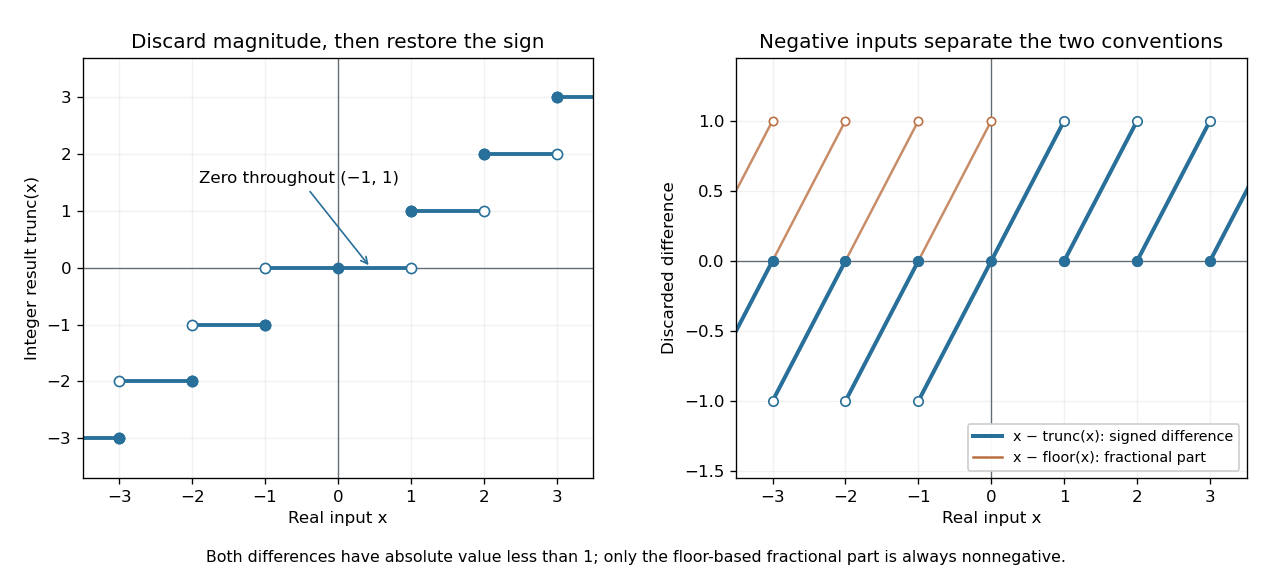
Truncation toward zero is symmetric in sign, while the fractional part defined by the floor function is always nonnegative
. Left: exact integer endpoint values distinguish the two sign-dependent truncation rules; a whole neighborhood of zero maps to zero. Right: takes the sign of a noninteger input, while lies in on both sides of zero. Open endpoints show excluded limiting values. Details.
For every real number ,The discarded difference has the sign of when is noninteger. In contrast, the fractional part is always in . At , these two differences are and . Thus specifying a signed fractional remainder requires specifying which integer-valued operation is used.
Unlike the floor function and ceiling function, truncation toward zero need not commute with adding an integer. At and , , whereas . This matters if negative coordinates are assigned to equal-width bins by converting a quotient to an integer: belongs to the bin under the floor function, but truncation gives zero. The appropriate operation follows from the declared bin intervals.
Truncation toward zero is a nondecreasing function with a discontinuity of a function at each nonzero integer. It has no discontinuity of a function at zero, because it is identically zero on . Its agreement with the floor function on the positive side and the ceiling function on the negative side explains the different closed endpoints in the diagram.
Ceiling function Created 2026-10-14 Updated 2026-10-20
The ceiling function gives the least integer large enough to meet a real lower bound. For a real number ,Thus , , and . The operation rounds upward in the total order on the real numbers, which can move a negative input towards zero. Its difference from the input obeys . Python's
math.ceil implements this least-integer definition. [ref]https://docs.python.org/3.14/library/math.html#math.ceil. Python 3.14 math.ceil documentation: the least integer at least x
.The ceiling count for fixed-size batches is a direct application. Suppose each box holds at most items, with positive integer , and there are items. The smallest number of boxes with enough capacity is : a candidate count must satisfy . For , , six boxes are needed, leaving unused places. Exactly 100 items need only five boxes, and zero items need zero boxes. Adding one to the floor function result unconditionally would therefore overcount at exact multiples of .
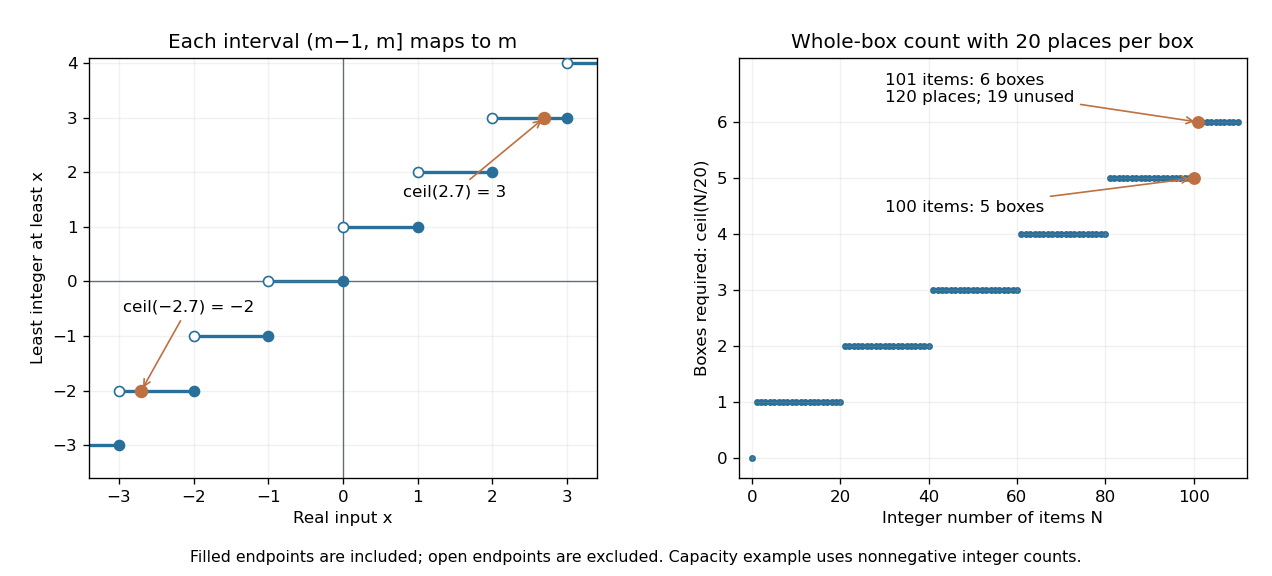
The ceiling function retains the endpoint on the left and counts enough whole containers
. Left: open and filled endpoints distinguish the half-open intervals where , including negative inputs. Right: the original capacity example uses 20 items per box; 101 items need six boxes, while an exact multiple of 20 needs no extra box. The right-hand inputs are integer item counts. Details.
For nonnegative integer and positive integer , Euclidean division gives the exact identityWrite , . The count is when the remainder is zero and otherwise, and the right-hand side encodes these two cases. This argument specifies the domain of the identity; arbitrary negative denominators require their own sign conventions.
The ceiling function is a nondecreasing function, constant on each of the half-open intervals , and has a discontinuity of a function at every integer. It is tied to the floor function by . Adding an integer shifts its output by the same amount: . At an integer the floor and ceiling agree; at every other input they differ by one. These statements refer to exact real numbers; an input already perturbed by floating-point arithmetic can land on the other side of a threshold.
Integer count in a closed interval 2026-10-14
For real numbers , the integers in the closed interval begin at and end at , if there are any. Their number is thereforeThe extra one includes both ends of the resulting integer interval. The maximum with zero handles an empty intersection: contains no integer, even though it has positive length.
For , the ceiling function selects and the floor function selects , giving . The four points are . For , the count is five, not four: the real length and the number of integer points are different quantities.
With fixed inlet thickness and velocity , and nose tension , integrating momentum gives . For a slice injected at , write and . Its thickness, velocity and position are , , and . Eliminating its age gives the steady profile behind the nose, while the nose is the slice with the earliest injection time.
For a colour singlet hadron built entirely from up quarks, down quarks, strange quarks, antiquarks and gluons, the net number of quarks is a multiple of three. The central SU(3) colour element multiplies the state by , while a singlet must be unchanged. The central flavour element supplies the same phase because all three light flavours form the fundamental representation. Every resulting flavour multiplet therefore has zero SU(3) triality. Heavy quarks are singlets of light-flavour SU(3), so hadrons containing them do not obey this argument. The zero-triality restriction allows higher light-quark multiplets as well as the familiar singlet, octet and decuplet.
There are unlisted articles, also show them or only show them.