
Symplectic representation of a stabilizer code Created 2026-10-14 Updated 2026-11-05
A stabilizer group with independent generators maps injectively to an r-dimensional isotropic subspace of the binary symplectic space of Pauli labels. For generator rows , commutation is over . Its stabilizer subspace has dimension . The labels of the centralizer of a stabilizer group form ; labels in act as nontrivial logical Pauli operators.
Iterative spreadsheet calculation 2026-10-14
A different interpretation can treat cyclic spreadsheet formulas as simultaneous equations and seek a fixed point by repeated numerical updates. This requires an explicit update rule, initial values and stopping condition. It is not automatically the meaning of a spreadsheet formula. In particular, a directed cycle alone tells us neither whether a fixed point exists nor whether a chosen update rule approaches it.
Two original toy examples make the distinction exact. The cyclic pair
X1=Y1+1, Y1=X1+1 has no solution over the real numbers: substitution gives . For X1=Y1, Y1=X1, every equal pair is a fixed point, so there is no unique answer. Simultaneously updating both spreadsheet cells from the previous pair gives . Starting at produces the periodic sequence , which does not approach a fixed point. Updating X1 first and immediately using its new value for Y1 instead gives in one sweep. That difference follows from the specified rules, not from a claim about any current spreadsheet product. Numerical iteration can be useful for a deliberately chosen model with a justification such as the contraction mapping theorem; ordinary acyclic spreadsheet dependency evaluation already has its answer from prerequisite order. Linear spline 2026-10-14
A linear spline is a continuous piecewise linear function on a specified spline knot sequence. For uniform integer spline knots, the hat basis in the displayed representation interpolates the data . The derivative is constant on each open span and can jump at a knot. Coinciding neighboring slopes remove a particular jump, but generic data give only regularity.
For and any two-by-two unitary matrix, expand the two columns of . The equal-index coefficients cancel, and the coefficient of is the determinant. Its modulus is one, so a common change of qubit basis preserves the spin singlet state up to a global phase. The density projector is exactly invariant.
Larmor precession Created 2026-10-14 Updated 2026-11-05
Larmor precession is the precession of a magnetic moment about an applied magnetic field. For a spin with gyromagnetic ratio and Hamiltonian , its expectation value obeys . A spin coherent state retains its coherent form during this rotation.
Stern-Gerlach experiment Created 2026-10-14 Updated 2026-10-18
A Stern-Gerlach experiment separates atomic beams according to a component of their magnetic moment in a nonuniform magnetic field. For an appropriate two-state spin system, calibrated outputs distinguish the two spin eigenvalues; Stern-Gerlach expectation estimation explains how repeated fresh preparations turn channel counts into an expectation value.
The decisive contrast is between two separated components of an atomic beam and the continuous spread predicted for randomly oriented classical magnetic moments. Neither component need be an infinitely narrow spot: velocity spread and the resolving power of the scientific instrument affect the spatial image. The apparatus converts an internal magnetic moment into a displacement large enough to inspect, connecting angular momentum eigenstates to macroscopic evidence.
Time-rescaled spike-train diagnostics Created 2026-10-14 Updated 2026-11-05
For a correctly specified conditional rate, transformed interspike intervals have independent unit-exponential distributions, apart from observation-boundary censoring. Their transforms should be uniform. Distributional checks and serial-correlation checks assess a fitted spike model on held-out data. A history-dependent model must include past spikes in its conditional rate; stimulus-only Poisson spike-train likelihood fitting cannot automatically capture refractoriness.
Rayleigh-Plesset equation Created 2026-10-14 Updated 2026-11-05
The Rayleigh-Plesset equation balances the radial inertia of an incompressible liquid around a spherical bubble against internal and ambient pressure, surface tension and viscous stress. Removing the last two effects and setting the bubble pressure to zero gives the following vacuum-collapse case.
Rayleigh equation for an inviscid spherical bubble Created 2026-10-14 Updated 2026-11-05
In radial potential flow outside a spherical bubble, incompressibility and the moving-boundary condition give and . The Unsteady Bernoulli equation, with its gauge fixed at infinity, yields the displayed radius equation when surface tension and viscosity are neglected. Pressure continuity at the interface identifies the liquid pressure with the gas pressure . The vacuum special case is Rayleigh collapse of a spherical cavity.
Spherical law of cosines 2026-10-14
For a nondegenerate convex minor spherical triangle, the spherical law of cosines relates two angular sides , their included interior angle , and the opposite angular side :Relabelling the vertices gives the corresponding formulas for and . As with the spherical law of sines, physical side lengths must first be divided by the sphere's radius. The spherical law of cosines determines uniquely from when the data describe such a spherical triangle. It also recovers each interior angle from three sides, for exampleUsing the cosine and the range selects a unique angle, avoiding the supplementary-angle ambiguity of an inverse sine calculation.
To derive the spherical law of cosines, let be the vertex unit vectors at , so , and . The outgoing unit tangent vectors at are and . Their dot product is both and , proving the identity. This gives a geometric explanation: spherical trigonometry compares angles in the tangent plane using vectors in the surrounding Euclidean space.
For a worked example on the unit sphere, take the verticesAt , the outgoing unit tangent vectors are and , so the interior angle is a right angle. The vertex dot products give . The spherical law of cosines then reduces to the right-angle identity , givingTo find , use the relabelled spherical law of cosines:The physical side lengths on a sphere of radius are and . For example, on a toy sphere with metres they are approximately , and metres; the interior angles stay the same. Applying the planar Pythagorean theorem directly to the angular sides would instead give . That flat right triangle calculation does not give the great-circle distance between and .
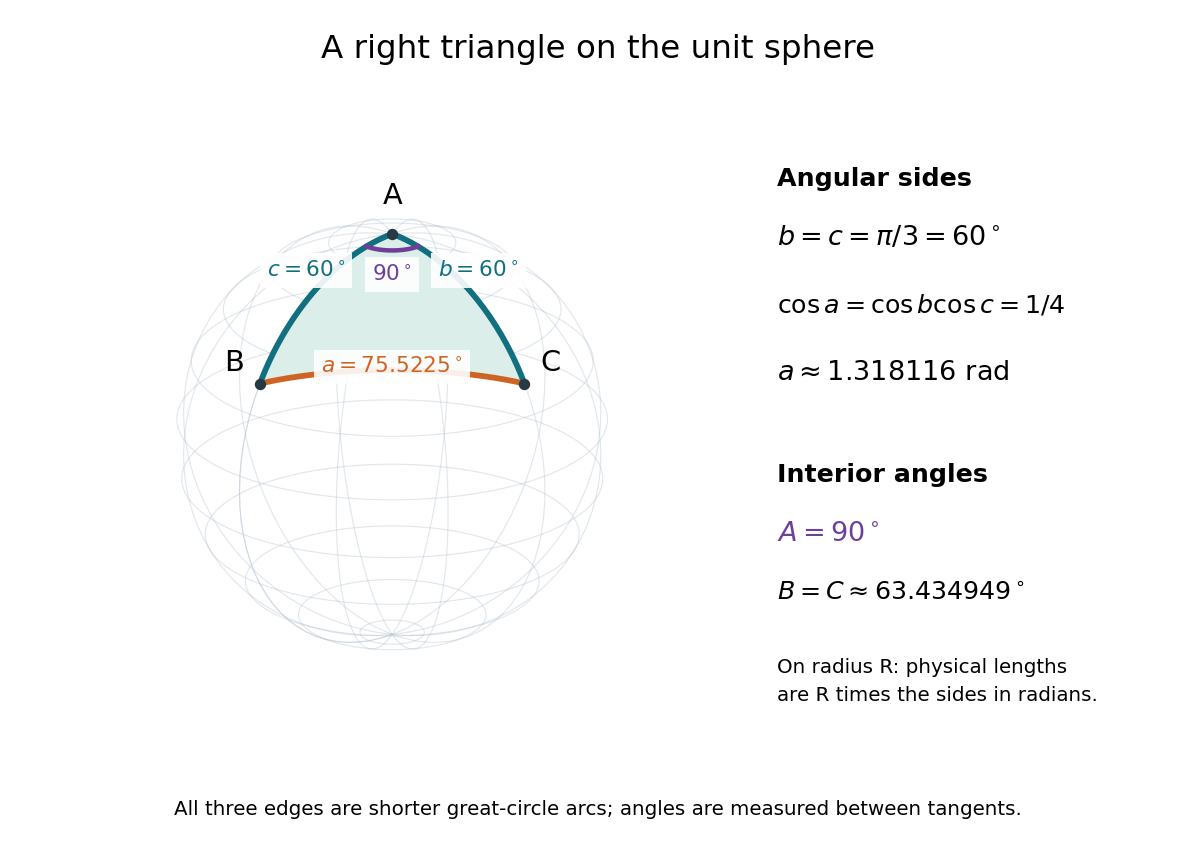

The familiar law of cosines reappears as a local approximation. With all small in radians, substitute the small-angle approximations and into the spherical law of cosines and keep terms through second order:Multiplication by gives the planar law of cosines for the physical side lengths. For a fixed small surface triangle on a progressively larger sphere, the angular sides shrink and this approximation improves. Thus the curved and flat formulas fit together: the Pythagorean theorem is recovered locally when is a right angle.
Spherical law of sines 2026-10-14
For a nondegenerate convex minor spherical triangle, with angular sides opposite interior angles , the spherical law of sines statesThe sines of sides refer to central angles, so a physical side length on a sphere of radius must enter as . All six angles lie in , and the denominators are positive. The reciprocal form, , is equivalent. This is Tatum's sine formula, equation 3.5.1, in Celestial Mechanics, section 3.5: spherical sine and cosine formulas.
A short proof explains the symmetry of the spherical law of sines. Let be the vertex unit vectors at . At , the outgoing unit tangent vectors towards are and . Their angle is , so the magnitude of their cross product is . Since both tangent vectors are orthogonal to , the scalar triple product obeysDividing by proves the spherical law of sines. Its beauty is that the same three-dimensional scalar triple product can be calculated at any vertex, producing all three ratios at once.
For the spherical triangle worked out under the spherical law of cosines, , and . Hence , and the spherical law of sines givesThe inverse sine gives , but the supplementary angle has the same sine. The spherical law of sines alone therefore leaves two candidates for this angle. The spherical law of cosines, using the known three sides, gives and selects ; likewise . When only two sides and an opposite angle are given, two distinct valid spherical triangles can remain. A cosine relation resolves an inverse sine branch only when enough additional data are known; it does not make every ambiguous data set unique.
Spherical triangle reflection group 2026-10-14
Reflections in the sides of a spherical triangle of angles generate a finite group when its images tessellate the sphere. The triangle area is by the spherical excess formula. Label its three vertex types and continue those labels across each reflected side; they are consistent around every vertex and, because the sphere is simply connected, globally. The generated group preserves these labels, so a chamber stabilizer fixes all three vertices and is trivial. Dividing sphere area by chamber area gives its order. Up to permutation the possibilities are for , and , of orders .
Spherically symmetric bound state of a finite well Created 2026-10-14 Updated 2026-11-05
For well depth and radius , let for a regular spherically symmetric wavefunction. At energy , the interior is and the exterior is proportional to , with and . Matching gives . The first negative-energy solution exists strictly above the displayed threshold. At equality the exterior zero-energy wave behaves as and is not square-integrable, so the threshold is not itself a bound state.
Spherical Hankel function 2026-10-14
These combinations of Spherical Bessel functions solve the radial Helmholtz equation. For time dependence , is outgoing and incoming. At fixed order and large argument, . Their recurrence is .
Logarithmic spherical Bessel square integral Created 2026-10-14 Updated 2026-10-18
Spherical shell Created 2026-10-14 Updated 2026-10-18
A spherical shell is the region between two concentric spheres. A thin mass shell at radius , thickness and mass density has mass to first order. Decomposing a spherical body into such shells makes the spherical shell theorem applicable to its gravitational potential energy.
Solenoidal isotropic spectral tensor Created 2026-10-14 Updated 2026-11-05
For a statistically homogeneous, isotropic, reflection-symmetric solenoidal vector random field in three dimensions, the nonzero-wavevector spectral tensor is a scalar multiple of the transverse projector of a vector field. Isotropy gives , while zero divergence gives . Its trace is , giving the displayed normalization. Without reflection symmetry an additional antisymmetric, helical term can occur.
Spectral-radius Liouville theorem 2026-10-14
If an entire Banach algebra-valued function has bounded spectral radius, that spectral radius is constant. The spectral-radius three-circle inequality on circles about an arbitrary point, with the outer radius tending to infinity, bounds every interior value by the maximum on any smaller circle. Upper semicontinuity of the spectral radius then lets the smaller radius tend to zero. Every value is bounded by the value at the arbitrary center; exchanging centers gives equality. The algebra-valued function itself can be nonconstant, for example for a fixed nonzero square-zero matrix .
In a complex unital Banach algebra, the spectral radius formula makes the root norms of tend to . If , those norms are eventually bounded above by a geometric sequence and the powers vanish. Conversely, vanishing powers eventually have norm less than one; the infimum version of the radius formula then forces . Consequently , including the case .
Spectral accuracy 2026-10-14
A spectral method has spectral accuracy for a class of smooth data when its error decreases faster than any fixed inverse power of the truncation size. For periodic Fourier series, this follows from arbitrarily many integrations by parts when every derivative matches across the periodic boundary. An analytic periodic extension to a complex strip gives exponential coefficient decay. Analyticity inside one period and matching only endpoint values do not suffice: a jump in a derivative of the periodic extension yields algebraic decay instead.
There are unlisted articles, also show them or only show them.