
Projected area 2026-10-14
The projected area of a planar patch viewed from a direction is the area of its perpendicular shadow onto a plane normal to that direction. If and are its unit normal and viewing unit vector, then by the dot product. On the outward side, this is . For a rectangle tilted around one edge, the width perpendicular to that edge contracts by and the edge length stays fixed, proving the formula. At grazing view ; interpret the radiance definition by a limit rather than dividing by zero.
Rayleigh centrifugal stability criterion Created 2026-10-14 Updated 2026-11-05
For inviscid cylindrical rotation without a magnetic field, an axisymmetric radial interchange conserves each parcel's specific angular momentum . Its restoring coefficient is . Increasing gives centrifugal stability; decreasing gives an exponentially growing interchange mode when radial displacement is allowed by the boundaries. A vanishing derivative is marginal, not a strictly restoring condition.
// Target: astrophysics.bigb
Repeated-message attack on the Rabin cryptosystem Created 2026-10-14 Updated 2026-11-05
For coprime moduli and , the Chinese remainder theorem recovers the integer uniquely in from the two ciphertexts. An ordinary integer square root then recovers the message. If distinct semiprime moduli share a factor, their greatest common divisor instead reveals factors of both moduli. Learning one message in the coprime case does not by itself give a general factoring algorithm or a decryption key for other ciphertexts.
Matter parity Created 2026-10-14 Updated 2026-11-05
Matter parity assigns odd parity to the quark and lepton chiral superfields and even parity to the Higgs chiral doublets and gauge superfields. It is related to component R-parity by . The Lorentz-invariant action contains an even number of fermions, so conserved matter parity is equivalent to conserved R-parity. Products of four matter superfields can be even while violating baryon number; matter parity alone does not exclude higher-dimensional proton-decay operators.
Subgroup correspondence for a surjective group homomorphism Created 2026-10-14 Updated 2026-11-05
For a surjection with kernel , inverse image and image give inverse order-preserving bijections between subgroups of and subgroups of containing . They preserve index. For an arbitrary subgroup , , so .
// Target: algebra.bigb
Universal property of a quotient group 2026-10-14
Let be a normal subgroup of , and let be the quotient map of groups. If a group homomorphism has group kernel containing , there is exactly one group homomorphism with . Its value is forced: . Every measurement by a group homomorphism that ignores can thus be performed on the quotient group directly. This is the universal property of the construction.
If is a normal subgroup, changing representatives to and , where , givesThe chosen representatives therefore give the same coset. Conversely, suppose the rule defines an operation on left cosets. Since for , multiplying by gives , hence . Applying this inclusion for every and proves , so is a normal subgroup. This makes normality exactly the condition needed to carry group operation to these classes.
Quotient map of groups Created 2026-10-14 Updated 2026-10-31
The quotient map of groups sends each group element to its coset modulo a normal subgroup. It is a surjective group homomorphism, with group kernel exactly . In the additive six-element example, it sends to , to , and to . The quotient map of groups records the identification that produces the new group.
M/M/1 utilization and delay 2026-10-14
Consider an M/M/1 queue with an exogenous Poisson process of arrivals of rate , one server, unlimited waiting space, first come first served service, and independent and identically distributed service times with an exponential distribution of rate , independent of arrivals. There is no blocking or abandonment, so offered rate and admitted queue throughput coincide: . The memoryless property makes the queue population a birth-death process. For , the stationary distribution of an M-M-1 queue isThis is a geometric distribution on the nonnegative integers. Its mean, together with Little's law, givesHere count the whole system, and count only waiting. These distinctions and formulas are derived in MIT 2.854, M/M/1 Queue notes, pages 1-2.
Take customers per hour and customers per hour. The mean service time is hour, or 12 minutes, and the server utilization is . Computing each quantity explicitly,Thus Little's law checks both boundaries: and . The mean number in service is , rather than one, because the server is idle 20 percent of the time. By PASTA, an arriving customer sees four customers already in the system on average. Under first come first served, the memoryless property gives mean residual service time for the customer in service; clearing those four customers takes hour on average, independently confirming the mean queueing delay.
Holding per hour fixed, increasing arrivals from to per hour raises server utilization from to , but doubles mean customer sojourn time from one to two hours. At per hour, server utilization is , , hours, , and hours. Both mean population and mean duration diverge as approaches from below. The formula describes an explosive congestion penalty near capacity even though all arrivals still eventually receive service at every fixed subcritical rate. At or above capacity there is no stationary distribution for this unlimited M/M/1 queue, so these finite stationary formulas no longer apply.
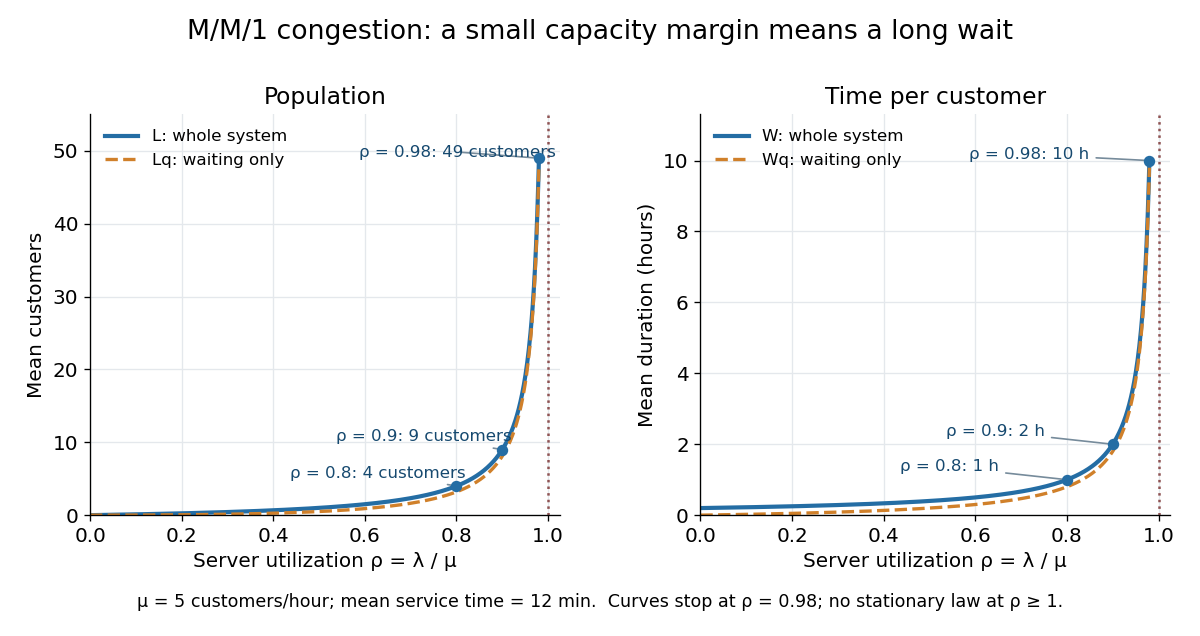

The inverse dependence of mean customer sojourn time on spare capacity, , makes server utilization a poor standalone measure of service quality. Adding capacity at a nearly saturated M/M/1 queue can sharply reduce queueing delay. Stanley B. Gershwin develops this capacity interpretation in Markov Processes and Queues, MIT 2.854, 2016, slides 71-72.
Little's law 2026-10-14
For a stable queue with finite long-run averages, a positive finite admitted rate, and negligible initial and terminal contributions after division by observation time, Little's law statesHere is the time-average queue population, is the admitted rate through the chosen system, and is the customer-average customer sojourn time inside that same boundary. Without abandonment, admitted rate equals completed-service queue throughput in this stable regime. It may differ from the offered arrival rate because of blocking. When customers abandon, count their admissions and exits too, and average their actual time inside; using only service completions would mismatch the population being measured.
For the waiting area alone the matching identity iswhere is mean queueing delay. For one server with no abandonment, service in arrival order, and finite mean service time ,with the server utilization. Mixing total population with waiting-only duration would count different portions of each customer's visit. Customers who start service immediately contribute zero to , and must still be included in that customer average.
The strength of Little's law is that it does not require a Poisson process, an exponential distribution of service times, or service in arrival order. The sample-path area identity for Little's law explains why: counting customer-time across time slices or across customer visits gives the same area. A sufficient probabilistic setting is repeated independent and identically distributed empty-to-empty cycles with finite positive mean cycle duration, finite positive mean customer count, and finite mean population area; the renewal-reward theorem then supplies the long-run averages. Stability alone does not guarantee finite mean queueing delay: the Pollaczek-Khinchine mean formula shows why a finite second moment of service time matters for that mean in an M/G/1 queue.
For example, suppose a service desk receives six requests per hour but admits only four; measured mean customer sojourn time of admitted requests is half an hour. Its mean queue population is customers. Multiplying the offered rate by that duration would incorrectly give three. Conversely, counting two customers on average and measuring admitted queue throughput of four per hour gives hour. This lets one estimate a hard-to-track duration from occupancy and completed-job counts.
John D. C. Little published a rigorous proof in 1961 under finite-mean, strict stationarity, and ergodicity assumptions on the arrival process. Those were assumptions of that proof, rather than a requirement that every useful form of the identity have random arrivals. [ref]
https://pubsonline.informs.org/doi/10.1287/opre.9.3.383. Little, A Proof for the Queuing Formula: L = λW, Operations Research 9(3), 383-387
. [ref]https://fisherp.scripts.mit.edu/wordpress/wp-content/uploads/2015/11/ContentServer.pdf. Original paper, opening statement
. Service discipline 2026-10-14
A service discipline specifies which customers receive the server's capacity and where newly arriving customers join the queue. First come first served and processor sharing give different sample paths even when their equilibrium populations agree.
Multiclass single-server queue 2026-10-14
An ordered state records the classes and positions of customers at a single server. Class- arrivals have rate and exponential service parameter . Under a symmetric service discipline, its stationary distribution is , where . If every , class-independent insertion and service position rules need not be equal: time reversal of a continuous-time Markov chain interchanges them and proves the same law. Aggregating words gives by the multinomial coefficient. With class-dependent service rates, first come first served need not have this product law.
Busy period 2026-10-14
A busy period is the interval from an arrival that finds the system empty until the next departure leaving it empty. It excludes the preceding idle waiting time. In a stable M/G/1 queue with arrival rate and mean service time , its mean is .
Heterogeneous two-server queue 2026-10-14
A queue with a Poisson process of arrivals and two independent service times with exponential distributions of different rates must distinguish the two possible single-customer states. If an arrival chooses either idle server with probability , the continuous-time Markov chain is reversible. Write for the states with only server one or two busy, and for total population. Its detailed balance equations give , and . These weights normalize exactly when . In equilibrium, reversed upward transitions have total rate in every state, so time reversal of a continuous-time Markov chain makes the departure stream a Poisson process of rate . This output conclusion requires stationarity.
Queue (queueing theory) Created 2026-10-14 Updated 2026-11-05
A queue consists of customers or jobs waiting for or receiving service. An arrival process adds customers and a service rule specifies which waiting customer is served next. A stochastic model of these events is studied in queueing theory; its queue length is the number of customers waiting or in service, according to the stated convention.
Alternating arrival and service queue Created 2026-10-14 Updated 2026-11-05
For positive , a continuous-time Markov chain may alternate between an arrival phase , with upward transitions at rate , and a service phase , with downward transitions at rate when the level is positive. Switching rates and are . Its stationary balance equations give a geometric invariant tail with ratio . A stationary probability exists exactly when , consistent with the stationary average service rate exceeding the arrival rate .
General-service infinite-server queue Created 2026-10-14 Updated 2026-11-05
Poisson arrivals of rate receive independent service times distributed as , with infinitely many servers so service starts on arrival. Starting empty, the occupancy at time is Poisson with mean , by independent thinning of the marked arrivals. If , the equilibrium count is Poisson with mean . Occupancy need not be a Markov process for a general service law; remaining service times carry additional state information.
Geometric-arrival single-service queue Created 2026-10-14 Updated 2026-11-05
Let the independent arrivals satisfy , with and . During a busy period, each served customer produces further customers, so the total number served has the total-progeny law of a Galton-Watson process with mean . Its extinction probability solves and is the smaller of and . The queue is positive recurrent for , null recurrent for , and transient for . In the positive recurrent case its stationary distribution is .
Scaling limit of a queue Created 2026-10-14 Updated 2026-11-05
An asymptotic description obtained by increasing queue resources or input size, or by approaching critical load while rescaling time and workload. Large-buffer queue scaling, many-source queue scaling, moderate-deviation queue scaling and the heavy-traffic limit of a queue preserve different relations between mean load, random fluctuations and storage.
Hyperbolic metric space 2026-10-14
For , a geodesic metric space is -hyperbolic when each side of every metric geodesic triangle lies in the closed -neighbourhood of the other two sides.
There are unlisted articles, also show them or only show them.