
For target density proportional to on , use the Pareto distribution proposal with . Its density ratio is proportional to , maximized at if that point exceeds . The tight envelope yields the highest acceptance probability for this fixed proposal. An inverse draw is with uniformly distributed on .
Acceptance mass for an unnormalized rejection envelope Created 2026-10-14 Updated 2026-10-25
If , and for a proposal probability density function , accept a proposal when an independent uniform distribution value is at most . Integrating the joint acceptance probability density function gives and conditional accepted probability density function . For independent proposals the accepted count has binomial distribution with parameters .
For , a Reissner-Nordstrom spacetime has an outer event horizon and an inner Cauchy horizon. Between them is timelike; inside the inner horizon is spacelike and the curvature singularity is timelike. The exact analytic extension contains repeated exterior blocks beyond the Cauchy horizons. Small perturbations produce severe inner-horizon blueshift and mass inflation, so that exact continuation is not a robust prediction for collapse. At the horizons merge into a degenerate Killing horizon; for the spherical electrovacuum solution instead has a naked singularity.
Reissner-Nordstrom horizon surface gravity 2026-10-14
For and , put . The stationary Killing vector field normalized at infinity generates the outer Killing horizon. In an ingoing null chart its covector is on that horizon; the Killing equation then gives , where . Thus the positive nonextremal surface gravity is . It tends to zero when , where the horizon becomes a degenerate Killing horizon. The past horizon branch has the opposite signed nonaffinity for the same time-translation field.
For and the exterior areal radius , integrate and choose . The Reissner-Nordstrom metric becomes the displayed form. Constant-time proper distance to diverges, but these exterior coordinates do not cover the horizon; ingoing null coordinates are regular there. Infinite spatial throat length therefore does not establish absence of an event horizon.
Extremal Reissner-Nordstrom causal crossing 2026-10-14
A neutral radial timelike geodesic of an extremal black hole has conserved specific energy , giving the displayed radial equation. An infalling geodesic reaches with finite nonzero and finite proper time. In ingoing coordinates, outgoing radial null curves have ; those starting inside approach only at infinite and cannot return to the same exterior future null infinity. This distinguishes causal access from length on a static slice, and supplies an operational event horizon test even without strictly trapped round spheres.
Reissner-Nordstrom Hawking temperature Created 2026-10-14 Updated 2026-10-25
For , near-horizon Euclidean geometry has polar form . Smoothness gives inverse temperature and the displayed formula. This assumes a nondegenerate Killing horizon and time normalized at infinity. Its nonextremal limit is zero at .
For full hydrogen ionization after instantaneous reionization, and . Integrating Thomson scattering givesFor , . At fixed baryon density and redshift, lowering the matter density reduces the expansion rate and increases the optical depth.
// Target: cosmology.bigb
Equal expected recoveries from excess of loss and stop loss Created 2026-10-14 Updated 2026-11-05
For independent exponential claims of mean and a zero-based geometric count of parameter , excess of loss reinsurance at per-claim reinsurance retention has expected recovery . The zero-based geometric sum of exponential variables has tail , so aggregate stop loss reinsurance at reinsurance retention has expected recovery . Equating them gives the displayed reinsurance retention relation. This comparison concerns claim payouts, before any reinsurance premium is charged.
Reinsurance retention 2026-10-14
A threshold limiting the insurer's retained payment under a reinsurance contract. Under excess of loss reinsurance it applies to each claim size; under aggregate stop loss reinsurance it applies to the total loss over the stated period. These contracts therefore cap different quantities even when their thresholds have the same numerical value.
Lavrentiev regularization 2026-10-14
For a positive self-adjoint linear operator , Lavrentiev regularization shifts itself rather than . In a finite-dimensional positive-definite problem, writing gives error coefficients in its orthonormal eigenbasis. Consequently . A known bound permits , giving a robust bound . For fixed positive , the sharper finite-dimensional estimate can give a linear noise rate with a smaller parameter; regularization is then a conditioning choice, not a cure for nonexistence of the inverse.
Sard's theorem 2026-10-14
For a smooth map between smooth manifolds, the set of critical values has measure zero in the target. In particular, regular values are dense.
Parametric regularity of exchange equilibria 2026-10-14
If zero is a regular value of the joint smooth aggregate excess demand , almost every parameter gives a regular economy. The regular level set theorem makes the zero set a manifold. Its projection to parameter space fails to have full rank exactly where the derivative with respect to prices is singular; Sard theorem makes these exceptional parameter values a null set.
Vapor-compression refrigeration Created 2026-10-14 Updated 2026-10-18
Vapor-compression refrigeration circulates a working fluid through cold and hot coils. In the cold coil, liquid becomes gas while absorbing heat from the refrigerated region. Compression supplies work and raises the pressure and temperature; the hot coil releases heat as the gas returns to liquid. A restriction reduces the pressure before the next cold-side passage. Changing the pressure changes the temperature of the phase transition, letting one circulating fluid receive and release heat at different temperatures. This physical implementation serves both refrigerators and heat pumps; its ordinary dissipative operation differs from the reversible Carnot cycle used to bound performance. [ref]
https://openstax.org/books/university-physics-volume-2/pages/4-3-refrigerators-and-heat-pumps. Ling, Moebs and Sanny, University Physics Volume 2, §4.3, Figure 4.7: circulating coolant
[ref] Inverse-square refractive-index profile Created 2026-10-14 Updated 2026-11-05
A transverse electric polarization with constant permeability and conserved transverse wavenumber satisfies , with and . Substitution reduces it to the Bessel equation. The profile is singular at , so each side requires its own boundary conditions.
Ramp reference signal 2026-10-14
A ramp reference signal changes at a constant rate from onward. Its derivative is for . A ramp reference signal tests whether a controller can keep following a moving goal, rather than merely reaching a fixed one; a finite steady-state tracking error can coexist with an unbounded reference signal.
Isotope scaling of diatomic vibration 2026-10-14
Near a stable equilibrium bond length , a Taylor expansion of a diatomic molecule's potential energy gives , with . Treat the internal stretch as a harmonic oscillator of reduced mass, initially omitting molecular rotation. If replacing an isotope leaves this local potential energy curvature unchanged, thenHere is the speed of light and a spectroscopic wavenumber; use consistent length units for and . The quantum harmonic oscillator gives adjacent energy eigenvalues separated by , with the Planck constant. Consequently a vibrational photon absorption can probe the same frequency scale, subject to electric-dipole selection rules.
For an explicitly approximate isotope example, assign the atomic masses of , , , and the mass-number values , respectively, with the unified atomic mass unit. These are stipulated approximations to individual atomic masses, not measured masses of molecules or natural-abundance averages. They giveThe symbol means deuterium, . Doubling the light partner's approximate atomic mass therefore produces a large predicted shift, whereas changing the already heavy chlorine partner by two mass units produces a much smaller one. A quantitative comparison with infrared spectroscopy requires actual isotope-specific atomic masses, fitted band parameters, and uncertainties, rather than identifying any arbitrary peak with .
Free two-mass spring 2026-10-14
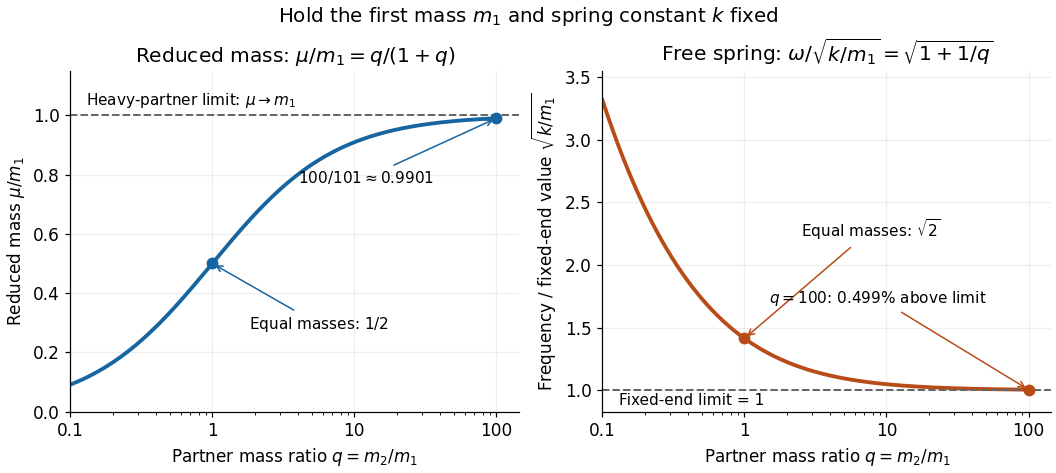
Take two point masses joined by a massless spring of spring constant and equilibrium length . Assume one-dimensional motion along the spring, no external force, no damping, and an extension satisfying Hooke's law; keep . For a real spring this is a model within its elastic range. Its potential energy is , soHere is angular frequency and is frequency. Choose so the model bodies do not cross. The internal normal mode has displacements and about equilibrium offsets from the centre of mass; its amplitude ratio is . The other normal mode is collective translation with zero frequency and no spring extension. This free pair has different boundary conditions from normal modes of two equal masses between three springs.
For and two masses, and . Replacing the second mass by gives and . Fixing the second endpoint instead would give : the free heavy partner still moves. The free pair's angular frequency exceeds that fixed-end limit by the factor , about at .

Two-particle relative coordinate 2026-10-14
Choose positions in one inertial frame and let . The centre of mass and two-particle relative coordinate areThe lighter body is farther from the centre of mass. Reconstructing both positions from these equations is part of solving the two-body problem; alone describes their separation, not either body's laboratory position.[ref]
Newtonian Dynamics by Richard Fitzpatrick. Reduced Mass, equations 324–326: centre and reconstruction of both particle positions
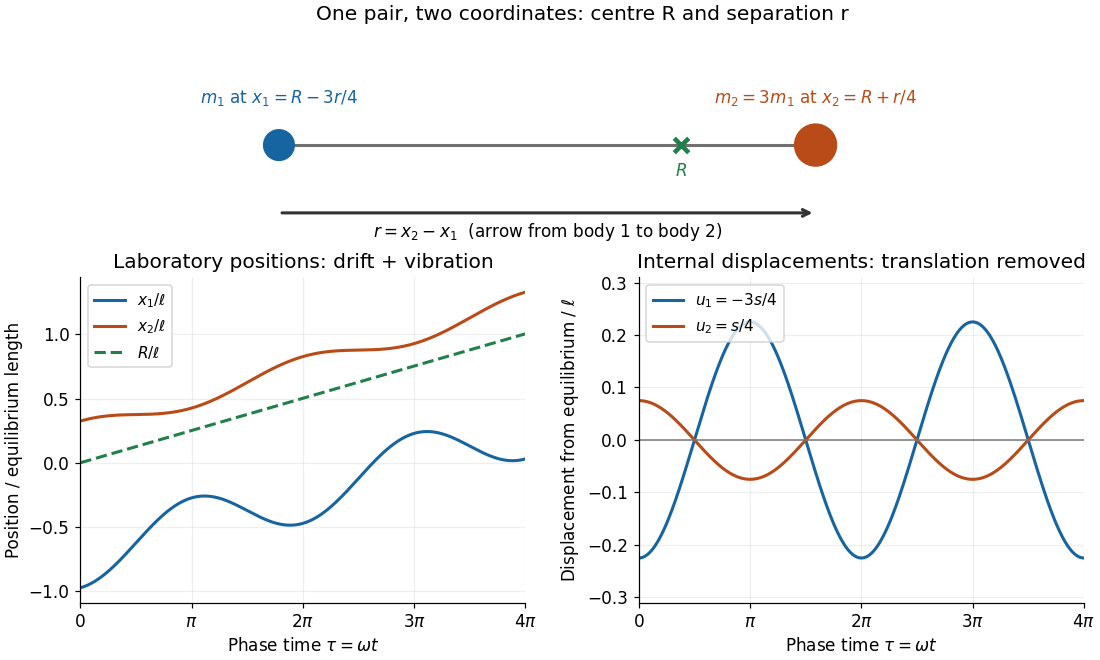
Centre of mass translation and internal two-particle relative coordinate for a pair with mass ratio three
. Original illustrative free two-mass spring model, with , equilibrium separation , relative extension , , and . The right plot subtracts both the translating centre of mass and each body's equilibrium offset. It shows internal displacements, not full distances from the centre of mass. Details.
Substitute the reconstructed velocities into the kinetic energy. The result is the exact two-particle instance of kinetic-energy decomposition about the centre of mass:The mixed dot product has coefficient ; the coefficient of is . This algebra needs constant positive masses but no particular force law. In the stationary centre of mass frame, the fraction of internal kinetic energy carried by body 1 is , and by body 2 is : the lighter body carries more.
For a closed pair with no external forces, write for the force on body 2 and for that on body 1, as required by Newton's third law. Adding and subtracting their Newton's second law equations yieldsThus the centre of mass moves uniformly while the two-particle relative coordinate behaves like one body of reduced mass. Equal-opposite internal forces suffice for these equations. For an internal central force, with , the internal torque vanishes and conservation of angular momentum gives constant . If the central force comes from a time-independent potential energy , then and the internal mechanical energy is conserved. The kinetic energy split alone does not establish either conservation law.
There are unlisted articles, also show them or only show them.