
Care-seeking effects on a recorded injury outcome Created 2026-10-14 Updated 2026-11-05
A recorded medically attended injury depends both on an injury occurring and on care being sought and recorded. An intervention that changes recognition of injuries or the threshold for seeking care can change recorded attendance even without changing underlying injury incidence. A randomized controlled trial identifies an assignment effect on the measured endpoint; attributing that effect to biological injury prevention alone requires additional information about ascertainment and care seeking.
Random sum 2026-10-14
A random sum has a random number of summands, usually with a nonnegative integer-valued random variable. The empty sum is zero. The dependence between and the summands must be stated; independent summands do not by themselves imply independence from .
Statistical dependence 2026-10-14
Two random variables are statistically dependent when their joint probability distribution differs from the product of their marginal probability distributions. Equivalently, some events determined by the two variables violate the product rule that defines independence. Nonzero covariance implies statistical dependence when the moments exist, but zero covariance does not in general imply independence.
Random element Created 2026-10-14 Updated 2026-10-14
A random element is a measurable function from a probability space to a measurable space . Its law is the pushforward measure for . Real-valued random variables and vector-valued random variables are examples; a stochastic sample path can also be a random element when its path-space sigma-algebra is specified. For a Polish space , the usual choice is its Borel sigma-algebra. A large deviation principle concerns the laws of a family of such random elements.
Poisson-Dirichlet distribution Created 2026-10-14 Updated 2026-11-05
Wishart distribution Created 2026-10-14 Updated 2026-10-25
For integer , the sum of independent vectors has a Wishart distribution. Its positive-definite density extends to real and is proportional to . It is a conjugate prior for the precision matrix of a multivariate normal distribution. Its mean is .
The WinBUGS declaration
dwish(R, nu) uses ; the density convention is documented in the NIMBLE BUGS-language manual. For it is proper, while the expected inverse matrix does not exist: that expectation requires . Specifying a Wishart prior on precision is therefore a substantive covariance assumption. Rado graph 2026-10-14
The Rado graph is the unique countably infinite graph with the two-uniform hypergraph extension property. Equivalently, for any disjoint finite vertex sets , some new vertex is adjacent to every member of and no member of . The back-and-forth method proves uniqueness. Independent edge sampling on the natural numbers with any fixed produces this graph almost surely. It contains both edges and nonedges and therefore is not a complete graph. Its first-order axioms constitute the theory of the random graph.
Random k-out graph 2026-10-14
Each vertex independently chooses distinct other vertices uniformly, and an undirected edge exists when either endpoint chooses the other. This has dependent undirected edges and is not a binomial random graph. Coupling the choices as the first entries of independent random permutations makes the graphs increasing in .
Preferential attachment 2026-10-14
In preferential attachment, new edges favour existing vertices in proportion to a prescribed attractiveness, often their current degree of a vertex. A complete model must specify initial conditions, self-loop conventions and the normalization at each attachment. These details matter for the vertex degree distribution of the earliest vertices.
Configuration model Created 2026-10-14 Updated 2026-10-20
For a prescribed degree sequence with even sum , attach labelled half-edges to vertex and choose a uniform perfect matching of the half-edges. Each pair becomes an edge, giving a multigraph that may have self-loops or parallel edges. The number of pairings is . Every simple graph with that degree sequence has exactly pairing representations, so conditioning on simplicity produces the uniform simple-graph model.
Ramond–Ramond potential 2026-10-14
A differential-form gauge potential from the Ramond–Ramond sector. A D-brane carries electric or magnetic charge under the appropriate potential. Circle reduction of the M-theory metric gives the IIA one-form potential, while its three-form gives the IIA three-form potential.
Filtered backprojection 2026-10-14
The Radon transform records line integrals of a planar density. Apply the transverse Hilbert transform and a derivative to each projection, then average the filtered values over all lines through the reconstruction point. With , the filter has Fourier multiplier . The Fourier inversion theorem, or the jump of the complexified transport Cauchy kernel, proves the displayed formula. The factor is when directions are integrated over a half-circle. The growing Fourier multiplier explains amplification of measurement noise and the need for regularization of an inverse problem.
Goldberger–Wise stabilization mechanism 2026-10-14
The Goldberger–Wise stabilization mechanism generates a radion potential in the Randall–Sundrum model using a weakly backreacting bulk scalar field. On , its static profile obeys , hence , where . Boundary potentials approximately fix , . For and , the leading radius-dependent potential is proportional to . Its leading minimum satisfies . Thus a modest ratio of boundary values can generate a large warp exponent. Corrections shift this minimum; the approximation requires small scalar field backreaction, and the four-dimensional cosmological constant still needs adjustment.
Prime support of an integer 2026-10-14
The prime support of an integer is the finite set of its distinct prime factors. For example, , and is the empty set. Its cardinality is the prime omega function , and the product of its elements is the radical of an integer . These are two different ways to summarize the same finite set: a count and a product.
Comoving entropy conservation Created 2026-10-14 Updated 2026-11-05
Adiabatic expansion conserves entropy in a comoving volume: is constant. With , it gives . Changes in entropy degrees of freedom must therefore be retained when transporting an early relic density to today, rather than setting constant across all particle thresholds.
// Target: cosmology.bigb
Calibrated radiant-flux measurement 2026-10-14
An optical power meter makes the definition operational: collect a specified beam on a calibrated photodiode, measure its electric current, and infer incident radiant flux using spectral responsivity. In the manufacturer-authored Model 1830-R Series Optical Power Meters User's Manual by Newport Corporation, §5.5.1 specifies a concrete sequence: connect the detector and its calibration module, select watt mode and the source wavelength, block the beam and press ZERO, then unblock it and read the display. The stored background includes dark current and ambient light present during zeroing. For narrowband radiation,The electric current difference divided by spectral responsivity has units . For a stipulated and difference , the inferred radiant flux is ; these numbers illustrate the inference and are not reported measurements. The entire beam must hit the active area, and §5.6 calls for correct wavelength, background subtraction, and operation below detector saturation. If an optical attenuator is fitted, §5.4 requires the calibrated detector–attenuator pair and the matching meter setting.
The calibration itself must connect electric current to independently known incident power. NIST's Spectroradiometric Detector Measurements: Ultraviolet, Visible, and Near-Infrared Detectors for Spectral Power by Thomas C. Larason and others describes this chain. A cryogenic radiometer, an electrical substitution radiometer, compares temperature changes from absorbed light with those from known Joule heating (§5.2). Transfer and working detectors carry that watt scale to a spectral comparator (§5.1). A source, monochromator, focusing optics, shutter, beam splitter, and monitor photodiode illuminate a standard and test detector in turn; calibrated current-to-voltage electronics and voltmeters provide the readout (§§3.2.2–3.2.4, 4.3.1). At each wavelength, subtract blocked-beam signals and normalize each detector signal by the simultaneously sampled monitor signal. Comparison with the standard yields the test detector's spectral responsivity. NIST uses two working standards and alignment normal to the beam (§6.1.1).
Controls distinguish a smaller collected radiant flux from a faulty conversion: block and unblock the beam to check the baseline; check that its footprint fits the active area; verify the calibrated optical attenuator configuration; and test proportional response within the specified operating range. Source drift faster than monitor sampling is not removed. NIST discusses finite spectral bandwidth, stray light, temperature, and spatial response variations (§§3.1.1, 6.2, 7.2). A broadband optical spectrum requires the weighted integral in spectral radiant flux, rather than dividing by an arbitrary single spectral responsivity. These limitations explain why the meter's displayed watts need a stated collection boundary, spectral assumptions, and calibration conditions.
Spectral radiant flux 2026-10-14
Spectral radiant flux resolves radiant flux by wavelength or frequency:Its units are per metre of wavelength or per hertz of frequency. A density quoted per nanometre must be integrated with wavelength intervals in nanometres; its numerical value is times the per-metre density. The frequency and wavelength spectral radiance conversion applies equally to spectral radiant flux, through the change of variables formula:with the speed of light in vacuum and expressed per metre. The Jacobian determinant preserves integrated power rather than the height or location of an optical spectrum's peak.
For two explicitly synthetic optical spectra, let and quote the following densities in :The triangle under and the rectangle under both have area : . Their band radiant fluxes differ: – contains of , while – contains of . These are specified functions, not measured source spectra.
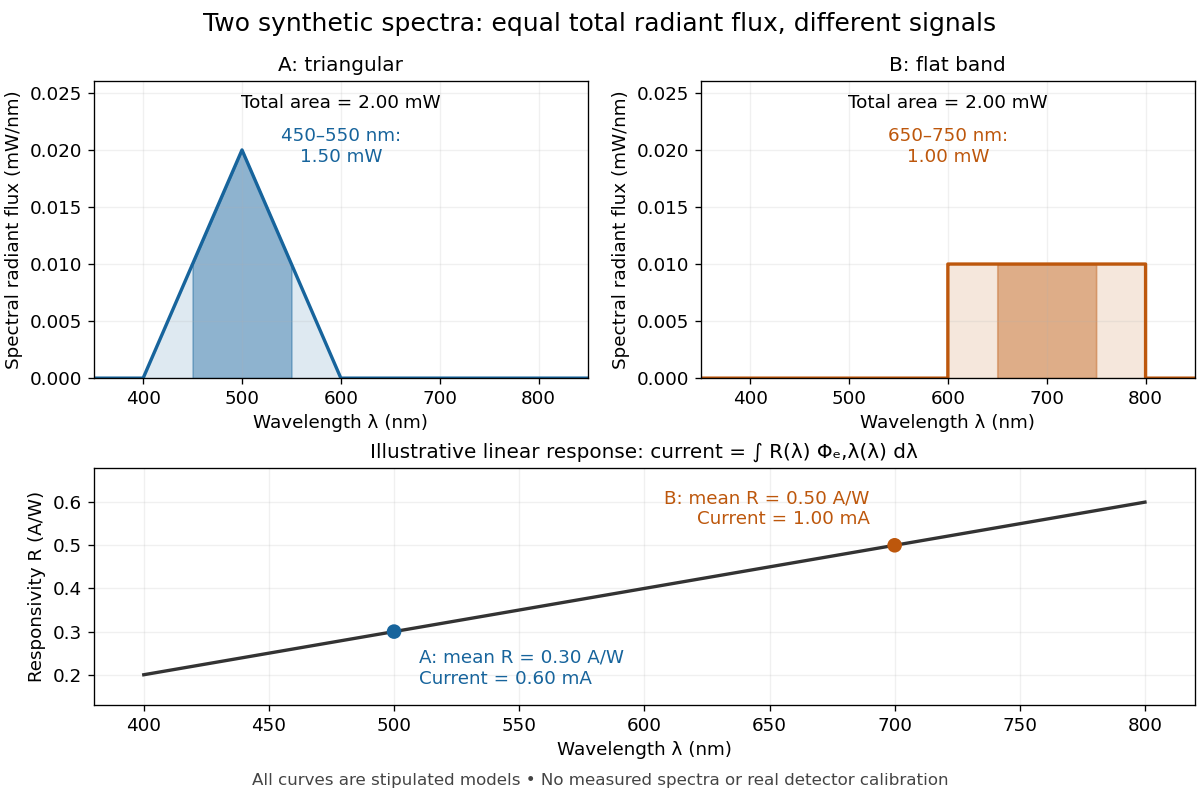

The dark-subtracted electric current of a linear photodiode isusing its spectral responsivity. The figure's stipulated gives and despite equal total radiant flux. Symmetry places 's mean wavelength at and 's at ; a linear averages to its value at that mean. A single electric current therefore cannot determine an unknown broadband radiant flux without additional spectral information or a sufficiently flat calibrated response.
Beam collection at fixed radiant flux 2026-10-14
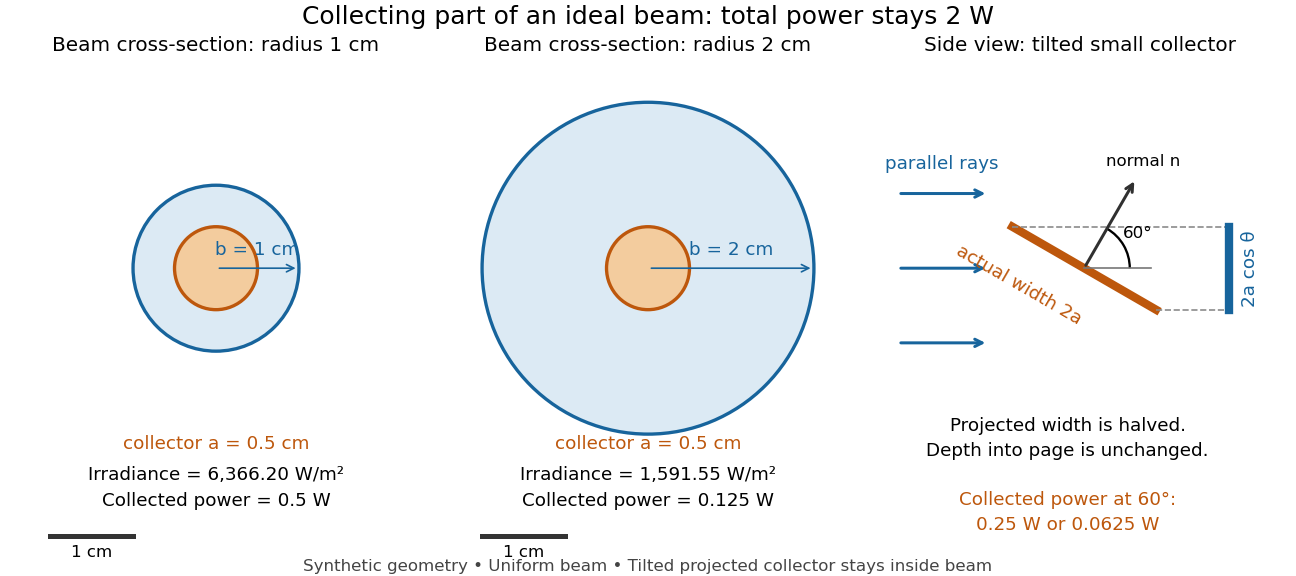
Consider an ideal parallel circular beam with uniform irradiance inside radius , zero outside, and total radiant flux . A centred circular collector of radius , perpendicular to the light rays, interceptsFor and , and the collected radiant flux is . Expanding the beam to while keeping fixed divides irradiance and the same collector's radiant flux by four: and . A collector covering either entire beam still receives .
Tilting a flat collector of actual area by an angle to the beam direction gives if its entire projected area remains inside the uniform beam. At the small collector's radiant flux halves. A collector large enough to intercept the whole beam after tilting still receives : the footprint on its surface grows as and cancels the irradiance factor. This model ignores diffraction, beam-edge structure, and changes in absorption with incidence angle; it counts incident rather than absorbed power.

Radiant flux through an oriented surface 2026-10-14
In geometrical optics, suppose radiation has a nonnegative radiance whose directional contributions add as power. Here is the actual propagation unit vector, is a solid angle element, and the collecting oriented surface has chosen unit normal . Assume the following integrals exist. The outward and inward radiant fluxes areBoth quantities are nonnegative; their difference is the signed net radiant flux. The dot product supplies the cosine of the angle with the unit normal, hence the projected area. For incoming radiation the outward unit normal gives a negative dot product; the minus sign makes the collected power positive. Measuring the incoming angle from a source-facing unit normal instead gives the familiar positive . The units check is .
Equivalently, the incoming surface integral is with local irradiance ; the emitted part of is with radiant exitance . For a small flat patch and a narrow accepted cone, nearly constant radiance and angle give . This approximation requires uniformity across the patch and cone. Direction-independent outgoing radiance over a whole hemisphere gives the different exact result , by Lambert's cosine law and the spherical coordinates calculation in radiant exitance. Replacing the cosine-weighted integral by the hemisphere's solid angle would double the answer.[ref]
These radiance formulas presume a description in additive directional power; they do not reconstruct arbitrary coherent wave interference from separate ray contributions. For general electromagnetic fields, the signed instantaneous power crossing an oriented surface is , using the Poynting vector ; optical measurements commonly average over many wave periods. A zero net radiant flux can conceal equal nonzero incoming and outgoing radiant fluxes.
Spectral radiance 2026-10-14
Spectral radiance is radiance per unit frequency or wavelength interval. Its astronomical synonym specific intensity is usually written or ; this is a spectral radiance, distinct from the radiant intensity in radiometry. For positive small intervals,The two expressions refer to the same spectral slice, with the positive widths related through frequency and wavelength . For frequency measured in hertz, , the units are . For wavelength measured in metres, . Integrating over a spectral band gives its radiance, and then multiplying by the collecting projected area and accepted solid angle gives a small uniform beam's radiant flux. A spectral measurement therefore retains information that the band-integrated power alone loses.
For an ideal blackbody, Planck's law gives and at temperature , independent of outgoing direction. Its existing frequency and wavelength peaks of Planck's law illustrate why the coordinate matters. The simpler flat-band calculation below isolates that same change of variables without the thermal physics.
There are unlisted articles, also show them or only show them.