
Near-grid quantum phase estimation 2026-10-14
For register size and eigenphase , the amplitude of decoded label is . The finite geometric series gives . If , this is . Thus the nearest exactly representable phase is returned with probability near one, not with certainty unless the offset vanishes.
// Target: quantum-error-correction.bigb
Quantum phase estimation tail bound Created 2026-10-14 Updated 2026-11-05
Let , let be the nearest label to , and let . The exact quantum phase estimation amplitude is . The sine bound on circular distances gives probability at most , where is the centered distance from to . At label distance from , , with at most two labels for each . Since , the tail telescopes to the displayed bound. Adding control qubits beyond desired phase bits gives circular accuracy below with failure probability at most .
Modular multiplication eigenstates 2026-10-14
For and order , multiplication by modulo is a unitary operator. On the orbit of one it cyclically permutes basis states. The displayed orthonormal eigenstates have eigenvalues , and . Thus quantum phase estimation on this efficiently prepared state samples a uniform without knowing . Controlled powers are implemented by quantum modular exponentiation. Sufficient phase resolution allows continued-fraction recovery in quantum order finding; the reduced denominator equals only when is coprime to .
Gradient ascent pulse engineering 2026-10-14
Gradient ascent pulse engineering parametrizes each control by time-slice amplitudes and optimizes a differentiable quantum-control objective. Forward products of slice unitary operators and backward adjoint propagation give derivatives with respect to every amplitude. For , the exact derivative is . Updating all slice amplitudes along these derivatives is gradient ascent for a fidelity, or gradient descent for its negative.
Adaptive experimental quantum control 2026-10-14
Parametrize a reproducible pulse by a finite vector and evaluate its objective experimentally on freshly prepared systems. Repeatedly update the pulse from measured objective values or finite-difference derivatives, including penalties for resources. This is closed-loop control across experimental runs, even when each pulse is open-loop control within a run. It reduces reliance on an inaccurate dynamical model but still requires preparation reproducibility, sufficient measurement statistics and stability of the experimental conditions.
Phase-insensitive unitary gate error 2026-10-14
The Cauchy-Schwarz inequality for the Hilbert-Schmidt inner product gives for -dimensional unitary operators. Equality holds exactly when . When absolute gate phase matters, use the phase-sensitive Hilbert-Schmidt distance instead.
For and , enforce the state equation with . Variation gives the same Schrödinger equation for the costate, propagated backward from . Control variation gives the displayed real gradient. Forward state propagation, backward costate propagation, and a constrained gradient update form direct-adjoint looping. These are necessary stationarity equations, not a guarantee of a global optimum.
For a real quantum optimal control objective , first variation gives the state equation, the adjoint equation, , and . The adjoint is taken for the Hilbert-Schmidt inner product. With dissipation it is essential to use , not silently the same generator as the forward state. These are necessary stationarity equations; they do not establish global optimality.
Bell correlations versus a classical mixture Created 2026-10-14 Updated 2026-11-05
Give Alice the first qubit and Bob the second . Compare the Bell state with a preparation that tosses a fair classical bit and gives both parties its value. Their density operators, written in the computational basis ordered , areThey have identical diagonal quantum state populations. The off-diagonal entries of the Bell state retain quantum coherence between and ; the classical mixture has none in this basis.
If both parties perform a Pauli measurement of , the Born rule gives and for both preparations. Perfect agreement here therefore cannot establish entanglement: an ordinary shared random bit already explains it.
Now both measure , whose normalized eigenstates are and . Changing basis givesThe Bell state again has matching outcomes, each with probability . For either product state or , each of the four outcome pairs has probability , so their classical mixture does too. Equivalently, the Pauli correlator is one for the Bell state and zero for this mixture, while is one for both.
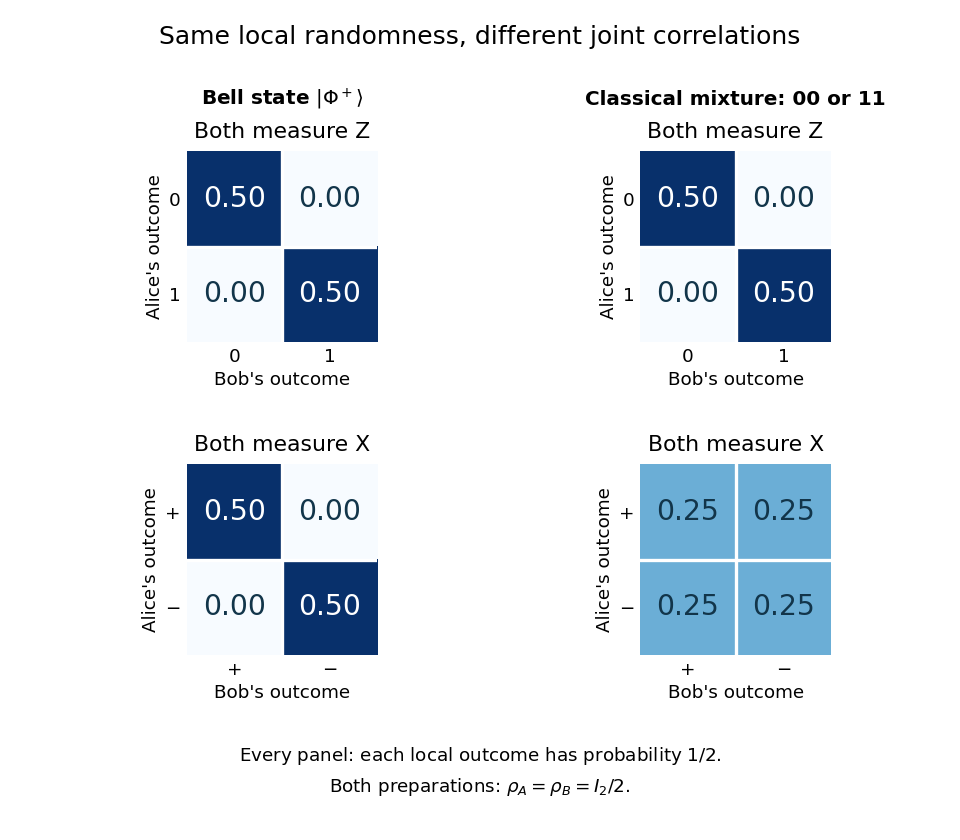
Joint measurement probabilities distinguish a Bell state from a classical mixture while every local outcome remains uniformly random
. Details. 
Taking a partial trace gives for both preparations. Thus every measurement confined to Alice's system has the same statistics in the two cases, and so does every measurement confined to Bob's. They reveal the difference by comparing records through classical communication. Conditional on Alice's result, Bob can predict a matching result for the Bell state; without that result, his outcomes remain evenly split. An uncommunicated local quantum channel, including a measurement with its outcome discarded, leaves his reduced density matrix unchanged. This is quantum no-signalling, even when conditional states change. [ref]
https://jhwatrous.github.io/TQI.2.pdf. Watrous, Basic notions of quantum information, sections 2.1.3 and 2.2.1, on reductions and channels
The Von Neumann entropy makes the joint-versus-local distinction numerical. With base-two logarithms, the Bell state has eigenvalues , giving , whereas the mixture has , giving . Both have . Their quantum mutual information is consequently two and one bits, respectively. The value two is not two readable classical bits in either local qubit: the matching records have ordinary mutual information one bit in both cases. Random records can come from a globally pure state. [ref]
https://jhwatrous.github.io/TQI.5.pdf. Watrous, Quantum entropy and source coding, on Von Neumann entropy and quantum mutual information
These two matching-axis measurements distinguish the specified preparations; they alone are not a test of a Bell inequality. A local hidden-variable theory could assign shared random answers separately to these two axes. Bell theorem concerns incompatible correlations across a suitable larger collection of measurement settings. Bell's 1964 paper established the obstruction for local hidden-variable descriptions of the predicted correlations. [ref]
https://journals.aps.org/ppf/pdf/10.1103/PhysicsPhysiqueFizika.1.195. Bell, On the Einstein Podolsky Rosen paradox, 1964
Correction implies detection at twice the weight Created 2026-10-14 Updated 2026-11-05
Split the support of a Pauli operator of weight at most into two sets of size at most . It is, up to a scalar phase, for two errors in the correctable family. The Knill--Laflamme condition makes its compression to the code scalar, which is quantum error detection. Expansion in the Pauli basis extends the assertion to every operator supported on at most qubits. The number counts affected qubits, not the cardinality of an arbitrary selected family of errors.
Perturbative interactions in scalar electrodynamics Created 2026-10-14 Updated 2026-11-05
Expanding the covariant kinetic term of scalar electrodynamics gives a one-photon two-scalar vertex and a two-photon two-scalar seagull vertex. Their tree amplitudes and Ward identities depend on a consistent choice of charge-flow and gauge covariant derivative convention.
Vacuum polarization Created 2026-10-14 Updated 2026-11-05
Vacuum polarization is the modification of a gauge field's propagation by quantum fluctuations of charged fields. In quantum electrodynamics, charged-particle loop contributions change the photon propagator; their proper two-point insertion is photon vacuum polarization.
Lorentz invariance and the Ward identity constrain the tensor structure. For an invariant vacuum it is transverse and can be written , up to the stated sign convention. This momentum-dependent response contributes to the scale dependence of the effective electromagnetic coupling. The calculation describes a field correlation, rather than a literal medium of separately detectable virtual pairs. A mass term for the photon is not generated merely by renormalizing a gauge-invariant vacuum polarization.
Electron-positron annihilation into two photons Created 2026-10-14 Updated 2026-11-05
The leading scattering amplitude is the sum of two tree-level Feynman diagrams, with the outgoing photons attached in either order to the fermion line. The Dirac propagator carries momentum or for incoming electron momentum . Their sum obeys the two-photon fermion Ward identity, although individual diagrams need not. Crossing symmetry relates this amplitude to Compton scattering.
Unitary operator controllability 2026-10-14
A finite-dimensional closed-system control model is unitarily operator controllable when its reachable propagators include every unitary operator. For the usual real Hamiltonian controls and freely chosen duration, this requires the Dynamical Lie algebra to be . If global phase is ignored, also suffices; exact access to all of still requires the central phase direction.
Density operator controllability 2026-10-14
A closed system has density operator controllability when every pair of density operators with the same spectrum can be connected by its controls. Under the standard finite-dimensional Hamiltonian assumptions, this holds exactly for Dynamical Lie algebra or . This definition ranges over every spectral orbit; a particular degenerate spectrum can be controllable under a smaller group.
Pure-state controllability 2026-10-14
For freely chosen control duration in a finite-dimensional closed system, pure-state controllability means the reachable group acts transitively on normalized states or their rays. Up to unitary conjugation, the possible Dynamical Lie algebras are , , and for even the standard compact symplectic Lie algebra , with or without . For , the symplectic possibilities are pure-state controllable but generally lack density operator controllability.
Dynamical Lie algebra 2026-10-14
The dynamical Lie algebra of a finite-dimensional Hamiltonian control system is the real span of its skew-Hermitian drift and control generators and all their nested commutators. The sign choice or gives the same algebra. Its connected group determines reachable propagators under the usual freely timed, real-control assumptions. An operator commuting with every generator also commutes with this algebra, imposing invariant sectors.
Bilinear Hamiltonian control system 2026-10-14
A finite-dimensional closed quantum control system with fixed drift and control Hermitian matrices, real control inputs, and dynamics linear in the state at fixed controls and affine in the controls at fixed state. Its Dynamical Lie algebra is generated over the reals by . Reachability depends on the admissible controls, allowed duration and phase convention.
For an infrared-safe observable, loop corrections and integrated unresolved real emissions have compensating infrared divergences and collinear divergences. Keep a common regulator until they are added. At the first QCD correction to photon-mediated quark production, virtual gluon exchange corrects the two-parton state and real emission supplies the three-parton state. Their inclusive sum is finite after ultraviolet renormalization; resolved three-jet rates additionally depend on an infrared-safe resolution prescription.
Jet (particle physics) Created 2026-10-14 Updated 2026-10-18
A collimated collection of final hadrons associated with an energetic parton and its radiation and hadronization. A precise perturbative prediction requires an infrared-safe observable that specifies how particles are grouped into jets.
There are unlisted articles, also show them or only show them.