
Potential energy surface Created 2026-10-14 Updated 2026-10-20
A potential energy surface assigns potential energy to the configurations of the reacting chemical atoms, for a specified electronic description. A reaction coordinate selects a path through this many-dimensional configuration space; a potential-energy profile then records the potential energy along that path. Different paths can share endpoints but cross different barriers. See the IUPAC Gold Book: potential-energy reaction surface.
Why the sky is blue 2026-10-14
In a clear terrestrial atmosphere, Rayleigh scattering by air molecules redirects some sunlight toward an observer looking away from the Sun. Shorter wavelengths are preferentially scattered, enriching the scattered light in blue compared with the incoming sunlight. Along the longer atmospheric path to the low Sun, more short-wavelength light is removed from the direct beam, helping produce red sunsets. [ref].
Violet light has an even shorter wavelength than blue light, so the Rayleigh scattering wavelength dependence alone cannot predict the perceived sky color. The incoming solar optical spectrum and the eye's differing response to wavelengths both matter; human vision is less sensitive to violet than to blue. [ref]
https://www.weather.gov/fgz/SkyBlue. NOAA National Weather Service, Why Is The Sky Blue?: solar spectrum and visual response
. Multiple scattering and other atmospheric particles also affect the observed sky. Cloud droplets are generally too large for this simple Rayleigh scattering model: Mie scattering describes spherical droplets, with much weaker visible wavelength selectivity, while repeated scattering helps make clouds appear white. [ref]https://www.giss.nasa.gov/edu/icp/research/ppa/1997/reyes/. NASA GISS, Aerosols in the Atmosphere: particle size, Mie scattering and white clouds
. Rayleigh scattering angular pattern 2026-10-14
For incident unpolarized light and the isotropic electric dipole response of Rayleigh scattering by a small sphere, let be the angle between the incident beam's propagation direction and the outgoing direction. The differential scattering cross-section and its relative angular pattern arewhere is an element of solid angle. Averaging over the two transverse directions of incident polarization of an electromagnetic wave gives this pattern. Forward scattering at and backward scattering at are equally strong: . Sideways scattering at is weakest, but nonzero: . [ref]
https://farside.ph.utexas.edu/teaching/jk1/lectures/node107.html. Fitzpatrick, Thomson Scattering, equations 1283–1287: averaging the dipole angular pattern
.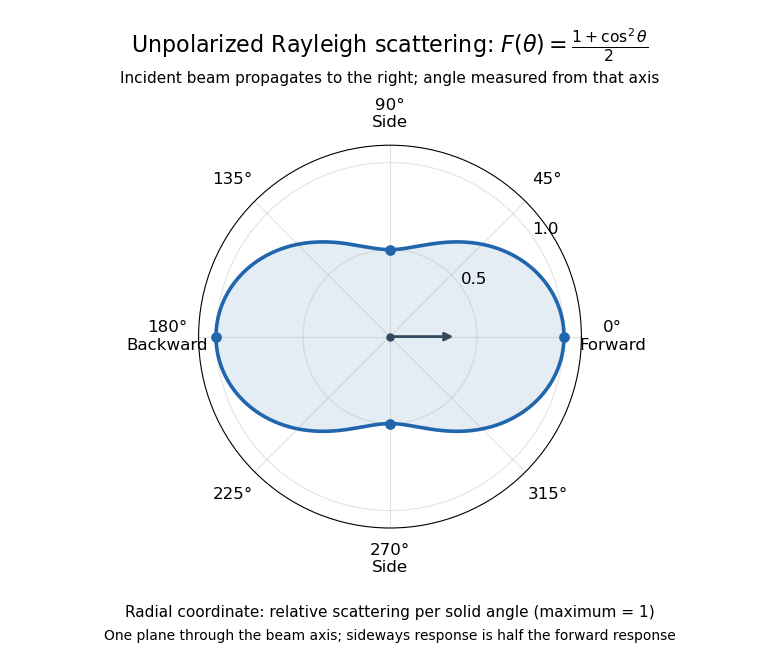
Rayleigh scattering angular pattern for incident unpolarized light, measured from the incident beam
. The plotted radial coordinate is , a relative differential scattering cross-section, rather than the distance travelled by light. The incident propagation axis points right: is forward, backward, and sideways. Rotating this plane about the incident axis gives the three-dimensional pattern. Details.
The normalization is consistent becauseThus integrating gives the total Rayleigh scattering cross-section . The plotted has maximum one; it is not itself normalized to unit solid angle integral.
For a single electric dipole driven by incident linear polarization, the angular distribution of electric dipole radiation instead has a factor, where is measured from the electric dipole moment direction, parallel to the incident electric field. That direction is perpendicular to the incident beam. Confusing with the beam angle would incorrectly predict zero forward scattering. Averaging the dipole patterns over incident unpolarized light yields the displayed .
Rayleigh scattering wavelength dependence 2026-10-14
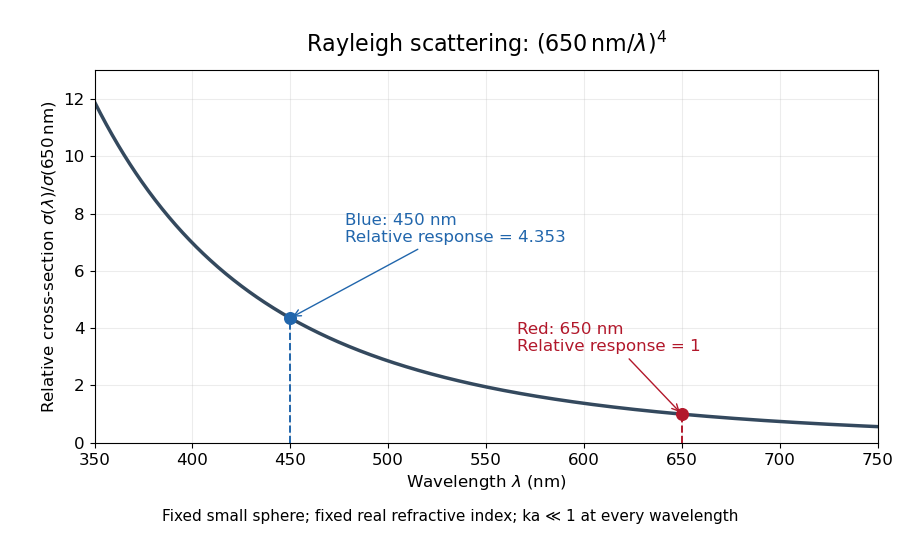
For a fixed sphere and fixed refractive index, both the Rayleigh scattering cross-section and scattering efficiency are proportional to . Halving wavelength multiplies either by , as long as the shorter wavelength still satisfies . If optical dispersion changes , the material factor changes too; the pure fourth-power comparison then needs correction.
For equal incident light intensities at blue wavelength and red wavelength , the same toy sphere givesBlue light therefore produces about times the scattered power. This compares the particle's response at two wavelengths; it does not assert that an actual sky has this ratio of observed blue and red light intensities.

Rayleigh scattering by a small sphere Created 2026-10-14 Updated 2026-10-20
Consider a fixed, homogeneous, nonabsorbing, nonmagnetic sphere of radius in vacuum. Let be its relative refractive index, a fixed real number; in vacuum this equals the sphere's refractive index. Treat as independent of wavelength over the range being compared, neglecting optical dispersion. Air can be approximated by vacuum here because its refractive index is close to one. These assumptions describe a toy particle, rather than a literal model of an individual air molecule.
The Rayleigh scattering cross-section is an effective area: the total scattered power is , where is the incident light intensity. For its leading approximation isThe units are area, since has units . This Rayleigh scattering cross-section measures scattering, not conversion of the incident electromagnetic radiation into heat. The definition follows [ref]
https://farside.ph.utexas.edu/teaching/jk1/lectures/node107.html. Fitzpatrick, Thomson Scattering: total and differential scattering cross-sections
.To see the mechanism, the nearly uniform applied electric field produces an electric dipole moment with peak magnitudewhere is the incident electric field peak wave amplitude and is vacuum permittivity. This is the sphere's response in electrostatics, with its permittivity divided by vacuum permittivity equal to under the nonmagnetic assumption. [ref]
https://farside.ph.utexas.edu/teaching/jk1/lectures/node42.html. Fitzpatrick, Boundary Value Problems with Dielectrics, equation 554: induced sphere dipole
. The averaged electric dipole radiation power is , with angular frequency and speed of light . Dividing by gives the displayed Rayleigh scattering cross-section. Thus doubling radius multiplies the electric dipole moment by eight and the scattered power by , provided the larger sphere still satisfies . [ref]https://farside.ph.utexas.edu/teaching/em/lectures/node95.html. Fitzpatrick, Electric dipole radiation: angular power and its integral
.A thin liquid lining inside a rigid cylindrical tube has pressure perturbation at leading order in . Lubrication theory gives flux , so mass conservation gives the displayed growth rate. Long waves with grow, while short waves are stabilized by curvature. The maximum occurs at .
Fjørtoft theorem 2026-10-14
For a smooth inviscid parallel shear profile with an exponentially growing mode, let be its velocity at an inflection point. The real and imaginary parts of the integrated Rayleigh equation for inviscid shear flow imply . Consequently somewhere in the channel. This strengthens Rayleigh's inflection-point theorem but is still only a necessary condition, not a sufficient instability criterion.
For a normal mode of an inviscid parallel flow, the perturbation pressure is . At an interface where is continuous but jumps, continuity of normal velocity and pressure gives continuity of and the displayed flux. Consequently . A sinuous mode of a planar jet may therefore have a cusp at a symmetric velocity-profile corner: even parity alone does not force its one-sided derivative to vanish.
Inviscid instability of a triangular jet 2026-10-14
Decaying normal modes of this continuous piecewise-linear profile satisfy between the corners. Pressure matching at a piecewise-linear shear interface yields an odd varicose mode of a planar jet with real speed and an even sinuous mode of a planar jet whose speeds satisfyIts reduced discriminant factors as . The second factor is positive for , while the first is strictly increasing and crosses zero once. Thus exactly the long-wave even branch is exponentially unstable, for , where .
An axisymmetric Stokes streamfunction disturbance of an axial basic flow obeys the displayed ordinary differential equation. Regularity requires at the axis, and an impermeable wall requires for nonzero . Multiplication by and integration by parts shows that a growing real-wavenumber mode requires to change sign; if it vanishes identically, the positive energy integral rules out such a mode. The condition concerns this cylindrical vorticity gradient rather than alone.
For below , between and , and above , decaying normal modes solve in each region. Pressure matching at a piecewise-linear shear interface gives continuity of and . The two corner conditions yield the displayed dispersion relation. At the wave speeds are , so one mode grows exponentially with rate .
Order of reaction 2026-10-14
In a power-form rate law , the partial orders of reaction are and , and the overall order of reaction is . For example, doubling at fixed multiplies by : factors of one, two, and four correspond to partial orders of reaction zero, one, and two. These exponents can also be fractional or negative. A single constant order of reaction need not describe a rate law that is not a power form. See IUPAC Gold Book: order of reaction.
For a simple irreversible conversion with rate equation , initial concentration , and fixed , compare zero-order reactions, first-order reactions, and second-order reactions using the dimensionless quantitiesTheir integrated curves, starting at , areFor the zero-order reaction, the plotted extension stops conversion at depletion. It does not continue to obey once . A negative concentration would be unphysical. The first-order reaction and second-order reaction approach zero without reaching it at finite time in these models.
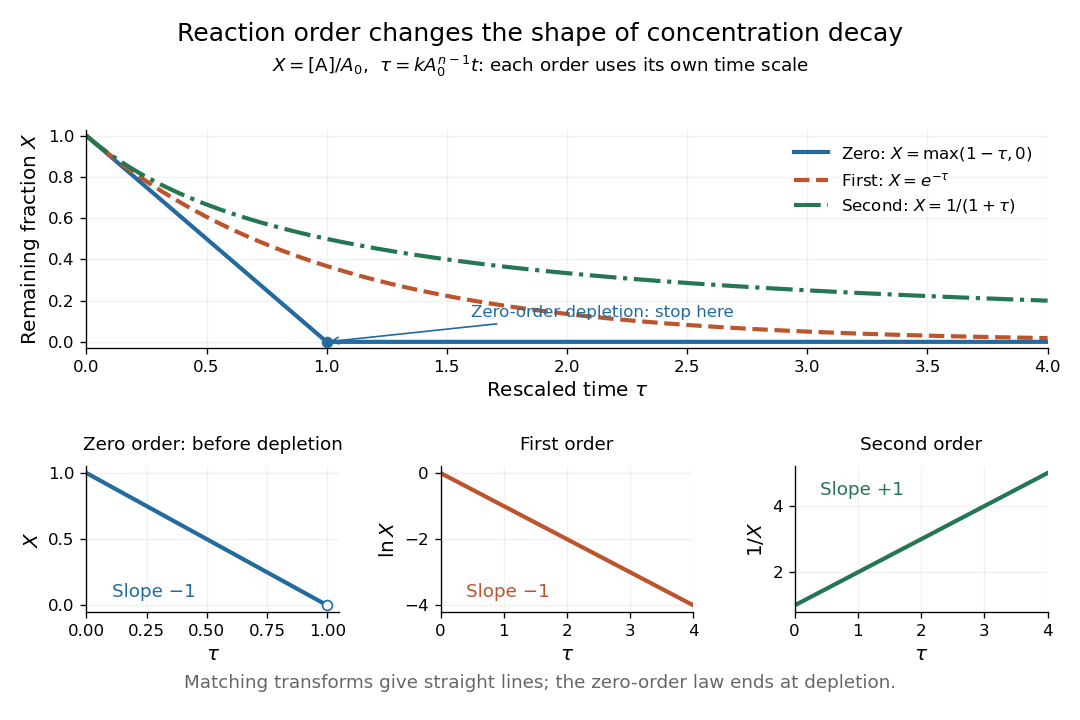
Dimensionless concentration decays for three orders of reaction, with zero-order reaction depletion and the corresponding linearizing plots
. Details. 
The common axis compares curve shapes after each model's own time rescaling, rather than equal laboratory times for an identical numerical . In the lower panels, , , and respectively give straight lines with slopes , , and for the matching order of reaction. The natural logarithm uses a dimensionless quantity. These transformed plots help test a proposed rate law; the zero-order reaction line applies only before depletion. See Flowers et al., Chemistry 2e, §12.4: integrated rate laws.
Integrated rate law 2026-10-14
An integrated rate law relates concentration to elapsed time after solving a rate equation with an initial condition. Its validity retains the assumptions of the underlying rate law, including fixed rate constants and appropriate stoichiometry. The second-order reaction reciprocal-concentration relation is one example; a different rate equation generally requires a different integrated rate law.[ref]
Chemistry 2e. §12.4, opening paragraph and “Second-Order Reactions”: concentration as a function of elapsed time
Reaction-rate elasticity Created 2026-10-14 Updated 2026-11-05
The displayed logarithmic derivative compares the loss and production flux sensitivities of species to the mean amount . At a steady state , it converts the normalized negative drift Jacobian into , where is the mean molecular lifetime. For constant production and loss proportional to , the scalar elasticity is .
// Target: mathematical-biology.bigb
Frobenius rank inequality 2026-10-14
For compatible matrices , the inequality is . One proof uses the block matrix . Subtract times its lower block row from its upper block row and then subtract its first block column times from its second. The result is , with rank . On the other hand, choose independent columns of from the first block column and independent columns of from the second. The corresponding columns of are independent: project a relation onto the upper block first, and then onto the lower block. Thus .
Blinded outcome assessment Created 2026-10-14 Updated 2026-11-05
An outcome assessor is kept unaware of randomized treatment assignment to limit differential questioning, interpretation and recording. This does not require the participant or intervention provider to be blinded. Participants can reveal their assignment, so standardized interviews and restricted records help preserve blinding. Blinding after assignment is different from allocation concealment before enrollment.
Number needed to treat Created 2026-10-14 Updated 2026-11-05
For a beneficial intervention reducing an adverse-event risk from to over a stated follow-up period, the number needed to treat is the reciprocal of the absolute risk reduction. Its clinical interpretation requires the population, outcome, horizon and comparison to be specified. Invert confidence limits for the risk difference in reversed order if both are positive. If the interval includes zero, the transformed confidence set is unbounded and may include both benefit and harm, rather than being one ordinary finite interval.
Selective outcome reporting Created 2026-10-14 Updated 2026-11-05
Reporting a favorable prespecified outcome while omitting a less favorable one can give an exaggerated impression of consistency of evidence. Multiple primary outcomes should be summarized transparently even when some lack statistical significance. A short abstract can prioritize results, but should not hide a materially different primary result; absence of information does not by itself establish deliberate misconduct.
Cluster-randomized trial Created 2026-10-14 Updated 2026-11-05
A cluster-randomized trial assigns whole groups, such as institutions, to an intervention rather than assigning individuals separately. Positive intraclass correlation reduces independent information: the equal-size exchangeable approximation has design effect for cluster size . The number of independent randomized clusters also matters for inference. Cluster assignment does not itself remove requirements for informed consent or justify dropping outcome ascertainment in the control arm.
Risk compensation in a prevention trial Created 2026-10-14 Updated 2026-11-05
Risk compensation is a possible behavioral response to a prevention intervention: feeling better protected can reduce vigilance or increase exposure to hazards, partially offsetting the intervention's direct protective effect. It is a hypothesis to investigate, not a conclusion established merely by an unfavorable treatment comparison. A randomized controlled trial of the overall package estimates its net assignment effect, which can include both physical protection and behavioral changes.
There are unlisted articles, also show them or only show them.