
Quasi-inverse of a quasi-isometry 2026-10-14
For a quasi-isometry with multiplicative constant and additive/coarse-surjectivity constant , choose with . The triangle inequality and the two distortion inequalities giveAlso . Hence is a quasi-isometry and both composites stay uniformly close to their respective identities. No continuity is required.
Interquartile range 2026-10-14
The interquartile range measures the width between the lower and upper quartiles, in the same units as the observations. It describes central spread rather than the distance between the observed extremes. In our toy box plot, ; moving the largest value from to would leave the quartiles and interquartile range unchanged under the chosen rule, because the order statistics used in their interpolation would not change.
Tunnel junction Created 2026-10-14 Updated 2026-11-05
A tunnel junction consists of two conducting electrodes separated by a thin region through which electrons can undergo quantum tunnelling. The separating region may be an insulating layer or a narrow vacuum gap. A difference in electrochemical potential supplies occupied incident states on one side and accessible states on the other.
For a simple barrier, the transmission probability decreases approximately exponentially with thickness, making the junction very sensitive to separation. This is the basis of scanning tunneling microscopy. The measured electric current also depends on the electronic density of states and the applied voltage. When a junction connects a sufficiently small conducting island, its capacitance can make individual charging energies large enough to produce Coulomb blockade.
Current-distance test of vacuum tunnelling Created 2026-10-14 Updated 2026-10-20
Tunneling through a controllable vacuum gap by Gerd Binnig and others made barrier width experimentally adjustable. Their apparatus used a pointed electrical conductor opposite a conducting plate, with fine positioning by piezoelectricity. Rubber-tube support and magnetic levitation above a cooled bowl exhibiting superconductivity suppressed vibrations; the junction itself remained near room temperature.[ref]
The readout was electrical resistance versus displacement at a fixed electric potential difference of 60 mV of either polarity. They observed an exponential function dependence spanning four orders of magnitude. Cleaning and better vacuum increased the inferred barrier from approximately 0.6-0.7 eV to 3.2 eV. Reproducible curves and the cleaning response argued against deforming contamination layers; an appropriate slope also helped exclude an ordinary conducting contact. The paper reports residual contamination, electronics-limited range and a jump attributed to release of thermal stress; its curve origins generally do not determine absolute gap widths.[ref]
Tunneling through a controllable vacuum gap by Gerd Binnig and others. p. 179, equation (1), Fig. 2 and accompanying control/limitation discussion
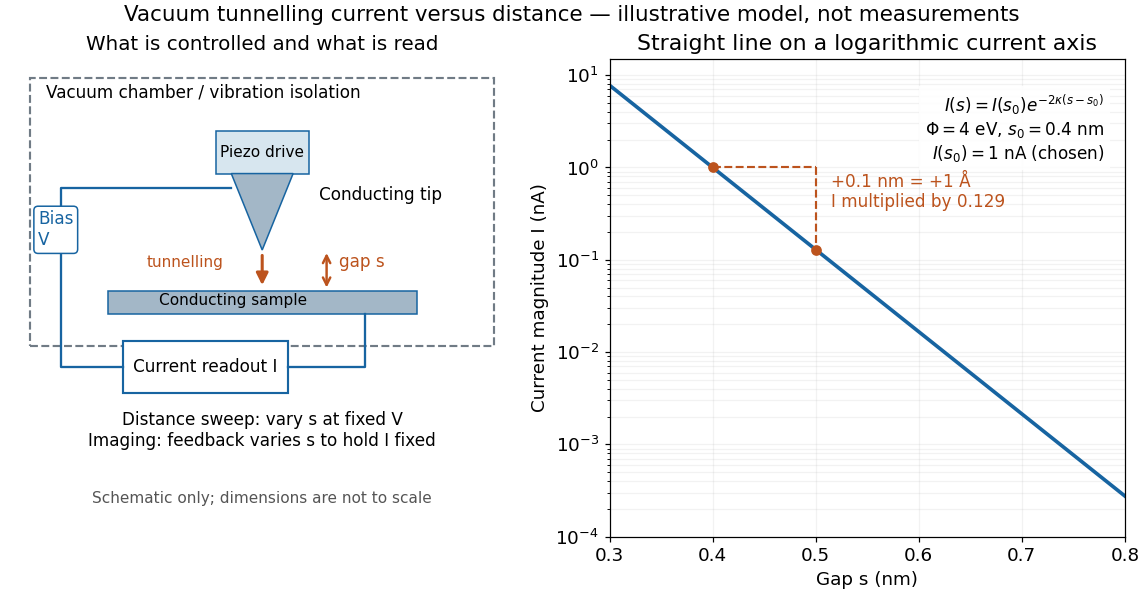
The ideal tunnel junction model explains the slope. At fixed small electric potential difference, fixed tip geometry and approximately unchanged density of states, take an effective barrier energy above the relevant electron states and approximate the current magnitude byThe coefficient includes the applied electric potential difference, available occupied and empty quantum states, and tip geometry. A single transmission probability is not an electric current: a junction combines contributions from many electron states in both directions, with the electric potential difference producing a net imbalance. Its tilted, material-dependent barrier is only approximated by the equal-exterior rectangular potential barrier; the exact single-particle formula above is not a complete junction model.
For the chosen model value electronvolts, . Increasing separation by multiplies by about , a reduction by about . The following diagram chooses solely for illustration; it contains no measured data and is not a fit to the 1982 curves.

Distance calibration is essential. In Scanning Tunneling Microscopy: From Birth to Adolescence by Gerd Binnig and others, the authors describe an initial inferred barrier near 1 eV. Recalibration found only half the quoted piezo displacement sensitivity and raised the inferred barrier above 4 eV. Thus an exponential trace alone was insufficient evidence for tunnelling through vacuum. The model makes the sensitivity explicit: the inferred depends quadratically on the distance scale.[ref]
Scanning Tunneling Microscopy: From Birth to Adolescence by Gerd Binnig and others. p. 397, piezo-sensitivity calibration discussion
For scanning tunnelling microscopy, feedback control adjusts the vertical position to hold electric current fixed during a lateral scan; the recorded height follows separation only when the surface is electronically homogeneous. Changes in the local density of states can also change apparent height. This limitation is already explicit in the authors' account of constant-current imaging.[ref]
Scanning Tunneling Microscopy: From Birth to Adolescence by Gerd Binnig and others. p. 391, Fig. 2, joint local density of states; p. 396, Fig. 5(a), electronically homogeneous surface condition
Evanescent probability current 2026-10-14
A nonzero probability density inside a barrier does not by itself imply transport. In one dimension, the probability current of a wavefunction is . A single evanescent wave has , a real quantity, hence . This is what happens on the inaccessible side of a potential barrier extending to infinity with .[ref]
For the finite-barrier wavefunction , the cross terms instead giveThe relative quantum phase of the two probability amplitudes permits a nonzero, spatially constant probability current, even though neither exponential function separately carries it. The probability continuity equation gives for this stationary state. Matching the wavefunction and its derivative also makes continuous at both faces, soHere is the quantum reflection probability, and is the transmission probability. The net exterior probability current equals the interior probability current; it is not lost as the wavefunction decreases. A physical incident wave packet supplies finite total probability, while the stationary state describes the energy component used to compute its transmitted flux.
Finite rectangular barrier matching Created 2026-10-14 Updated 2026-10-20
Take a nonrelativistic particle of constant mass with energy , and choose the same zero of potential energy on both sides of a rectangular potential barrier:The equality of the exterior potential energies matters: it gives the same exterior wavenumber and makes . Here is the reduced Planck constant. This model has a finite jump in potential energy, no delta potential, and no absorbing term.
For , the time-independent Schrödinger equation gives the spatial wavefunctionThe full stationary state is . We set the incident probability amplitude to one and impose no incoming wave from the right; this scattering wavefunction is not a normalizable wavefunction. The tunnelling decay constant describes exponential decay, rather than an oscillatory wavenumber in the barrier. Both exponential functions are needed on the finite interval: the growing term is not excluded by a condition at infinity.
The wavefunction and its derivative are continuous at each face, giving four linear matching conditions:Their solution supplies the transmission amplitudeA short derivation is to use the two right-face equations to express and in terms of , then substitute into the left-face equations. Taking the squared modulus gives the rectangular barrier transmission probability.
Single-qubit process tomography 2026-10-14
To identify the physical channel of a single-qubit unitary gate, prepare each of the three positive Pauli matrix eigenstates and estimate each output Pauli expectation. Their nine means areThey determine the Bloch vector rotation , hence the channel on all states. If two gates have the same channel, their relative unitary commutes with all three Pauli matrices: commuting with forces it diagonal and commuting with forces equal diagonal entries. Thus they differ by a scalar global phase, proving uniqueness up to that phase. This procedure needs no controlled gate or eigenstate of the unknown gate. Estimating its bounded measurement means to error with fixed confidence uses order repetitions. It determines the relative eigenphases but cannot determine an overall eigenvalue phase from uncontrolled gate access alone.
Interferometric polarization tomography 2026-10-14
A polarizing beam splitter converts a photon polarization qubit to two paths. Rotating one arm's photon polarization to match the other and recombining at a balanced beam splitter gives . Measurements at phases zero and recover the transverse Bloch vector components; direct counts in the two separated arms recover the population difference. All three components, rather than a fringe alone, determine an arbitrary photon polarization density matrix.
// Target: quantum-theory.bigb
Convex roof extension Created 2026-10-14 Updated 2026-10-25
A convex roof extension extends a function on pure states to arbitrary density operators by minimizing its ensemble average over all pure state decompositions. It agrees with on pure states: every positive-weight state in a decomposition of a rank-one density operator has the same one-dimensional support. Concatenating nearly minimizing ensembles proves that is a convex function. Moreover, every convex function that is no larger than on pure states is no larger than , by applying convexity to each decomposition. Infima need not be attained; an arbitrarily small additive error suffices when is finite.
Impulsive quantum kick 2026-10-14
An impulsive quantum kick is the limit of a pulse with finite integrated Hamiltonian operator, rather than a bounded finite step. For a bounded self-adjoint operator with units of action, a rectangular pulse lasting has exact unitary time evolution for every . In the limiting notation , is the Dirac delta function andThe integral estimate for quantum state continuity at a finite Hamiltonian step no longer tends to zero: the pulse height diverges. A bounded background Hamiltonian operator contributes vanishing evolution during this limit. A more general pulse with noncommuting generators can require time ordering; integrated area alone then need not specify the result.
For example, , with a Pauli matrix, sends a qubit in to . At , the Born rule predicts with probability one, however short the regularized pulse is. Its finite rotation is precisely what a bounded finite step cannot accomplish at the switching instant.
Dicke state Created 2026-10-14 Updated 2026-11-05
The -qubit Dicke state with excitations is the normalized equal superpositionwhere is the Hamming weight in the computational basis. The binomial coefficient counts the mutually orthogonal summands, proving normalization. Every permutation of the qubits leaves the vector unchanged. Splitting the sum according to the first bit and using givesTerms with zero coefficient are omitted at the endpoints. This recursion is useful for partial traces and for distributing a logical qubit among many symmetric physical qubits.
Encode signs by the unit Bloch vector . Perform the requested Pauli measurement and interpret a positive outcome as zero. Every input and index has success . To prove optimality, write each binary-measurement difference as , where positivity gives . Averaging over all eight inputs cancels the terms. For any encoding vectors of norm at most one, the average success is at most . The Cauchy-Schwarz inequality bounds the sum by , proving the optimum even for mixed encodings and general binary measurements. The constant-success construction also maximizes worst-case success.
A concrete quantum quench experiment loaded a Bose-Einstein condensate of chemical atoms from a magnetic field trap into an optical lattice: three orthogonal laser standing waves, with approximately beam waists. An loading ramp preceded a increase in lattice depth. This suppressed quantum tunnelling while retaining each well's vibrational ground state. The switch preserved atom-number populations rather than freezing every motional degree of freedom.[ref]
Collapse and revival of the matter wave field of a Bose-Einstein condensate by Markus Greiner and others. Greiner and others, manuscript pp. 3–4: preparation and switching; p. 7, Methods: wavelength, beam waists and lattice geometry
After variable hold times, releasing the traps and taking photon absorption images after of flight revealed disappearance and return of interference peaks. Background-subtracted peak counts supplied a coherent fraction. Varying final depth tested the predicted revival period ; varying initial depth tested the collapse's sensitivity to atom-number statistics. Peak broadening outside counting windows and spatial variation of limited later signals.[ref]
Collapse and revival of the matter wave field of a Bose-Einstein condensate by Markus Greiner and others. Manuscript p. 4 and figure 2 caption on p. 11: flight and image extraction; figure 3 caption on p. 12: readout limitations; figures 4–5 captions on pp. 13–14: final-depth and initial-depth comparisons
Here is the on-site interaction energy. The approximate isolated-well Hamiltonian operator , with number operator , gives different quantum phases to its number states, which later rephase. This is a many-level realization of the distinction between fixed populations and changing quantum phases.[ref]
Collapse and revival of the matter wave field of a Bose-Einstein condensate by Markus Greiner and others. Manuscript pp. 2–3, equations (1)–(2): isolated-well Hamiltonian and number-state phase evolution
Two-level sudden quench 2026-10-14
Take an isolated two-level system, or a spin one-half qubit, with Pauli matrices . Let and . The initial and final Hamiltonian operators areThe energy gaps are . Prepare the initial ground state , with energy eigenvalue . A final orthonormal eigenbasis isDirect matrix multiplication gives and . The unchanged initial quantum state is . Its new probability amplitudes are the inner products ; the Born rule gives . The angle between the real amplitude vectors is , whereas the Hamiltonian axis on the Bloch sphere rotates through .
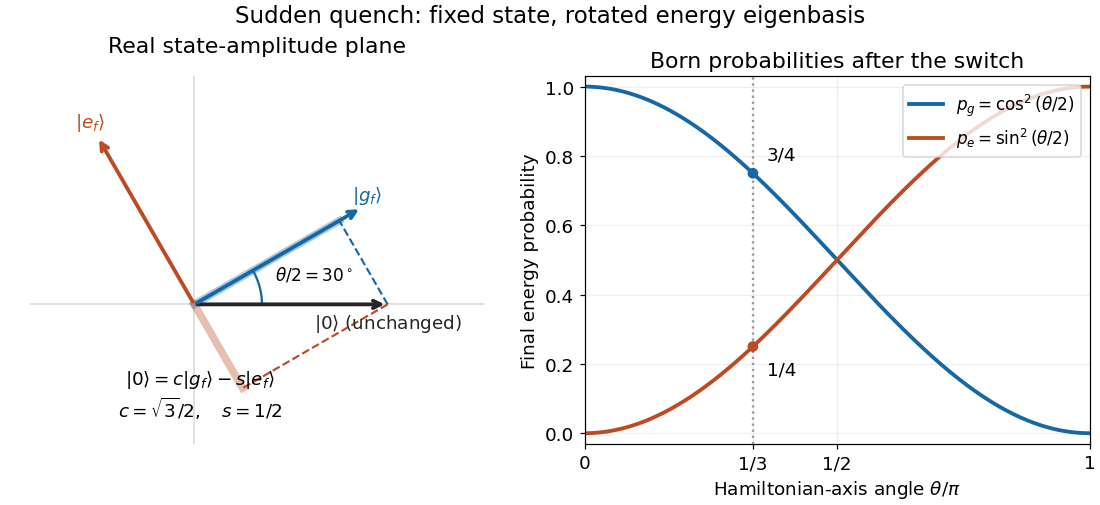

At , and , so the final energy measurement gives with probability and with probability . At the initial ground state remains the final ground state; at it is the final excited energy eigenstate. These statements are about the new energy labels, not an instantaneous physical rotation of the quantum state.
Quantum Laurent plane Created 2026-10-14 Updated 2026-11-05
For , define a vector space with basis , , , and product . Bilinearity of the exponent verifies associativity. This constructs the algebra and proves the basis independently of its presentation. It localizes the quantum plane at powers of and gives a quotient witness for noncommutativity and noncocommutativity of the coordinate Hopf algebra of quantum SL2.
Quantum enveloping algebra action on the quantum plane Created 2026-10-14 Updated 2026-11-05
For with and , the quantum enveloping algebra of sl2 acts by , and . Negative exponents here have zero coefficients and are omitted. The quantum integer identity verifies the commutator. These operations preserve total degree and make the quantum plane a module algebra.
Dyadic phase-gate identification Created 2026-10-14 Updated 2026-11-05
For the phase gate , apply powers to a uniform quantum superposition on qubits. Binary positional weights multiply the phases into on basis vector . The inverse quantum Fourier transform returns exactly, by orthogonality of roots of unity. Preparing the powers by repeated applications uses copies of ; this does not claim a number of gate calls polynomial in . If is odd, its powers generate the entire set of dyadic phase gates because has a modular inverse modulo .
For a unitary operator eigenphase , an -qubit quantum phase estimation register of size has output probability amplitudeChoose the nearest integer label to , with labels understood modulo , and put , taking the representative . The finite geometric series gives . For , concavity of sine gives , while . Thus the probability of the nearest label is at least . At it is exactly one. If two labels tie for nearest, each satisfies the bound.
For a -dimensional unitary operator , a maximally mixed state on its target is the equal mixture of these orthonormal eigenvectors. Therefore quantum phase estimation with register size produces label with probabilityThis follows by linearity of unitary time evolution and the Born rule on the spectral mixture. If every eigenphase has an exact -grid label, that label has probability equal to its multiplicity divided by . Otherwise the exact distribution has tails, and the nearest labels are guaranteed only the nearest-integer success bound for quantum phase estimation weighted by the corresponding spectral probabilities.
Use CNOT gates to encode one logical qubit and zero ancillas into the repetition subspace spanned by . Apply the phase gate in parallel to all physical qubits, then undo the encoding. The logical phase is multiplied by in one oracle-time layer. This copies computational-basis labels coherently rather than cloning an arbitrary quantum state. Blocks of sizes prepare a dyadic Fourier phase state using parallel oracle applications.
There are unlisted articles, also show them or only show them.