
Probability mass Created 2026-10-14 Updated 2026-11-05
The probability mass at an outcome is the probability of its singleton, . It equals the jump of the cumulative distribution function. For a discrete probability distribution these masses form the probability mass function; a continuous probability distribution gives every individual outcome mass zero. Positive probability mass at a point is distinct from the height of a probability density function.
Mixed probability distribution Created 2026-10-14 Updated 2026-11-05
A mixed probability distribution combines a discrete probability distribution with a continuous probability distribution. For example, put probability at zero and probability into a uniform distribution on . Its cumulative distribution function is for , for , and for . The jump at zero and the continuous increase both contribute; neither an ordinary probability density function alone nor a probability mass function alone describes the whole law.
Odds 2026-10-14
For an event of probability , its odds in favor are . They compare the probability of the event with that of its complement. Conversely . For example, probability gives odds , or one to three in favor. The same transformation applies to a conditional probability; an odds ratio compares these transformed probabilities in two groups, while a risk ratio compares the probabilities themselves.
Complement rule of probability Created 2026-10-14 Updated 2026-10-25
For an event in a sample space , the complementary event occurs exactly when does not occur. The complement rule of probability follows from the Kolmogorov axioms: and are disjoint, their union is , and their probabilities therefore add to .
This rule is useful when an event is easier to describe through its failure. For a nonnegative integer-valued random variable , turns an at-least-one calculation into a single value of the probability mass function. In sampling without replacement, the hypergeometric distribution gives the chance of missing all marked objects, so its complement gives the chance of finding at least one.
Junction tree Created 2026-10-14 Updated 2026-11-05
A junction tree connects the maximal cliques of a chordal graph into a tree satisfying the running intersection property. Its edges carry separators equal to the intersections of the endpoint cliques. Assigning original factors to containing cliques permits exact sum-product belief propagation without summing independently over the entire collection of variables.
Szemerédi's theorem 2026-10-14
For every positive density and positive integer , every sufficiently large subset of of size at least contains a nonconstant arithmetic progression of length .
Semi-random method 2026-10-14
The semi-random method constructs a combinatorial object in many small random rounds, discarding incompatible proposals and updating the remaining constraints after each round. Independent proposals give calculable expected changes; concentration and deterministic corrections preserve the statistics needed for subsequent rounds. Unlike a single random sample, this combines repeated randomness with a structured evolving state. The Rödl nibble is a matching in a hypergraph version of this method.
Iterated prisoner's dilemma Created 2026-10-14 Updated 2026-10-20
The iterated prisoner's dilemma is a repeated game with a prisoner's dilemma at each round. Earlier choices can change later best responses: a present gain from defection may be outweighed by lost future cooperation. A pure strategy now specifies an action after every possible observed history, including histories that its own prescribed play would never reach. The horizon, observations, initial actions, and payoff convention must be specified before assessing a Nash equilibrium or subgame perfect equilibrium.
For the following worked example, repeat the prisoner's dilemma above infinitely at rounds . Assume public perfect monitoring: after each round both players observe both actions exactly, without error. They share a discount factor and evaluate a path of stage payoffs using the normalized discounted payoffThe round-zero weight is one before normalization, including when . A larger discount factor gives future payoffs more weight; the geometric series makes a constant stage payoff have the same normalized value. These assumptions and normalization follow [ref]
https://ocw.mit.edu/courses/6-254-game-theory-with-engineering-applications-spring-2010/5a158a7558165d0e22b5b27fcfa01713_MIT6_254S10_lec15.pdf. Asu Ozdaglar, MIT 6.254, lecture 15, slides 6–15
. The numerical payoffs here are our example; the lecture uses a different table.Suppose both players use grim trigger: play initially and while every past action of both players was ; after any observed , play forever. With no unilateral deviation, each gets normalized payoff . A first unilateral deviation to earns now, then at most each round because the opponent switches permanently to always defect. The deviator attains that continuation payoff by choosing thereafter. At any history of mutual cooperation, the comparison is thereforeCooperation is a best response precisely whenEquivalently, without normalization the geometric series givesMultiplying both unnormalized payoffs by the same positive factor leaves the best response comparison unchanged.
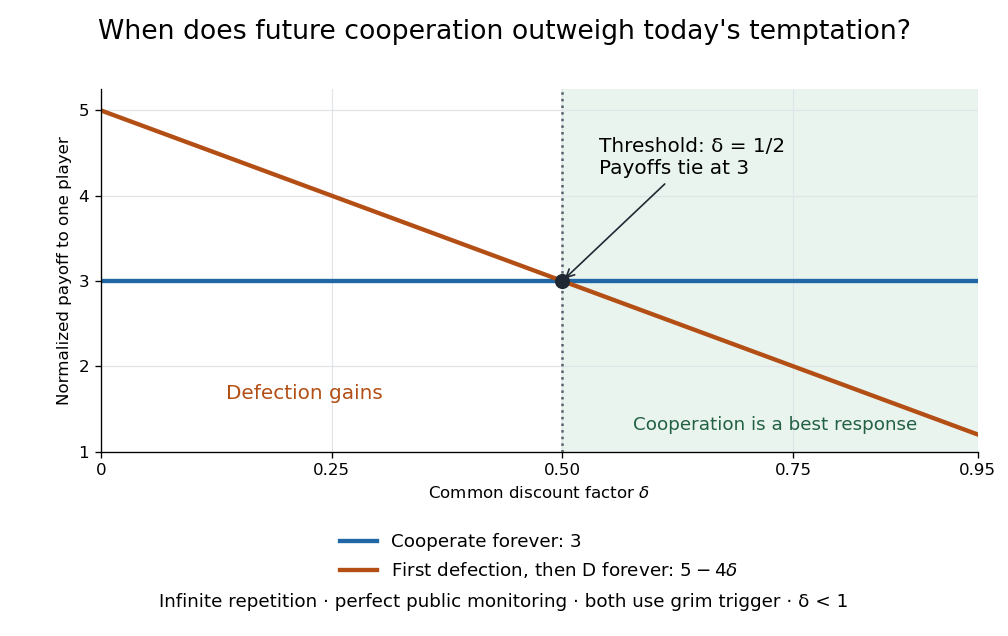
Repeated prisoner's dilemma: normalized cooperation and first-deviation payoffs cross at discount factor one half
. Details. 
For example, with discount factor , the first unilateral deviation gives normalized payoff , so mutual grim trigger is not a Nash equilibrium. At , it gives , so cooperation is preferable. At the two payoffs tie: the incentive to cooperate is weak, which is sufficient for a subgame perfect equilibrium.
The punishment is credible after every history containing a defection: the opponent's pure strategy then prescribes forever, and remains the stage best response, earning rather than . Together with the cooperative-history comparison, this establishes mutual grim trigger as a subgame perfect equilibrium for . Delaying the first unilateral deviation merely delays the same gain or loss; further cooperation during punishment only lowers the deviator's payoff. Mutual always defect also remains a subgame perfect equilibrium, so patience permits cooperation without making it inevitable.
This calculation assumes an infinite horizon and ; it does not define a discounted payoff at . With a finite, commonly known final round and positive weight on each round, backward induction instead gives mutual defection in every round of this stage game. Observational errors change the model too: one mistaken defection permanently activates grim trigger. Historical dependence, initial memories, and the payoff time convention also affect whether a cooperative rule resists or invades other pure strategies; the existing reactive strategy and Tit for tat discussions concern those additional questions.
Spite plateau 2026-10-14
The Spite plateau is the approximately constant lithium abundance in warm, metal-poor halo stars. It provides an important estimate of primordial lithium only after accounting for stellar atmosphere physics and possible transport and nuclear destruction of lithium within the stars.
After cosmological weak freeze-out, the surviving neutron fraction is , where is the initial neutron-to-proton ratio and is the mean lifetime. Baryon number is conserved because a decaying neutron becomes a proton. If almost all surviving neutrons enter helium-4, neutron-limited helium synthesis gives the displayed primordial helium mass fraction. Increasing the half-life increases survival. If the longer lifetime also represents uniformly weaker weak interactions, it raises the temperature of cosmological weak freeze-out and the initial neutron fraction, reinforcing the helium increase. That last conclusion requires specifying how the weak rates change, rather than treating lifetime alone as a complete microscopic model.
Primordial helium response to the neutron-proton mass difference Created 2026-10-14 Updated 2026-11-05
At fixed cosmological weak freeze-out temperature and fixed neutron survival factor, neutron-proton chemical equilibrium gives and neutron-limited helium synthesis gives . Differentiating yields the displayed sensitivity. A finite change gives . Increasing the positive mass difference reduces helium production. Changes to the weak conversion rates, neutron lifetime or nuclear history must be supplied separately for a full abundance prediction.
In polynomial modular arithmetic, prime-row binomial coefficient divisibility gives . Multiply by and compare coefficients of for ; the term cannot contribute.
// Target: foundations-of-mathematics.bigb
Prime ring Created 2026-10-14 Updated 2026-11-05
A prime ring is a nonzero ring whose zero ideal is a prime ideal of a noncommutative ring. Equivalently, the product of any two nonzero two-sided ideals is nonzero. This condition is weaker than absence of zero divisors: a full matrix ring over a division ring is prime even when its size is greater than one. For a commutative ring, primeness is exactly being an integral domain.
For , the first order bound already gives . The second supplementary law for quadratic reciprocity says that two is then a quadratic residue modulo . Euler's criterion gives , so its multiplicative order divides . Thus , further reducing the candidate factors. At , meets this bound. The restriction matters: has factor five, which is not one modulo eight.
Atomless support of a Pareto allocation 2026-10-14
For an atomless measure of consumers with measurable, complete, transitive and continuous preference relations, every exactly feasible Pareto efficient consumption allocation admits nonzero quasi-equilibrium supporting prices. Countably many rational strict-improvement directions remove all exceptional null sets simultaneously. If their convex hull contained zero, sufficiently small disjoint cohorts could make those improvements in exactly balancing proportions, violating Pareto efficiency. A supporting hyperplane theorem then supplies the prices. Individual convexity of preferences is unnecessary.
A Fourier mode advected with a homologous spherical flow has phase . Its material derivative in the background vanishes because . Thus contraction shortens its physical wavelength while preserving its phase on each fluid element. Linearizing the continuity equation and pressureless momentum equation gives and . Combining these with the Poisson equation for Newtonian gravity yields for nonzero compressive wavenumber. It is a local bulk calculation, without the moving cloud-boundary conditions.
Corner expansion of pressure-driven sector flow Created 2026-10-14 Updated 2026-10-25
In a symmetric wedge , a constant Poisson forcing admits the particular solution , except at resonant angles. Zero-wall harmonic corrections have exponents . If the smallest exponent is below two, the global boundary data make that homogeneous mode dominate the local quadratic forcing. If it is below one, the velocity gradient can be singular although the velocity vanishes. When an exponent equals two, the appropriate radial solution contains , since .
Pressure tapping Created 2026-10-14 Updated 2026-11-05
A small flush opening communicating the local surface static pressure through tubing to a manometer or pressure transducer. An upstream-facing Pitot tube instead brings incident flow to rest to measure stagnation pressure.
Kinematic pressure 2026-10-14
Dividing a pressure disturbance by the constant reference mass density gives a quantity whose gradient enters the Boussinesq equations directly as an acceleration. Its units are squared velocity. Distinguish this convention from physical pressure when calculating energy flux or comparing wave polarization formulae.
Atmospheric pressure Created 2026-10-14 Updated 2026-10-18
Atmospheric pressure often provides the reference for a gauge pressure measurement: . The absolute pressure is measured relative to an ideal vacuum, whereas zero gauge pressure means equality to the chosen reference. The actual atmospheric pressure can vary; it must be specified when converting between these descriptions. [ref]
University Physics Volume 1 by William Moebs and others. OpenStax: atmospheric, gauge and absolute pressure
. There are unlisted articles, also show them or only show them.