
Sheaf (mathematics) 2026-10-14
A sheaf of sets is a presheaf in which compatible sections on any open cover glue to one unique section on the union.
A sheaf may additionally carry abelian group or module structure on its sections, with restriction and gluing preserving that structure. The underlying sheaf of sets retains the same local-to-global axiom.
For independent normal random variables with unknown common mean and variance, let and . The standardized future difference is normal with variance and is independent of the residual sum of squares. Thus the ratio using the displayed standard error has Student's t-distribution with degrees of freedom. This is unconditional repeated-sampling prediction coverage, not a confidence interval for the mean.
Exponential-potential power-law inflation 2026-10-14
Use natural units, the unreduced Planck mass , and . In a flat universe dominated by a canonical inflaton, and solve the inflaton equation of motion and Friedmann equation exactly when and . The positive-potential scaling solution requires , while cosmic inflation requires . Its constant equation-of-state parameter is . In terms of the reduced Planck mass , the exponential slope is and the same exponent is .
Potential energy of mixed-layer deepening with an initial buoyancy jump Created 2026-10-14 Updated 2026-11-05
Let an initial upper mixed layer have finite depth , buoyancy , and fixed upper boundary; beneath it let with the initial interface at . Homogenization down to conserves buoyancy and gives mixed buoyancy . Integrating gravitational potential energy over the initial and final profiles gives the displayed increase per unit area. Its derivative is . Specifying absorbed mixing power is not enough to determine deepening unless the initial depth or an alternative upper-reservoir model is supplied.
Gravitational energy Created 2026-10-14 Updated 2026-11-05
Gravitational energy is the potential energy associated with gravity. In Newtonian gravity, separated point masses haveFor a continuous isolated distribution, the corresponding self-energy is , where is its own Newtonian gravitational potential with zero at infinity. The half avoids counting every pair twice.
For a spherical body with a fixed dimensionless mass density profile, , with determined by that profile; a uniform sphere has . The inverse-radius scaling follows by rescaling every separation at fixed total mass.
This competes with the internal energy of an ultrarelativistic degenerate electron gas, which scales as at fixed electron number . Its electron degeneracy pressure instead scales as ; it is the internal energy, rather than the pressure itself, that shares the gravitational scaling. With , comparing the two energy coefficients gives the Chandrasekhar mass scalewhere is one unified atomic mass unit and the mean number of atomic mass units per electron. The numerical coefficient requires a stellar structure model.
Repulsive inverse-square potential Created 2026-10-14 Updated 2026-10-18
This potential energy generates a repulsive central force . It is an inverse-square potential but an inverse-cube force; the powers must not be confused with the Coulomb or gravitational potential proportional to .
Abundant number Created 2026-10-14 Updated 2026-10-14
A positive integer whose proper-divisor sum exceeds itself; equivalently, its sum-of-divisors function satisfies . For example, .
Deficient number 2026-10-14
A positive integer whose proper-divisor sum is smaller than itself; equivalently, its sum-of-divisors function satisfies . For example, ; also .
Perfect number Created 2026-10-14 Updated 2026-10-14
A perfect number is a positive integer equal to the sum of all its positive proper divisors. The divisor itself is excluded: including it gives the equivalent condition for the sum-of-divisors function. The smallest examples are and .
For comparison, has proper divisors , whose sum is : it is a deficient number. The proper divisors of are , whose sum is : it is an abundant number. The proper-divisor sum classifies these examples with the same rule, and gives , so one is not a perfect number.
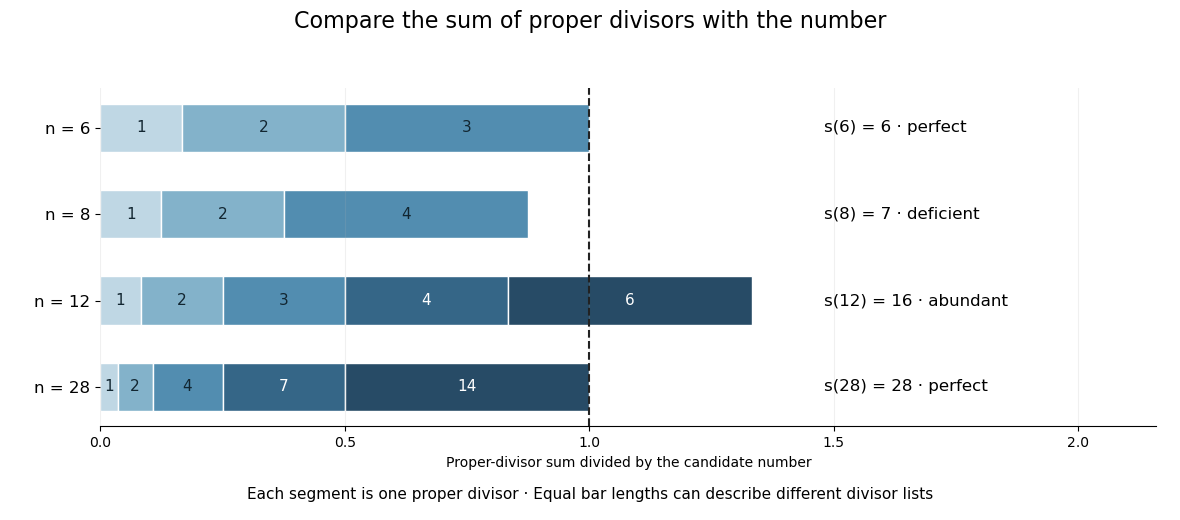
Proper divisors balance a perfect number, fall short of a deficient number, or exceed an abundant number
. Original exact proper-divisor sums for . Each bar is normalized by its candidate number, and its segments are labelled with the actual proper divisors. The dashed line at one marks equality with the candidate. These are finite arithmetic calculations, not empirical data. Details.
The interesting question is how such balances can be constructed without testing every smaller integer as a possible divisor. The Euclid-Euler theorem answers it for even integers: a Mersenne prime gives , and every even perfect number arises this way. For , this produces . The connection links divisor sums to primality testing for a particular family, while keeping the necessary hypotheses visible.[ref]
Euclid's Elements already gives the construction in Book IX, Proposition 36: add a succession of powers of two, and if their sum is prime, multiply by the final power of two. The modern finite geometric series makes the same pattern transparent. This original statement supplies the forward construction, rather than the converse classification of all even perfect numbers.[ref]
Power of two Created 2026-10-14 Updated 2026-11-05
In this positive integer context, a power of two is for a nonnegative integer , giving . Allowing negative or real exponents gives a broader meaning of exponentiation, which is not intended in the integer divisibility criteria here.
Nester two-form 2026-10-14
This antisymmetric spinor bilinear converts the positive energy theorem into a boundary-charge identity. Its divergence is in the mostly-plus conventions specified here. On a spacelike hypersurface the first term is twice the difference between the squared spatial covariant derivative and the squared spatial Dirac operator. The Witten spinor equation removes the negative square, while the dominant energy condition controls the curvature term through the Einstein constraints.
Static zero-energy parallel-spinor rigidity 2026-10-14
The vacuum Witten-Nester identity makes a zero-energy Witten spinor parallel under the Sen spinor connection on a complete asymptotically flat slice. In an orthogonal static slicing, extrinsic curvature vanishes, so this spinor is intrinsically parallel. Contracting its spin-curvature integrability condition gives zero spatial Ricci tensor; in three dimensions this implies flatness. The static vacuum equation then gives a parallel lapse gradient, which asymptotic normalization forces to vanish. The time-independent spinor consequently extends to a spacetime parallel spinor, with Minkowski spacetime the complete regular asymptotically flat example.
Parallel spinors and vanishing ADM mass 2026-10-14
A nonzero spacetime parallel spinor makes the Nester two-form vanish, so its ADM boundary charge vanishes. For complete regular spin initial data in an asymptotically flat spacetime under the dominant energy condition, the ADM momentum is future causal. Its contraction with the spinor's nonzero future causal Dirac current cannot vanish if the momentum is timelike. Thus the invariant ADM mass is zero; in a rest frame this gives zero energy. Local parallel-spinor existence without asymptotic/global hypotheses does not establish this mass conclusion.
Bochner's theorem 2026-10-14
For a locally compact Hausdorff Abelian group, a continuous positive-definite function is uniquely representable as for a finite positive Radon measure on the Pontryagin dual group. Its total mass is . Conversely every such finite positive measure defines a continuous positive-definite function.
For an Abelian group, on finite formal sums of group points, define , with the first variable linear. Quotient by the null space of this positive semidefinite form and complete to a Hilbert space. Left translation is unitary, and generates a dense span of translated vectors. For continuous , the equality gives strong continuity. This realizes as a matrix coefficient without assuming its integral representation.
Decimal expansion Created 2026-10-14 Updated 2026-11-05
A decimal expansion writes a nonnegative real number using decimal digits at successive powers of ten:Nonnegative indices describe the integer part, and negative indices describe the fractional part. For a negative real number, add a minus sign to the expansion of its positive magnitude. A terminating decimal has a zero tail; a general decimal expansion can require infinitely many fractional digits.
An infinite tail of nines can duplicate a terminating expansion. For example, the geometric series gives . The usual uniqueness convention excludes a final infinite tail of nines, and redundant leading zeros are ignored.
For a nonnegative integer , only finitely many nonnegative powers are needed: . This makes divisibility tests into polynomial calculations modulo the proposed divisor. Since ,Thus is divisible by exactly when its alternating digit sum is divisible by . That sum need not be literally zero: for , it is , and .
A localized release of actual fluid volume per unit width on a reflecting half-line has the Barenblatt solution , where and . The mass conservation normalization is . Zero slope at the reflecting boundary gives zero Darcy flux. For symmetric spreading on the full line, the same formula has when denotes the total released volume. A finite initial patch is not determined by volume alone; this exact source profile has a concentrated initial release.
Inclined porous gravity current 2026-10-14
For a thin buoyant layer beneath an inclined impermeable roof, the hydrostatic approximation and Darcy's law give and the volume flux per unit width . The first term transports fluid upslope; the second spreads the layer through its hydrostatic pressure gradient. The porosity multiplies the stored fluid volume, so the advection speed is , not the Darcy velocity .
For energy remaining , , , running cost and terminal cost , the normal maximizing Hamiltonian is , where the constant costate defines . Hence full power is chosen below the threshold and zero power above it. Free completion time on an active terminal arc gives . Global optimality still requires a comparison of feasible completion times; the maximum principle is only a necessary condition.
Area-constrained quadratic control cost 2026-10-14
For a closed planar path with , and , the signed area satisfies times the usual oriented area. Periodic Wirtinger and Cauchy-Schwarz inequalities give . Thus terminal requires cost at least . A clockwise circular path traversed once at constant speed attains equality, proving the global minimum rather than merely a stationary Pontryagin extremal.
There are unlisted articles, also show them or only show them.