
For bounded linear operators between Hilbert spaces with and , the operator is coercive and invertible for . The reconstruction uniquely minimizes . Testing its normal equation for coercive Tikhonov regularization by gives . If is injective, exact-data consistency and , give norm convergence to .
Tikhonov filter norm bound 2026-10-06
For a bounded linear operator between Hilbert spaces, the spectral regularization method for quadratic Tikhonov regularization has scalar coefficient . Since , this coefficient is at most . The spectral theorem for normal operators transfers this scalar bound to the operator norm, providing the noise term in the noise-bias decomposition for linear regularization.
Tikhonov stability bound 2026-10-06
The reconstruction operator in Tikhonov regularization has scalar gain . Its maximum over is , so a data perturbation of norm at most changes the solution by at most . A convergent noisy-data parameter choice satisfies and . Fixed-parameter stability is distinct from stability of the unregularized inverse.
Singular-system Tikhonov filter 2026-10-06
For a singular system of a compact operator with , Tikhonov regularization gives , where and the inner product is linear in the first argument. The bounded gain yields a norm-convergent reconstruction; components in are discarded and no component in is introduced.
Quadratic norm penalty Created 2026-10-06 Updated 2026-10-14
A squared Hilbert space norm penalizes reconstruction size in Tikhonov regularization. For , adding to produces a strictly convex coercive function with unique minimizer. Its first variation contributes to the normal equation for a linear inverse problem, shifting to . It selects a minimum-norm representative and controls amplification of noisy small-singular-value components.
Quadrupolar tidal forcing Created 2026-10-06 Updated 2026-10-14
For a point-mass companion at separation , subtract the constant and linear terms of its Newtonian gravitational potential in a frame accelerating with the target's center. The leading residual isIt is degree two in spherical harmonics. In a circular orbit with angular frequency , its time-dependent components force at in a frame with no spin; there is also a static component. This is the leading approximation in , and the tidal amplitude may be absorbed into a harmonic-dependent constant.
Tidal force Created 2026-10-06 Updated 2026-10-14
Differential gravitational acceleration, multiplied by the affected mass, across a spatially extended body. In the linear approximation the acceleration difference is , where is the tidal tensor. Stellar tidal forces limit the domain of a circumplanetary orbit; sufficiently strong ones can produce tidal disruption.
To isolate a tidal force, subtract the gravitational acceleration shared by the body as a whole. Let a reference test particle follow , and let another have position . In a translating accelerated reference frame with parallel, nonrotating axes,for a source point mass, when . Here is its standard gravitational parameter and the last term uses Big O notation. This Taylor expansion removes the common inward pull and keeps the spatial variation. The near side has an excess pull toward the source; the far side has a deficit of inward pull, which is an outward relative acceleration. Both sides can stretch apart while both still accelerate toward the source.[ref]
Chapter 7: The Theory of Gravitation. §7–4, discussion of stronger near-side and weaker far-side attraction
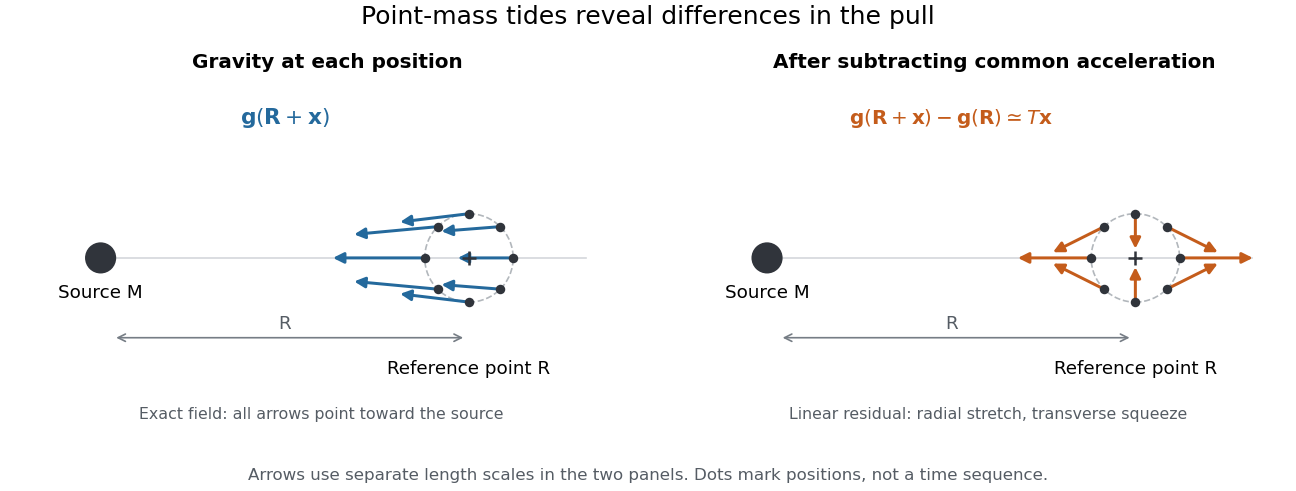
Subtracting common gravitational acceleration reveals radial stretching and transverse squeezing
. Blue arrows show the exact Newtonian gravitational field at several positions near a reference point. Orange arrows show its linear residual, calculated with the tidal tensor. Arrow lengths use separate scales in the two panels; this is a comparison of direction and spatial variation, not two equal-magnitude fields. Details.
For a material element of mass , the residual external force in this translating accelerated reference frame is . Actual deformation also depends on elasticity, pressure and self-gravity. A rigid body approximation suppresses deformation but can still have internal forces that resist the tidal force. The point-mass tidal stretching and squeezing pattern describes freely falling, noninteracting test particles, rather than promising the same shape for every solid, star or ocean. A rotating reference frame introduces centrifugal acceleration and Coriolis acceleration, which must be included separately.
Tidal disruption 2026-10-06
Disruption of a self-gravitating body when differential gravitational acceleration across it exceeds its binding acceleration. For a body of radius , mass at distance from a much more massive body , the competing scales are and ; their equality gives , up to geometry and internal-structure factors. The tidal tensor gives the directional differential acceleration. A tidal disruption event near a black hole is a specific astronomical application.
Quadrupolar point-mass tidal potential Created 2026-10-06 Updated 2026-10-14
Subtracting the constant and uniform-acceleration terms from the point-mass relative potential gives , with force convention . Its tidal tensor is . This is the leading term for target size small compared with separation.
Tidal dissipation Created 2026-10-06 Updated 2026-10-14
Tidal dissipation converts mechanical energy associated with a time-varying tidal deformation into heat. It can reduce orbital eccentricity, drive synchronous rotation, and contribute deep planetary heating. A circular orbit with exact synchronous rotation, perpendicular spin axis and no additional forcing has a static tidal deformation in the body's frame and need not sustain substantial tidal heating.
For ,If , its contribution to is . Since , summing over the prime factors proves the bound. Here is Dirichlet convolution and is the Von Mangoldt function.
Summatory bound for three to the prime omega 2026-10-06
The Euler product and Mertens second theorem give . The log-weighted convolution bound for three to the prime omega, with the Chebyshev estimate , then gives . A direct bound for the full range follows from , where :
For the three-to-one spatially forced amplitude equation with forcing , put . The real phase constant belongs inside the factor of . If and the phase has been chosen so that , the scaling , gives the displayed canonical amplitude equation, with and . A negative cubic saturation coefficient cannot give the same cubic sign under a forward-time normalization; zero forcing or zero cubic coefficient requires another scaling.
Threefold phase-locked equilibria 2026-10-06
The canonical three-to-one spatially forced amplitude equation has nonzero equilibrium points satisfying and . Thus . Each positive amplitude has three phases separated by : two amplitude branches normally mean six complex equilibrium points. For the larger branch is asymptotically stable and the smaller consists of saddle equilibria, except that its zero-amplitude root at is not a nonzero equilibrium point. Equality gives a saddle-node bifurcation. This phase locking breaks continuous translation symmetry down to threefold symmetry.
Hamiltonian limit of three-to-one forcing 2026-10-06
For small positive forcing-frame frequency , use , and in the three-to-one spatially forced amplitude equation. The leading system is . Writing gives the Hamiltonian system and the displayed first integral. The origin is a center equilibrium; three saddle equilibria at and lie on . The factorization reveals a triangular heteroclinic cycle, containing closed periodic orbits for every .
Three-subspace decomposition 2026-10-06
Every triple of subspaces is a direct sum of one-dimensional membership blocks and two-dimensional three-line blocks. Split off the triple intersection, then the pairwise intersections using projections killing the third subspace. Next split complements to , using projections killing the other two subspaces. The remaining subspaces are pairwise disjoint and each lies in the sum of the other two. Their sum is , with the graph of an isomorphism . A graph basis splits this into two-dimensional blocks. A complement to the total span supplies zero-membership blocks. This elementary argument classifies the three-subspace quiver.
Thurston norm Created 2026-10-06 Updated 2026-10-14
For a compact oriented three-manifold, the integral relative class has norm the minimum of over properly embedded oriented topological surfaces representing . Homogeneity and continuity extend it to real relative homology. It is a seminorm, since spheres, disks, annuli and tori have zero cost.
Excellent three-manifold Created 2026-10-06 Updated 2026-10-14
In the orientable case an excellent compact three-manifold is an irreducible three-manifold and a boundary-irreducible three-manifold, is not a ball, contains a two-sided properly embedded incompressible surface, and has every properly embedded incompressible zero-Euler characteristic surface a boundary-parallel surface. In particular it has no essential annulus or torus. These properties give lower bounds on the Thurston norm of classes with essential boundary.
Irreducible three-manifold Created 2026-10-06 Updated 2026-10-14
An orientable three-manifold is irreducible if every embedded two-sphere bounds a three-ball. This makes innermost-disk simplifications of embedded topological surfaces possible without changing the ambient three-manifold.
Boundary-irreducible three-manifold Created 2026-10-06 Updated 2026-10-14
A compact three-manifold is boundary-irreducible when there is no embedded disk with interior in the manifold and boundary an essential curve in its boundary. Thus its boundary has no compressing disk.
There are unlisted articles, also show them or only show them.