
Measurability 2026-10-06
Measurability is the property that inverse images of measurable target sets are measurable in the source space. For a stochastic process, joint measurability in time and sample is a different condition from the separate adaptedness condition at each fixed time. The predictable sigma-algebra and progressive measurability encode particular joint measurability requirements.
Essential range Created 2026-10-06 Updated 2026-10-25
The essential range of a real or complex measurable function consists of the values whose every neighborhood receives inputs of positive measure:It depends on the measure as well as the function. This definition concerns values arbitrarily near , not necessarily inputs at which exactly. It therefore retains meaningful limiting values while ignoring values occurring only on null sets. [ref]
https://www.mat.univie.ac.at/~gerald/ftp/book-schroe/schroe2.pdf. Teschl, Mathematical Methods in Quantum Mechanics, §2.4, equation (2.77): essential range
.For on with Lebesgue measure, the ordinary image of a function is , but the essential range is . Neither endpoint is attained, yet inputs with or have positive measure for every . Every interior value also belongs to the essential range, although its exact fiber is a singleton of zero measure. Positive measure of a fiber is sufficient, but is not necessary, for a value to belong to the essential range.
The two-sided example from essential infimum and essential supremum illustrates what disappears. It follows on , except and . Its ordinary image of a function is , whereas its essential range remains . The missing ordinary values and still have arbitrarily close neighbors with positive measure; the exceptional values and can each be isolated by a sufficiently small neighborhood whose preimage is a null set.
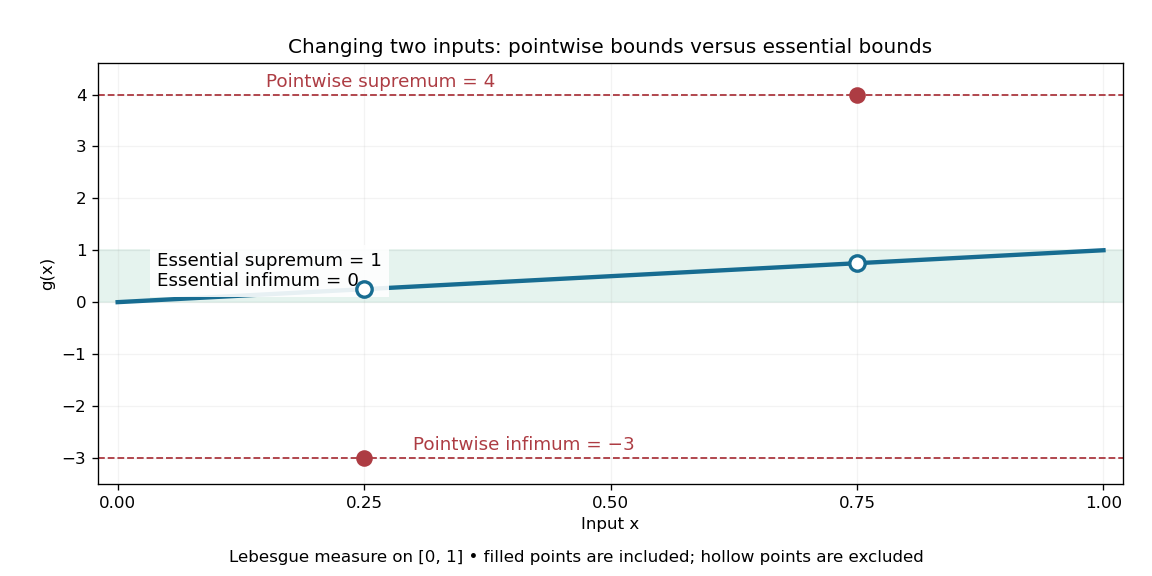
The essential range of the modified identity function remains , while its ordinary image of a function includes two isolated outliers
. For Lebesgue measure, the filled outliers and fail the criterion of positive measure in every neighborhood. The hollow values and still belong to the essential range because nearby outputs occur on intervals of positive measure. Details.
For the three-point example in L-infinity norm, the values are . With weights the essential range is ; with weights it is . A small but positive probability retains ten, so an essential range does not discard a value merely because it is rare. For a real function on a space of positive total measure, the essential infimum and essential supremum are the lower and upper edges of its essential range, allowing infinite bounds. The L-infinity norm instead takes the upper edge of the essential range of .
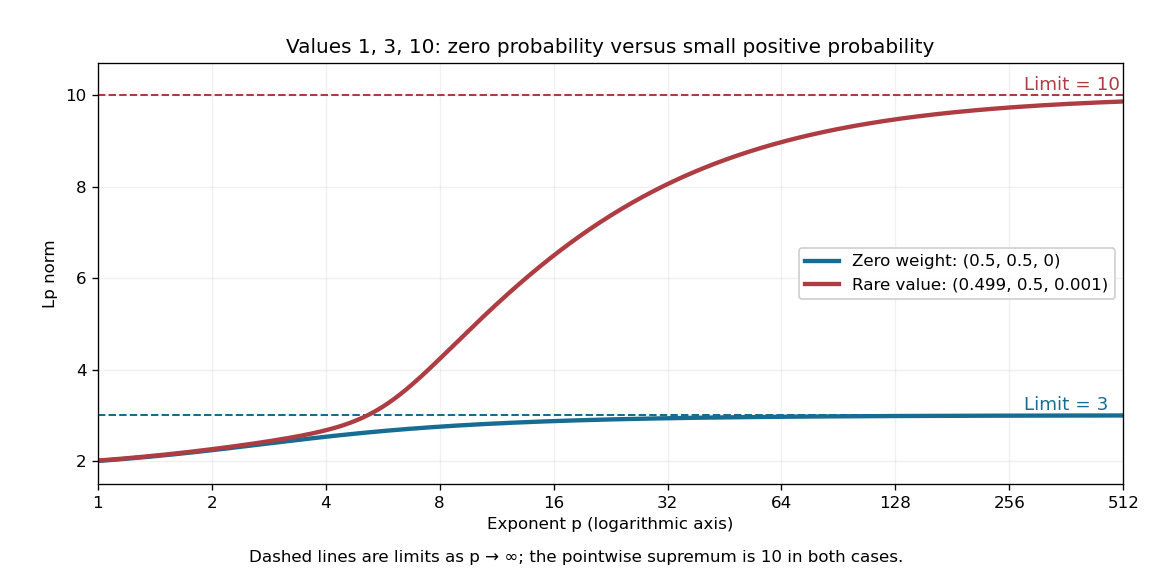
Including ten in the essential range changes the limiting Lp norm, even when its probability is only
. The blue case has essential range , while the red case has essential range . These finite positive-valued examples make their largest essential values equal to their L-infinity norms. Details.
A useful operator connection is the spectrum of a real multiplication operator: on a nonzero L2 space over a sigma-finite measure, multiplication by a real measurable function has spectrum equal to its essential range, with the natural domain when is unbounded. Outside that range, has a positive lower bound almost everywhere, so multiplication by gives an inverse function that is a bounded linear operator. Near an essential value, this lower bound fails. Thus discarding null sets is precisely what makes the range match an operator acting on almost everywhere equivalence classes. [ref]
https://www.mat.univie.ac.at/~gerald/ftp/book-schroe/schroe2.pdf. Teschl, Mathematical Methods in Quantum Mechanics, §2.4, equations (2.74)–(2.77): multiplication-operator spectrum
. Endpoint secant-tangent approximation Created 2026-10-06 Updated 2026-10-07
If is continuous at an interval endpoint, differentiable in its interior, and has a finite one-sided derivative there, then its secant slope and tangent slope are arbitrarily close at some interior point. Apply the mean value theorem on a short endpoint interval; both the secant at its far endpoint and the secant at the resulting intermediate point approach the same one-sided derivative. No continuity of the derivative is required.
If two coupled processes approach each other in L2 and one family of marginals is uniformly tight, then their expectations of any bounded continuous test function approach each other. On a large compact set use uniform continuity; outside it use boundedness; control excessive coupling separation by the second-moment Markov bound. A constant expectation for one process then identifies the other limit. No global derivative or Lipschitz bound is necessary.
For an eccentric inner body and circular outer perturber near the reduced period ratio, the leading resonant argument is . Its disturbing function amplitude is of order . At a mean conjunction, ; at actual alignment the exact expression is with and .
Mean free path through randomly oriented disc absorbers Created 2026-10-06 Updated 2026-10-20
For an unclustered population of fully covering circular disc absorbers, the inverse mean free path is proper number density times mean projected area. A comoving number density must first be multiplied by . The incidence then constrains the proper radius; covering factor and multiplicity of detectable lines can change the inference.
Ising auxiliary mean-field free energy 2026-10-06
The approximate partition function obtained by decoupling each Ising bond has this free energy. The quadratic constant compensates double counting. Its stationary condition is the self-consistency equation; away from stationarity parametrizes the assumed effective field and need not equal that distribution's mean Ising spin. It agrees at stationary points with the Bragg-Williams free energy of the Ising model, although their off-equilibrium expansions differ.
Bragg-Williams free energy of the Ising model Created 2026-10-06 Updated 2026-10-14
A product trial distribution with actual mean Ising spin givesIts entropy is the sum of independent-spin entropies, with . Differentiation gives , the self-consistency equation. The variational mean parameter is distinct from the assumed field parameter of the Ising auxiliary mean-field free energy until the equilibrium condition is imposed.
Maximum flow with vertex capacities 2026-10-06
The maximum flow problem with internal vertex capacities reduces to the usual edge-capacitated problem by splitting each constrained vertex into input and output copies. The connecting edge carries its entire through-flow. Feasible flows correspond under this construction, preserving the source-to-sink value; the Ford-Fulkerson algorithm and max-flow min-cut theorem therefore apply to the transformed network.
Edmonds–Karp algorithm Created 2026-10-06 Updated 2026-10-14
This maximum flow algorithm repeatedly augments along a shortest residual path found by breadth-first search. Residual distances from the source never decrease. If the same arc becomes saturated again after being restored by a reverse augmentation, the distance to its tail has increased by at least two. Thus each arc is critical only times, yielding augmentations. Each search costs , so the total time is . Termination with no residual source-sink path supplies a max-flow min-cut theorem certificate.
Server connectivity under component failures Created 2026-10-06 Updated 2026-10-14
To find the smallest link failure set separating a client from every server, add a common sink with sufficiently large-capacity server arcs and give original links unit capacities in both directions. The max-flow min-cut theorem identifies the minimum failure count . Unit-capacity vertex splitting also charges intermediary node failures. The network tolerates fewer than failures and fails for some set of failures. This concerns connection to at least one server, not separate connectivity to each server.
Almost disjointness number 2026-10-06
The least size of an infinite maximal almost disjoint family on omega. Zorn lemma extends an infinite disjoint family to a maximal one; thus . The bounding-to-almost-disjointness inequality supplies .
Matrix Fourier block 2026-10-06
For and a degree- unitary irreducible representation, the matrix Fourier block is the operator on defined in the title. Its singular values satisfyPointwise operator norm at most one implies . These blocks are operators on a matrix space, rather than simply the entrywise scalar Fourier transform on a finite group without any reshaping.
If and , select the singular values of the matrix Fourier blocks. Their weighted count lies between and . Scaling unit right singular vectors and their corresponding unit left singular vectors by gives matrices satisfying and Hilbert-Schmidt inner product orthogonality within each chosen irreducible representation. The Schur averaging of rectangular matrices then gives for the concatenated and the corresponding block diagonal matrix .
Matrix preconditioner Created 2026-10-06 Updated 2026-10-18
A matrix preconditioner is an auxiliary invertible matrix whose matrix inverse is cheap to apply and whose use improves the eigenvalues of a linear system. In symmetric positive-definite matrix problems, a symmetric positive-definite matrix preserves that structure under the symmetric transformation .
Applying means solving for a supplied vector . This notation does not require forming a general matrix inverse. A diagonal matrix gives componentwise divisions; a factored matrix gives auxiliary solves such as forward substitution and back substitution.[ref]
Notes for Ma221 Lecture 21, Nov 10 2009. Math 221, Matrix Computations, Fall 2009; Basic iterative methods, web lines 297–308, recurrence (*) and cheap auxiliary-solve requirement
Choosing makes the solve trivial but changes nothing; choosing gives the exact correction but asks us to solve the original linear system.[ref]
When every entry of a payoff matrix is positive, its game value is positive. Setting converts the row player's probability vector and guaranteed value into the displayed linear program, whose optimum is . Conversely normalizing a feasible gives a mixed strategy guaranteeing . The dual maximizes under , and recovers the column strategy by normalization. Adding a constant to every payoff preserves Nash equilibria and lets this positive-payoff formulation handle general finite zero-sum games.
Matrix exponential when the square is minus the identity Created 2026-10-06 Updated 2026-10-07
If a real square matrix satisfies , split the absolutely convergent matrix exponential into even and odd powers to obtain . It is the fundamental matrix for . Consequently every solution has period , and the eigenvalues over the complex numbers belong to .
Schur orthogonality relations 2026-10-06
For inequivalent chosen unitary irreducible representations of a finite group, uniform expectation givesThe Kronecker deltas in the first case refer to entries in the same chosen basis. Averaging an intertwiner and applying the Schur lemma proves the formula; summing diagonal entries gives character orthogonality.
Constant-drift massive elliptic estimate 2026-10-06
There are unlisted articles, also show them or only show them.