
Regular hyperbolic octagon fundamental polygon Created 2026-09-24 Updated 2026-09-24
Polygonal-schema Euler count Created 2026-09-24 Updated 2026-09-24
Polarization argument for a vanishing quadratic form Created 2026-09-24 Updated 2026-09-24
For a complex sesquilinear form , the values determine . In particular, expanding at and shows that for every implies . Over the reals this conclusion can fail for nonsymmetric bilinear forms, as a nonzero skew-symmetric form has zero diagonal.
Infinite-server queue transient distribution Created 2026-09-24 Updated 2026-10-14
For an M-M-infinity queue with empty initial state, Poisson arrivals of rate and exponential lifetimes of rate produce a Poisson occupancy of mean at time .
Binomial thinning conditional on a total Created 2026-09-24 Updated 2026-10-06
Poisson integral Created 2026-09-24 Updated 2026-10-03
The Poisson integral convolves boundary data with the Poisson kernel to produce a harmonic function in a half-space. In the upper half-plane,
Normal-approximation tests for a Poisson exposure model Created 2026-09-24 Updated 2026-09-24
Estimators for a Poisson exposure model Created 2026-09-24 Updated 2026-10-14
For , unweighted least squares through the origin and maximum likelihood giveBoth estimators are unbiased.
Pointwise Euclidean invariants need not depend only on current curvature and torsion Created 2026-09-24 Updated 2026-09-24
For sufficiently smooth curves, obeys Euclidean and parameter-translation covariance but is not determined by the pair . Under the bare covariance definition, nonlocal examples such as work as well.
Clamped-map proof of planar path crossing Created 2026-09-24 Updated 2026-09-24
Projecting a sign-corrected displacement map back to a square turns Brouwer's fixed point into a zero of the displacement, proving that paths joining opposite side pairs intersect.
Poincare inequality with a partial Dirichlet boundary Created 2026-09-24 Updated 2026-09-24
If is bounded and connected and a boundary portion has positive surface measure, thenfor every whose trace vanishes on . Otherwise a normalized counterexample sequence, the Rellich-Kondrashov compactness theorem, and continuity of the trace would produce a nonzero constant with zero trace on .
Poincare-Wirtinger inequality Created 2026-09-24 Updated 2026-10-06
On a bounded connected Lipschitz domain , every satisfiesEquivalently, the gradient norm is equivalent to the norm on the mean-zero Sobolev space.
Planar duality for rectangle crossings Created 2026-09-24 Updated 2026-10-05
Finite-dimensional continuation criterion Created 2026-09-24 Updated 2026-10-14
Under the Picard-Lindelöf theorem's hypotheses on , extend a solution of a differential equation as far as possible, to a maximal interval . If , the time-state trajectory must eventually leave every compact subset of . Equivalently, confinement near to one compact subset of permits continuation past . See Teschl, Section 2.6, Lemma 2.14 and Corollaries 2.15–2.16, pp. 52–53.
The domain restriction matters even for a bounded trajectory. Restrict , , to . Then exists in this domain only for ; at its values are . As , it approaches the excluded boundary point while remaining bounded. Its trajectory cannot fit into any compact subset of near that endpoint. This is escape from a finite domain, without finite-time blowup in norm. Enlarging the domain to gives the same formula for every real .
Conversely, , , stays in the compact set for every fixed . Its growing exponential function is unbounded over the entire future, but has no finite-time blowup. At , its largest value on is only . The relevant question is boundedness before each finite endpoint, rather than one bound valid forever. The tangent function in the diagram under the Picard-Lindelöf theorem illustrates the other possibility: its norm escapes every bound before .
This criterion is useful because an estimate can secure continuation without an explicit formula. In a finite-dimensional vector space, a bounded closed ball is compact; a bounded state trajectory therefore supplies the needed compact set when its time-state closure is inside the domain. That final proviso prevents mistaking a domain boundary for finite-time blowup.
A common sufficient estimate comes from global Lipschitz continuity in the state. Assume for an open time interval , with continuous and a Lipschitz constant valid for all states on each compact time interval under consideration. For , let , finite by continuity. Then , and the Gronwall inequality gives, for wherever the solution already exists,For instance, , , has and the exact solution , attaining this estimate; at the value is . Finite bounds of this kind give continuation throughout , with the analogous estimate backwards in time. When , this gives existence for all real times. If has a finite endpoint, it gives no continuation beyond that prescribed domain. The underlying linear-growth criterion is [ref].
A brief explanation of the continuation mechanism suffices: within the protecting compact set, the continuous function is bounded, say by . The integral equation yields near the finite endpoint, so has a limit . The protecting compact set puts inside . Restarting the initial value problem there and using local uniqueness joins the trajectories.
Totality problem Created 2026-09-24 Updated 2026-09-24
For an effective enumeration of computably enumerable languages , the totality problem isIt is -complete: a condition maps effectively to a program whose domain is .
Sachs-Wolfe combination Created 2026-09-24 Updated 2026-09-24
In Newtonian gauge, combines the intrinsic photon temperature perturbation with the gravitational redshift at emission. With constant potentials and negligible baryon loading it oscillates as for adiabatic initial conditions.
Debye model Created 2026-09-24 Updated 2026-09-24
The Debye model replaces the crystal's vibrational spectrum by a continuum of phonon modes up to a cutoff chosen to preserve the total number of vibrational degrees of freedom.
Phonon dispersion relation Created 2026-09-24 Updated 2026-10-14
A phonon dispersion relation gives its angular frequency as a function of its wavevector . For an isotropic power law, .
Latent heat Created 2026-09-24 Updated 2026-10-14
Latent heat is the heat absorbed or released in a first-order phase transition through its entropy jump. For an equilibrium conversion from thermodynamic phase to thermodynamic phase at fixed pressure, evaluate both thermodynamic phases at the same temperature and pressure on their phase coexistence curve:Use one normalization throughout: , and may all be per mole, giving in , or all per unit mass, giving in . Here is entropy and is enthalpy on that basis. Equal Gibbs free energies of the coexisting thermodynamic phases give . Identifying this enthalpy difference with supplied heat assumes a closed system and an equilibrium conversion with only pressure-volume work. [ref]
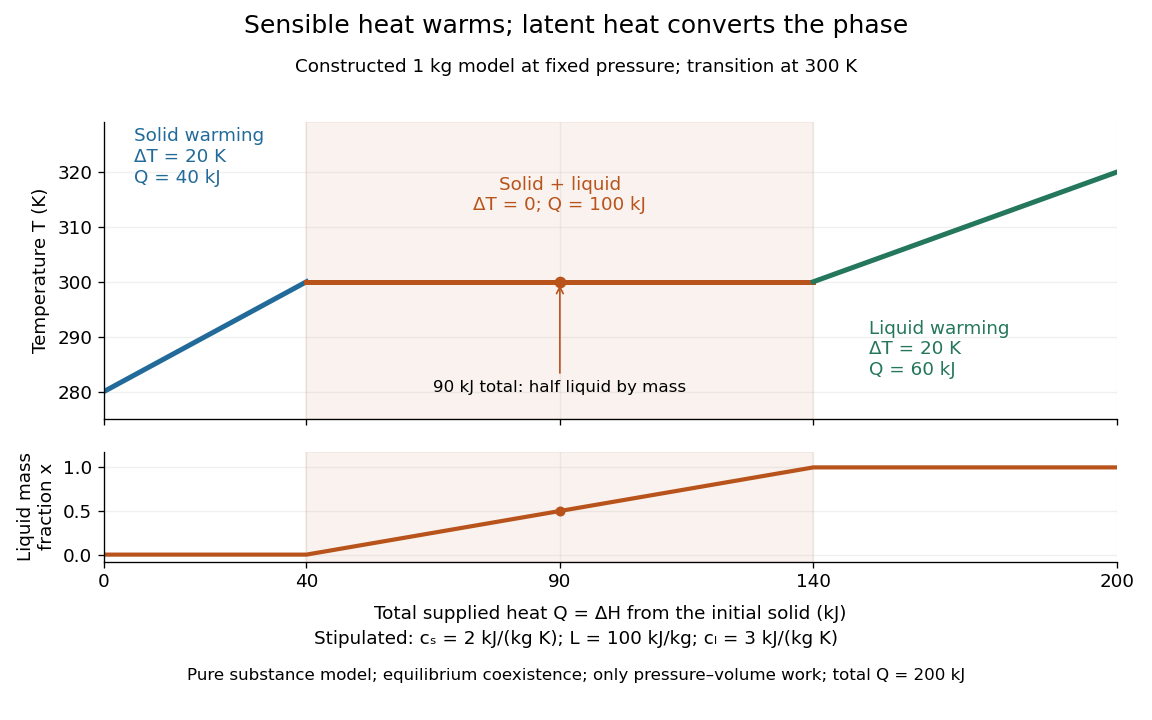
For a pure substance with positive latent heat per unit mass , let be the phase fraction of the higher-enthalpy thermodynamic phase, measured by mass. While both thermodynamic phases coexist at the fixed pressure,Adding heat changes rather than the temperature; this creates the horizontal portion of a heating curve. Once , additional heat raises the temperature according to specific heat capacity at constant pressure. Reversing the conversion releases heat. The plateau represents changing enthalpy, rather than a finite single-thermodynamic phase heat capacity satisfying . [ref]
For a constructed fixed-pressure model, take , initial temperature , transition temperature , solid specific heat capacity at constant pressure , latent heat , and liquid specific heat capacity at constant pressure . These are stipulated model parameters, not empirical properties of a named material. Heating the solid to takes of sensible heat; converting it fully to liquid takes another of heat; heating the liquid to takes . The total is . After a total heat input of , and the temperature is still . The corresponding per-unit-mass entropy jump is .

A continuous phase transition has no latent heat. Its heat capacity can have a jump or a singularity without a finite interval in which added heat converts coexisting thermodynamic phases at a constant temperature. A heating plateau therefore requires the stated phase coexistence conditions; it is not a feature of every phase transition. [ref]
Statistical Physics by David Tong. Tong, Statistical Physics, first-order and continuous transitions
First-order phase transition Created 2026-09-24 Updated 2026-10-03
At a first-order phase transition, the Gibbs free energy is continuous while at least one first derivative, such as entropy or volume, jumps. A nonzero entropy jump produces latent heat .
There are unlisted articles, also show them or only show them.