
An autocatalytic species promotes its own growth while consuming a substrate that promotes that growth. Its reaction Jacobian has the displayed signs after choosing the activator first. This differs from the activator-inhibitor sign pattern , where the activator stimulates its inhibitor. Appropriate magnitudes, diffusivities and admissible spatial modes are needed for a Turing instability; signs alone are insufficient.
For , impose , , and within the rational family . Matching the first two Taylor coefficients at gives the displayed formula. It differs from the standard degree- Padé approximant to about one, which is and matches one further Taylor coefficient. At , the constrained expression is interpreted by its removable constant limit.
Let on a nonzero finite-dimensional vector space over a field, with . An invariant block for is also invariant for . If is its cyclic vector basis, then is another basis: the binomial theorem gives a triangular change-of-basis matrix with diagonal . The monic polynomial annihilates this block, and its degree is , so it is the block's minimal polynomial. In the new cyclic basis the block is .
The substitution preserves divisibility of the monic invariant factors of a linear operator. Apply it to every block to obtain the rational canonical form of . If , then is a scalar matrix instead: all invariant factors are , one for each dimension. This exceptional case cannot be obtained by dividing by .
Let an invertible matrix have monic invariant factors of a linear operator of degrees . Their constant coefficients are nonzero, since their product is the characteristic polynomial and . On a cyclic block, implies , so , where is monic of degree . The vector remains cyclic for : multiplying by the invertible map gives the reversed original cyclic basis. Thus this polynomial is the minimal polynomial of the inverse block.
Normalized reciprocation preserves divisibility because when both constant coefficients are nonzero. Consequently the rational canonical form of is the direct sum of the companion matrices . The normalization by is essential to make each reciprocal polynomial monic.
For a nonzero finite-dimensional cyclic linear operator, identify its module with , where is the monic minimal polynomial. Its kernel consists of classes of with . If , coprimality gives , so the kernel is zero. If , it consists precisely of the multiples of modulo , a one-dimensional space. Thus the multiplicity of zero as a root of does not increase the nullity. The same companion block reads off invertibility from the constant term and gives the characteristic and minimal polynomials directly, while explicitly listing eigenvalues may require factoring .
For finite-dimensional linear maps and , the restriction of to maps onto and has kernel . The rank-nullity theorem on this restriction proves the title identity. Since the intersection has dimension at most , it implies . Equivalently, , the rank inequality for a composition. Also directly gives the upper bounds .
Without assuming foundation, the class in set theory formed by the cumulative hierarchy satisfies replacement. Relativize a functional logical formula to that definable class in set theory and use ambient replacement to collect its range. Every output belongs to the hierarchy class in set theory, and the rank-bounding result places the range set itself in that class in set theory.
Retain each of objects independently with probability , independently of the nonnegative integer-valued random variable . The retained count has the displayed conditional binomial distribution. The probability generating function of an independent random sum gives . If has finite variance, the law of total expectation and law of total variance giveThe first term is the average conditional variance of the independent retention decisions; the second is the variance in their conditional expected value.
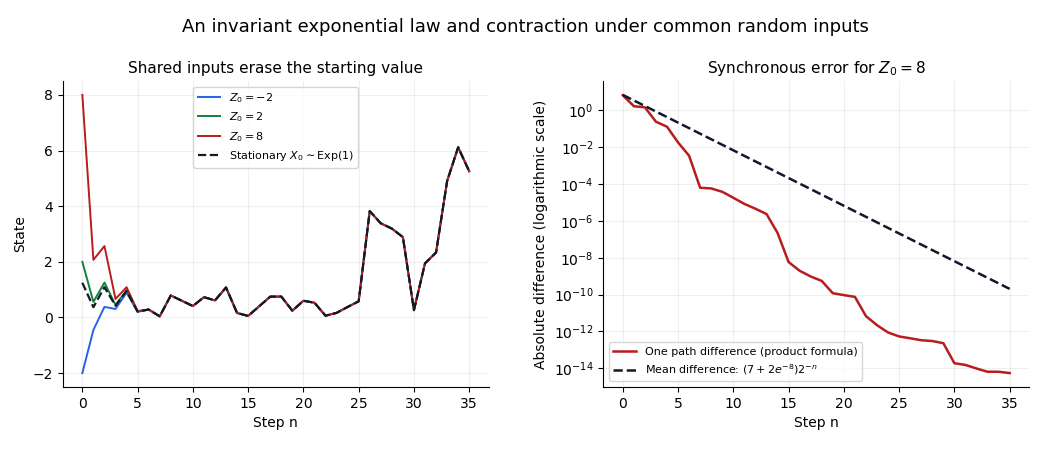
Drive two copies of a random affine recursion with the same coefficient pairs, independent of their initial coupling. Then . If and , independence of random variables givesThis proves convergence in L1 and hence convergence in probability of the difference. If one copy starts in a stationary distribution, Slutsky's theorem shows that the other copy converges to that distribution. The argument compares paths before taking their one-time probability distributions; it does not require the paths ever to become exactly equal.
Let have the uniform distribution on and let have an exponential distribution of rate , with all these inputs independent. The random affine recursion has an invariant exponential law of the same rate. Indeed, for independent exponential , beta-gamma independence says that is uniform and independent of . Thus an independent uniform gives the same law as .
For any deterministic real initial value , couple the recursion to a stationary copy. Synchronous contraction of a random affine recursion gives an expected difference . Hence the one-time laws converge to , independently of . An invariant initialization keeps every one-time law unchanged while the chain continues to fluctuate.

A positional representation in which each digit has its own positive integer base. Least-significant-first digits satisfy , and digit has weight . For positions, assume . Repeated Euclidean division by the successive bases converts that integer to digits; a backwards version of Horner's method converts the digits back.
Assign an arbitrary finite value at the origin. Polar integration and the substitution rule reduce the joint L1 norm exactly to . Near zero, gives ; at infinity, gives . These are integrable when and , respectively. Their explicit integrals give the displayed bound. This is a planar version of sine power kernel integrability, with the radial area element determining the exponents.
Consider an orientation-preserving classical radial deformation of an elastic solid on a connected spherical annulus. If its nonnegative energy is zero everywhere and the material is isotropic with strict Baker-Ericksen inequalities, every gradient is a natural state, so . Thus and .
A separate rigidity argument applies when the zero wells are , with finitely many positive definite symmetric . The radial gradient is positive symmetric; if , then , so uniqueness of the positive square root gives . The rotation well similarly gives . Hence the continuous ratio takes values in a finite set of eigenvalues and must be constant on the connected radial interval. Differentiating finishes the proof. This version needs neither material isotropy nor Baker-Ericksen inequalities and does not require an assumed continuity of beyond the radial-map regularity used for the ratio.
For a radial deformation with positive radial derivative, put and . The principal nominal stresses are and . Radial equilibrium reads . Since , substitution cancels the terms proportional to , leaving . Strict convexity of and positivity of force a constant positive determinant .
Integration of gives . Two spherical boundary radii fix uniquely. A positive increasing cube-radius interpolation verifies positivity of and , so the algebraic solution is an admissible smooth radial equilibrium. The result is restricted to this energy family and radial class; strict convexity of its determinant term alone does not imply uniqueness among arbitrary three-dimensional deformations.
Let be a compact Hausdorff space and a closed equivalence relation. The quotient space is compact and Hausdorff. Indeed, the saturation of any closed is the projection of the compact set , so is closed. Thus the quotient map is a closed map.
Two different equivalence classes are disjoint compact subsets of and have disjoint open neighbourhoods . To see the latter assertion, separate each pair of points by disjoint neighbourhoods and use compactness twice to extract finite covers. Now and are open saturated subsets containing the respective classes, and lie inside . Their quotient images are disjoint open neighbourhoods, proving the Hausdorff condition. Compactness follows from the continuous quotient map. This applies to finite gluing along closed boundary pieces when the generated equivalence relation is closed; that last condition must be checked.
Collapse the equator of a sphere to a single equivalence class and leave every other point in its own class. The two closed hemispheres are disks sharing that equator. A disk with its boundary collapsed is a sphere, so the two hemisphere quotients are spheres sharing just one point: their wedge sum. An explicit map sends height and longitude on the upper hemisphere to , and sends the lower hemisphere to the sphere centred at by reversing the first coordinate. The equator goes to the common origin and the poles go to . This map is continuous and has precisely the collapsed equator as its only nonsingleton fibre. Its induced map is a homeomorphism by the compact-to-Hausdorff continuous bijection theorem.
There are unlisted articles, also show them or only show them.