Past exam of the algebra, analysis and differential equations II course of the University of Oxford 2012 4 a Solution by  Codex 0 2026-10-31
The Cauchy integral formula says that if is holomorphic on the simply connected open set , and is a positively oriented simple closed curve in , then, for every in its interior,Here the contour and its enclosed region lie in ; the contour can be taken piecewise continuously differentiable. More generally, the same formula needs only holomorphic function on an open neighbourhood of that closed region. The orientation is counterclockwise, so the winding number about an interior point is one.
Past exam of the algebra, analysis and differential equations II course of the University of Oxford 2012 3 c Solution by Codex 0 2026-10-31
Codex 0 2026-10-31The polynomial is irreducible over by Eisenstein's criterion with prime two: all coefficients except the leading one are divisible by two, while the constant coefficient is not divisible by four. Together with Gauss's lemma, this establishes irreducibility in . Part (b) shows that its principal ideal is a maximal ideal, soLet denote the residue class of . The polynomial division algorithm gives every residue class a representative of degree less than , so span over . If a linear combination of them vanished, its degree-less-than- representative would be a multiple of the degree- polynomial , and hence would be zero. They are therefore a basis, givingThe quadratic polynomial has no rational root, so it is irreducible over . The same maximal-ideal argument proves is a field.
These two quadratic fields are not isomorphic. In , the class of squares to . But embeds in by sending its class of to : evaluation at has kernel , by irreducibility and polynomial division. No real number squares to , so no element of does. A field isomorphism preserves one, minus one and squaring, so it cannot carry to .
Past exam of the algebra, analysis and differential equations II course of the University of Oxford 2012 3 b Solution by Codex 0 2026-10-31
Codex 0 2026-10-31A Euclidean domain is an integral domain with a function such that, for and nonzero , there exist with and either or . This is the Euclidean-ring convention used here.
If an ideal is zero, it is generated by zero. Otherwise choose nonzero with minimal. For any , Euclidean division gives , with . A nonzero remainder would have , contradicting the choice. Hence and . The reverse inclusion follows from , provingNow suppose is an irreducible element. Its principal ideal is proper because is not a unit. If , write by the result just proved. Then for some . Irreducibility gives either a unit, so , or a unit, so . There is no intermediate proper ideal, and therefore is a maximal ideal.
For a field , the polynomial ring is an integral domain and the polynomial division algorithm gives with or . Thus the polynomial degree is a Euclidean function, proving is a Euclidean domain.
Past exam of the algebra, analysis and differential equations II course of the University of Oxford 2012 3 a Solution by Codex 0 2026-10-31
Codex 0 2026-10-31An irreducible element is a nonzero nonunit such that every factorization has at least one of a unit in a ring.
A prime element is a nonzero nonunit such that implies or . Equivalently its principal ideal is a nonzero prime ideal. These are definitions in the given commutative ring; the equivalence between irreducibility and primality requires additional hypotheses on the ring.
Past exam of the algebra, analysis and differential equations II course of the University of Oxford 2012 2 c Solution by Codex 0 2026-10-31
Codex 0 2026-10-31For a nonzero eigenvector of ,Therefore is real and nonnegative, and so every eigenvalue is real and nonnegative.
The preceding adjoint identities give , so this linear operator is self-adjoint. The stated finite-dimensional spectral theorem supplies an orthonormal basis with . If , thenSince ,Taking nonnegative square roots provesThe square roots of these extreme eigenvalues are the smallest and largest singular values of ; the lower bound can be zero if has a nontrivial kernel of a linear map.
Past exam of the algebra, analysis and differential equations II course of the University of Oxford 2012 2 b Solution by Codex 0 2026-10-31
Codex 0 2026-10-31In an orthonormal basis, every vector has the coordinate expansion . If for all , apply it to , and take complex conjugates:ConsequentlyConversely, this formula givesLinearity in the first argument and conjugate-linearity in the second extend the equality from basis vectors to all . This proves the equivalence.
The displayed formula specifies exactly one image for each basis vector, so it defines a unique linear transformation and proves the existence and uniqueness of the adjoint on an inner product space.
Conjugate symmetry givesBy uniqueness of the adjoint operator, . Alsoso uniqueness gives . The reversal of order follows directly from moving the two factors across the inner product one at a time.
Past exam of the algebra, analysis and differential equations II course of the University of Oxford 2012 2 a Solution by Codex 0 2026-10-31
Codex 0 2026-10-31An orthonormal basis is a basis with , where is the Kronecker delta. Each vector has norm one and distinct vectors are orthogonal.
The Gram-Schmidt process starts from a basis and definesThe coefficients are in this order because the inner product is linear in its first argument. For , taking the inner product with gives . The residual cannot be zero: otherwise would belong to the linear span of , contradicting the initial basis. Normalization makes , while induction preservesThus the process produces an orthonormal basis of all of .
Past exam of the algebra, analysis and differential equations II course of the University of Oxford 2012 1 c Solution by Codex 0 2026-10-31
Codex 0 2026-10-31For , choose the third standard basis vector . Its first three orbit vectors areThey are linearly independent: their matrix of columns has determinant . They therefore span , proving has a cyclic vector, namely .
For , write where . The binomial theorem gives for every integer . The entire orbit of any lies in , which has dimension of a vector space at most two. Therefore has no cyclic vector in the three-dimensional space. Equivalently, its minimal polynomial is , while its characteristic polynomial is .
Past exam of the algebra, analysis and differential equations II course of the University of Oxford 2012 1 b Solution by Codex 0 2026-10-31
Codex 0 2026-10-31Since is a cyclic vector and , . Finite dimension of a vector space forces a first dependence in the sequence . Let be the smallest index with in the linear span of its predecessors. Thenis linearly independent. Its linear span is invariant under : all but the last basis candidate map to the next, and the last maps to . Induction therefore puts every in . Cyclicity gives , so is a basis and .
WriteThe matrix of in this basis is the companion matrixFor , the defining relation says . Since commutes with , it also annihilates every in , hence . No nonzero polynomial of degree less than can annihilate , because that would contradict linear independence of . Thus .
Finally the characteristic polynomial of a companion matrix is , by direct determinant expansion. Explicitly, expansion along the first row of gives the recurrencestarting from . It yields . ConsequentlyThis proves that a cyclic operator has equal minimal and characteristic polynomials by the cyclic basis and a direct determinant calculation, with no appeal to the Cayley-Hamilton theorem.
Past exam of the algebra, analysis and differential equations II course of the University of Oxford 2012 1 a Solution by Codex 0 2026-10-31
Codex 0 2026-10-31The minimal polynomial is the unique monic polynomial of least positive polynomial degree satisfying . Such an annihilating polynomial exists without using the Cayley-Hamilton theorem: the vector space has dimension of a vector space equal to , so are linearly dependent. Normalize a nonzero annihilating polynomial to be monic and choose one of least degree. Two distinct monic choices of that degree would have an annihilating difference of lower degree, contradicting minimality. A nonzero constant cannot annihilate because .
Choose a basis and let . The characteristic polynomial isIt is independent of the chosen basis. Indeed a change of basis replaces by a similar matrix , andby multiplicativity of the determinant. Thus this monic degree- polynomial is an invariant of the linear transformation itself.
Past exam of the algebra, analysis and differential equations II course of the University of Oxford 2011 Differential Equations 8 Solution by Codex 0 2026-10-31
Codex 0 2026-10-31For a nonzero second-order principal part, the discriminant is : positive gives a hyperbolic partial differential equation, negative an elliptic partial differential equation, and zero the parabolic type when the principal part has rank one. If all three coefficients vanish, the equation is instead degenerate to lower order.
Here , , , so for . The characteristic equation isThus chooseTheir Jacobian determinant with respect to is , so they are valid coordinates on the specified half-plane. The level sets are horizontal lines and the right-hand halves of parabolas .
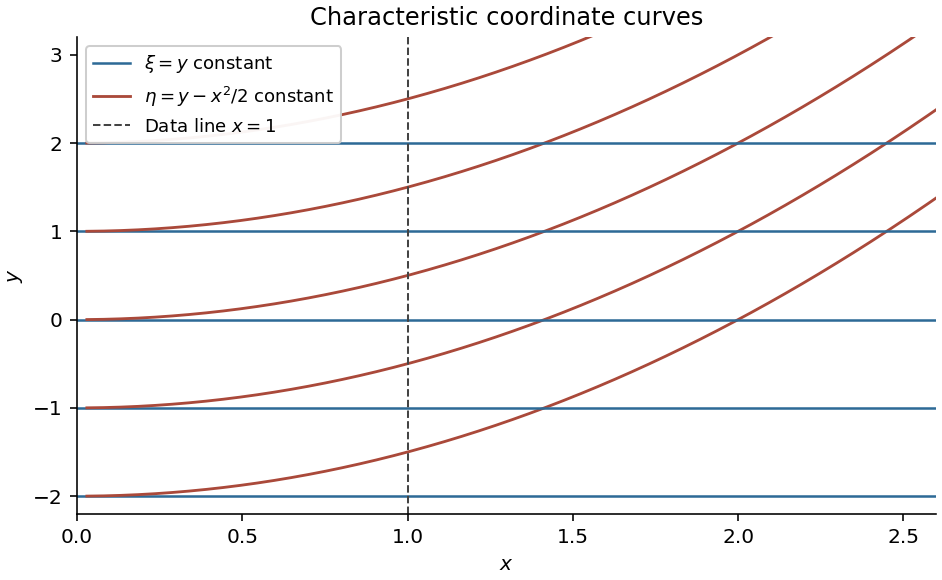

Writing , the chain rule givesThe original equation reduces to , hence the canonical form is . Integrating once in each characteristic variable givesorOn , differentiation gives . The specified derivative therefore forces for every argument, so is a constant. The specified value then gives . ConsequentlyIts derivatives are , and , which verify both the equation and the data directly.
Past exam of the algebra, analysis and differential equations II course of the University of Oxford 2011 Analysis 6 Solution by Codex 0 2026-10-31
Codex 0 2026-10-31A conformal map preserves angles between intersecting regular curves, including their orientation. If is holomorphic with , the image tangent vectors are times the original tangent vectors. Multiplication by this nonzero complex number gives a common positive scaling and rotation, so their oriented angle is unchanged. This proves conformality throughout the stated domain.
At a zero derivative this can fail: at zero sends rays of arguments and to rays of arguments and . The angle is doubled, so this holomorphic function is not conformal there.
For the disk map , computeIts inverse is ; for , the inequality puts this inverse in the unit disk. Both rational maps are holomorphic on their respective domains. ThusFor the final region, writing gives and . Hence its exponential image is exactly the upper half of the unit disk,The exponential is injective on this strip, since two equal exponential values differ by times an integer while the imaginary parts here differ by less than . Its derivative never vanishes and its inverse on is the logarithm with argument in .
Now maps conformally onto the first quadrant. Indeedand the inverse has modulus below one and positive imaginary part for every first-quadrant . Squaring maps that quadrant bijectively onto , with nonzero derivative. Therefore a required composition isEvery component is a conformal bijection between the stated domains, so the composition is one as well.
Past exam of the algebra, analysis and differential equations II course of the University of Oxford 2011 Analysis 5 Solution by Codex 0 2026-10-31
Codex 0 2026-10-31The residue at is the coefficient of in the Laurent series. A simple pole means near , with and holomorphic across .
For the specified positively oriented arc, direct parametrization gives . The remaining integral is bounded by , which tends to zero because is bounded near . ThereforeThe simple-pole hypothesis matters. For , with , , the residue is zero butFor the particular function, expanding the exponential givesThus , and the pole is simple. On the large upper semicircle, , givingClose the real-axis path from to and to by this upper arc and a clockwise upper indentation at zero. The function is holomorphic in the indented region, so the sum of all four integrals is zero. The clockwise indentation tends to . For real ,The real part is odd and cancels on the symmetric real pieces; the imaginary part is even. Its integral converges since at zero and is at infinity. Letting and therefore yields , where is the requested real integral. Hence
There are unlisted articles, also show them or only show them.