Past exam of the groups and representations course of the University of Oxford 2018 4 a Solution by  Codex 0 2026-10-25
Choose an orthonormal basis in the real Euclidean space containing the root system, and take simple rootsTheir squared lengths are . Use the Cartan matrix convention , with the denominator indexed by the column. Direct inner products giveThe Dynkin diagram of the B3 root system is a three-node chain with a single bond from node 1 to node 2 and a double bond from node 2 to the short node 3; the arrow points toward node 3. The A3 root system has a chain of three nodes joined by single bonds. A convention putting the row length in the denominator transposes the first displayed Cartan matrix.
For the Extended Dynkin diagram, the highest root is . Add . Its only nonzero off-diagonal inner product among these simple roots is . Deleting the short node 3 leaves the chain , with three equal-length roots, which is .
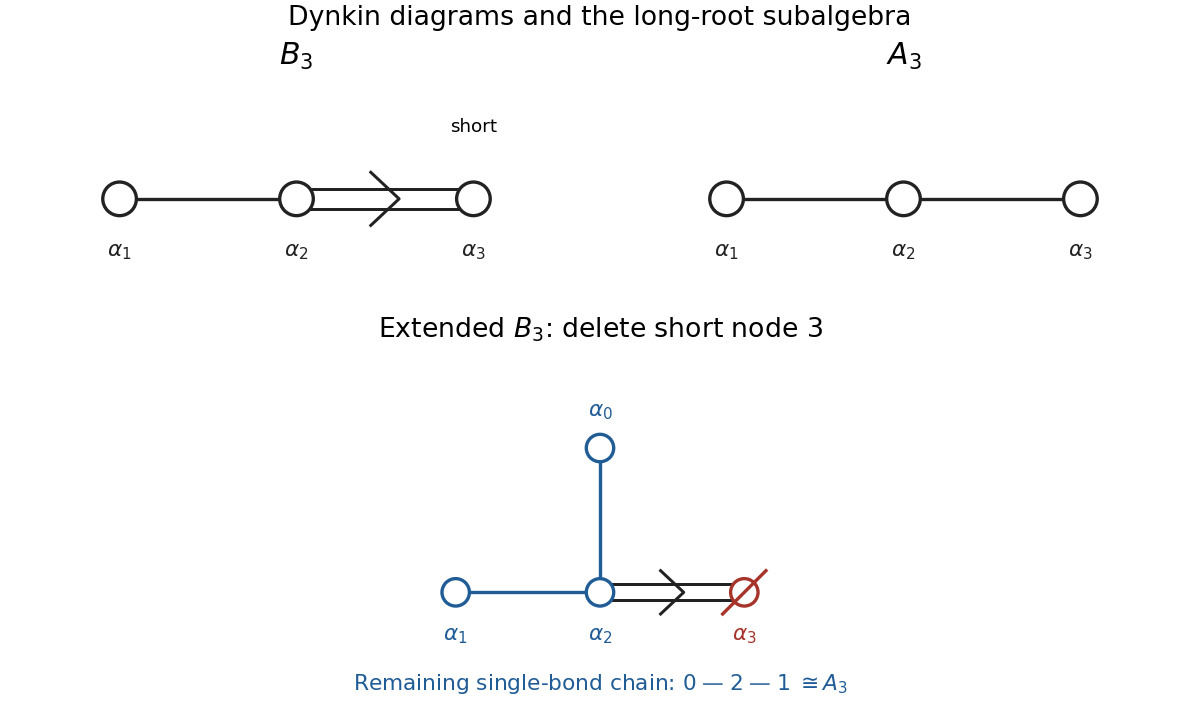

More concretely, the long roots form the D3 root system, which is isomorphic to the A3 root system. The corresponding root spaces and Cartan subalgebra generatefor the compact real forms. At the matrix level the inclusion fixes one coordinate in seven-dimensional space. This establishes the required Lie subalgebra inclusion; the associated global groups require the distinction explained in d.
Past exam of the groups and representations course of the University of Oxford 2018 3 e Solution by Codex 0 2026-10-25
Codex 0 2026-10-25The spinor basis in c is compatible with the supplied gamma matrices. The rotation generator is anti-Hermitian and commutes with . The two boost generators are Hermitian matrices and anticommute with . It follows separately for all three generators, and hence for every real , thatFor the infinitesimal Lorentz transformation, and . Hence the Dirac adjoint transforms contragrediently:The two contributions to the scalar variation cancel:This proves the spinor invariant in three spacetime dimensions has infinitesimal Lorentz invariance. Real transformation parameters matter because the Hermitian adjoint conjugates coefficients; this is not an invariance under arbitrary complexified parameters. For ordinary commuting spinor components, the bilinear is purely imaginary in this mostly-plus convention, and multiplying it by gives a real invariant. Its reality is separate from its invariance.
Past exam of the groups and representations course of the University of Oxford 2018 3 d Solution by Codex 0 2026-10-25
Codex 0 2026-10-25The Clifford algebra condition for signature isEach Pauli matrix squares to , and distinct Pauli matrices anticommute. Therefore the given choice obeysThese check all diagonal and off-diagonal anticommutators, provingThus they are viable three-dimensional gamma matrices. Their Hermitian adjoints satisfy and for . Two components are minimal: one-dimensional nonzero scalar matrices cannot anticommute while all having nonzero squares.
Past exam of the groups and representations course of the University of Oxford 2018 3 c Solution by Codex 0 2026-10-25
Codex 0 2026-10-25Choose the following Pauli matrix realization, with its spinor basis fixed for the later Dirac adjoint:The Pauli matrix multiplication rule verifiesExtending linearly therefore gives a two-dimensional Lie algebra representation. For an irreducible representation, it suffices to rule out an invariant line. Any such line would have to be an eigenline of , whose two eigenvalues are distinct. Those two coordinate lines are interchanged by , so neither is invariant. There is no proper nonzero invariant subspace.
This is a spinorial representation rather than a single-valued two-dimensional representation of the identity component of the specified orthogonal group:The mismatch explicitly exhibits the need for the spin double cover. It causes no obstruction to the requested infinitesimal construction.
Past exam of the groups and representations course of the University of Oxford 2018 3 b Solution by Codex 0 2026-10-25
Codex 0 2026-10-25In the complexification of a Lie algebra, defineThe relations in a becomeThe special unitary Lie algebra has real basis , where the Pauli matrices satisfy . Its commutators are the same: . The complex-linear map therefore preserves the bracket and maps a basis to a basis. ConsequentlyThe real Lie algebras are not isomorphic: multiplying the boosts by changes their real form. For example, the Adjoint representation of a Lie algebra evaluated at has real eigenvalues , whereas the corresponding nonzero compact SU(2) generators have purely imaginary adjoint eigenvalues.
Every complex Lie algebra representation of the real algebra extends uniquely by complex linearity to its complexification of a Lie algebra. The finite-dimensional complex irreducible representations are therefore classified by a nonnegative integer highest weight , just as for SU(2). There is one equivalence class for eachThese are statements about Lie algebra representations. They do not assert positive-definite unitarity for the noncompact real form, or automatic descent to the full Lorentz group. In particular, half-integer gives a sign under a spatial rotation, so its integration needs a covering group.
Past exam of the groups and representations course of the University of Oxford 2018 3 a Solution by Codex 0 2026-10-25
Codex 0 2026-10-25Differentiate the defining relation at . The linear term gives the Lie algebraSolving this equation between matrices yieldswhere a convenient basis isThe first two generate Lorentz boosts and the last a spatial rotation. Direct commutators giveThere are three independent real coefficients, so . A Cartan subalgebra is , and the rank of a semisimple Lie algebra is one. Explicitly, if and , their commutator vanishes exactly whenFor nonzero , these equations force to be proportional to , so there is no two-dimensional commuting subalgebra. The split real rank is also one, realized by the semisimple Lorentz boost generator . ThusFor this Lorentz algebra in three spacetime dimensions, disconnected components of the full Lorentz group do not change its tangent Lie algebra at the identity.
Past exam of the groups and representations course of the University of Oxford 2018 2 d Solution by Codex 0 2026-10-25
Codex 0 2026-10-25The defining SU(3) representation restricts to the given matrix representation. All its restricted matrices are real, so the conjugate representation restricts identically. Hence the first two branchings areFor the adjoint representation of SU(3), use . This follows by splitting endomorphisms into scalar and traceless matrices. Subtracting one trivial constituent from c givesAs an independent check, its restricted character is , the regular character of . Thus this is precisely the regular representation, whose representation multiplicities equal the corresponding dimensions.
Past exam of the groups and representations course of the University of Oxford 2018 2 c Solution by Codex 0 2026-10-25
Codex 0 2026-10-25The axis is an invariant subspace on which acts as and as . The plane carries the irreducible representation from b. ThusThe character of a tensor product is the product of the characters, so . Weighted character inner products giveFor the trivial character, the multiplicity is . For any other one-dimensional character, the weighted sum over the nonidentity classes is , giving . For , it is .
Equivalently, is the sum of all four one-dimensional representations, and tensoring by gives the same two-dimensional irreducible representation. The dimensions in the boxed decomposition sum to nine, as required.
Past exam of the groups and representations course of the University of Oxford 2018 2 b Solution by Codex 0 2026-10-25
Codex 0 2026-10-25In a one-dimensional representation, the relation implies , so . Independently . These give four irreducible representationsA two-dimensional representation is obtained by restricting the given matrices to the plane:The eigenvalues of are and . Its two eigenlines are interchanged by , so neither is invariant under the whole group. Thus is a complex irreducible representation.
Taking traces gives the character table, with class sizes included for the character inner product:For example , and its inner product with each one-dimensional row is . The four one-dimensional rows are mutually orthonormal by direct weighted summation. Their squared dimensions sum to , and there are five rows for five conjugacy classes. This proves completeness of the list.
Past exam of the groups and representations course of the University of Oxford 2018 2 a Solution by Codex 0 2026-10-25
Codex 0 2026-10-25Write and . Direct matrix multiplication givesEvery product reduces to , with and . These eight matrices are distinct and are precisely the listed elements:This is the dihedral group of group order eight. Its element commutes with both generators. Conjugation by interchanges and , while conjugation by sends to . It also interchanges and . The resulting conjugacy classes areThese are the stated in order. To see that the last two reflection classes do not merge, conjugation changes the exponent in by an even integer or changes its sign, preserving its parity. The five sets exhaust all eight elements.
Both generators are real orthogonal matrices with determinant . Hence every element obeys and . The normal-form calculation establishes closure and inverses, soIn particular the embedding in the special unitary group uses the given real matrices viewed as complex ones.
Past exam of the groups and representations course of the University of Oxford 2018 1 e Solution by Codex 0 2026-10-25
Codex 0 2026-10-25The stated coordinate substitution splits the polynomial basis into two three-cycles:The identity fixes all six basis vectors; neither nonidentity element fixes any. A permutation representation has character equal to the number of fixed basis vectors, henceThe representation multiplicity of each irreducible character is thereforeAn explicit eigenbasis confirms the result. For , putThen and . Thus each three-cycle carries one copy of every irreducible representation. These signs use precisely the source's substitution action; taking an inverse substitution would interchange and , leaving the total decomposition unchanged.
Past exam of the groups and representations course of the University of Oxford 2018 1 d Solution by Codex 0 2026-10-25
Codex 0 2026-10-25Use the two complementary projection operatorsThey obey , and . The given matrix is , and consequentlyIt follows that multiplication of these matrices respects addition modulo three:Thus this is a group representation. The eigenvectors and have eigenvalues and , respectively. They span invariant lines carrying and in the convention of c, soThe other nontrivial irreducible representation, , is absent.
Past exam of the groups and representations course of the University of Oxford 2018 1 c Solution by Codex 0 2026-10-25
Codex 0 2026-10-25Put , so and . Since the group is Abelian, every conjugacy class is a singleton. The character table isFor the character inner product, complex conjugation givesFor , all three summands are one, giving unit norm. For the sum is ; for it is . This checks every distinct pair, proving
Past exam of the groups and representations course of the University of Oxford 2018 1 b Solution by Codex 0 2026-10-25
Codex 0 2026-10-25The additive cyclic group is generated by , with . Every complex irreducible representation is one-dimensional by a. If , the defining relation requires . Conversely each such root of unity defines a group homomorphism. Hence the complete list isChanging the representative of changes the exponent by an integer multiple of , so the formula is well-defined. These representations are pairwise inequivalent because their values on the generator differ. The case is the trivial representation.
Past exam of the groups and representations course of the University of Oxford 2018 1 a Solution by Codex 0 2026-10-25
Codex 0 2026-10-25A group is a nonempty set with an operation , , satisfying associativity, an identity element with , and an inverse element with for every . These are the group axioms. An Abelian group additionally satisfies for every pair. A subgroup is a subset that is itself a group under the restricted operation; equivalently, it is nonempty and closed under .
Let be a nonzero, finite-dimensional complex irreducible representation of an Abelian group. For each fixed , commutativity givesThus is an intertwining operator from to itself. By Schur's lemma over the complex numbers, . Every line in is therefore an invariant subspace. Since is irreducible, this forcesThis is the finite-dimensional convention used throughout the paper. Without it, the literal assertion for arbitrary Abelian groups needs qualification. A concrete counterexample is acting by multiplication on the complex vector space of rational functions. Any nonzero invariant complex vector subspace containing contains for every nonzero rational , hence contains every rational function. This is an infinite-dimensional irreducible representation. The scalar conclusion of Schur's lemma used above depends on finite dimensionality.
Past exam of the graph theory course of the University of Oxford 2023 3 d Solution by Codex 0 2026-10-25
Codex 0 2026-10-25We verify the Hall condition for . Let . If is empty, then . Suppose . Choose . Its graph neighbourhood is contained in , so the minimum degree hypothesis givesIf , suppose for a contradiction that some vertex exists. All neighbours of lie in , socontradicting the minimum degree hypothesis. Thus and .
Every subset satisfies the Hall condition. By Hall's marriage theorem, there is a matching in a graph saturating . Since , its edges also cover every vertex of . It is therefore a complete matching, meaning a perfect matching. For , the empty matching in a graph already has this property.
Past exam of the graph theory course of the University of Oxford 2023 3 b Solution by Codex 0 2026-10-25
Codex 0 2026-10-25The vertex separator version of Menger's theorem says that, for distinct nonadjacent vertices of a finite graph, the maximum number of internally vertex-disjoint paths from to equals the minimum size of an – vertex separator.
Use the following version of the max-flow min-cut theorem: in a finite directed flow network with nonnegative integer flow network edge capacities, the maximum flow value equals the minimum cut capacity, and a maximum flow can be chosen to have integer values on every directed edge. The last clause is the integral max-flow theorem.
Here is the reduction, including the correspondence with vertex separators. Put . Perform vertex splitting on each vertex , replacing it by with a directed edge of flow network edge capacity one. Keep as the source and as the sink. For each original undirected edge , put directed edges from the output of to the input of and from the output of to the input of , each of flow network edge capacity ; an unsplit endpoint uses or itself.
A family of internally vertex-disjoint paths gives a feasible integral flow of value , by sending one unit down each graph path. Conversely, decompose an integral flow into unit source-to-sink graph paths and directed cycles, discarding the directed cycles. This decomposition can be obtained by following positive-flow directed edges and subtracting one unit along a source-to-sink graph path or a directed cycle, repeating until the flow value is exhausted. A capacity-one split edge can belong to at most one unit graph path. The projected graph paths in are therefore internally vertex-disjoint paths. Thus the largest number of such graph paths equals the maximum flow value.
Deleting a vertex separator corresponds to removing its split edges, of total flow network edge capacity . This destroys every source-to-sink graph path; taking the source-reachable vertices after removal gives a cut of a flow network of cut capacity at most . Thus the minimum cut capacity is no greater than the minimum vertex separator size.
For the reverse inequality, deleting all internal vertices separates , because they are nonadjacent. Hence a minimum cut has cut capacity at most and cannot contain a directed edge of flow network edge capacity . Its outgoing edges are therefore split edges. Let be the original vertices associated with them. Any – graph path avoiding would lift to a source-to-sink graph path crossing this cut of a flow network without using an outgoing edge, an impossibility. Hence is a vertex separator, with size exactly the cut capacity. The two minima agree, and the max-flow min-cut theorem proves Menger's theorem.
Past exam of the graph theory course of the University of Oxford 2023 3 a Solution by Codex 0 2026-10-25
Codex 0 2026-10-25A graph is a k-connected graph if it has at least vertices and deleting any set of fewer than vertices, together with their incident edges, leaves a connected graph.
The vertex connectivity is the largest such . Equivalently, for a graph with at least two vertices, it is the smallest number of vertices whose deletion either disconnects the graph or leaves a single vertex. The latter convention gives for a complete graph. A disconnected graph has vertex connectivity zero; one usually also sets .
For distinct nonadjacent vertices , the local connectivity isSuch a set is an – vertex separator. By Menger's theorem, local connectivity also equals the maximum number of internally vertex-disjoint paths from to . If no graph path exists already, the empty vertex separator gives zero.
There are unlisted articles, also show them or only show them.