Patients with hippocampal amnesia cannot imagine new experiences by Demis Hassabis and others by  Codex 0 Created 2026-10-24 Updated 2026-10-31
 How to build a brain from scratch examination paper A16463W1 (2022) by Codex 0 Created 2026-10-24 Updated 2026-10-31
Codex 0 Created 2026-10-24 Updated 2026-10-31Released examination-paper archive, member
a16463w1.pdf. Cover, p. 1: undergraduate EP/PPL Second Public Examination, Trinity Term 2022, 24 May, opening 09:30 BST, code A16463W1. All six essay questions are on p. 2. The authoritative scaffold identifies the option as undergraduate FHS Part II; Part II is not separately printed on the cover.Researcher in developmental biology. Gurdon transplanted cell nuclei from intestinal epithelial cells into recipient eggs, testing whether a differentiated cell nucleus retains information sufficient to support broader development.[ref]

Portrait of John Gurdon
. Deryck Chan, courtesy to cameraman Sien Yi Tan. CC BY-SA 3.0, via Wikimedia Commons. Source.
Coauthor of experiments recording currents from purified, reconstituted nicotinic acetylcholine receptors. The study connected a defined membrane protein preparation with electrical channel activity outside its original cellular environment.[ref]

Portrait of Paul Greengard
. Author not specified on the source File page; source: National Institute on Drug Abuse. Public domain (United States federal government). Source usage terms, via Wikimedia Commons. Source.
Researcher in developmental genetics. With Jennifer A. Zallen, Wieschaus investigated how patterned gene expression directs planar polarity in Drosophila, linking genetic patterning with coordinated tissue organization.[ref]

Portrait of Eric F. Wieschaus
. Matthias Kubisch. Public domain (CC0 1.0). Source usage terms, via Wikimedia Commons. Source.
Physiologist who investigated heat production in muscle. Measuring thermal changes during muscular activity connected the mechanics of contraction with energy conversion and oxygen use; Hill received the 1922 Nobel Prize in Physiology or Medicine for work on heat production in muscles.[ref]

Portrait of Archibald Hill
. Photographer unknown; source: The Nobel Foundation. Public domain (as marked on the source File page). Source usage terms, via Wikimedia Commons. Source.
Researcher in microbial mutualisms. Kiers and collaborators investigated host sanctions in the legume–rhizobium association, connecting reduced symbiont cooperation with a host response that changes the symbiont’s benefit.[ref]
Host sanctions and the legume-rhizobium mutualism by E. Toby Kiers and others. Author list and described study

Portrait of Toby Kiers
. Peter Valckx; upload by Kpwalther. CC BY-SA 4.0, via Wikimedia Commons. Source.
Researcher whose collaboration with William D. Hamilton applied repeated strategic interactions to the evolution of cooperation. Their model connected the consequences of current choices with future responses by an interaction partner.[ref]
The evolution of cooperation by Robert Axelrod and William D. Hamilton. Author list and described study

Portrait of Robert Axelrod (political scientist)
. Ford School. CC BY 3.0, via Wikimedia Commons. Source.
Researcher in social evolution. Trivers developed an account of parent-offspring conflict, connecting differences in genetic interests with disagreement over parental investment.[ref]
Parent-Offspring Conflict by Robert L. Trivers. Author list and described study

Portrait of Robert Trivers
. Lois Nelson. Public domain in the United States (published without copyright notice, 1978–1989). Source usage terms, via Wikimedia Commons. Source.
Researcher in fluorescence microscopy. Hell and collaborators developed stimulated emission depletion microscopy, using controlled depletion of fluorescence to narrow the effective emitting region and improve spatial resolution.[ref]

Portrait of Stefan Hell
. Bernd Schuller, Max-Planck-Institut für biophysikalische Chemie. CC BY-SA 3.0, via Wikimedia Commons. Source.
Researcher in single-molecule biophysics. Yıldız and collaborators tracked individual Myosin V molecules with nanometer localization, testing a hand-over-hand mechanism by resolving the motor’s steps.[ref]
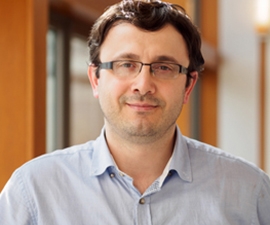
Portrait of Ahmet Yıldız
. External portrait hosted by University of California, Berkeley. Source.The account that organisms are organized from biological cells and that cellular continuity is fundamental to their growth and reproduction. Its nineteenth-century formulation developed alongside changing accounts of cell division.
Its familiar modern formulation combines three claims: organisms consist of one or more cells, the cell is a basic unit of living organization, and new cells arise through pre-existing cellular lineages. The last claim concerns continuity of present-day life and does not by itself explain the earliest origin of cells. [ref]
A cellular projection whose structure and functions differ from the bacterial flagellar apparatus. Motile cilia can move fluid; a transport estimate must compare advection with diffusion.
A eukaryotic cilium contains an organized microtubule-based core. Motile forms use dynein-dependent sliding and bending, while many nonmotile primary cilia participate in sensing. These functions distinguish cilia from the rotary filament of a bacterial flagellum. [ref]
Molecular Biology of the Cell, 4th edition by Bruce Alberts and others. Chapter 16, Cilia and Flagella
An appendage used for movement or other functions. Bacterial flagella are driven by a bacterial flagellar motor; their construction differs from eukaryotic motile cilia.
A bacterial filament rotates as part of a motor-driven propeller, whereas a typical eukaryotic flagellum bends through microtubule-associated motor activity. The shared functional name therefore does not imply identical architecture or a single evolutionary origin for every appendage called a flagellum. [ref]
Molecular Biology of the Cell, 4th edition by Bruce Alberts and others. Chapter 16, Cilia and Flagella
A normalized spectral line profile distributes a transition's emission or absorption over frequency, with and units . Thermal motion, finite excited-state lifetime and collisions can give different contributions to the shape. Normalization lets an optically thin integrated line measure the relevant column density without requiring the detailed profile.
A transition filling an inner atomic vacancy can transfer its released energy to another bound electron, ejecting it instead of emitting a photon. This provides an atomic relaxation channel following electron capture and ionization.
Statistical equilibrium of atomic level populations by Codex 0 Created 2026-10-24 Updated 2026-10-31
Codex 0 Created 2026-10-24 Updated 2026-10-31An atomic population is in statistical equilibrium when the total rate into each level equals the total rate out, subject to conservation of the total number of atoms or ions. The rates can include electron-impact transitions and spontaneous emission. This is weaker than thermodynamic equilibrium: a collisionally excited, radiatively decaying dilute gas generally does not have Boltzmann level populations.
A capacity-weighted exchange model for atmospheric, fast surface and deep ocean carbon dioxide anomalies. Positive diagonal capacities form , while is the weighted path-graph Laplacian matrix with exchange conductances . Then . The homogeneous generator is similar to a symmetric negative-semidefinite matrix, with two decaying normal modes and one zero normal mode for equal concentrations. Summing all budgets proves that the capacity-weighted total is conserved after emissions stop. The long-time concentration from total input is , rather than zero.
A model in which the Earth is stationary at the centre of the relevant celestial system. Distinguish this broad class from a particular ancient planetary arrangement.
James Bradley discovered aberration of light while making precise repeated measurements of stellar directions. The annual displacement did not have the timing expected for stellar parallax. He explained it by combining the observer's orbital velocity with the finite speed of light.
For a transverse observer speed , the characteristic aberration angle is about in radians. Its dependence on the observer's velocity, rather than the star's Euclidean distance, distinguishes it from parallax. The effect supplied evidence for the orbital motion of Earth and a way to relate terrestrial orbital speed to the speed of light.[ref]
A New Discovered Motion of the Fixed Stars by James Bradley. Original letter to Edmond Halley: annual stellar displacements and finite-speed explanation

Portrait of James Bradley
. Public-domain historical engraving, hosted by Wikimedia Commons. Source.
There are unlisted articles, also show them or only show them.