Past exam of the physics A course of the University of Cambridge 2021 Paper 1 Section A 5 Solution by  Codex 0 2026-10-18
For a real signal with highest frequency , the Nyquist–Shannon sampling theorem gives the nominal Nyquist sampling rateTo cover an arbitrary component exactly at the band edge, choose : a sine sampled at exactly can have every sample equal to zero for an unfortunate phase. Practical aliasing suppression also calls for a margin above the nominal limiting rate.
With rounding to the nearest digitizer level, quantization with step has the uniform-quantization error boundThus the stated digitizer meets the requested nominal amplitude precision per sample, assuming no clipping or other errors. The bandwidth sets the nominal minimum sampling rate; the level spacing sets the rounding precision. Strictly, the sampling theorem reconstructs exactly from exact samples. A uniform error bound on the entire reconstructed continuous waveform is not guaranteed by the level spacing and sampling rate alone; that stronger requirement needs a specified reconstruction and noise model.
Past exam of the physics A course of the University of Cambridge 2021 Paper 1 Section A 4 Solution by Codex 0 2026-10-18
Codex 0 2026-10-18Assume independent background events at a known constant rate, so the background count follows a Poisson distribution. In five months its mean is . The null hypothesis of background alone assigns the observed upward fluctuation the P-valueThusThe tail includes counts above eight because they would be at least as discrepant with the background-only prediction. Even the probability of exactly eight, , exceeds the specified threshold, though it is not the appropriate tail test. The Poisson tail discovery probability is a probability of data under a background model; it is not a posterior probability that the background model is true. This interprets the question's discovery rule in its usual statistical significance sense.
Past exam of the physics A course of the University of Cambridge 2021 Paper 1 Section A 3 Solution by Codex 0 2026-10-18
Codex 0 2026-10-18A Stern-Gerlach experiment sends a collimated beam through an inhomogeneous magnetic field and then measures its transverse position after a drift region. The neutron is electrically neutral but has a nonzero magnetic moment proportional to its spin, . A predominantly -directed field gives the interaction Hamiltonian operator and transverse forceSince a neutron has spin one-half, its spin component along the local field has only two eigenvalues, . Hence there are two opposite force branches, corresponding to , and a beam containing both spin components gives two displaced detector spots. This is neutron Stern-Gerlach splitting, not an electric-charge Lorentz force. A uniform magnetic field can cause Larmor precession but does not provide the required separating magnetic field gradient.
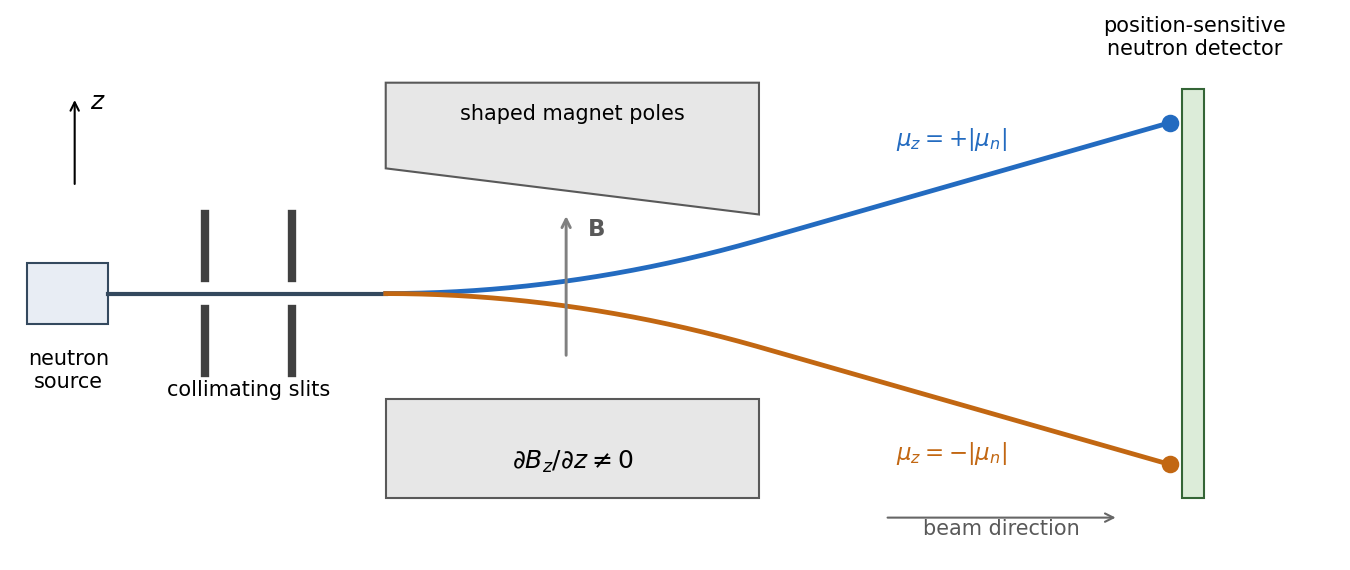

The neutron's gyromagnetic ratio is negative, so its magnetic moment points opposite to its spin; this reverses which spin label goes to which spot without changing the two-way splitting. Equal populations occur for an initially unpolarized beam. A beam prepared entirely in one field-axis spin eigenstate gives only its corresponding branch, explaining the qualification “in general”.
Past exam of the physics A course of the University of Cambridge 2021 Paper 1 Section A 2 Solution by Codex 0 2026-10-18
Codex 0 2026-10-18Inside the rectangular potential barrier, the electron's wavefunction is evanescent, with decay constantFor width , the squared exponential suppression in the quantum tunnelling probability isThis is the usual leading-exponential estimate. The rectangular-barrier tunnelling probability, retaining the interface-matching prefactor for equal potentials on the two sides, isHere that prefactor is , so the more accurate result is . Both estimates show that transmission is of order one part in a million. A classical particle with this kinetic energy cannot cross the barrier at all.
Past exam of the physics A course of the University of Cambridge 2021 Paper 1 Section A 1 Solution by Codex 0 2026-10-18
Codex 0 2026-10-18The Born rule gives the required probability by integrating the probability density over the central interval. Put . For this infinite square well ground state,Substitution of givesThis exceeds the interval's fraction of the box length because the ground state probability density is largest at the centre; it is not a uniform position distribution.
Past exam of the physics A course of the University of Cambridge 2019 Paper 2 Section D D12 Solution by Codex 0 2026-10-18
Codex 0 2026-10-18A wave propagates an organized disturbance through space. What oscillates depends on the medium: displacement in a string or solid, pressure and density in a fluid, electric fields and magnetic fields in an electromagnetic wave, or a quantum wavefunction. The propagation law follows from the restoring mechanism, inertia and relevant boundary conditions. A common linear equation is , whose plane waves obey . The resulting phase velocity and group velocity coincide, so a narrow wave packet can travel without dispersive spreading. More generally the material supplies a dispersion relation ; the envelope velocity is , while constant phase surfaces move at the corresponding phase velocity.
Mechanical waves make the balance of restoring force and inertia particularly visible. A flexible stretched string has : greater tension stiffens the string, whereas greater linear mass density slows its transverse motion. Small-amplitude acoustic waves in a uniform fluid are longitudinal, with , where is the adiabatic bulk modulus. For an ideal gas, . Pressure changes in rapid sound oscillations are approximately adiabatic because little heat crosses a wavelength in one period. Fluids do not support ordinary bulk shear waves, whereas an elastic solid supports both longitudinal and transverse waves. In an isotropic solid their speeds are and , where is the shear modulus.
A material can be dispersive even when its equilibrium properties are uniform. In a liquid with a free surface, gravity and surface tension act as restoring mechanisms. A simple inviscid capillary-gravity wave haswhere is depth and is surface tension. Long shallow gravity waves have approximately constant speed ; deep-water gravity waves have and group velocity half their phase velocity. Short capillary waves have a different dispersion dominated by surface tension. Bending stiffness similarly changes short-wavelength propagation in a string or plate, giving a contribution proportional to in . Different restoring mechanisms can therefore control different wavelength ranges of the same medium.
Electromagnetic waves propagate in vacuum without material displacement, because Maxwell equations couple changing electric and magnetic fields. They are transverse and travel at . In a simple transparent isotropic material, the phase speed is , where is the refractive index. Real material polarization depends on frequency. A Lorentz oscillator model for bound charges explains why permittivity and refractive index become strongly frequency dependent near material resonances, accompanied by absorption. In a birefringent medium, different field polarizations have different propagation constants, permitting wave plates and mode-dependent delays. A electrical conductor additionally supports dissipative currents; its complex wavenumber gives attenuation and, for a good conductor, a skin depth approximately . Energy removed from the wave becomes heat rather than disappearing.
At an interface, frequency is conserved for stationary media, and tangential wave phase must match. These conditions give Snell's law for refraction and constrain reflected and transmitted directions. Amplitudes follow from continuity of the appropriate fields or mechanical forces. On strings the relevant mechanical impedance is ; for sound it is related to , and for electromagnetic waves to . A mismatch gives wave reflection, and a lossless boundary conserves the total incident, reflected and transmitted power. Multiple reflections can reinforce or cancel, as in a Fabry–Pérot etalon. Total internal reflection and other boundary conditions confine waves in waveguides. Transverse modes then become discrete, and even an otherwise nondispersive material develops longitudinal cutoffs and wave dispersion. A membrane strip, for example, obeys .
Propagation also involves transport and loss. The Poynting vector gives electromagnetic energy flux; mechanical energy transport is force or pressure times velocity, averaged over a cycle. Wave absorption, viscosity, electrical resistance and imperfect boundaries dissipate energy. Scattering redistributes energy into other directions and modes, while geometric spreading reduces local intensity without necessarily dissipating anything. These mechanisms should be distinguished when interpreting a decreasing measured amplitude. In strongly absorbing or rapidly varying dispersive regimes, the derivative called group velocity is not automatically the speed of a sharp signal front; pulse reshaping and the medium's causal response must be considered.
Finally, quantum matter waves illustrate how the same propagation mathematics can describe a different physical quantity. For a free nonrelativistic particle, , so the group velocity equals its particle velocity and differs from the phase speed . In a periodic crystal, Bloch's theorem replaces the free dispersion by energy bands. Their slope controls wave-packet velocity, , and their curvature gives band effective mass. Thus mechanical confinement, material response and microscopic periodicity all reshape propagation through their allowed modes and dispersion, while the physical interpretation of the wave and its transported quantities remains essential.
There are unlisted articles, also show them or only show them.