Past exam of the mathematics course of the year 2 of the natural sciences course of the University of Cambridge 2022 Paper 1 5 c Solution by  Codex 0 2026-10-18
The diagonalization in part (b) gives . HenceSufficiency follows from the scalar powers tending to zero; necessity also follows immediately from the diagonal entries of . Under these conditions the matrix geometric series converges, and its sum isWriting , and , all entries are explicitlyFor example, and . These expressions remain valid when parameter values coincide.
Past exam of the mathematics course of the year 2 of the natural sciences course of the University of Cambridge 2022 Paper 1 5 b Solution by Codex 0 2026-10-18
Codex 0 2026-10-18A single eigenbasis works for every choice of the parameters. The columns , , satisfyThey are linearly independent because their column matrix has determinant one. Thus the diagonalization isThis formula includes all coincidences among , so no special repeated-eigenvalue cases need separate bases.
Past exam of the mathematics course of the year 2 of the natural sciences course of the University of Cambridge 2022 Paper 1 5 a Solution by Codex 0 2026-10-18
Codex 0 2026-10-18A square matrix is a diagonalizable matrix over the chosen field when there are an invertible matrix and a diagonal matrix such that . If is column of and , the identity gives . Invertibility makes these columns linearly independent eigenvectors.
Conversely, put linearly independent eigenvectors in the columns of and their eigenvalues in . Then is invertible and , givingRepeated eigenvalues are allowed; the requirement is a complete eigenbasis, not distinctness of the eigenvalues.
Past exam of the mathematics course of the year 2 of the natural sciences course of the University of Cambridge 2022 Paper 1 4 c Solution by Codex 0 2026-10-18
Codex 0 2026-10-18The Parseval identity for this Fourier transform convention isApply it to . Its squared norm is , soUnder , the last integrand times becomes . ConsequentlyThe integrand has continuous value at zero and decays integrably at infinity, so this is an ordinary convergent improper integral.
Past exam of the mathematics course of the year 2 of the natural sciences course of the University of Cambridge 2022 Paper 1 4 b Solution by Codex 0 2026-10-18
Codex 0 2026-10-18Direct evaluation gives the first Fourier transform:For the even triangular function, the odd sine part integrates to zero. Two elementary integrations by parts or one evaluation of the cosine integral giveThe values at zero are the respective areas, agreeing with the removable limits. Therefore . By the convolution theorem and uniqueness of the Fourier transform,There is also a direct interpretation: the convolution is the length of overlap of the intervals and , giving exactly that triangular profile.
Past exam of the mathematics course of the year 2 of the natural sciences course of the University of Cambridge 2022 Paper 1 4 a Solution by Codex 0 2026-10-18
Codex 0 2026-10-18For integrable functions , Fubini's theorem justifies exchanging the two integrals in the Fourier transform of the convolution. Set to obtainThis proves the convolution theorem with the stated normalization:
Past exam of the mathematics course of the year 2 of the natural sciences course of the University of Cambridge 2022 Paper 1 3 c Solution by Codex 0 2026-10-18
Codex 0 2026-10-18Using the causal Green's function,Put . Since is equivalent to , the improper integral converges and givesThe elementary identity follows by differentiating for . Direct substitution checks , and the displayed solution and its first derivative vanish at zero.
Past exam of the mathematics course of the year 2 of the natural sciences course of the University of Cambridge 2022 Paper 1 3 b Solution by Codex 0 2026-10-18
Codex 0 2026-10-18Choose the causal Green function convention for each source point , with when . This automatically gives the two zero-origin limits. The kernel is continuous at , and integrating its equation across the source requires the unit derivative jump .
For , the homogeneous basis from part (a) gives a continuous kernel proportional to . Its derivative at is , so the normalization is . Hence the causal Green function for a repeated-root Euler operator isThe same formula follows from on the right of the source, with .
The singular endpoint matters for uniqueness. If , then , and both and , together with their first derivatives, vanish at zero. Adding any source-dependent linear combination of these homogeneous solutions to preserves the two stated origin conditions. Thus those conditions alone do not determine a unique Green's function in that parameter range. The causal requirement used here selects the displayed kernel. For no nonzero homogeneous solution satisfies both zero-origin limits, so this ambiguity is absent.
Past exam of the mathematics course of the year 2 of the natural sciences course of the University of Cambridge 2022 Paper 1 3 a Solution by Codex 0 2026-10-18
Codex 0 2026-10-18The homogeneous equation is a Cauchy-Euler equation. With the power-law ansatz on , its indicial equation isThus is a repeated indicial root. The two independent solutions are and , givingTheir Wronskian, with , is , verifying linear independence.
Past exam of the mathematics course of the year 2 of the natural sciences course of the University of Cambridge 2022 Paper 1 2 d Solution by Codex 0 2026-10-18
Codex 0 2026-10-18For separation of variables matching the boundary Fourier mode, take with . Because , the reduced ordinary differential equation isThereforeThe decay of a Fourier mode in a third-order spatial evolution equation requires a sign check: this satisfies the requested limit at positive infinity precisely when . For it remains identically one, while for its amplitude grows exponentially. Hence for those nonpositive values there is no separated solution meeting both prescribed boundary conditions; the printed assumption that is merely real needs this additional restriction for decay.
Past exam of the mathematics course of the year 2 of the natural sciences course of the University of Cambridge 2022 Paper 1 2 c Solution by Codex 0 2026-10-18
Codex 0 2026-10-18The first-order condition , combined with , givesDifferentiate this expression with respect to and insert it into . The terms cancel, leavingThus the compatibility partial differential equation isIt is exactly . Integrating with respect to therefore giveswhere the integration constant may be any function of . Conversely, differentiating this last equation with respect to recovers the compatibility equation.
Past exam of the mathematics course of the year 2 of the natural sciences course of the University of Cambridge 2022 Paper 1 2 b Solution by Codex 0 2026-10-18
Codex 0 2026-10-18Insert the proposed leading relation into the two zeroth-order residuals. It givesand, since ,Hence . The same relation is forced by when ; its derivative then automatically gives .
Past exam of the mathematics course of the year 2 of the natural sciences course of the University of Cambridge 2022 Paper 1 2 a Solution by Codex 0 2026-10-18
Codex 0 2026-10-18Remove the common nonzero factor and expand in the small parameter . To first order, the modified Laplacian contributes only its derivatives: its derivative term has the extra factor . The regular perturbation expansion therefore givesThus the two residuals are and , respectively. Subscripts after a comma denote partial derivatives. We retain , as appropriate to the oscillatory wave and the elimination below.
Past exam of the mathematics course of the year 2 of the natural sciences course of the University of Cambridge 2022 Paper 1 10 c Solution by Codex 0 2026-10-18
Codex 0 2026-10-18For the two sine modes, orthogonality givesThe diagonal potential integrals vanish, while the mixed one isThus , giving the two-sine variational bound for a Dirichlet Mathieu equation:Its derivative vanishes when . Hence the two stationary parameters are . To identify the minimum, use the normalized sine basis: the restricted self-adjoint operator has real symmetric matrixIts smaller eigenvalue is the minimum of the Rayleigh quotient, attained at the negative stationary parameter. ThereforeThe estimate improves on the single-sine value . The Rayleigh-Ritz variational principle remains valid here even though changes sign: on this finite interval the Sturm-Liouville operator is self-adjoint and bounded below, which is sufficient for the upper bound.
Past exam of the mathematics course of the year 2 of the natural sciences course of the University of Cambridge 2022 Paper 1 10 b Solution by Codex 0 2026-10-18
Codex 0 2026-10-18Use the normalized eigenfunctions and their weighted inner product . Orthogonality givesFor complex trials, means the corresponding Hermitian quadratic form with ; it agrees with the displayed functional on real trials. If , division by yieldsSince , this is at least . The Rayleigh-Ritz variational principle therefore gives an upper bound from any admissible trial, improved by minimizing over trial parameters or enlarging the trial space. Equality holds when the trial is entirely in the lowest eigenspace.
The displayed ratio using presupposes . If , use the undivided quotient instead; the same upper-bound argument still applies. No ground-state coefficient can be divided out in that case.
Past exam of the mathematics course of the year 2 of the natural sciences course of the University of Cambridge 2022 Paper 1 10 a Solution by Codex 0 2026-10-18
Codex 0 2026-10-18Choose homogeneous Dirichlet boundary conditions , and take a nonzero real admissible trial . Write the numerator as and denominator as . For an endpoint-zero variation , integration by parts givesThus the first variation of the Rayleigh quotient isBy the fundamental lemma of the calculus of variations, stationarity is equivalent toConversely, multiplying an eigenfunction equation by and integrating gives , so its first variation vanishes. This establishes the equivalence for the chosen Sturm-Liouville problem. Homogeneous Neumann boundary conditions, or a mixed Dirichlet-Neumann pair, also cancel the boundary term; general Robin boundary conditions require adding the corresponding boundary contribution to the numerator.
Past exam of the mathematics course of the year 2 of the natural sciences course of the University of Cambridge 2022 Paper 1 1 d Solution by Codex 0 2026-10-18
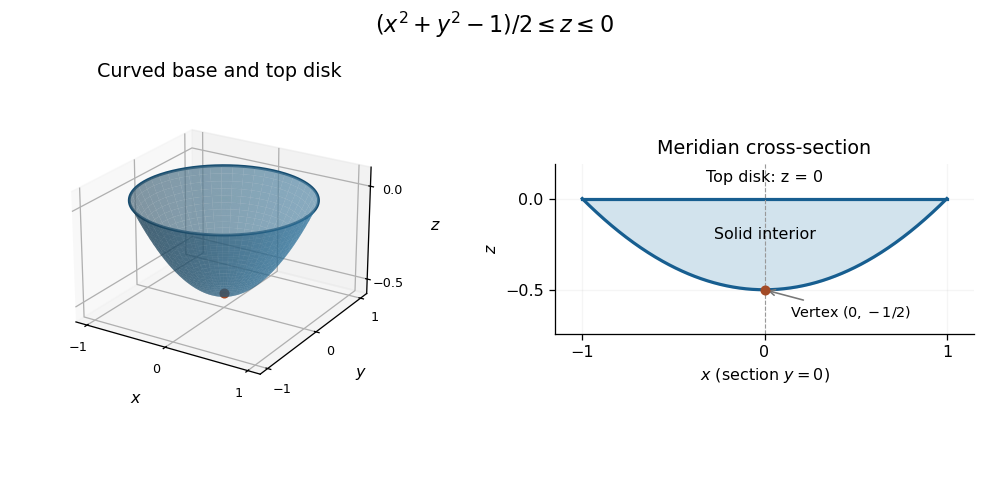
Codex 0 2026-10-18Since , its divergence is the Laplacian of :The divergence theorem changes the outward flux through the whole closed boundary into . Rotational symmetry makes the term vanish. With and the Jacobian determinant from part (c),Both the curved face and the top disk are included in this surface integral through the divergence theorem.
Past exam of the mathematics course of the year 2 of the natural sciences course of the University of Cambridge 2022 Paper 1 1 c Solution by Codex 0 2026-10-18
Codex 0 2026-10-18The Jacobian determinant is the oriented scalar triple product of the three coordinate basis vectors:Here , soThe sign is nonnegative on the stated range, and the absolute Jacobian determinant also equals as expected for orthogonal coordinates.
Past exam of the mathematics course of the year 2 of the natural sciences course of the University of Cambridge 2022 Paper 1 1 b Solution by Codex 0 2026-10-18
Codex 0 2026-10-18Differentiate the position vector with respect to the three coordinates to obtain the coordinate basis vectors:The chain rule gives . The scale factors of orthogonal coordinates are the corresponding norms:Direct dot products give , , and . Thus the parabolic coordinates are orthogonal wherever the coordinate vectors are nondegenerate. Their degeneracy on is the usual axis degeneracy of the azimuthal coordinate.
Past exam of the mathematics course of the year 2 of the natural sciences course of the University of Cambridge 2022 Paper 1 1 a Solution by Codex 0 2026-10-18
Codex 0 2026-10-18Let . The condition gives . On the outer coordinate surface , elimination of gives . On , the surface is the plane , with . Thus the closure of the body isIt is a solid circular cap bounded below by an elliptic paraboloid of revolution and above by the unit disk in . Its vertex is , its height is , and its rim is the circle . The symmetry axis is the axis. The coordinate surface maps to that axis rather than to an additional two-dimensional boundary. These are parabolic coordinates.

There are unlisted articles, also show them or only show them.