
Order the positive integers by odd numbers from upward, then twice the odds, then four times the odds, and so on, followed by descending powers of two and finally . If a continuous interval map has a cycle of one period, it has cycles of every period later in this order. In particular, period three forces every positive period.
An ice sheet is a large body of glacier ice covering land. Its mass budget combines accumulation, surface ablation, basal melting and discharge. Changes of floating ice shelves can influence discharge of grounded ice through changes in restraint, even though shelf melt itself has only a small direct sea-level contribution.
Seal leak current bypasses the membrane patch through an imperfect seal. For an ideal ohmic seal to a zero-voltage bath, , positive from pipette to bath. At and its magnitude is , far larger than the synthetic single-channel step. A stable baseline can be subtracted, but changing leakage can mimic a biological response. Intrinsic membrane leak through ion channels is distinct from this bypass: interpreting both as the same electrical conductance obscures whether the biological cell or the seal changed.
A zonal-mean meridional overturning circulation associated with Southern Ocean wind forcing. In a southern-hemisphere channel with eastward wind stress, the mean circulation has northward surface transport and a southward deep return. Its Eulerian strength need not equal the residual water-mass transport because eddy-induced overturning can oppose it.
The ratio of viscous force to Coriolis force in a rotating fluid at length scale . This convention uses rotation frequency ; conventions omitting the factor two are also common. For small , bulk viscosity is weak but no-slip boundaries can form Ekman layers of thickness of order , with relatively larger boundary shear stress.
A wave caustic is a locus where the projection of a family of rays or wavefronts becomes singular. Several ray paths may coalesce there, and the geometrical approximation can predict divergent intensity. Finite-wavelength diffraction replaces that ideal divergence by a resolved wave pattern. The construction applies to acoustic as well as optical waves.
For positive real numbers and nonnegative weights with , the weighted geometric mean isIt takes a weighted mean of logarithms. A zero weight excludes that input; equal weights give the ordinary geometric mean. If occurs times in a list of total length , its correct weight is . For the list ,and replacing all four entries by preserves the product .
There is also an optimization interpretation. A logarithmic transformation turns multiplicative discrepancies into additive ones. For a positive representative , the weighted mean minimizes squared deviations identity givesThus uniquely minimizes weighted quadratic loss in logarithmic coordinates. The weighted arithmetic mean minimizes squared discrepancies in the original coordinates. These two objectives explain why different choices of what constitutes an error select different summaries.
The strictly concave function and the reversed Jensen's inequality give , where is the weighted arithmetic mean. Apply the same reasoning to the multiplicative inverses to get for the weighted harmonic mean. Thus ; equality holds exactly when all positive-weight inputs agree. For this list, , , and . The weights specify which inputs are represented and must stay the same across the comparison.
A group length function satisfies , and . Word length for a chosen generating set is an example; Coxeter length uses the simple reflections.
A cube complex, in the cubical CW complex convention used here, is built from standard hypercubes by identifying their faces of a cube using isometries. The restriction of each characteristic map to a face of a cube agrees with the characteristic map of a lower-dimensional cell, after an isometry of that face. The cubes carry their Euclidean metrics, giving an induced length distance on each connected component.[ref]
Face identifications may identify different boundary points of the same cube. For example, one interval with its endpoints identified is a circle, and one square with opposite sides identified is a torus. The latter has one vertex, two edges and one square; it is the Salvetti complex for two commuting generators.
A stricter polyhedral convention requires every closed cube to embed and every pair of cubes to meet in one common face. That convention needs a finer cell decomposition of these examples. The cubical-CW convention allows the one-vertex quotient models used in geometric group theory. Being a nonpositively curved cube complex is an additional condition, detected by the link of a vertex in a cube complex.
Choose a finite symmetric generating alphabet and one word representing each group element, with the empty word. The associated paths in the Cayley graph start at the identity and traverse one edge per unit time, remaining at their endpoint after completion. A synchronous combing has a constant such that paths to adjacent endpoints stay within at equal times. An asynchronous version permits increasing reparametrizations. The formal language need not be a regular language; regular synchronous representative languages define automatic groups.
Let be the Mendelian segregation probability, and assume the child's disease status depends on the parental genotypes only through its own genotype, with penetrance proportional to . Bayes' theorem gives the displayed conditional law. For a diallelic parent pair there are four equally likely labelled transmission outcomes. If an unordered genotype occurs in of them, , so its probability is . Dropping multiplicities would, for example, misweight a heterozygous child of two heterozygotes.
A morgan is a unit of genetic map distance: an expected value of one exchange along the transmitted chromatid in the interval. One morgan equals 100 centimorgans; it does not mean a recombination fraction of one.
The Haldane mapping function connects additive genetic map distance to endpoint recombination fraction in a toy model with no crossover interference. Specify the model directly along a transmitted chromatid: the exchange count in the interval has a Poisson distribution with expected value , where is the distance in morgans. Counts in disjoint intervals are independent random variables. This is the transmitted-chromatid convention; is not the mean number of exchanges across all four chromatids in meiosis.
An odd exchange count changes parental phase. Summing the odd terms of the Poisson distribution givesFor , the inverse and short-interval approximation areHere is the natural logarithm. At , the recombination fraction is ; at , the distance is morgans, or about centimorgans. The linear approximation is useful only near zero. The recombination fraction approaches as grows; has no finite inverse in this model.
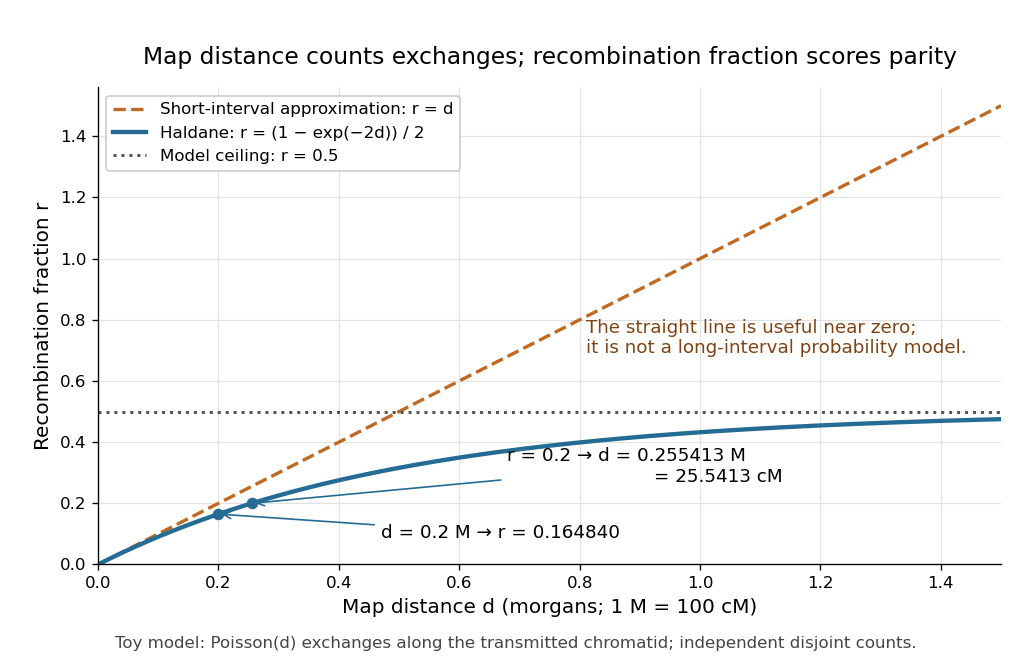
Haldane mapping function versus the short-interval approximation: genetic map distance keeps growing while the recombination fraction approaches one half
. Details. 
The model is a useful baseline, not a universal rule for every interval during meiosis. Crossover interference can change the relationship between distance and recombination fraction. For the count convention and assumptions, see Weeks, Tang and Kwon (2009): genetic map functions and exchange-count conventions. Haldane's original paper is bibliographically recorded as The combination of linkage values, and the calculation of distances between the loci of linked factors, Journal of Genetics 8 (1919), 299–309, in Selected Genetics Papers of J. B. S. Haldane, edited by K. Dronamraju (1990), contents.
In Java, type erasure implements generic code by replacing a type parameter with its bound, or
Object if unbounded, while inserting required casts and bridge methods. Thus List<String> and List<Integer> share a runtime list class even though the compiler checks different element types. Some generic type information remains in metadata for reflection, so erasure does not mean every trace of generic declarations disappears. Restrictions such as the inability to directly create new T() follow from the absence of a distinct reified runtime class for arbitrary type arguments.[ref]https://docs.oracle.com/javase/tutorial/java/generics/erasure.html. Oracle, Type Erasure: replacement, casts and bridge methods
// Target: computer-science.bigb
Even when
S is a subtype of T, neither G<S> nor G<T> is generally a subtype of the other. This prevents unsafe writes into mutable generic containers. Wildcards express restricted views.// Target: computer-science.bigb
A method declaring its own type parameters, for example
<T> List<T> singletonList(T value). The type parameter connects argument and result types and permits compile-time checking without casts at ordinary call sites. A method mentioning only a generic class's type parameter need not itself be a generic method.// Destination: computer-science.bigb
Two components mutually repress when each inhibits the other's production. With decreasing , the two negative interactions create a positive feedback loop. Sufficiently strong repression can produce two stable states: high , low , and the reverse.
// Target: mathematical-biology.bigb
Biological translation uses a ribosome to read messenger RNA codons and assemble the corresponding amino acid chain. Transfer RNA adaptors match codons through base pairing and carry the amino acids; the genetic code supplies the correspondence. The chain grows from the N-terminus toward the C-terminus, by adding each new residue at the C-terminus. See Clark, Douglas and Choi, Biology 2e: ribosomes, transfer RNA and protein synthesis.
In the gene expression diagram, read in the chosen reading frame. Under the standard genetic code, AUG specifies methionine and GCU specifies alanine; UAA is a stop codon. The result before any subsequent processing is the two-residue chain N–methionine–alanine–C, followed by termination. The stop codon contributes zero amino acids. See Clark, Douglas and Choi, Biology 2e: the standard genetic code. This example assumes appropriate initiation at the displayed AUG in a suitable context in a eukaryote; the diagram displays the coding segment, not a complete independently translatable messenger RNA.
Initiation establishes the starting position and reading frame, using a ribosome, an initiating transfer RNA and additional factors. At a standard stop codon, a release factor promotes release of the chain rather than delivery of another amino acid by transfer RNA. See Clark, Douglas and Choi: initiation and termination of translation. A short two-residue example illustrates decoding, not the size or folding of a typical functional protein.
The useful connection is between two different alphabets: nucleotides specify the order of amino acids through the genetic code. Base pairing helps select transfer RNA, while the ribosome catalyzes joining the delivered amino acids. The messenger RNA remains a template rather than being consumed as the chain's building material. Separating template, adaptor and product makes clear why transcription and biological translation are distinct mechanisms.
Transcription is synthesis of RNA using one DNA strand as a template by an RNA polymerase. During elongation the RNA polymerase reads that template while extending RNA . Only the selected region is transcribed; other regions need not be active, and the template strand can differ between genes. See Alberts et al.: RNA polymerase and selection of transcribed DNA regions.
For the displayed example, align these three nucleotide sequences in the same left-to-right positions:The first template triplet TAC selects AUG: T pairs with A, A with U, and C with G. The next CGA selects GCU, and ATT selects UAA. The coding strand therefore matches the RNA lettering except for T versus U, whereas the template is complementary. Reading that template in its own direction gives ; orientation cannot be discarded. The gene expression diagram keeps all three rows aligned. See Clark, Douglas and Choi, Biology 2e: template and coding strands in transcription.
This correspondence makes nucleotide sequences interpretable, but replacing T by U is valid only after identifying the coding strand. Moreover, RNA may be processed after transcription, so the initial product and mature messenger RNA need not have identical uninterrupted nucleotide sequences. Transcription also makes functional RNA that will not undergo biological translation. See Alberts et al.: RNA processing and RNA as the final gene product.
A transcription factor is a protein that regulates transcription. Combinations of transcription factors help select gene expression patterns during cell differentiation. [ref]
Anatomy and Physiology 2e by J. Gordon Betts and others. Anatomy and Physiology 2e, §3.6, Differentiation and Figure 3.35: transcription factors
There are unlisted articles, also show them or only show them.