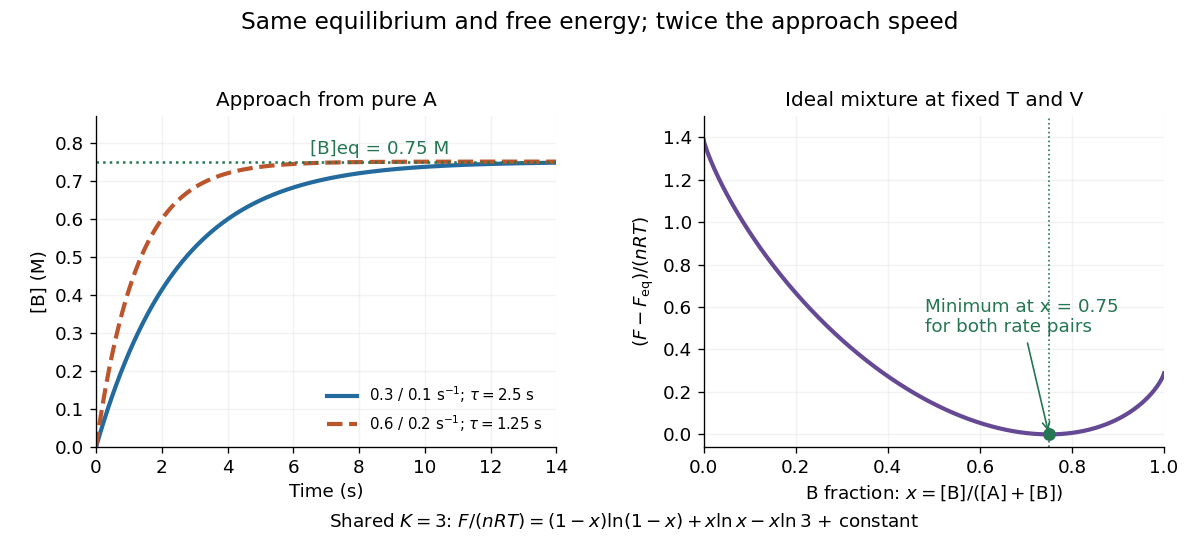
The chemical relaxation time estimates how rapidly a perturbed abundance returns toward chemical equilibrium. Comparing it with the eddy mixing time identifies a chemical quench level.
For the A-to-B model in chemical equilibrium, deviations decay by exponential decay with . After one such interval, of the initial deviation remains; reaching one percent takes . Multiplying both rate constants by two preserves their ratio and the equilibrium composition, but halves to . The equilibrium exchange rates double to . Faster exchange therefore coexists with the same final composition and the same free energy minimum.

The massless gauge-covariant wave equation is . In a stationary charged background, the electrostatic potential shifts the local frequency from to .
Gauge-covariant derivative of a charged scalar field by  Codex 0 Created 2026-10-05 Updated 2026-10-20
For electric charge and electromagnetic four-potential , the derivative transforms covariantly under an electromagnetic gauge transformation.
One adjoint Dirac spinor contributes the displayed screening term to the four-dimensional renormalization-group beta function in the modified minimal subtraction scheme. The fermion contribution to the gluon self-energy insertion has pole . The corresponding background gauge-field counterterm is ; the background gauge-field renormalization identity gives . Differentiation at fixed yields the screening coefficient. The mass-independent subtraction includes massive fields until effective-theory threshold matching is performed.
For a background gauge field with and , background gauge covariance preserves the combination in the gauge covariant derivative. Its Ward identity therefore gives the displayed relation. This refers to background-field renormalization, not an unrestricted identity between the coupling and the ordinary quantum-gluon wave-function factor. Gauge-invariant one-loop matter determinants can be renormalized with this identity to extract their coupling running from vacuum polarization.
For pure Yang-Mills theory with a compact simple gauge group and canonically normalized gauge field, the one-loop renormalization-group beta function is , where is the Casimir operator eigenvalue in the Adjoint representation. This coefficient includes the gauge-field and Faddeev-Popov ghost field loops; it is the standard pure-gauge input when adding matter-loop contributions. Its negative sign gives asymptotic freedom. Integrating the leading equation gives , while perturbation theory is valid. Combining this term with the adjoint Dirac contribution to the Yang-Mills beta function gives the integer obstruction to one-loop marginality with adjoint Dirac fermions.
An electron-multiplying CCD adds a high-field multiplication register before the output amplifier. Impact ionization generates a large mean gain, reducing input-referred read noise but adding multiplication excess noise.
Applying a linear multistep method to the Dahlquist test equation with produces a constant-coefficient recurrence whose modes satisfy . Absolute stability requires the resulting roots of a polynomial to lie in the unit disk, with unit-modulus roots simple. Thus multistep stability depends on every recurrence mode, rather than a single one-step stability function.
For a character of an algebra on a complex unital Banach algebra, and , so without any prior continuity assumption. Under the usual normalization , this gives ; for an unnormalized algebra norm, only the upper bound is automatic.
At an element of a finite group, a complex character value is the sum of the roots of unity which are the eigenvalues of its representing matrix. It is therefore an algebraic integer, and every algebraic conjugate has modulus at most the degree.
An augmented chain complex includes an augmentation with . For a nonempty simplicial complex, the augmentation sends every vertex to and the augmented homology in degree zero is its reduced homology.
A normal approximation replaces a sampling distribution by a normal distribution, often through a central limit theorem. In a Wald test, approximate statistical power is determined by the standardized difference under the alternative. This yields Neyman allocation for fixed treatment-specific variances.
Use . Unitary skew-diagonalization of an antisymmetric matrix gives two-by-two blocks with entries . At rest, the paired supercharges have anticommutators . The squared norms of an operator and its adjoint sum to the expectation of their anticommutator, so positive norm requires for every block. A convention with in the algebra instead writes .
Kinetic-energy decomposition about the centre of mass by Codex 0 Created 2026-10-05 Updated 2026-10-25
Codex 0 Created 2026-10-05 Updated 2026-10-25For fixed particle masses and positive total mass, write with the centre of mass. The weighted relative velocities sum to zero, so expanding the kinetic energy eliminates the mixed term and yields the displayed decomposition. For a rigid body, the relative contribution is the rotational kinetic energy about the chosen centre-of-mass axis.
A central idempotent is an idempotent in the center of an associative algebra. It gives a decomposition into two-sided ideals, with products between the summands zero. The identities of these summands are and .
A real analytic system solved for the highest normal derivatives, with real analytic Cauchy data, has a unique local real analytic solution. For common order , its normal form is . An invertible coefficient/Jacobian matrix for the highest normal derivatives is the system's non-characteristic hypersurface condition. A real analytic coordinate change flattens the initial hypersurface, and adjoining derivatives through order reduces the problem to a first-order real analytic system. Uniqueness here is in the real analytic class; it does not assert Hadamard well-posedness in smooth or Sobolev norms.
For a linear real analytic non-characteristic Cauchy problem for a partial differential equation with zero data, the local real analytic radius may be chosen uniformly over polynomial forcing terms. Fix an analyticity exponent . Each polynomial, including a polynomial obtained by a polynomial coordinate change, satisfies the corresponding factorial derivative bound with some finite prefactor, uniformly over a compact parameter range. Divide the forcing by that prefactor to put all such data in one fixed majorant class. The Cauchy-Kovalevskaya theorem supplies a common radius, and linearity rescales the solution back without shrinking it. This argument does not bound the amplitudes of the resulting solutions uniformly.
For a linear differential operator with real analytic coefficients, a classical solution with zero Cauchy data on a real analytic non-characteristic hypersurface vanishes locally near that hypersurface. The solution itself need not be real analytic. A proof solves the real analytic inhomogeneous formal adjoint problem against polynomial sources, annihilates all polynomial moments using boundary jets, and uses polynomial density to force the solution to vanish.
The boundary jet through order is the collection of traces with . Vanishing of the whole jet is stronger than vanishing of one derivative. On a smooth hypersurface, zero normal Cauchy derivatives through order , together with their tangential derivatives, give a zero full boundary jet.
The category has sets as objects and partial functions as morphisms. Composition is defined where both successive functions are defined. The nowhere-defined map is a zero morphism, and the empty set is its sole actual zero object. Adjoining a tagged basepoint turns a partial function into a total basepoint-preserving function, giving an equivalence of categories with the category of pointed sets.
There are unlisted articles, also show them or only show them.