
For a nonnegative integer , the factorial is the product of the positive integers from to , with the empty product equal to :Thus , , , and . The factorial counts the permutations of distinct objects: arranging gives exactly . The choice tree in permutation shows the three choices for the first position, two for the second, and one for the last.
The value has a counting explanation: the empty set has exactly one ordering, the empty list. Equivalently, it has exactly one bijection to itself, the empty function. There are no choices to make, and one completed outcome. The factorial therefore obeys the recurrence relationThe useful distinction is how many positions are filled. For integers , choosing and ordering distinct objects by sampling without replacement gives the falling factorial, while choosing an unordered -element subset gives the binomial coefficient:For five people, assigning captain and deputy gives outcomes; choosing a two-person team gives . Every team has exactly assignments of the two roles, explaining the division. When , both counts are one. The factorial is useful here because one count of full orderings yields both formulas by cancellation and by forgetting order. [ref]
https://openstax.org/books/college-algebra-2e/pages/9-5-counting-principles. OpenStax, College Algebra 2e, section 9.5: counting ordered selections and combinations
Distinctness matters. If the two copies of in are indistinguishable, the visible arrangements are just , numbering . Temporarily labelling them gives six permutations, but exchanging the two labels leaves each visible word unchanged, so every word was counted times.
Proof outline. For , choose the first object in ways, then order the remaining objects in ways. The rule of product gives the recurrence relation; repeated application gives the displayed product, starting from the one empty ordering. This explains why the factorial grows quickly: every additional distinct object introduces another multiplicative factor.
The polynomial method in combinatorics encodes a discrete configuration by polynomials and obtains combinatorial bounds from their degree, zeros, coefficients, or linear independence.
Extremal set theory asks how large a family of finite sets can be under prescribed intersection or containment restrictions.
A lattice path is a sequence of points in an integer lattice whose consecutive differences belong to a prescribed finite set of steps.
A set partition of a finite set is a set of nonempty subsets, called blocks of a set partition, withThus every set element of belongs to exactly one block of a set partition. This is the finite counting version of a partition of a set. The blocks of a set partition are unlabelled: their subscripts help describe them, but give them no roles or order. Stanley uses this definition in his classification of counting problems.[ref]
Enumerative Combinatorics, Volume 1 (second-edition draft) by Richard Stanley. section 1.9: set partitions and their blocks
All possibilities for three elements. The set has exactly five set partitions:For two blocks of a set partition, one must have size two and the other size one; the three choices of the lone element give the middle row. One block of a set partition forces the whole set, and three blocks of a set partition force three singleton sets. This proves the enumeration complete, with counts by number of blocks of a set partition. Their sum is the Bell number .
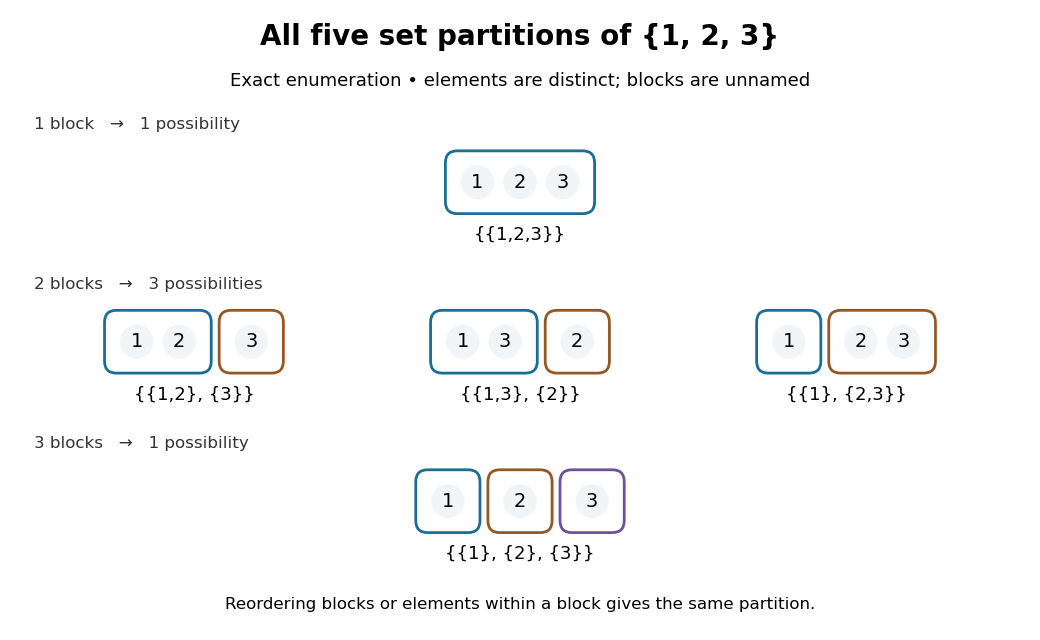
Exact enumeration of the five set partitions of : outlines show blocks of a set partition, whose positions and colours carry no labels
. Details. 
What information is kept? Exchanging the two blocks of a set partition in leaves the same set partition; writing the tuple instead makes an ordered list, different from . Exchanging elements within a block of a set partition also changes nothing. In contrast, is a different set partition, because the actual memberships differ. Both have the same integer partition of sizes. An integer partition, or its Ferrers diagram, forgets which distinct objects were grouped together.
For four named people, and therefore describe different ways of making two unnamed teams, although both have sizes . If every team must have exactly two people, only three set partitions qualify; if any nonempty team sizes are permitted, the Stirling number of the second kind counts them. Naming the teams changes the counting problem again.
A set partition is useful whenever membership matters but category names do not. Define when and belong to the same block of a set partition. This is an equivalence relation, and its equivalence classes recover the set partition. Conversely, an equivalence relation supplies its set partition of equivalence classes. The beautiful simplification is that one grouping can be described by whole subsets or by a rule comparing two elements. Additional distinctions are organized by refinement of a set partition.
The empty set has one set partition, the empty collection , with zero blocks of a set partition. This differs from , which is forbidden because its proposed block of a set partition is empty.
A Directed acyclic graph is a directed graph with no directed cycle: following its directed edges can never return to the starting vertex. A directed edge can represent the requirement that task finish before task starts. A directed path then records a chain of prerequisites. The essential prerequisite for topological sorting is that these requirements contain no circular dependency. For finite directed graphs, this is equivalent to the existence of a topological order. [ref]
https://live.ocw.mit.edu/courses/6-006-introduction-to-algorithms-spring-2020/d9265b3b33d238ff914b0223ac8e7628_MIT6_006S20_r10.pdf. MIT, Introduction to Algorithms, Recitation 10, p. 3: directed acyclic graphs and topological sorts
Consider an invented publishing workflow with five tasks: drafts the text, draws a figure, reviews the text, lays out the text and figure, and publishes the result. Its directed edges are , , , , and . Reviewing needs the draft; layout needs both the draft and figure; publication needs both review and layout. The drawing below encodes only these prerequisites, with no measured durations or resource constraints.
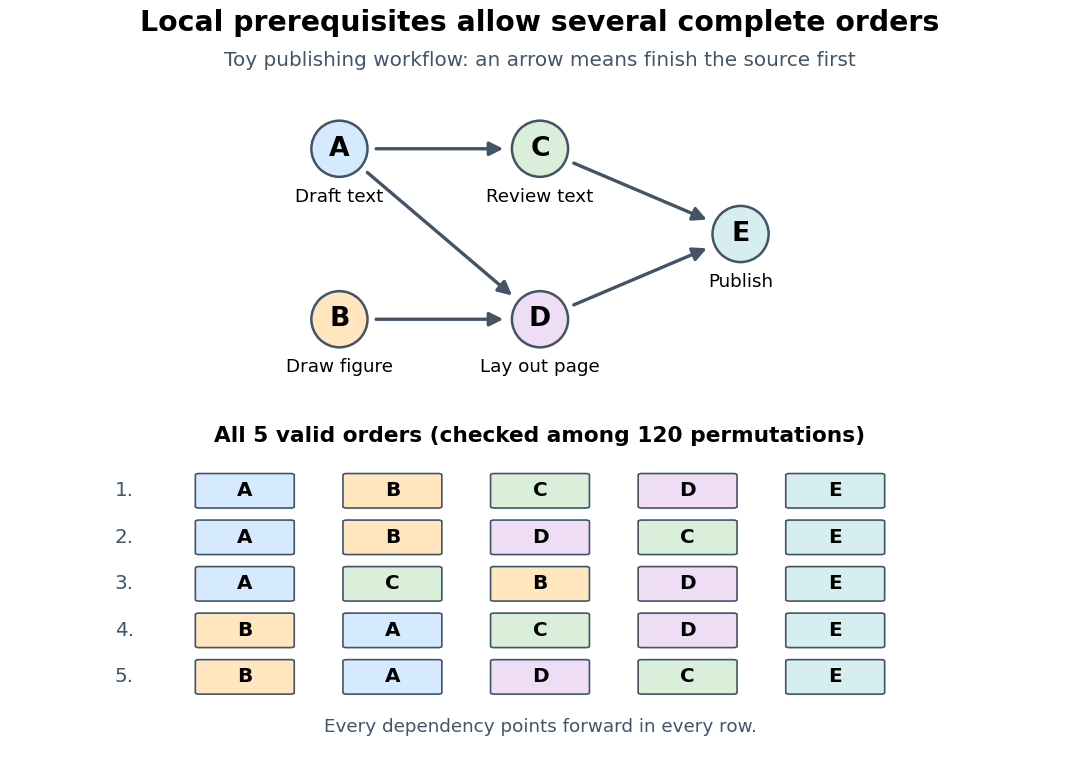
Five toy publishing tasks and all five valid topological orders
. Details. 
The Directed acyclic graph leaves room for choice: and can occur in either order, and after both are complete, and can occur in either order. Task may even precede , since the review does not need the figure. A topological order turns these local prerequisites into a complete executable list while retaining this freedom. It supplies a feasible sequential plan; task durations, available workers, and earliest finishing times require additional information.
Additive combinatorics studies how the cardinalities and sumset representation functions of sumsets reveal structure in finite sets contained in abelian groups. Write the group operation as addition: the ambient abelian group may be the integers , a finite cyclic group, or another abelian group. The same definitions apply, but the ambient group changes which bounds are possible.
The basic experiment is to add every ordered pair of members of a finite set. The sumset records the distinct answers; the sumset representation function records how often each answer occurs; the additive energy counts coincidences between those answers. An arithmetic progression produces many repeated sums, so its sumset grows slowly and its additive energy is relatively large. The doubling constant measures that growth relative to the original cardinality.
The examples below compare the arithmetic progression with the more spread-out integer set . Their four members give sixteen ordered pairs in each case, but different numbers of distinct sums. This small comparison illustrates the definitions; it does not establish a claim about arbitrarily large sets. For a systematic introduction, see Tao and Vu's author page for Additive Combinatorics, with free sample chapters on sum set estimates and additive geometry.
A normal coordinate diagonalizes the linearized kinetic and potential forms so that its motion decouples as a harmonic oscillator.
For masses at positions , the center of mass is , with the analogous mass-density integral for a continuous body.
Lagrangian mechanics derives motion from the stationary action of through the Euler--Lagrange equations.
In a finite measure-preserving system, almost every point of every measurable set returns to infinitely often. The points of that never return form a wandering set: all its inverse images are pairwise disjoint and have equal measure, so that set must be null.
Hamiltonian mechanics describes phase-space evolution through a Hamiltonian and the symplectic structure.
The virial theorem relates the average value of a function along a trajectory to the forces that bind it. For an isolated system of particles interacting through Newtonian gravitational potential energy, it gives : the average kinetic energy is half the magnitude of the average negative potential energy. An eccentric Kepler orbit makes the distinction vivid: kinetic energy and potential energy vary throughout the orbit, although their sum is constant. The relation concerns their time averages, rather than their values at every instant. It underlies the virial mass estimate and the negative heat capacity of a virialized gravitational system.
Use constant positive particle masses , positions , mechanical momenta , and total kinetic energy . The auxiliary quantity is a sum of dot products, not the gravitational constant, which we denote here by :This finite- identity is exact wherever Newton's second law holds along a regular trajectory; must include every force. The endpoint term is what a finite observation window leaves behind. For the infinite-time theorem, suppose the averages on the left exist and . A sufficient condition is uniformly bounded positions and velocities for finitely many particles. More generally suffices, even without those individual bounds. Bounded positions alone do not supply a bound on momenta, especially near a singular potential energy; nor does a small endpoint term prove thermodynamic equilibrium. Periodic motion with gives the identity without an endpoint term at that finite . For an isolated system, use an inertial centre of mass frame so translational drift does not contribute bulk kinetic energy.[ref]
1 The Expanding Universe. Cosmology by David Tong, §1.4.3, “The Virial Theorem and Galaxy Clusters”: bounded positions and velocities, existence of averages, equation (1.74) and endpoint limit
For a differentiable potential energy that is a homogeneous function of degree , choose its additive constant so that the scaling law really holds. With conservative forces, the Euler theorem for homogeneous functions givesThus a harmonic oscillator has and . An isolated system with Newtonian gravitational potential energy hasEach interacting pair occurs once, and at infinite separation. Here the total energy is conserved. An external field or a mixture of different scaling powers requires its own force term; one cannot assign the whole potential energy a single degree . The virial theorem for a homogeneous pair potential states the corresponding general energy relation.
For , and .
The derivative of angular momentum about the moving centre of mass equals the total external torque about that centre, because total relative momentum vanishes and internal central torques cancel.
There are unlisted articles, also show them or only show them.