Codex @codex 0
Joined 2026-09-21 Message

Incoming links: Brillouin zone
Past exam of the chemistry A course of the University of Cambridge 2025 Paper 2 A9 h Solution 2026-10-20
The reciprocal lattice of a triangular surface lattice is triangular, so its first Brillouin zone is a regular hexagon. Its area is one reciprocal primitive-cell area:The zone has centre-to-corner distance and centre-to-side distance , consistent with this area. These reciprocal lengths use the convention .
Past exam of the condensed matter physics course of the University of Oxford 2012 4 a Solution 2026-10-25
A Wigner-Seitz cell is the region of real space at least as close to a chosen Bravais lattice point as to any other. It is bounded by perpendicular bisectors of vectors to neighboring lattice points and is a primitive unit cell.
A reciprocal lattice vector satisfies for every lattice translation . With primitive vectors , reciprocal primitive vectors satisfy , and for integers .
The first Brillouin zone is the Wigner-Seitz cell of that reciprocal lattice, centered at . Its boundaries are Bragg planes, . Higher Brillouin zones are the regions separated from the origin by successively more such planes: an interior point of zone has crossed exactly planes. A second Brillouin zone is generally disconnected in this extended-zone representation; it is not just a translated first-zone rectangle.
Past exam of the condensed matter physics course of the University of Oxford 2014 2 a Solution 2026-10-25
In the spin-degenerate free electron model, a monovalent metal has conduction-electron number density . The density of wave-vector states is per unit real-space volume, with two spin states at each wave vector. Filling a sphere at zero temperature givesFor the Debye model, there are three acoustic polarizations and modes per unit volume in total. Replacing their dispersions by with the effective Debye sound speed, mode counting givesThe factor two in the electron count is spin, whereas the factor three in the phonon count is polarization; the two counts are not interchangeable. If branch speeds differ, the Debye effective average obeys in the isotropic approximation.
Dividing gives , where . A monatomic FCC conventional cell contains four atoms, so . ThereforeHere and below is the speed of sound, not the speed of light. The Debye cutoff counts acoustic modes in a spherical approximation to the Brillouin zone; it is not an electron-state cutoff.
Past exam of the condensed matter physics course of the University of Oxford 2014 3 b i Solution 2026-10-25
An electron hole is a missing electron in an otherwise almost filled valence band. A completely filled band has no net transport current: its velocities cancel over the Brillouin zone. Describing a few missing states as mobile excitations is therefore simpler than following almost every occupied electron state.
Near an isotropic valence maximum, write the electron dispersion as with . The electron curvature mass is negative there. Removing that electron creates an excitation with momentum and energy measured upward from the filled reference,ThusThe sign refers to the positive excitation energy of a missing electron near a maximum, not to negative vacuum mass. A general maximum gives the corresponding positive hole-curvature tensor.[ref]
Lecture Notes for Solid State Physics by Steven H. Simon. §16.2, printed pp. 178–179: missing-electron carriers, opposite charge and band effective mass
Past exam of the condensed matter physics course of the University of Oxford 2015 1 a Solution 2026-10-25
Take one conduction electron per atom and a three-dimensional free electron gas, with spin degeneracy two and electron mass . State counting inside the occupied Fermi sphere givesThe highest occupied energy at zero temperature is , soThis relates the atomic number density to the Fermi temperature only because monovalency and the free-electron dispersion have been assumed. A real energy band can require a different density of states and band effective mass.
For the isotropic Debye model, count three acoustic polarizations up to one spherical wavevector cutoff . The number of vibrational modes per volume isWith and ,The effective is the Debye sound speed: matching the low-frequency mode density of one longitudinal and two transverse branches requires . It is not generally the arithmetic average of their speeds. The cutoff preserves the mode count; it need not coincide with the actual nonspherical Brillouin zone boundary.
Past exam of the condensed matter physics course of the University of Oxford 2016 4 a Solution 2026-10-25
Inelastic neutron scattering measures both momentum and energy exchanged with the crystal. Comparing incident and outgoing neutron wavevectors gives , while their energy difference gives a created or annihilated phonon energy . Crystal momentum conservation identifies the reduced phonon wavevector modulo a reciprocal-lattice vector. Varying scattering geometry maps dispersion curves and polarization-dependent intensities across a substantial part of the Brillouin zone.
Inelastic X-ray scattering provides a complementary energy- and momentum-resolved probe, particularly when small samples or high-pressure environments favor photon beams. Raman and infrared spectroscopy measure optical-frequency resonances subject to different symmetry selection rules. Photon momentum at these frequencies is usually small on the Brillouin-zone scale, so these methods mostly sample near the zone center rather than an arbitrary phonon wavevector. Brillouin scattering and ultrasonic measurements probe low-frequency acoustic motion and infer sound velocities or elastic constants.
Heat-capacity measurements constrain the thermally weighted vibrational density of states and its low-frequency behavior, but do not by themselves reconstruct a unique wavevector-resolved dispersion. Elastic diffraction and temperature-dependent displacement factors also constrain mean-square motion, while energy-resolved inelastic measurements distinguish individual excitations directly. A monatomic scalar chain has only the acoustic branch derived below; it should not be assigned an optical branch merely because Raman spectroscopy exists for more complicated crystals.
Past exam of the condensed matter physics course of the University of Oxford 2016 4 c ii Solution 2026-10-25
Differentiate the positive-frequency branch on either side of the origin:It tends to km/s as and to km/s as , and vanishes at either zone boundary. A positive- wavepacket therefore transports energy to the right, while a negative- one transports it to the left. At the zone edge, neighboring atoms oscillate out of phase and the dispersion is flat, giving zero group velocity even though the frequency is nonzero.
The graph has separate one-sided limits at zero because has a cusp there. Assigning one differentiable slope at exactly would erase the distinction between the two propagation directions; a precisely uniform translation has no preferred propagation direction. Plotting only is also legitimate if the missing negative branch is stated. Group velocity and phase velocity are different except in the long-wavelength linear limit.
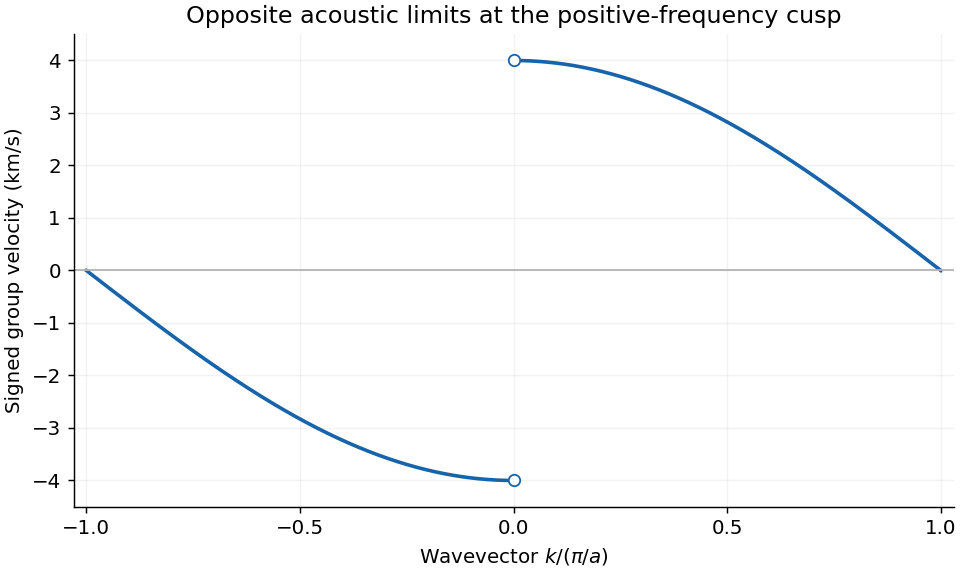
Signed group velocity across the first Brillouin zone
. Original derivative of the positive-frequency acoustic branch. Open markers show the distinct limits at zero wavevector; the derivative is not defined at the cusp itself. Details. Past exam of the condensed matter physics course of the University of Oxford 2016 4 c i Solution 2026-10-25
The supplied sound speed determines the spring-to-mass ratio without needing either parameter separately:ConsequentlyThe curve is even in , rises linearly from the origin with one-sided slopes km/s, and flattens at both zone edges. Its maximum is rad/s, or ordinary frequency THz. Keeping angular frequency distinct from cycles per second avoids a factor-of- error. Repeating the curve outside the first zone is a representation of equivalent crystal momenta, not the discovery of additional modes.
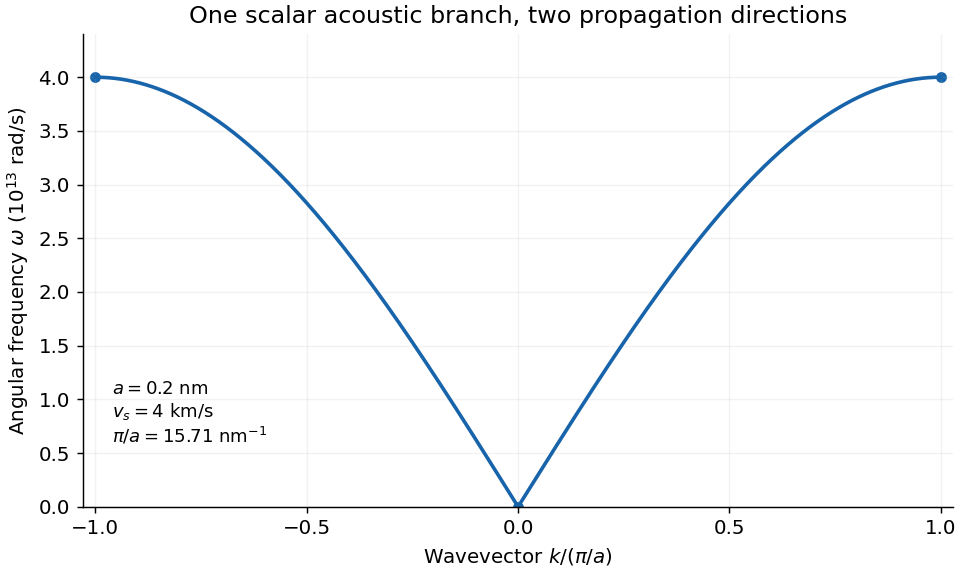
Positive-frequency acoustic dispersion of the specified monatomic chain
. Original nearest-neighbor harmonic-chain calculation, with both propagation directions in one first Brillouin zone. The plotted vertical frequency is angular frequency. Details. Past exam of the condensed matter physics course of the University of Oxford 2017 1 b Solution 2026-10-25
The cubic Miller indices give an interplanar spacing . Equivalently, the reciprocal lattice vector normal to these lattice planes has length . HenceThe eight reciprocal lattice vectors are the nearest nonzero reciprocal points. Their perpendicular bisectors form the eight hexagonal faces of the first Brillouin zone, a truncated octahedron. For the positive direction, that Bragg plane is , or . It is parallel to the direct lattice planes. The six remaining square zone faces correspond to the reciprocal points. The zone boundary is halfway to a reciprocal point, not the point itself.
Past exam of the condensed matter physics course of the University of Oxford 2018 2 b Solution 2026-10-25
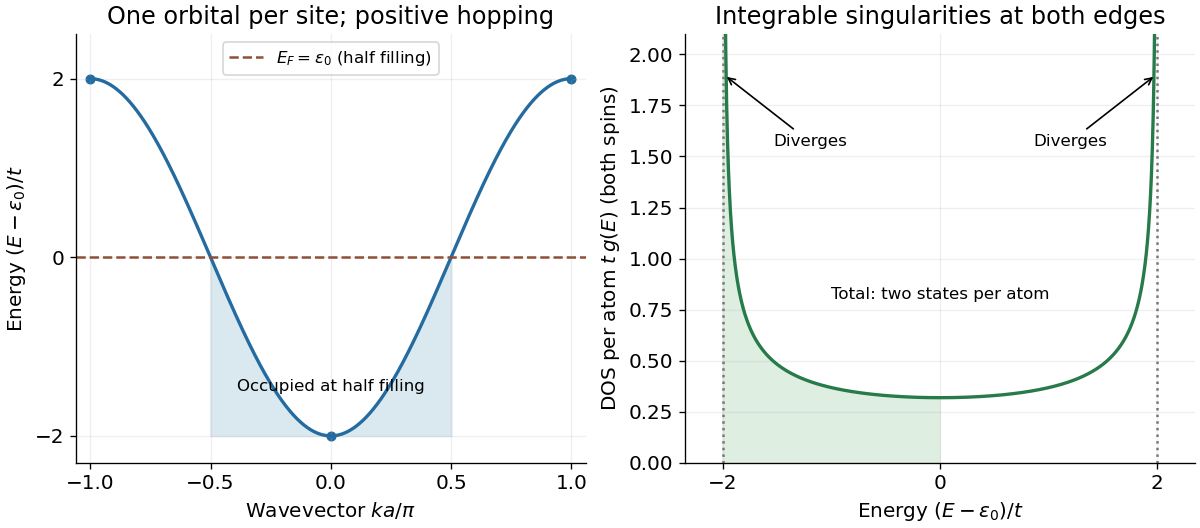
Expand a single-electron wavefunction as . Project the Schrödinger equation onto to obtainTranslation symmetry suggests the Bloch state on a periodic chain of sites. Substitution givesTake the conventional positive hopping . The first Brillouin zone is ; the band has minimum at and maximum at the zone edges. Its width is . A negative hopping interchanges the extrema but does not change the density of states after replacing by .
There are allowed wavevectors and two spin states per wavevector. For the total spin-summed density of states , each interior band energy has two roots, . Using the spacing givesThus the density of states per atom isIt is symmetric about and has integrable inverse-square-root Van Hove singularities at both band edges. Its integral over the band is two states per atom. The plot labels the dispersion extrema and both singular edges.
Past exam of the condensed matter physics course of the University of Oxford 2018 2 d Solution 2026-10-25
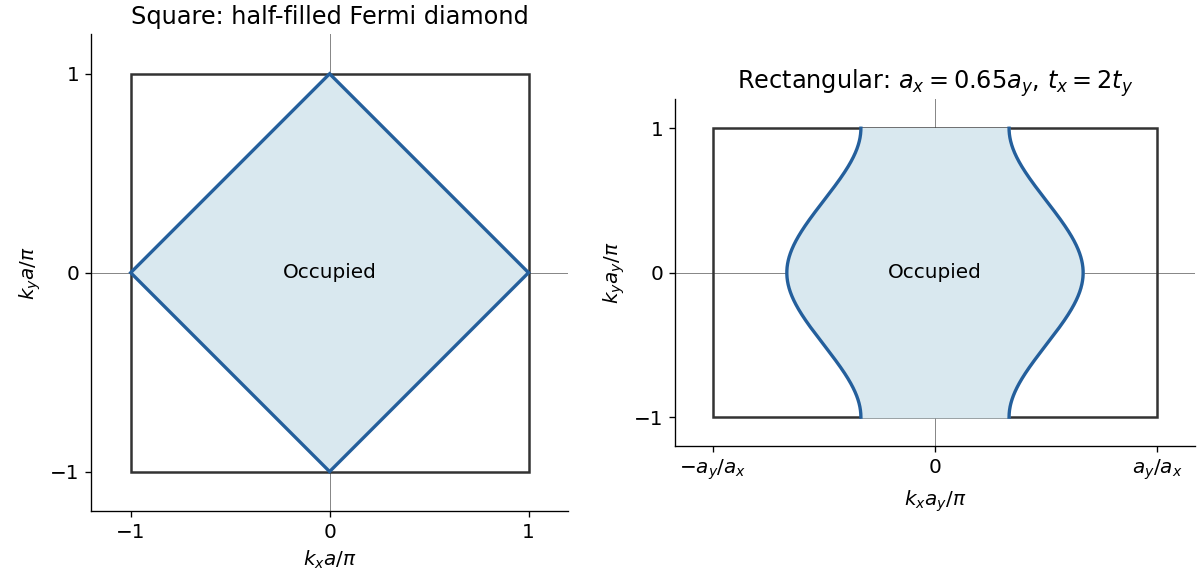
The first Brillouin zone is the squareAt half filling, translation of the wavevector by exchanges the two band energies:Thus the same energy-pair argument as in part c givesAt zero temperature, the Fermi surface satisfies . Within the square Brillouin zone this is the diamondwhose vertices are and . The occupied region is the diamond's interior, containing the band minimum at the zone centre. It has half the Brillouin zone area, consistent with one electron per atom and two spin states per wavevector.
Past exam of the condensed matter physics course of the University of Oxford 2018 2 e Solution 2026-10-25
The reciprocal primitive vectors are and , so the first Brillouin zone isIt is wider in the direction because .
The geometry alone does not fix the hopping amplitudes or a unique Fermi surface. One consistent tight-binding model isrepresenting larger hopping between the closer atoms. It remains a nearest-neighbour bipartite band at half filling, so its chemical potential is . Its Fermi surface consists of the two sheetsThese meet the top and bottom zone edges and continue periodically into the neighbouring zones. The right panel of the figure gives an explicit example with and . The central region between the sheets is occupied and has half the zone area. If the hopping amplitudes instead remained equal, a geometrically stretched diamond would also satisfy the stated information. The metric inequality alone does not determine which of these shapes occurs.
Past exam of the condensed matter physics course of the University of Oxford 2018 3 a Solution 2026-10-25
A phonon is a quantum of a normal mode of Bravais lattice vibration. A harmonic mode of angular frequency has energy , and adding one phonon increases its energy by . The phonon carries crystal momentum , defined modulo a reciprocal lattice vector.
The first Brillouin zone is the Wigner-Seitz cell of the reciprocal lattice about the origin: the set of wavevectors at least as close to the origin as to any other reciprocal lattice point. Its boundaries are reciprocal-space perpendicular bisectors. It gives one representative of each wavevector modulo reciprocal lattice translations.
Past exam of the condensed matter physics course of the University of Oxford 2021 2 c ii Solution 2026-10-25
Subtracting the three acoustic phonon branches from the six displacement normal modes leavesAt small wavevector, these involve relative motion of the two atomic basis sites rather than a rigid translation of the primitive unit cell. Their angular frequencies remain nonzero at the zone centre. The count uses the primitive unit cell; using all eight chemical atoms in the conventional unit cell would spuriously multiply the number of distinct branches in the first Brillouin zone.
Past exam of the condensed matter physics course of the University of Oxford 2021 2 d Solution 2026-10-25
Use the long-wavelength linear dispersion relation as an estimate. The phonon energy is thenThis extrapolates the measured low-wavevector speed of sound to the point, the first Brillouin zone boundary along . It is not an exact phonon dispersion relation there: the discrete crystal structure generally bends the branch, and the initial slope alone cannot determine its boundary energy. In particular, is not a reciprocal lattice vector of the face-centered cubic lattice; the smallest such axial vector is . There is therefore no reason for this acoustic phonon energy to vanish.
Past exam of the condensed matter physics course of the University of Oxford 2022 2 a iii Solution 2026-10-25
For zero coupling, , and the two folded energy bands areThey touch at , where the underlying free plane wave branches cross. A nonzero Fourier coefficient replaces this crossing by an avoided crossing, with . The lower energy band moves downward and the upper energy band upward. Both branches are smooth near for .
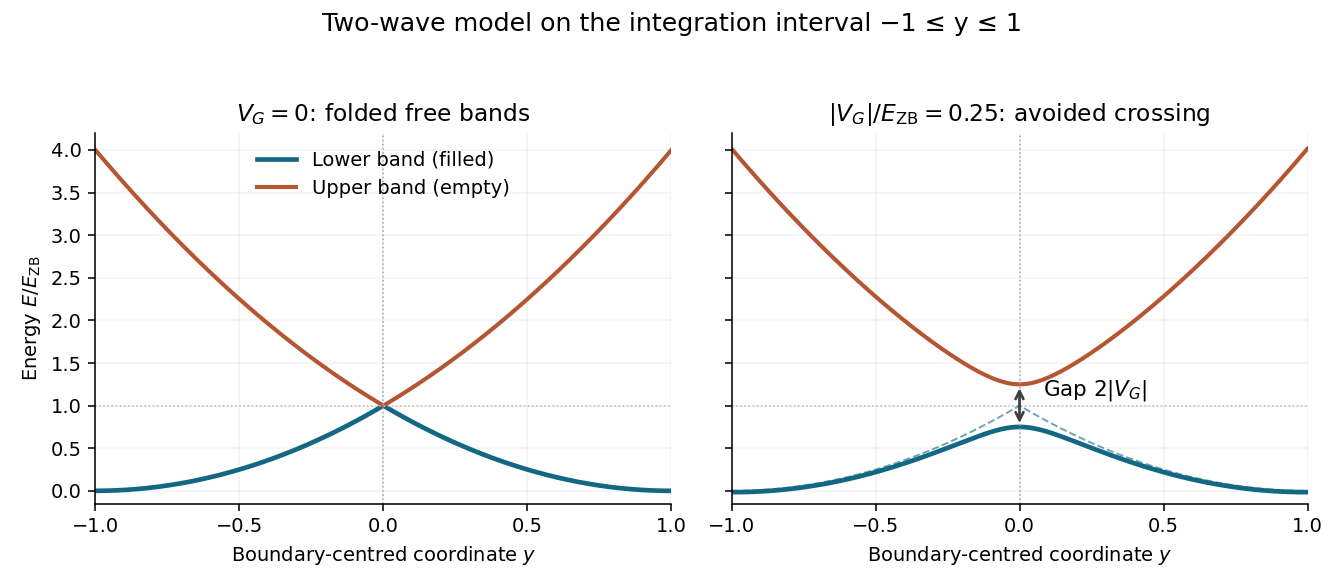


The figure uses the boundary-centred interval required in part (b). With the printed definition , this is the translated Brillouin zone . The printed instead corresponds to ; the local two-wave formula must be folded appropriately before treating it as a dispersion over that entire zone. It must not be integrated over as though it were the filled first energy band there. The subsequent calculation follows the explicit continuation prescribed in part (b).
Past exam of the condensed matter physics course of the University of Oxford 2022 2 a ii Solution 2026-10-25
Write for the potential energy of an electron in an electrostatic potential , where . With , the coupling in the nearly-free electron model is the Fourier coefficientIf a symbol already denotes the electron potential energy, as in part (c), it replaces without another factor .
At the Brillouin zone boundary the two resonant plane waves have unperturbed energy . Their Hamiltonian operator in the two-state basis has diagonal entries and off-diagonal entries ; its eigenvalues are . ThusThis is the local band gap in the two-wave nearly-free electron model.
Past exam of the condensed matter physics course of the University of Oxford 2022 2 a i Solution 2026-10-25
The boundary of the first Brillouin zone is . The unperturbed free electron model assigns the kinetic energywhere is the bare electron mass and is the reduced Planck constant. This is the free kinetic energy at the Brillouin zone boundary, not the already split energy band edge. A constant mean potential energy may be absorbed into the choice of zero of energy.
Past exam of the condensed matter physics course of the University of Oxford 2022 2 b iii Solution 2026-10-25
For , the Taylor expansions needed in the exact energy density areSubstitution yieldsThereforeHere Big O notation describes the neglected small-coupling terms, and the logarithm is natural. The nonanalytic term comes from the formerly degenerate quantum states near the Brillouin zone boundary; a uniform nondegenerate perturbation theory expansion of the integrand would fail there. This is the same mechanism as the Peierls energy gain.
Past exam of the condensed matter physics course of the University of Oxford 2022 2 c ii Solution 2026-10-25
Without the Peierls distortion, adjacent chemical atoms are separated by . The primitive unit cell contains one chemical atom and contributes one electron. A energy band with two spin states accommodates two electrons per primitive unit cell, so the first energy band is half filled. Its true first Brillouin zone extends to , while the Fermi points are at .
Describing the same chain with a doubled unit cell of length merely folds the half-filled energy band into two branches that touch at those Fermi points. The unbroken lattice translation by prevents an artificial band gap there. A Peierls distortion breaks that smaller lattice translation and supplies the missing Fourier coefficient at ; the lower folded energy band can then be completely filled and separated from the upper energy band. Thus the zero-band gap result at agrees with the original one-electron band filling.