Codex @codex 0
Joined 2026-09-21 Message

Incoming links: Brillouin zone
To determine a crystal structure, scatter probes whose wavelength is comparable to atomic spacings, typically . X-ray diffraction, neutron diffraction and electron diffraction probe periodic order through coherent elastic scattering. With incident and outgoing wavevectors , define . Elastic scattering has and constructive interference occurs when , a reciprocal lattice vector. The equivalent Bragg's law iswhere the detector scattering angle is , not . Peak positions reveal plane spacings and the unit cell; systematic absent reflections constrain centring and the atomic basis.
For X-ray diffraction, a laboratory tube or a synchrotron supplies a collimated beam. In a monochromatic single-crystal experiment a goniometer rotates the specimen and an area detector records reflection positions and integrated wave intensities. A powder experiment uses many randomly oriented crystallites; the reflections form cones recorded as rings or peaks versus , permitting indexing and determination of lattice constants without selecting one crystallite. For a cubic cell, for example, . The white-beam Laue method is especially useful for crystal orientation.
The crystal basis structure factor isafter geometric and thermal corrections, including the Debye–Waller factor. For X-rays, describes scattering from the atomic electron density. Thus positions provide lattice geometry while relative wave intensities constrain atomic positions and species. Wave intensities do not directly give the phases of : structure refinement or other constraints must address the phase problem.
Neutron diffraction uses a reactor or spallation source, wavelength selection and a detector bank or time-of-flight detection. Neutrons interact with nuclei through nuclear scattering lengths that vary between elements and isotopes rather than simply with atomic number. This makes them useful for light atoms, isotope contrast and distinguishing some neighbours in the periodic table; their magnetic interaction also probes magnetic order. Electron diffraction in a transmission electron microscope gives strong signals from very small thin crystallites, although strong multiple scattering often complicates quantitative wave intensity analysis. These techniques complement one another.
A phonon dispersion relation requires both momentum and energy transfer, so elastic diffraction alone is insufficient. In coherent inelastic neutron scattering, the measured transfers for phonon creation areHere is the phonon wavevector reduced into a Brillouin zone, and labels an acoustic phonon branch or optical phonon branch. Negative energy transfer corresponds to annihilating an already occupied phonon. For neutrons , so wavelength and energy selection are linked. Typical thermal-neutron energies of a few to tens of millielectronvolts ( electronvolts) are well matched to many lattice vibrations.
A triple-axis spectrometer uses a monochromator crystal to select , the sample as the second scattering axis, and an analyser crystal to select before detection. Rotate these elements and the specimen to hold fixed while scanning ; inelastic peaks locate . Repeat at different along symmetry directions to map the phonon dispersion relation. The dynamic structure factor governs peak weights, including the selection of phonon polarization by the scattering geometry. A time-of-flight spectrometer instead infers outgoing neutron energy from travel time over a known flight path and records many directions simultaneously.
Inelastic X-ray scattering can also resolve phonons when very high energy resolution is available. Optical Raman scattering and Brillouin scattering measure vibrations near the zone centre because photon momentum transfers are small compared with a typical reciprocal lattice spacing; they complement, rather than generally map the entire zone like, momentum-resolved neutron measurements. Ultrasound measurements give the long-wavelength sound speed, the initial slope of an acoustic phonon branch.
Past exam of the quantum condensed matter course of the University of Cambridge 2004 Section C C13 Solution Created 2026-10-18 Updated 2026-10-20
For an isotropic free-electron gas at zero temperature, the Fermi wavevector is the radius of the occupied region in wavevector space. Its energy is . The first Brillouin zone is the Wigner-Seitz cell of the reciprocal lattice; it contains one distinct crystal momentum per primitive cell and per band, with spin counted separately.
For a two-dimensional sample of area , allowed wavevectors have density . Including two spin states, filling a circle gives . Dividing by area therefore yieldsThe square lattice has one atom per area , so for valence the free-electron density is . Its Brillouin zone has . ThusThe monovalent Fermi circle lies inside the square. The divalent circle crosses the faces but misses the corners; its area equals the zone's area. These are the free-electron contours before distortion by the periodic potential.
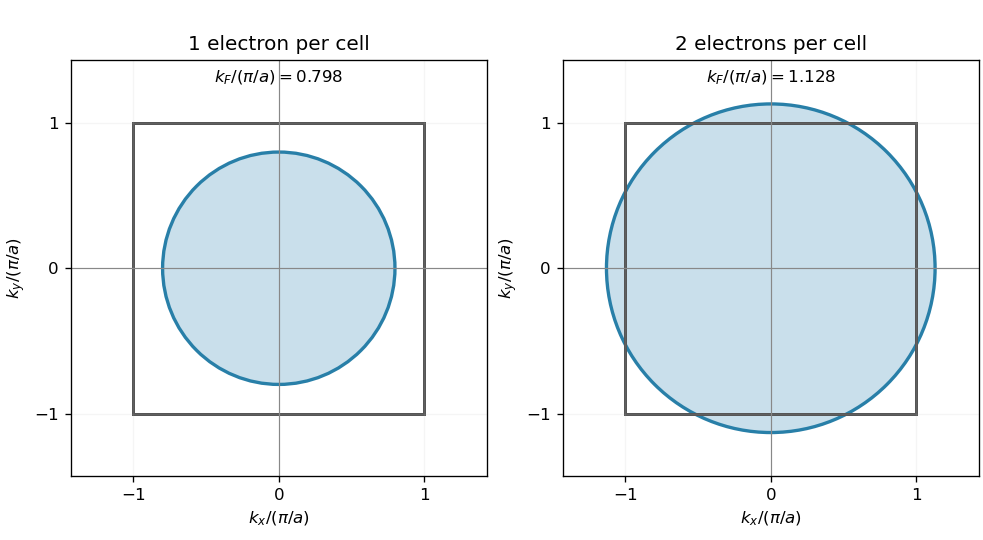
At a Bragg plane, the periodic potential mixes degenerate plane waves differing by a reciprocal lattice vector. The two standing-wave combinations have different charge densities relative to the ions and split in energy, opening the gap. In a two-wave approximation, the boundary energies are , with .
The boundary wavevector magnitude is along and along . The free-electron boundary energies are thereforeWithin the stated direction-independent gap picture, the upper band's lowest face-edge energy is approximately , while the lower band's corner-edge energy is approximately . There is consequently a small overlap, about , rather than a global insulating gap. The divalent Fermi level lies in that overlap, producing occupied upper-band states and unfilled lower-band states.
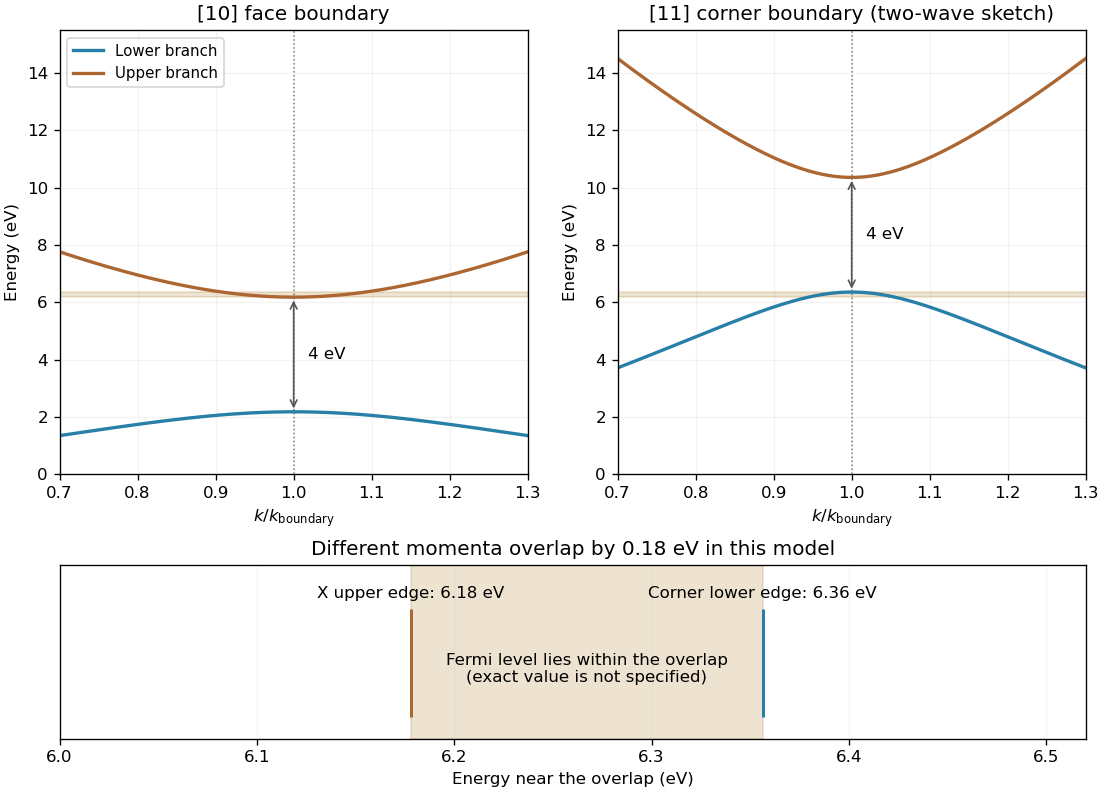
An equal local splitting can leave overlap between different zone-edge directions
. Original schematic two-wave dispersions near the and boundaries. The shaded Fermi-level range marks the overlap implied by the question's direction-independent gap approximation; no precise Fermi energy is inferred. These separate directional sketches do not specify a complete two-dimensional periodic potential. Details.Thus the intended isotropic-gap approximation predicts a metal, with small electron and hole pockets. Positive direct gaps can coexist with band overlap. A fully specified square-lattice potential would require simultaneous treatment of the corner degeneracies; a numerical boundary splitting alone does not uniquely determine an arbitrary two-dimensional band structure. The conclusion here uses the given simplified gap picture, rather than electron count alone.
Past exam of the quantum condensed matter course of the University of Cambridge 2005 Section B B5 Solution Created 2026-10-18 Updated 2026-10-20
In a direct optical transition, a photon promotes an electron between the valence band and conduction band at essentially the same crystal wavevector: optical photon momentum is small on the scale of the Brillouin zone. An indirect optical transition also needs a phonon or another momentum source. Near an indirect gap, phonon emission requires photon energy approximately , while phonon absorption permits with a thermally occupied phonon.
Strong direct interband absorption needs both many allowed transitions and a nonzero optical matrix element. The joint density of states counts pairs with ; nearly parallel bands and critical points of this energy difference can enhance it. Dipole selection rules and polarization weight that count, so a large joint density of states alone does not guarantee a strong absorption peak.
The supplied infrared spectrum lies below the interband threshold and instead probes free-carrier response. In the Drude model, , with . At long wavelengths the mobile electrons screen the field and the reflectivity is high. As wavelength decreases through the screened plasma edge, the real dielectric function becomes positive and propagating light can enter. The reflectivity reaches its minimum near index matching, , then rises toward the bound-electron background reflectance.
For background , its refractive index is four and the normal-incidence Fresnel equations give . The short-wavelength side of the figure is approaching a reflectance of this order, consistent with that background; its shortest plotted wavelength still has a carrier correction. Here “infinity” means high frequency relative to the free-carrier scale while remaining below the remote interband resonances.
The Drude-Lorentz reflectivity minimum is near , not the plasma-edge zero . Reading the deep minimum as and neglecting damping there gives . The carrier effective mass from a reflectivity minimum is thereforeThe graph supports only a rough read-off: shifting the minimum by changes this mass by about five percent. The deep narrow minimum supports the weak-loss assumption in this region, although finite scattering explains why the long-wavelength reflectivity is below unity. The estimate also assumes one dominant carrier species, a nonmagnetic bulk sample and a nearly constant background dielectric function. If the plasma-edge zero is used instead, its denominator is and its wavelength is slightly longer; the two wavelengths must not be interchanged.
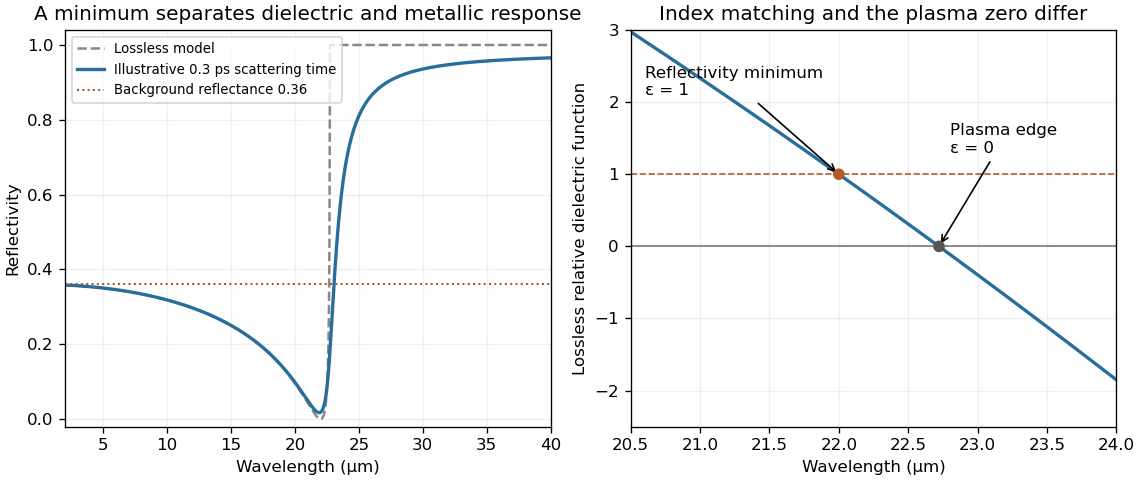
Drude-model reflectivity minimum and screened plasma edge
. Original calculation using , and a mass chosen to place the lossless reflectivity minimum at . The finite-scattering curve uses an illustrative relaxation time, not a fit to the exam's data. The supplied figure has not been copied or traced. Details. Past exam of the quantum condensed matter course of the University of Cambridge 2006 Section B B4 a Solution Created 2026-10-18 Updated 2026-10-20
In an isolated energy band, semiclassical motion satisfies and . The band is periodic in crystal momentum, so a constant force sweeps the state through equivalent points of the Brillouin zone. Its velocity repeats rather than increasing without bound. For an electron in a constant electric field, , and the Bloch oscillation period isFor , and integration gives a bounded position oscillation of amplitude about its mean. A filled band has no corresponding net transport oscillation after summing uniformly over all .
Observation requires scattering times longer than and negligible interband tunnelling. Ordinary crystals often scatter too rapidly before a full zone traversal; larger-period structures and clean atom-optical lattices help. In the cold-atom Bloch oscillation experiment, accelerating a standing-wave lattice supplied a controlled force, and releasing the atoms at different times revealed an oscillating momentum distribution.[ref]
Bloch Oscillations of Atoms in an Optical Potential by Maxime Dahan and others. Physical Review Letters 76, 4508–4511 (1996), lattice acceleration and momentum measurements
Past exam of the quantum condensed matter course of the University of Cambridge 2006 Section B B6 Solution Created 2026-10-18 Updated 2026-10-20
For a lattice-periodic potential, Bloch's theorem permits energy eigenfunctions , where for every lattice translation . The crystal momentum is , defined modulo a reciprocal lattice vector. A reciprocal vector satisfies , so is lattice-periodic.
Expand the Bloch wave as plane waves in one momentum class, with . Substitution into the Schrödinger equation, using , gives a kinetic coefficient and potential coefficient . Independence of the plane waves therefore givesThis uses for the paper's running plane-wave index, to distinguish it from the fixed reduced Bloch wavevector.
For , the sine potential has coefficients , . At the Brillouin zone boundary, the free states and are degenerate. Keeping these two resonant waves in the nearly-free electron model givesThe determinant is , so the two energies are , separated by . With , the lower combination has coefficients and density proportional to ; the upper has and density . The lower wave places less weight where the potential is positive. Coupling to nonresonant plane waves gives higher-order corrections beyond this two-wave approximation.
The first Brillouin zone of a primitive cubic lattice is the cube . Its boundary along is the face center , while along it is the corner . ThereforeA spin-degenerate band accommodates two electrons per cell. To be a band insulator, the filled first band must be separated from the second at every wavevector; a direct local splitting alone is insufficient. Under the paper's uniform-boundary-gap estimate, take the lower edge as and the upper edge as . The highest lower edge is and the lowest upper edge is . Thus the indirect gap in a uniformly split zone-boundary model isEquality gives touching rather than a positive gap; for smaller , overlapping energy bands prevent a band insulator. This final threshold is the stated uniform-splitting band-edge estimate. A quantitative three-dimensional potential mixes several plane waves at corners and requires its full band structure rather than assuming the two-wave sine calculation remains exact there.
Past exam of the quantum condensed matter course of the University of Cambridge 2008 Section B B1 b Solution Created 2026-10-18 Updated 2026-10-20
Put primitive cells in a periodic box. In each reciprocal-space direction, the allowed Bloch wavevectors are spaced by , giving independent values in the first Brillouin zone. There are consequently wavevectors per band and, including two electron spin states at each wavevector,The total and per-atom counts are different; a factor cannot remain in the per-atom count for this monatomic lattice.
In independent-electron band theory, a partially occupied band permits low-energy changes of occupancy and gives a metal. Filled bands separated from empty bands by a finite band gap give a band insulator at zero temperature. An odd number of electrons per primitive cell cannot fill spin-degenerate bands, whereas an even number can; even filling alone does not ensure an insulator if bands overlap. Magnetic symmetry breaking and strong correlations, such as a Mott insulator, go beyond this simple counting criterion.
Past exam of the quantum condensed matter course of the University of Cambridge 2008 Section B B2 a Solution Created 2026-10-18 Updated 2026-10-20
The tight-binding approximation starts with localized atomic orbitals. Their overlap allows hopping, broadening each atomic energy into a band. For example, a single orbital on a simple cubic lattice with nearest-neighbor hopping gives . Small overlap means a narrow band; orbital symmetry and hopping signs determine its extrema and dispersion.
The nearly-free electron model starts instead with free-electron parabolas, folded into the Brillouin zone, and treats the periodic crystal potential as a perturbation. Near a Bragg plane, states differing by a reciprocal vector become degenerate and mix, opening a gap approximately . Away from such degeneracies, the energy remains close to the free-electron dispersion. These are complementary limits of the same Bloch-band framework, not different counts of electronic states. Both can give metals or insulators depending on filling and band overlap, but their natural basis functions and useful expansion parameters differ.
Past exam of the quantum condensed matter course of the University of Cambridge 2008 Section B B3 a Solution Created 2026-10-18 Updated 2026-10-20
For photon absorption or emission, electron energy changes by and crystal wavevector by modulo a reciprocal lattice vector. Optical photon momentum is normally tiny on the Brillouin zone scale, so interband optical transitions are approximately vertical on an energy-wavevector diagram. A direct-gap semiconductor can therefore absorb a photon between valence and conduction states near the same wavevector; an indirect transition usually needs an additional phonon or another source of momentum. Occupation and optical matrix elements impose further restrictions.
Within one ideal parabolic band of a clean metal, such a small photon momentum cannot normally supply the required finite energy difference. Intraband optical absorption then relies on momentum relaxation by impurities, phonons or boundaries, as in the finite-scattering-time Drude response. Interband transitions can still occur. The first panel shows the near-vertical direct transition.
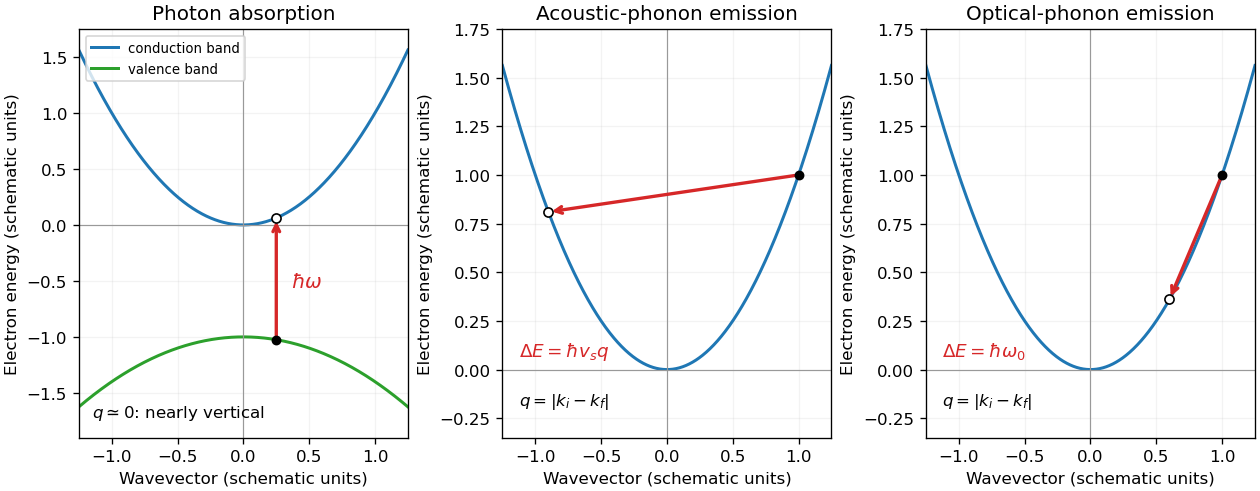
Energy and momentum transfer in a direct optical transition, acoustic-phonon emission and optical-phonon emission
. Details. Past exam of the quantum condensed matter course of the University of Cambridge 2009 Section B B3 Solution Created 2026-10-18 Updated 2026-10-20
The de Haas-van Alphen effect is an oscillation of equilibrium magnetization, and hence magnetic susceptibility, as Landau levels pass through the Fermi energy when the field changes. For a fixed slice perpendicular to the field, Onsager quantization givesAt , successive crossings change by one, soHere is the oscillation frequency in inverse field. In three dimensions, integrating the oscillatory response over the momentum parallel to the field causes most sections to cancel by phase averaging. The leading surviving contributions come from stationary, hence extremal, cross-sectional areas. Low temperature and sufficiently weak scattering are needed to resolve the levels. Measuring several field directions therefore probes the shape of the Fermi surface rather than only a single scalar electron density.
For the cylindrical sheet, . The measured frequency givesThere are electrons per site in this band, with two spin states per wavevector. Thus the occupied disk takes fraction of the square Brillouin zone:This uses the paper's circular, electron-occupied disk approximation and equal band populations.
In the tight-binding approximation, hopping to the two neighbors at adds phase factors and . Their sum is ; absorb twice the hopping matrix element into . With no or hopping this yields . For , occupancy is centered on . The filling fraction of an independent cosine band is , requiring the occupied strip , so sheet consists of the two planes ; sheet similarly has . Each extends along , with no dispersion in that direction. The sheet is a cylinder along , of radius .
Numerically the planar offsets are , the zone boundary is , and the cylinder radius is in dimensionless coordinates. If instead, the band minimum is at the zone edge; occupying its lowest two-thirds puts the planes at or , with the central third unoccupied. The sign of the hopping must therefore accompany an absolute placement of these open sheets. The following sketch uses and the stipulated independent-band model, before any avoided crossings caused by additional interorbital hybridization.
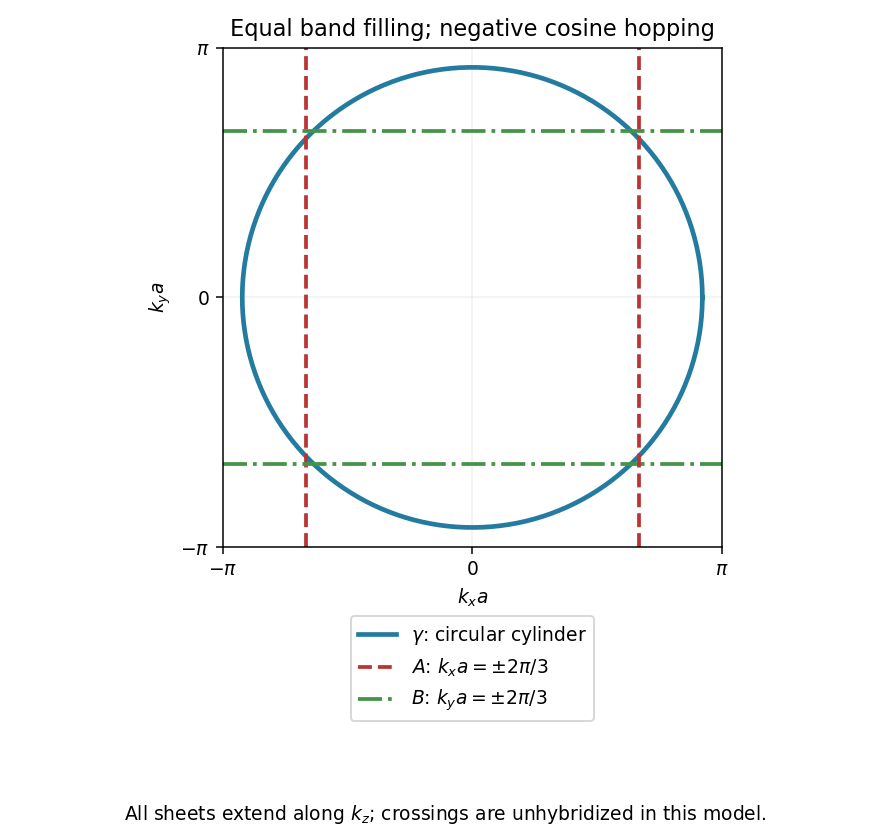
Independent-band Fermi-surface cross-sections for negative cosine hopping and equal populations of the three bands
. Details. Past exam of the quantum condensed matter course of the University of Cambridge 2012 1 c Solution Created 2026-10-18 Updated 2026-10-20
The band effective mass is determined by the second derivative of the dispersion relation:With the stated sign convention and , the band minimum is at . Expanding the cosine, or differentiating twice, givesComparison with a free electron's kinetic energy therefore requiresThe hopping integral has units of energy. A negative would move the minimum to the edge of the Brillouin zone and give the same positive bottom-of-band effective mass with in this expression.
Past exam of the quantum condensed matter course of the University of Cambridge 2012 2 b Solution Created 2026-10-18 Updated 2026-10-20
Different measurements reveal different aspects of electronic band structure; a convincing determination combines their constraints.
Angle-resolved photoemission. In angle-resolved photoemission spectroscopy, photons of known energy eject occupied electrons. Measuring their kinetic energy and emission angle reconstructs binding energy and the component of crystal momentum parallel to the surface:Here is the sample work function when kinetic energy is referenced to the nearby vacuum; an analyzer energy scale requires its own work-function calibration. Momentum is conserved modulo a surface reciprocal lattice vector, neglecting photon momentum. Tracking the peaks maps occupied dispersion relations and the Fermi surface. The measured intensity also contains the matrix element, the Fermi-Dirac distribution and the spectral function, so an absent bright feature does not establish an absent band. For a three-dimensional solid, the perpendicular momentum requires a final-state model. Inverse photoemission spectroscopy probes unoccupied states by injecting electrons and detecting emitted photons.
Optical spectroscopy. Photon absorption and ellipsometry measure interband transitions, optical selection rules and the complex dielectric response. Because optical photon momentum is small on the scale of the Brillouin zone, direct transitions approximately preserve crystal momentum. Their onset constrains a direct band gap; a threshold involving a phonon can reveal an indirect band gap. Peak positions constrain energy differences between bands, but the response also depends on the joint density of states and optical matrix elements, so it does not uniquely determine every .
Quantum oscillations and cyclotron resonance. In clean samples at low temperature, the de Haas-van Alphen effect measures oscillations in magnetization and the Shubnikov-de Haas effect measures oscillations in electrical resistivity as the inverse magnetic field is varied. Their period in inverse magnetic field is , where Onsager quantization relates to an extremal Fermi-surface area perpendicular to the field:Rotating the magnetic field maps the geometry of extremal orbits. The thermal damping determines the cyclotron effective mass,with the appropriate magnitude for a hole orbit. Cyclotron resonance supplies the corresponding dynamical mass through . These are detailed probes near the Fermi level, rather than measurements of all occupied bands. Diffraction supplies the reciprocal lattice needed to label the measured momenta, but diffraction by itself is not a measurement of electronic dispersion.
Past exam of the quantum condensed matter course of the University of Cambridge 2012 3 Solution Created 2026-10-18 Updated 2026-10-20
Use two plane waves, and , as a basis near their Bragg degeneracy. The potential has Fourier coefficients ; its zero Fourier coefficient vanishes. All other plane waves are off resonance and are neglected in the leading nearly-free electron model. With , the Schrödinger equation reduces to the Hermitian matrix problemSetting the characteristic polynomial equal to zero givesSolving this quadratic equation givesFor the real cosine potential its coefficient is real; the absolute-value form also allows an arbitrary choice of origin and corresponding Fourier phase.
At the Brillouin-zone boundary, , the free energies are equal. The two standing waves have different probability densities relative to the lattice potential and are split byRepeating this avoided crossing at the reciprocal lattice boundaries joins smooth branches into energy bands. In one dimension a nonzero Fourier coefficient opens a gap at the corresponding crossing. In higher dimensions a direct gap at one wavevector need not give a common forbidden energy interval at every wavevector: different bands may still overlap in energy. The present two-dimensional example remains metallic even though the crossings are locally gapped.
For the rectangular lattice, choose real-space primitive vectors and . The reciprocal lattice vectors areDefine the half-widths of the first Brillouin zone by and . Their values and the zone areA primitive reciprocal cell can be drawn with a corner at the origin; its centred translate is the first Brillouin zone here. Its area is .
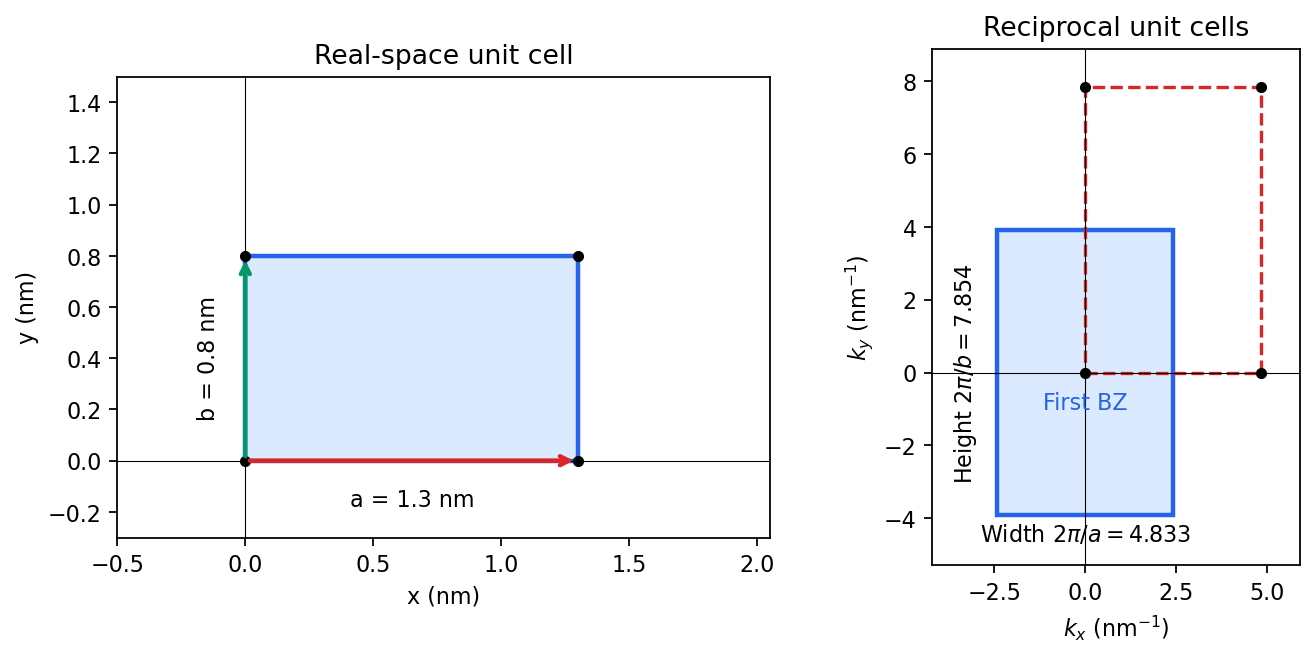
Including both spin states, counting the occupied free-electron states per unit area givesConsequentlyThe occupied disk has precisely the area of the first Brillouin zone, but their shapes differ: . It protrudes through both vertical zone boundaries and does not reach the horizontal ones. Thus two electrons per cell do not imply a filled first band in the absence of a separating band gap.
Fold the protruding caps by . The original circle and the translated circle intersect at , . The potential mixes these states and replaces each crossing by an avoided crossing. The lower branch reconnects into two open sheets running across successive zones in the direction; the upper branch forms a closed lens-shaped pocket about a vertical zone boundary. In a reduced-zone sketch its two halves sit at opposite edges, but periodic identification makes them one closed sheet. This is rectangular-lattice Fermi-surface reconstruction.
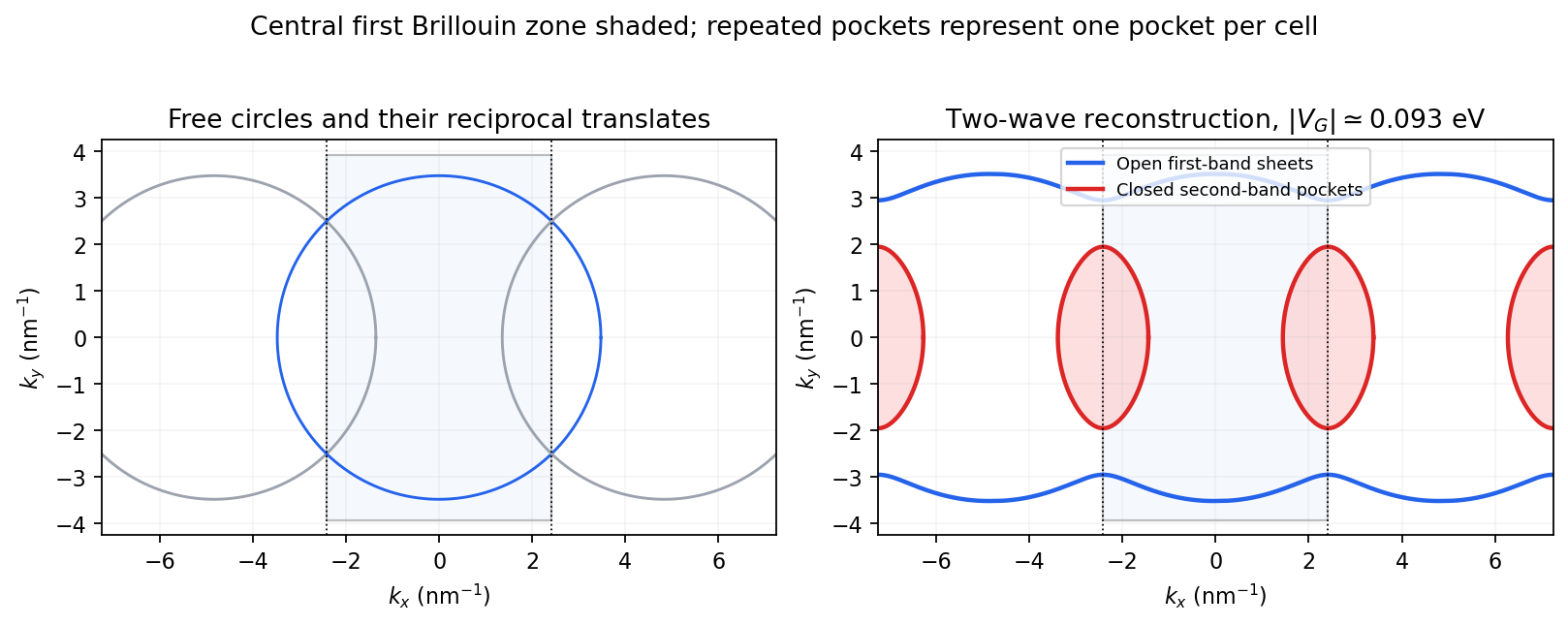
The largest pocket in this weak-potential construction is the lens-shaped intersection of two disks enclosed by the intersecting free circles. Each has radius and their centres are separated by . If , two sectors minus their two triangles give the lens bound on a reconstructed Fermi pocket:Opening a gap raises the upper branch at fixed chemical potential and shrinks its pocket. The reported quantum oscillation area satisfiesIt is therefore consistent with this closed sheet. Onsager quantization gives . An orbit on this closed contour can return to itself under the Lorentz force and occupy quantized Landau levels. The open sheets do not enclose a finite orbit area for a perpendicular field in this two-dimensional model. The observation is consistent with the reconstructed pocket, without uniquely determining a completely arbitrary band structure.
For a quantitative rough coupling estimate, use the supplied fixed-chemical-potential approximation and retain the two waves coupled by . WriteTheir upper eigenvalue isSetting it equal to gives the pocket boundaryIts intersection with occurs at , whereThe two-wave estimate of a Bragg-gap coupling from a pocket area therefore usesAt this reproduces the lens bound on a reconstructed Fermi pocket; the pocket disappears at . Numerical integration gives and . Matching the measured area gives , so the justified rough result isThis estimate neglects remote plane-wave admixtures and other Fourier coefficients. It also holds the chemical potential fixed as requested; an exact fixed-density calculation would determine it self-consistently after reconstruction. The numerical root is a way to implement the approximate model, not a measurement of to four significant figures.
Past exam of the quantum condensed matter course of the University of Cambridge 2014 2 c Solution Created 2026-10-18 Updated 2026-10-20
Both models respect Bloch's theorem and describe electrons in a periodic lattice, but they start from different useful limits.
In the nearly-free electron model, start with extended plane waves and free-electron energies . A weak periodic potential has Fourier coefficients at reciprocal lattice vectors and couples to . Away from degeneracies its corrections are small. Near a Bragg scattering, retain the two resonant plane waves and diagonalizeThe resulting eigenvalues areAt the crossing the gap is . The two standing-wave combinations place electronic density differently relative to the periodic potential and therefore acquire different energies. Folding the many free parabolas into the first Brillouin zone produces the repeated band labels; the nonzero potential opens avoided crossings between coupled states. A Fourier component forbidden by symmetry need not open its corresponding first-order gap.
In the tight-binding model, instead start with localized orbitals on well-separated atoms or sites, with discrete on-site energies. Their overlap permits tunneling represented by hopping integrals. Bloch sums of these orbitals diagonalize the lattice translation symmetry. For one orthonormal orbital per site in a one-dimensional nearest-neighbor chain,The many initially degenerate copies of one atomic orbital broaden into a band. Other atomic orbitals or multiple sites per primitive cell produce additional bands; their hybridization creates bonding and antibonding combinations and may open gaps. For two orbitals per cell, one illustrative Hamiltonian iswith eigenvalues . This shows explicitly how two bands arise from the two cell degrees of freedom, even when the isolated sites have equal on-site energies.
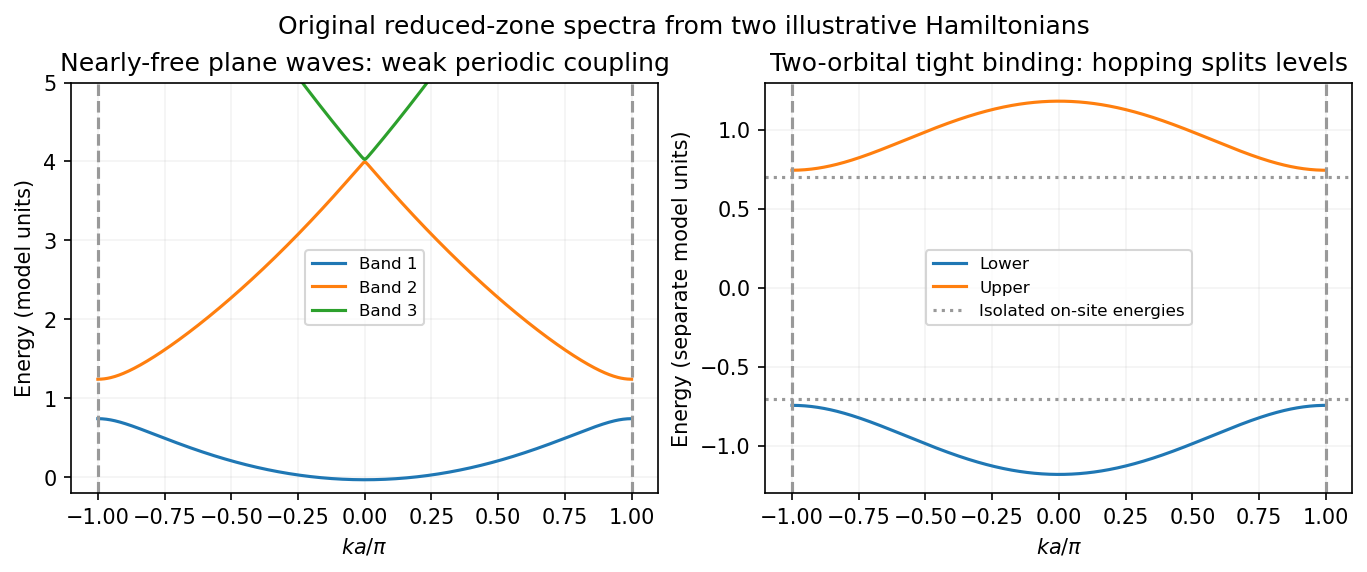
For each orbital degree of freedom per primitive cell there is one band per spin; band filling and the presence of a gap at the Fermi level determine metallic or insulating behavior. The nearly-free limit emphasizes weak Bragg scattering of extended states, while tight binding emphasizes hopping between localized states. They are complementary approximations to electronic band structure, rather than two incompatible explanations of why periodic solids have bands.
For an electron wavepacket in one isolated band under a uniform electric field,Because , acceleration through successive Brillouin zones makes the velocity periodic rather than increasing indefinitely. For ,for a positive field along the chosen axis. Integration givesThe excursion amplitude of a Bloch-oscillating wavepacket is about its mean and peak-to-peak extent . The turning of velocity corresponds semiclassically to Bragg reflection near a zone boundary.
Coherent Bloch oscillations require scattering/dephasing times long compared with and a field weak enough to avoid substantial interband tunnelling. Ordinary metals usually scatter too rapidly; semiconductor superlattices and cold atoms in periodic optical potentials provide cleaner realizations. A completely filled band has canceling velocities, so its net current does not oscillate simply because individual wavepackets can.[ref]
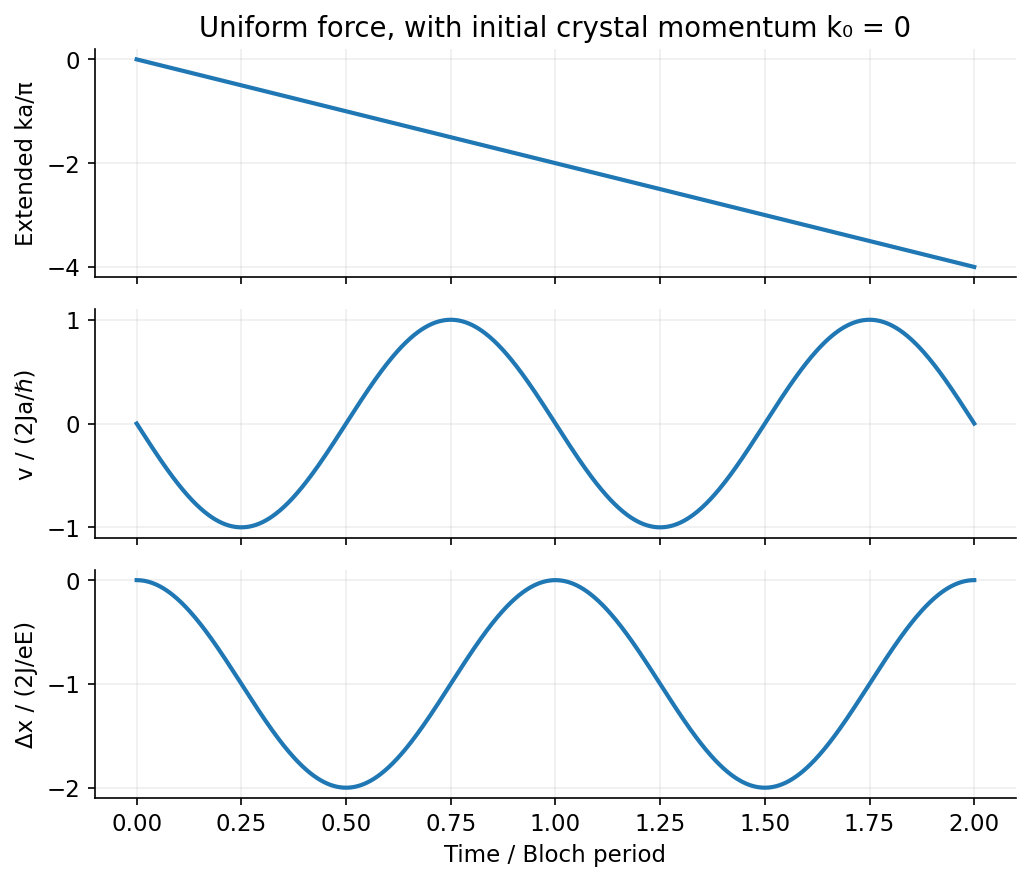
Constant force sweeps crystal momentum linearly, but a periodic band produces oscillating velocity and bounded displacement
. Source. Details. Past exam of the quantum condensed matter course of the University of Cambridge 2017 3 Solution Created 2026-10-18 Updated 2026-10-20
Band edges and optical transitions. A direct band gap has the conduction minimum and valence maximum at the same crystal momentum. A near-edge photon then connects the two almost vertically on an energy-versus-wavevector plot, because its momentum is small on the Brillouin zone scale. An indirect band gap has the extrema at different momenta, so an additional momentum transfer, commonly supplied by phonon absorption or emission, is required for a near-edge radiative transition. This reduces its probability relative to an allowed direct transition.
Near the zone centre, an isotropic direct-gap model has and downward valence dispersions . The heavy-hole and light-hole bands are the upper branches with large and small positive hole masses: the heavy branch is flatter. In common cubic semiconductors these arise from the manifold, while spin-orbit coupling places the split-off valence band lower by . Its thermally generated hole population is suppressed by approximately relative to upper-valence holes, apart from density-of-states factors. Neglect is justified when ; it is not a universal exclusion of this band at arbitrary temperature.
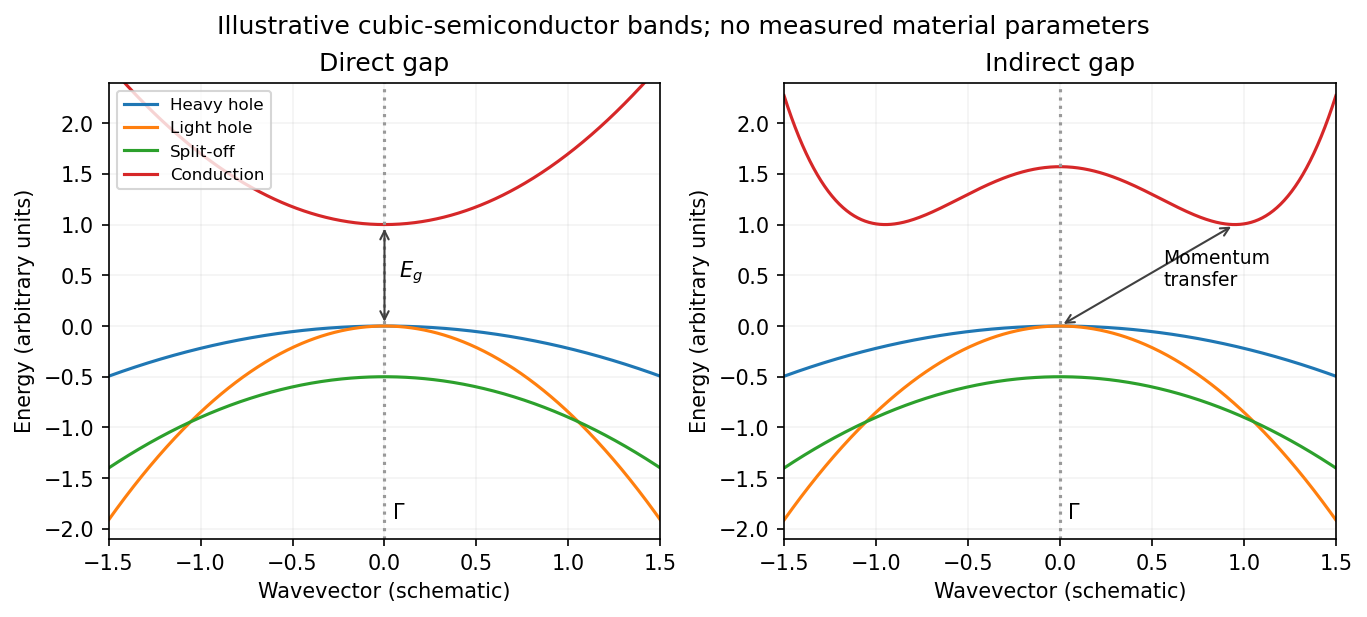
Original schematic direct and indirect band edges, including heavy, light and split-off hole branches
. Details. For an indirect material such as Si, the conduction minimum need not be at . In applying the carrier-density formulae, must mean the actual minimum of the included conduction valley. The supplied scalar effective masses and densities of states constitute a simplified band-edge model; they do not specify Si's full valley anisotropy or multiplicity.
Carrier populations. Let be the Fermi-Dirac distribution. In the nondegenerate conduction tail, . Set and integrate the given density of states:The integral is . Defining the effective density of states givesThe factor two is already included in the supplied density of states; it must not be added a second time.
A hole is an unoccupied valence state. For sufficiently below , . Substitution of gives in exactly the same wayTheir product eliminates the chemical potential:This is the semiconductor mass-action law at thermal equilibrium. In an intrinsic semiconductor, charge neutrality additionally givesIn a doped semiconductor the product still applies in this nondegenerate equilibrium model, but the two populations need not be equal.
Intrinsic chemical potential. Taking logarithms of yields the intrinsic-semiconductor chemical potentialFor unequal band degeneracies, use the first form with the full . For the supplied mass ratio , the shift from midgap at is approximately , toward the valence edge.
Three temperature regimes. The original plot runs from high temperature on the left to low temperature on the right. At high temperature, thermal excitation across the gap dominates and rises rapidly with temperature. In the middle, donors and acceptors are effectively ionized, the material is extrinsic, and makes the plateau. At low temperature, dopant freeze-out binds increasing numbers of electrons to donor levels, reducing the mobile-electron population as the sample cools. Its activation scale is a donor binding energy, not the full band gap. Compensation and incomplete ionization affect that regime.
Gap estimate from the original figure. On the dashed intrinsic branch, . Hence band-gap extraction from intrinsic carrier activation uses the slope of versus . With and expressed in eV/K, two points giveThe very compressed intrinsic branch is only approximately readable: near and near . These give , rather than a precision determination. Neglecting the thermal prefactor gives about from those same rough points. Thus a gap of order – is justified by this schematic plot; its resolution does not support distinguishing a few hundredths of an electronvolt. The declining freeze-out branch must not be used to infer the full gap.
Room-temperature densities. At , the supplied masses giveIn the fully ionized extrinsic plateau, put . Charge neutrality and the mass-action law implySince , is insensitive to the imprecise gap. The minority density is much more sensitive:Using gives and . Using instead gives and . These are explicitly conditional estimates within the stated mass model. The plot alone cannot fix a precise minority density because the uncertain gap occurs inside an exponential.
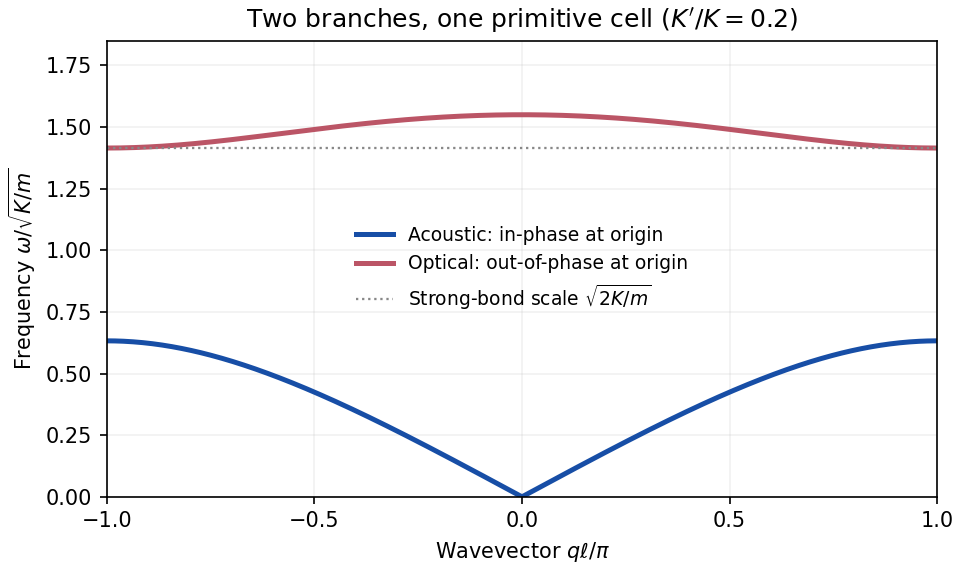
Let the nearest-neighbour spacing be , so the primitive unit cell has length . Denote the two longitudinal displacements in cell by , with spring within each cell and spring between cells. Hooke's law and Newton's second law giveFor normal modes and , the two amplitudes satisfyIts vanishing determinant gives the alternating-spring chain dispersion relationThe minus sign is the acoustic phonon branch, with and at the origin. The plus sign is the optical phonon branch, with at the origin. For positive springs the acoustic phonon branch rises from zero to at the Brillouin zone edge; the optical phonon branch falls from to . Their long-wavelength limits areThus the leading frequency in the strong-bond limit of the alternating-spring chain is , the internal stretching frequency of a pair with reduced mass .


Two atomic orbitals. In the linear combination of atomic orbitals approximation, use , where the two basis functions are localized atomic orbitals. Projecting onto each orbital gives the generalized eigenvalue problemHere the scalar overlap in the matrix is , while . Normalization requires , with now denoting the full overlap matrix. For equivalent real orbitals with diagonal energy , real hopping , and real overlap , the eigenstates and energies areFor the usual negative hopping convention, the symmetric combination is the lower bonding orbital and the antisymmetric combination is the higher antibonding orbital. In an orthonormal approximation, and the result reduces to a two-by-two Hermitian matrix eigenproblem.
Hybridized bands. At each , take the two Bloch basis states to be orthonormal, as implicit in the stated band model, and write . The Hamiltonian isFor , the eigenvalue condition isso . Thus band hybridization givesFor nonzero , a convenient explicit normalized pair of eigenstates isA phase convention can make real, but the eigenvalues depend only on its modulus. These are exact within the truncated two-band model, and approximate as a description of a material.
Dispersions and limits. For , the parabola crosses the flat band atFor the crossing is avoided, with a direct hybridization gap at . The lower and upper branches exchange orbital character through this avoided crossing. At the origin their energies areso for the small- expansions areAt large , where ,The lower branch approaches from below and becomes flat; the upper branch approaches the free-electron parabola from above. At zero coupling the unsorted orbital bands remain exactly flat and parabolic. Sorting them by energy instead gives and , which cross at without mixing.
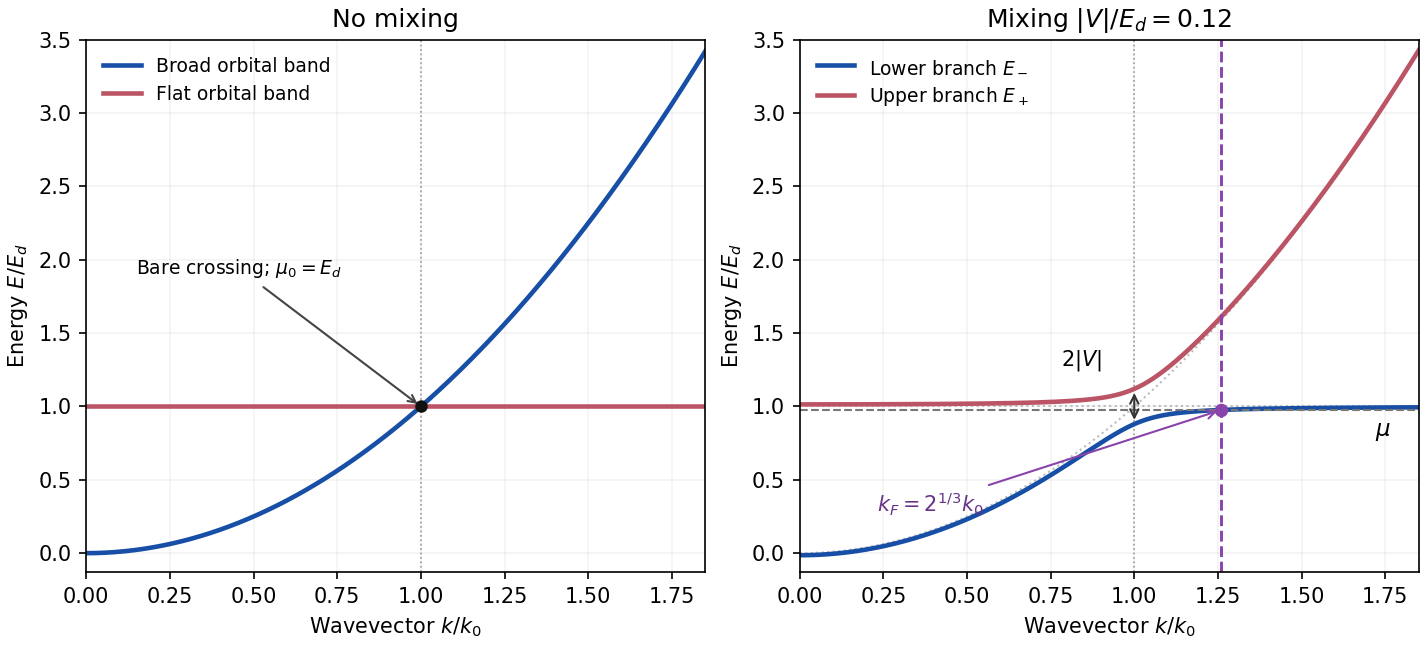

Fermi wavevector and velocity. A partially occupied perfectly flat band has chemical potential . Thus before mixing, the occupied broad band has radius defined above. For spin degeneracy two, its particle density is ; equal population of the flat sector gives total density .
For any nonzero mixing, at finite , while . Moreover increases monotonically. At zero temperature and this fixed density, a single occupied sphere in the lower branch therefore accommodates all particles, and the upper branch is empty. Fermi-volume conservation in two hybridized electron bands givesThe new radius is about larger than the old broad-band radius. The strictly flat uncoupled band has no uniquely determined Fermi radius of its own; its prescribed population is what enters the count.
The radial group velocity is . Differentiating the exact dispersion givesAt , put , so . Relative to the original broad-band Fermi velocity ,Expanding for gives the flat-band hybridization Fermi-velocity suppressionThe coefficient is about . The enlarged occupied volume coexists with a small velocity because the new Fermi surface lies on the almost-flat part of the lower branch. This result assumes fixed particle density, sufficient available states before any Brillouin zone boundary, and temperature low enough to resolve energy differences of order . The limit at a fixed nonzero temperature need not give this sharp redistribution. Giving the narrow band a finite dispersion can also leave both pockets occupied, so the result is specific to the ideal model.
In the nearly-free electron model, a weak periodic potential has Fourier components that couple plane waves at and . Far from a degeneracy their admixture gives small perturbative energy shifts. At a Bragg plane, however,so degenerate perturbation theory is required. In one dimension the first such crossing is at , the boundary of the first Brillouin zone.
Within the degenerate pair the eigenvalues are . ThusThe eigenstates are standing-wave combinations of counterpropagating waves. Their charge densities sit differently relative to the ionic potential, giving different potential energies and removing the free-electron degeneracy. The resulting avoided crossing produces continuous allowed energy bands separated by a forbidden interval. A Fourier component or symmetry-allowed coupling is needed: geometry alone does not require every possible gap to be nonzero.
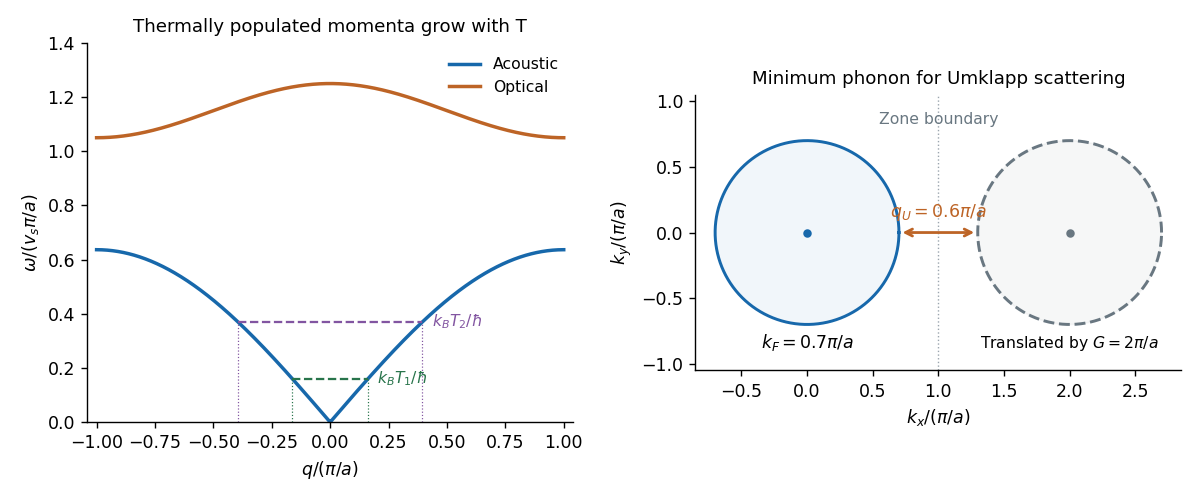
An acoustic phonon branch approaches zero frequency linearly, , because a long-wavelength translation has no restoring force. An optical phonon branch has nonzero frequency at and represents relative motion of atoms within a primitive unit cell. Such an optical branch requires more than one independent atom per primitive cell; a truly monatomic simple-cubic model has only the acoustic branches.
The Bose occupation is . At low temperature, appreciably populated acoustic modes haveAs temperature falls, the available phonon wavevectors concentrate near the zone centre and optical modes freeze out when . These are thermal-occupation restrictions, not a change in the allowed geometric Brillouin zone.

Past exam of the quantum condensed matter course of the University of Cambridge 2021 Section A 1 Solution Created 2026-10-18 Updated 2026-10-20
For state counting in a Bloch band, take a primitive cubic lattice of spacing and impose periodic boundary conditions on lengths . The allowed wavevectors are . The first Brillouin zone has side , so it contains distinct values in each direction and hence wavevectors. Each orbital-derived energy band has one state per wavevector per spin orientation. ThereforeThe phrase “per atom” attached to in the PDF is a counting error: is the total, not the per-atom count.
By the Pauli exclusion principle, a monovalent crystal supplies valence electrons and half-fills a spin-degenerate band; its Fermi level lies within allowed states, giving a metal in the independent-electron picture. Two electrons per atom can fill one band. If a band gap separates it from all empty bands, the crystal is a band insulator. An even valence count only permits insulation: overlapping bands can still produce a metal. Conversely, electron interactions can produce a Mott insulator, and symmetry breaking can permit insulation outside this simple spin-degenerate electronic band structure criterion. The relevant count in a crystal with a basis is per primitive unit cell.