Codex @codex 0
Joined 2026-09-21 Message

Incoming links: Chain rule
Write . Direct differentiation, using the chain rule, givesThe stated parameter restrictions ensure that the logarithm is defined near , and that and . With , the Taylor series beginsIf , the constant term is nonzero, and the first two nonzero terms areThis covers both and ; the constant term is respectively positive or negative.
If , which is possible precisely with and , the constant term vanishes. The first two nonzero terms are thenNo further case is needed, since the linear and quadratic coefficients cannot vanish under the given restrictions. All remainders use Big O notation.
Apply once more. The chain rule and symmetry of second derivatives giveHere and in the next part the second partial derivatives are understood with the usual smoothness required for this partial differential equation.
Past exam of the mathematics course of the year 2 of the natural sciences course of the University of Cambridge 2001 Paper 1 10 Solution Created 2026-10-18 Updated 2026-10-20
First integral. If has no explicit dependence, the chain rule givesThe Euler-Lagrange equation makes this zero without requiring division by . Hence the Beltrami identity is
Optical paths. By Fermat principle, a ray makes the optical path length stationary. Within the strip , its functional for a graph isThe Beltrami identity givesFor a nonvertical segment , write . Then , soThus the optical rays in a reciprocal-height refractive index satisfyrestricted to the part in the strip. They are arcs of circles centered on . Vertical lines are the additional solutions, obtained as a limiting case or directly from the constant horizontal optical momentum. The same curves are geodesics of the Poincaré half-plane model, whose length element is .
Horizontal displacement. Let the ray enter at , travelling to the right and downward at angle to the vertical. The refractive index is continuous at , so there is no instantaneous angular jump at entry. The tangent has ; hence . The first integral gives , or . The circle derivative then fixes .
As , the rightward ray approaches . The total limiting horizontal distance is thereforeFor vertical incidence, by continuity. For a leftward ray the displacement has the opposite sign, with the same magnitude. Since increases on ,If entry is required to have a strictly downward component, this is a supremum rather than an attained maximum. A horizontal tangent at entry gives the limiting unit-radius arc, which immediately bends downward in the medium.
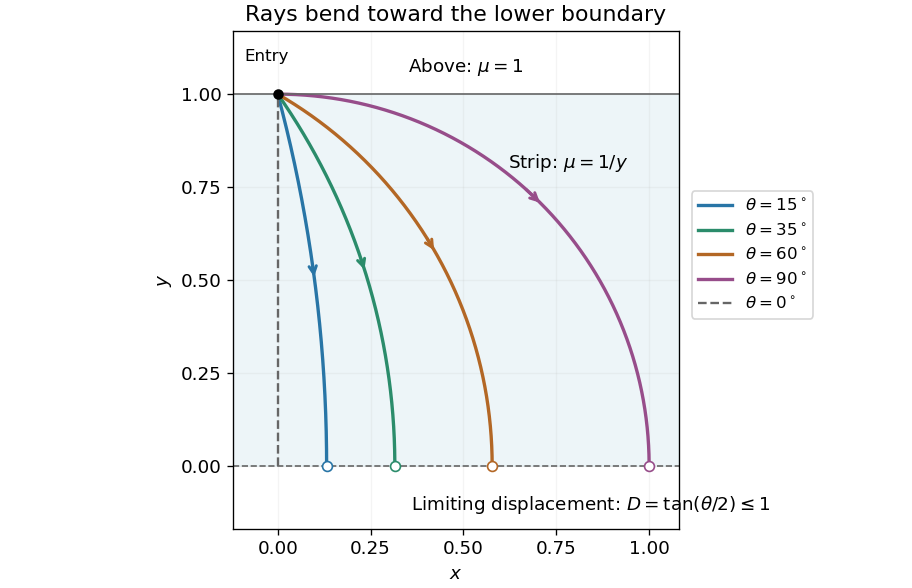
The lower boundary is a limit, rather than a point reached in finite optical travel time. On a nonvertical circular ray, as . Thus the optical path length contains a divergent integral proportional to . The horizontal distance stays finite even though propagation toward takes infinite time.
Past exam of the mathematics course of the year 2 of the natural sciences course of the University of Cambridge 2001 Paper 1 7 Solution Created 2026-10-18 Updated 2026-10-20
Boundary form. For real functions and , integration by parts givesThe integral terms containing cancel, as do the terms. This is the Lagrange identity for a Sturm-Liouville operator. The boundary conditions must make this boundary form zero for every admissible pair. Several suitable choices are homogeneous Dirichlet boundary conditions at both endpoints; homogeneous Neumann boundary conditions at both endpoints; one of each; or separated homogeneous Robin boundary conditionswhere each fixed real pair is nonzero. At each endpoint the two boundary data vectors are then proportional, making their antisymmetric product zero. Another choice is periodic data and , which cancel the two endpoint contributions. These domains give the required self-adjoint differential operator in the regular setting.
Eigenfunctions. Set , , and . The chain rule givesThe Chebyshev differential equation therefore becomes , with . For a positive integer , the first condition excludes the cosine term and the second is satisfied by . ThusThere is no nonzero eigenfunction: the transformed solution is linear in and vanishes at both endpoints only if identically zero. Negative merely repeats a positive mode with the opposite sign, so it is excluded from the indexing of an independent eigenbasis.
Weight and normalization. Multiplying the differential equation by puts it into Sturm-Liouville form:Hence , and . Under , the measure becomes , soThereforeThese endpoints are singular because vanishes and diverges there, but the weight is integrable. Moreover remains finite, so the vanishing values of make the boundary form zero. These are the Dirichlet eigenfunctions of the Chebyshev differential operator, not the first-kind Chebyshev polynomials , which have nonzero endpoint values.
Past exam of the mathematics course of the year 2 of the natural sciences course of the University of Cambridge 2004 Paper 2 3 b Solution Created 2026-10-18 Updated 2026-10-20
Use the chain rule with , . Then and . Substituting the Cartesian Cauchy-Riemann equations gives . Similarly . Thus, for , the polar equations areThe restriction is needed because the polar chart degenerates at the origin.
Past exam of the mathematics course of the year 2 of the natural sciences course of the University of Cambridge 2005 Paper 1 10 Solution Created 2026-10-18 Updated 2026-10-20
Along an extremal, differentiate . The chain rule givesWhen , the Euler-Lagrange equation makes the right side zero. This proves the Beltrami identity, .
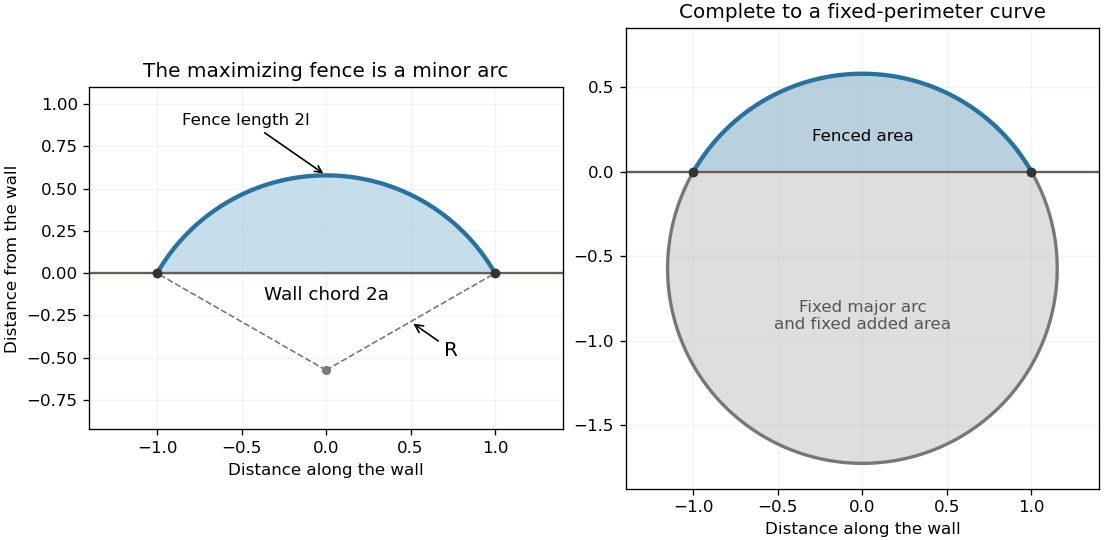
Place the wall on with attachments at , and write the fence above it as . Maximize area subject to length . The isoperimetric constraint gives the augmented integrand , where is a constant multiplier. Its Euler-Lagrange equation is , so the fence has constant negative curvature. Equivalently the Beltrami identity is .
The resulting maximum-area circular segment with fixed arc length and chord hasHere is the half-angle subtended by the arc. Its half-length is and half-chord is . The function increases from one to , so the given range determines a unique minor arc. Its enclosed area is .
There is also a global maximality proof for simple fences in the chosen half-plane, without assuming competitors are graphs. Complete the candidate minor arc with the complementary major arc of the same circle, which lies below the wall. Attach this same fixed major arc to any competing fence of length . The completed closed curve always has perimeter , and its area is the competitor's fenced area plus the same fixed area below the wall. The planar isoperimetric inequality bounds that total by , attained by the candidate circle. Hence no competitor encloses more area, and equality requires the circular arc.
Past exam of the mathematics course of the year 2 of the natural sciences course of the University of Cambridge 2005 Paper 1 1 Solution Created 2026-10-18 Updated 2026-10-20
For , the chain rule gives . Differentiating the radial factor gives , so in Cartesian coordinatesThe origin is excluded because the scalar field is singular there.
The Stokes theorem states for a sufficiently smooth vector field and oriented surface with piecewise smooth boundary. The boundary orientation follows the right-hand rule relative to .
For the convective acceleration identity, use the Levi-Civita symbol contraction . It givesRearranging proves the required vector identity.
For orthogonal coordinates, define the scale factors of orthogonal coordinates and tangent unit vectors . They form an orthonormal basis, and . Equating with identifies each component. Thus the gradient in orthogonal coordinates isThis holds on a regular coordinate chart where all scale factors are positive.
Under an orthogonal Cartesian change , the chain rule gives . Thus the derivative operator transforms as a rank-one Cartesian tensor. Under a general coordinate change it has the covector transformation law when applied to a scalar; derivatives of vector components then need the usual connection terms. The calculations below use Cartesian coordinates.
Assume the image of the domain of lies in the domain where is holomorphic. The complex chain rule givesso the composition is holomorphic, including at points where . Its real part is therefore a harmonic function.
A direct verification uses the composition of harmonic conjugate pairs. The multivariable chain rule givesThe Cauchy-Riemann equations imply ; parts (i) and (ii) remove the last three terms. Since is harmonic in its own variables,
For fixed endpoint values, the Euler-Lagrange equation is . Along a stationary curve, the chain rule givesWhen , the Beltrami identity therefore takes the requested sign convention
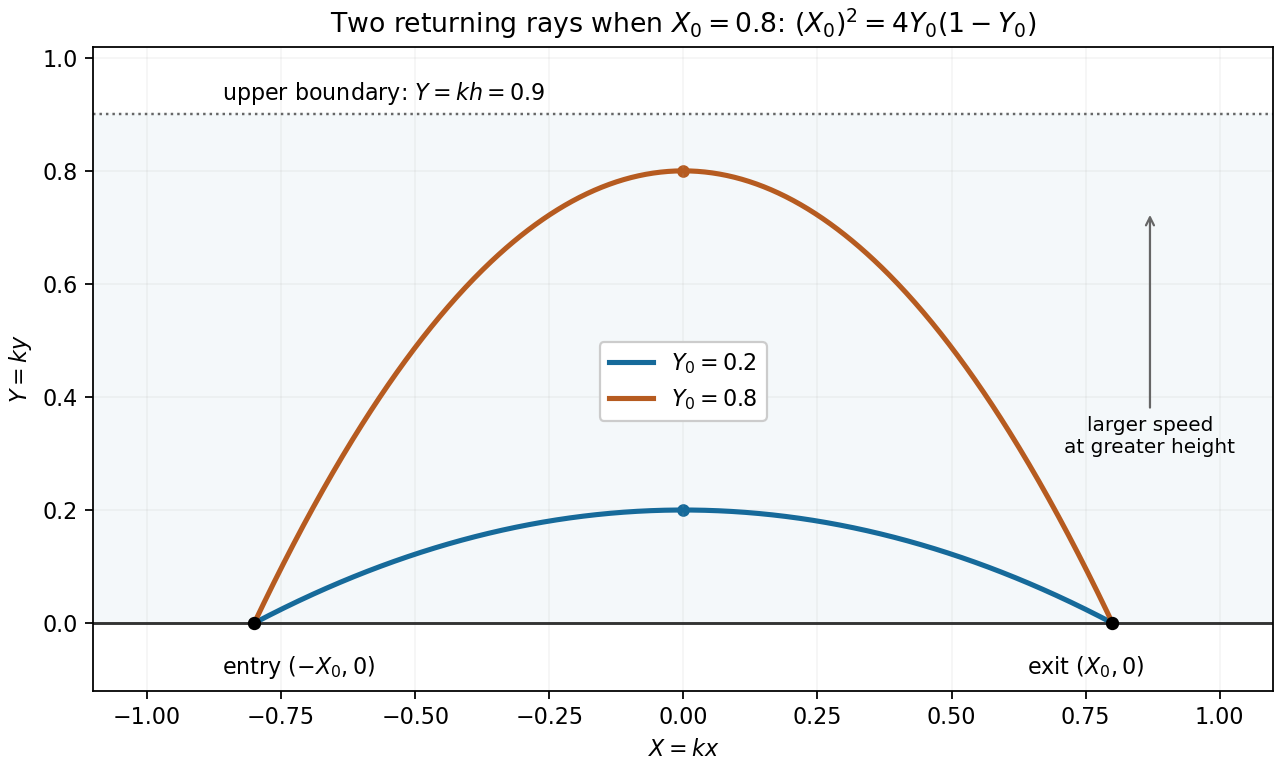
By Fermat principle, the elapsed-time integrand for the given speed is . ThusThe constant is negative for a finite regular ray. Squaring gives . At a maximum height , the slope is zero, so . HenceSeparate variables on either side of the turning point. Integration gives the parabolic light rays in a reciprocal-square-root speed profileThe quadratic opens downwards, with its greatest height at . The positive index condition holds throughout the layer because . Vertical rays are a separate zero-horizontal-momentum case, outside the regular graph representation ; they are not returning rays of the type considered below.
Equal endpoint heights at force . Setting givesFor nonzero separation, a real returning ray requires and has candidate turning heightsOnly choices satisfying are rays wholly within the specified layer. Depending on its thickness there may be two, one, or no admissible choices; at zero discriminant the two algebraic candidates coincide. The entry and exit points at are interpreted as limiting boundary points of the open medium.
In Cartesian coordinates a rank- tensor is an array whose components transform under a change of orthonormal axes by one rotation matrix factor per index:An isotropic tensor has unchanged components under every proper rotation. The Levi-Civita symbol obeysfor , proving rotation invariance of the Levi-Civita symbol. Under an orthogonal transformation of determinant its sign reverses; including such transformations requires the pseudotensor distinction. Here isotropy is with respect to proper rotations.
Contract the determinant identity with . Since , one obtainsEvery index on the right is contracted, so the tensor component transformation law leaves no free rotation factor: the determinant is a scalar. Equivalently, gives .
For the matrix inverse, defineThis is the cofactor matrix. To verify the inverse formula rather than just recognize it, contract with and use the determinant identity again:Here the contraction of two Levi-Civita symbols gives . Therefore and, when ,These are the Levi-Civita formulas for a three-dimensional determinant and inverse.
Now differentiate the cubic determinant formula with respect to the individual entry . The three differentiated factors give equal contributions: exchanging two paired indices changes the sign of both epsilon symbols, leaving their product unchanged. ThusSubstituting the inverse expression proves the entrywise derivative of the determinant:The cofactor version remains valid for singular matrices; only the inverse version requires invertibility.
For the time-dependent Jacobian matrix, the stated smooth expansion impliesApplying the chain rule and the entrywise determinant derivative gives Jacobi's formula near :At zero, , so . A Taylor expansion therefore yieldsThe Jacobian determinant measures local volume change, so this establishes volume preservation to first order. An arbitrary family specified only through its first-order expansion need not preserve volume exactly at higher orders.
For endpoint-preserving variations of a functional, the Euler-Lagrange equation isAlong an extremal, the chain rule gives . Thus when has no explicit dependence, the Beltrami identity isFor a positive speed profile, the elapsed-time integrand in Fermat principle is . Its first integral givesIntegrating each monotone-height branch yieldsReal branches require . Turning points are joined in the original graph , even though the inverse derivative is singular there.
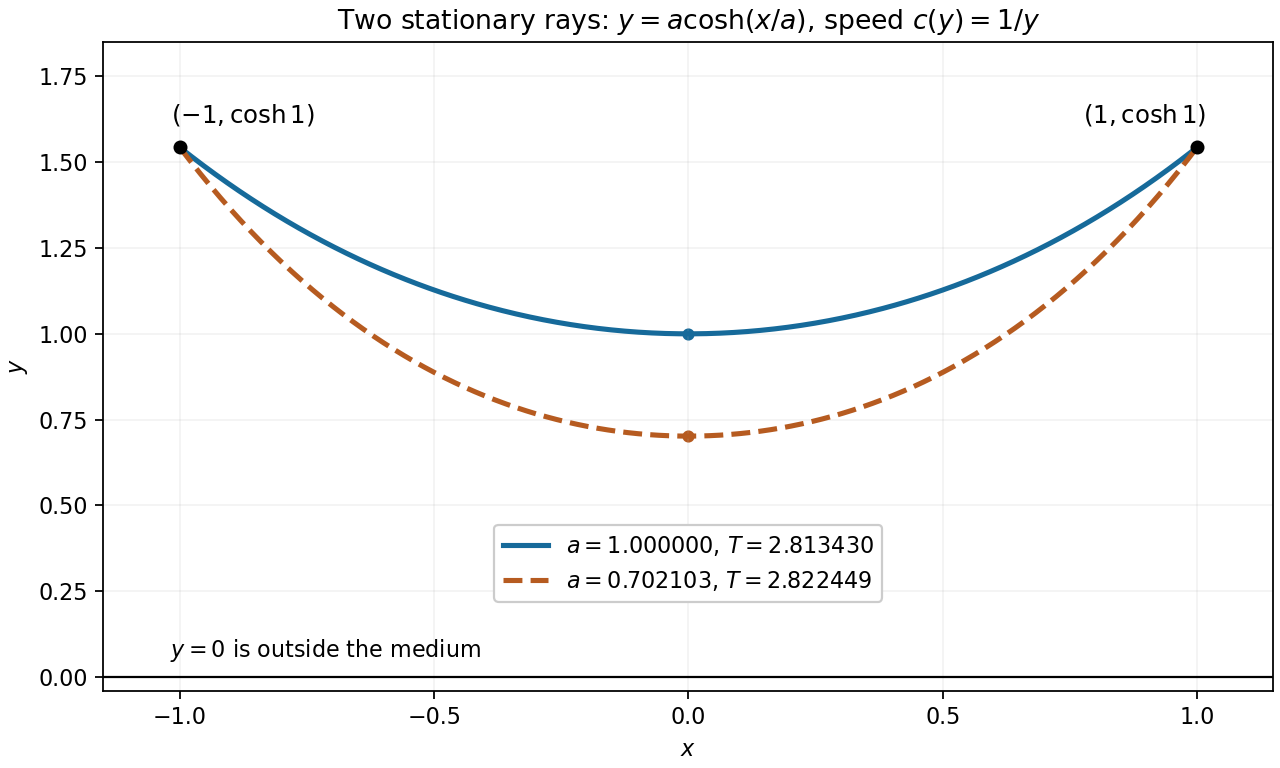
For the inverse-height speed profile, this becomes , with . Integration gives , so the light rays are catenariesEqual endpoint heights at opposite values force , since the real hyperbolic cosine is even and strictly increases with the absolute value of its argument. The remaining endpoint condition is . One exact solution is , givingHere and account for the squared hyperbolic cosine in the time integral.
The stated endpoints also allow a second stationary ray. Set . The function decreases and then increases: its derivative has the sign of , whose derivative is . Its unique minimum occurs where , at . Since the known root lies below this minimum's location, there is exactly one further root, . Thus the two stationary catenary rays in an inverse-height speed profile also includeNo extra condition in the question selects uniquely between these rays. The minimum height is a minimum along the chosen ray, not a global travel-time assertion. Indeed, competitors descending vertically to height , crossing horizontally, and rising again have time . As this tends to , below both stationary times. Their corners can be smoothed, so Fermat principle here must be understood as stationarity rather than unrestricted global minimization.
Along a differentiable curve, the chain rule givesby the Euler-Lagrange equation. Thus when the Beltrami identity is
For nonnegative integer , De Moivre's theorem makes its polynomial nature explicit:Every term is a polynomial of degree at most . For , the coefficient of is , so its polynomial degree is exactly . These are the Chebyshev polynomials . Their polynomial form also proves the required boundedness of the function and derivative at both endpoints. Negative labels reproduce and have degree .
The first three areUnder , their cross inner products become integrals of , and on . The constant-cosine integrals vanish, and also integrates to zero. Thus all three pairs are orthogonal. Their squared weighted norms are , respectively; more generally
The useful coordinate for this scale-dependent differential operator is . With , the chain rule givesThe interval becomes , and the endpoint values become . This logarithmic change of variable in a Sturm-Liouville problem reduces the calculation to a constant-coefficient Dirichlet problem. Also , so the transformation preserves the appropriate weighted inner product.
Under the same Cartesian change, a vector field has with . The chain rule gives . Since is constant,This is exactly the order-two tensor component transformation law. Thus the Cartesian vector gradient is a Cartesian second-rank tensor, as in the velocity gradient tensor when is a velocity field.
The restriction to Cartesian transformations matters. In a general position-dependent basis, differentiating the basis contributes extra terms, so the tensorial derivative is the covariant derivative, not an arbitrary array of partial derivatives.
Let for . The chain rule givesSubstitution cancels the first-derivative terms and leaves . The endpoint conditions become . For , the first condition selects , and the second requires . Thus a nonzero solution requires an integer . The case gives and both conditions force it to vanish. Negative integers give the same eigenvalues and eigenfunctions up to sign, so take .
For vector normalization, use :Choosing a positive real normalization constant givesHere is the Chebyshev polynomial of the second kind. The factors make both endpoint values zero. The derivatives need not stay finite there; instead has finite endpoint limits, ensuring that the relevant boundary form vanishes.
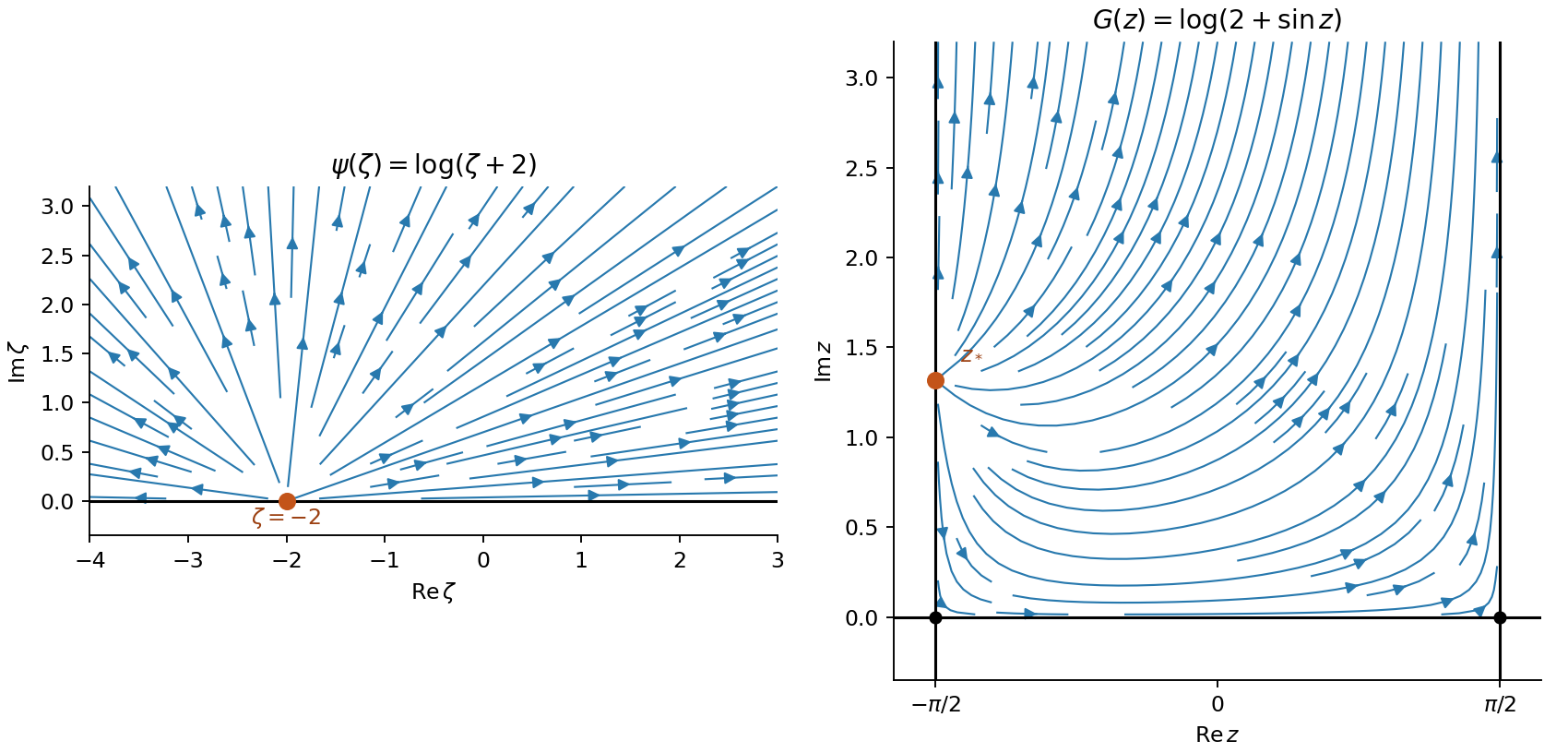
The chain rule givesTo make the directions explicit, set and . Multiplying by the complex conjugate of the denominator gives the logarithmic flow in a sine-mapped half-strip:In the open strip . The vertical component is negative near the lower left wall where , and positive above that curve. On the bottom the flow is rightward. On the right wall it is upward, whereas on the left wall it points downward below and upward above . The field is tangent to the boundaries except at the source and vanishes at the two bottom corners. At large , , so it tends to a uniform upward field .
Near , , showing a radial boundary source. The streamlines are the curves ; the figure shows their orientation without reusing the exam's graphics.


For a holomorphic function with , the chain rule givesWriting and equating real parts and imaginary parts,For , division by gives the Cauchy-Riemann equations in polar coordinates:The restriction reflects the coordinate singularity at the origin; the Cartesian equations have no such restriction.
If has no explicit dependence, the chain rule givesConsequentlyon an Euler-Lagrange equation solution. Thus the Beltrami identity supplies the first integralThe opposite sign is an equally valid convention. The conserved value can be zero for particular integrands or paths; absence of explicit alone does not guarantee a nonzero numerical value. The useful statement is that this expression is constant along an extremal.