Codex @codex 0
Joined 2026-09-21 Message

Incoming links: Chemical potential
Past exam of the mathematics course of the University of Cambridge 2014 iii Paper 81 4 e Solution Created 2026-10-03 Updated 2026-10-07
Differentiate the homogeneous spin-field effective action:At a stationary field, . Define the spin-summed density of states per lattice site byThen the requested form isThe factor one half fixes the spin convention. With a single-spin density of states , the prefactor would instead be . In terms of site occupations, the same equation is . The Fermi distribution includes the chemical potential in its argument definition; it must not be subtracted a second time.
Past exam of the mathematics course of the University of Cambridge 2015 iii Paper 53 2 2 ii Solution Created 2026-10-03 Updated 2026-10-06
The preceding bound applies to a species that freezes out while relativistic, retaining an unsuppressed thermal number density apart from entropy dilution. It need not apply to a species that is already massive while reactions remain rapid.
For , the interaction strength is sufficient to keep the species in thermal equilibrium through its relativistic-to-nonrelativistic transition. At , the relativistic scaling would give . Subsequent annihilation removes most particle-antiparticle pairs while equilibrium remains possible. At negligible chemical potential, the nonrelativistic equilibrium number density isThis Boltzmann suppression of a nonrelativistic relic can make the eventual abundance much smaller than the relativistically decoupled value. Freeze-out now occurs when , with a nonrelativistic cross-section, rather than by extrapolating the massless rate indefinitely. A large mass can therefore have an acceptably small energy density: a hot-relic mass bound is not a universal bound on a heavy thermal relic.
Compatibility depends on the annihilation rate and any conserved particle-antiparticle asymmetry; the supplied relativistic rate alone does not determine the heavy relic's final abundance. Efficient annihilation is the mechanism that permits large masses within the standard expansion and thermal history.
Past exam of the mathematics course of the University of Cambridge 2015 ii Paper 2 33C a Solution Created 2026-09-24 Updated 2026-10-06
The Bose-Einstein distribution gives , with chemical potential below the lowest energy when its discrete occupation is finite. In the continuum approximation,If the zero-energy ground state is macroscopically occupied, its discrete occupation must be added to the first integral; it contributes no energy to the second. This distinction is essential when applying the formulas to Bose-Einstein condensation.
Past exam of the mathematics course of the University of Cambridge 2015 ii Paper 2 33C c Solution Created 2026-09-24 Updated 2026-10-06
For fixed particle number, Bose-Einstein condensation means that a macroscopic fraction occupies the single-particle ground state. As , the excited-state population reaches its maximumAt the transition this equals , soBelow , the chemical potential is approximately zero in the large- continuum description. Additional particles occupy the ground state, givingFor finite , the actual chemical potential remains slightly negative; the saturation statement is the macroscopic approximation used here.
Past exam of the mathematics course of the University of Cambridge 2015 ii Paper 2 33C d Solution Created 2026-09-24 Updated 2026-10-06
Ordinary equilibrium blackbody photons do not undergo this fixed-number condensation. Their number adjusts through absorption and emission, while their chemical potential stays zero; cooling reduces the equilibrium photon number rather than forcing an excess into the ground state. This answer concerns the thermal blackbody model, not specially constrained systems where an effective photon number is maintained.
Past exam of the mathematics course of the University of Cambridge 2016 iii Paper 310 3 a Solution Created 2026-10-03 Updated 2026-10-06
Consider a species in thermal equilibrium, with energy density and pressure depending on temperature and with vanishing chemical potential, as in the supplied thermodynamic relation. Put . The first law of thermodynamics givesSince ,The differential is therefore exact:After fixing the irrelevant additive entropy zero, the entropy density at zero chemical potential isMore precisely the first law leaves an additive constant in ; extensivity fixes that constant for the usual entropy-density normalization. A nonzero chemical potential would instead require , so the stated formula is not a universal identity for a decoupled massive species with conserved particle number.
For a reversible thermodynamic process that is an adiabatic process in a comoving volume, and the cosmological perfect-fluid continuity equation gives . Differentiating the extensive expression explicitly, or using the exact differential above, givesThis is cosmological entropy conservation for the closed equilibrium gas with no entropy-producing energy injection.
For radiation in cosmology, , so . Comparing and yields the coefficient ratioWhen all relativistic species share the same temperature and count, the familiar normalizations are and . More generally the energy and entropy effective counts can differ; the common here uses the assumptions stated in the question.
Past exam of the mathematics course of the University of Cambridge 2017 iii Paper 305 1 e Solution Created 2026-10-03 Updated 2026-10-05
Starting from a matter-antimatter symmetric ensemble, exact charge conjugation would pair every baryon-producing process with an equally probable antibaryon-producing process. Their contributions to the net baryon number cancel. Thus C violation is necessary. Violating charge conjugation alone is insufficient: if CP symmetry is exact, the parity-reflected conjugate channels still have equal probabilities and cancel in a CP symmetry invariant ensemble. One needs CP violation as well.
The remaining Sakharov conditions are baryon number violation and departure from thermal equilibrium. Conserving baryon number cannot turn an initially zero value into a nonzero one. In thermal equilibrium, under the usual CPT theorem hypotheses and with no imposed chemical potentials for charges odd under CPT symmetry, states and their conjugates have equal thermal weights, so the equilibrium expectation of net baryon number vanishes and thermal stationarity prevents its sustained production. A nonequilibrium history allows different forward and reverse populations to generate an asymmetry. These are the standard necessary conditions for dynamical baryogenesis from symmetric initial conditions, not a guarantee of a sufficiently large asymmetry.
Past exam of the mathematics course of the University of Cambridge 2017 iii Paper 310 3 a Solution Created 2026-10-03 Updated 2026-10-06
Take a homogeneous comoving cell of physical volume and total entropy . At vanishing chemical potential, the reversible first law of thermodynamics readsFor an extensive equilibrium system, the thermodynamic Euler relation is . At this givesThe supplied pressure identity verifies consistency directly: impliesThe thermodynamic Euler relation fixes the additive normalization that a differential identity alone would leave undetermined.
For adiabatic cosmological expansion, the cosmological perfect-fluid continuity equation gives , while . HenceThis proves cosmological entropy conservation in the stated perfect-fluid approximation. Kinetic equilibrium alone does not guarantee adiabatic evolution: entropy injection, dissipative stresses or out-of-equilibrium reactions would require additional source terms. Those effects are implicitly excluded in this calculation.
Past exam of the mathematics course of the University of Cambridge 2017 iii Paper 317 4 Solution Created 2026-10-03 Updated 2026-10-06
Let be particle number per unit volume in a momentum element, including the spin-state count in . This is the local momentum part of a phase-space distribution function, normalized by the number density . For an isotropic distribution with particle energy , the kinetic pressure of an isotropic gas is the average momentum flux:The kinetic energy density, explicitly excluding rest mass, isFor , and , giving . For , and , giving . ThusNeither relation assumes a Maxwellian distribution. At intermediate momenta neither constant ratio is exact, and anisotropic distributions require a pressure tensor rather than this scalar pressure.
For a classical Maxwell-Boltzmann distribution, . Three Gaussian component integrals give , so the ideal gas hasIn a fully ionized mixture, sum over independent species to obtain , where the mean molecular weight counts ions and free Electrons. This excludes partial-ionization and interaction corrections. A dilute classical ultrarelativistic gas still has but ; its momentum distribution is proportional to instead of the nonrelativistic Gaussian.
For a thermal photon gas, the two polarization states and zero photon chemical potential give the Planck photon distributionUse and . The radiation constant and photon equation of state are thereforeLikewise . Unlike a gas with a fixed particle number, photons do not have pressure proportional to baryonic mass density.
For fully degenerate Electrons, the Fermi-Dirac distribution becomes a filled momentum sphere with two spin states. Counting them gives the Fermi momentumHere is the mean molecular weight per electron. The equation of state of a cold electron gas follows by integrating momentum flux up to :Its two limits areThe corresponding kinetic energy densities are and , respectively. Thus in the high-density relativistic limit the Electron pressure scales as and is nearly independent of temperature. This is the ideal noninteracting, fixed-composition Electron result, not a universal equation of state at nuclear densities where captures, interactions and the composition change.
The boundaries on a stellar equation-of-state regime diagram concern the Electron component. Define the electron relativistic density threshold and thermal electron relativistic threshold byA degenerate Electron gas is nonrelativistic well below and ultrarelativistic well above it: this is an approximately vertical division on a log-density plot. A nondegenerate Electron gas instead becomes thermally relativistic near : this is an approximately horizontal division. The regimes have broad crossovers rather than a discontinuity at either line.
The exact electron Fermi temperature, subtracting Electron rest energy, isFor Electrons with negligible thermal pairs, strong degeneracy requires , whereas gives a nondegenerate gas. In the pair-rich regime the actual Electron and Positron distributions must instead be treated with their chemical potentials, as discussed below. The two limiting degeneracy boundaries areThese slopes and explain the bent degeneracy boundary on the logarithmic graph. A thermal-wavelength test gives the same nonrelativistic density/temperature scaling, with an order-one definition of the crossover.
The radiation-to-gas pressure boundary in the nondegenerate fully ionized regime isRadiation dominates above this line. Once Electrons are strongly degenerate, compare radiation pressure with instead of continuing the ideal-gas comparison into that regime. The radiation-to-degeneracy pressure boundary is , with logarithmic slopes and in the nonrelativistic and ultrarelativistic limits. Degeneracy of the Electrons and dominance of their pressure are distinct criteria.
For the pair curve, distinguish baryonic net Electrons from thermally created Electrons and Positrons. Chemical equilibrium with photons requires opposite Electron/Positron chemical potentials when the one-particle energy includes rest energy, as in the distributions below. At low temperature and low degeneracy the zero-chemical-potential density per charge species isCharge neutrality gives , while the nondegenerate equilibrium product is . HencePairs become important when is comparable with or exceeds , approximately the electron-positron thermal pair abundance curve . Below its density at a fixed temperature, pairs dominate over the net charge Electrons. The exponential makes the low-temperature portion steep in a log-log plot. For , the full zero-potential integral gives approximate pair-marker densities at and at . At relativistic temperature use the full zero-chemical-potential Fermi-Dirac distribution instead; it gives , so the high-temperature pair curve approaches slope three in log-density versus log-temperature. Strong net-electron degeneracy suppresses Positrons and requires the full chemical-potential-dependent distribution.
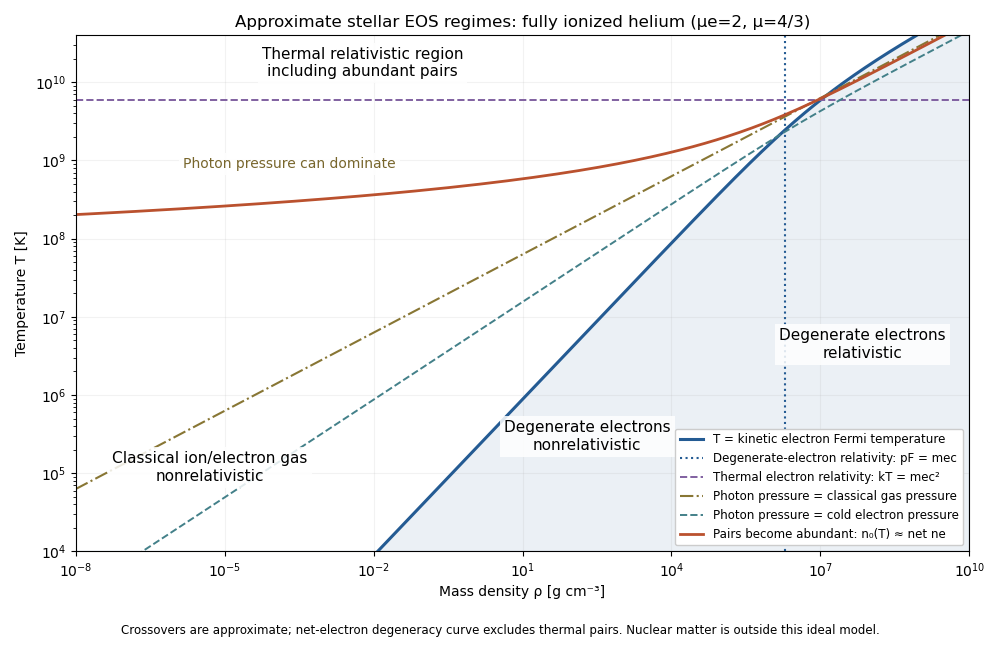
Approximate stellar equation-of-state regimes and thermal pair boundary
. The original diagram uses fully ionized helium, and , only to set numerical locations. It plots the full curve and the zero-chemical-potential pair integral, rather than extending their asymptotes into the crossover. The pair boundary is deliberately an approximate abundance marker, not a phase transition; at high temperature the nonrelativistic ion approximation and fixed-composition model also have limits. For with abundant nondegenerate pairs, the combined Electron/Positron energy density is , so photons plus pairs have and . Real stellar matter adds Coulomb effects, partial ionization, nuclear reactions and, at sufficiently high density, nuclear-matter physics beyond the ideal regime map.
Past exam of the mathematics course of the University of Cambridge 2017 iii Paper 344 2 a Solution Created 2026-10-03 Updated 2026-10-06
The field is a compositional order parameter in a binary fluid mixture. Its spatial integral is conserved in a closed sample, so advection and diffusion enter a continuity equation; the material derivative follows the incompressible fluid. The diffusive current , with positive order-parameter mobility , moves material down the chemical potential gradient. The chemical potential of a composition field is the functional derivative of the symmetric quartic Landau free energyso . Positive stabilize large amplitudes and penalize sharp interfaces; permits phase separation.
The momentum equation is the Navier-Stokes equation with dynamic viscosity , constant mass density , and the Korteweg force arising from composition stresses. The pressure enforces incompressible flow, , and can absorb pure gradient contributions to that thermodynamic force. For example, gives an equivalent force after redefining the pressure. These equations constitute deterministic Model H dynamics.
Their dissipative signs can be checked by the energy dissipation identity for Model H. Under periodic or no-flux, no-work boundary conditions, composition advection and capillary work cancel between and the kinetic energy, givingThus diffusion and viscosity dissipate energy, while the reversible advective coupling transfers it between composition and motion. Thermal noises are omitted at this deterministic hydrodynamic level.
Past exam of the mathematics course of the University of Cambridge 2017 ii Paper 2 34D a Solution Created 2026-09-24 Updated 2026-10-05
Here is the probability of microstate , including all occupation data. In the grand canonical ensemble, with energy , particle number , chemical potential and ,Substitution in the Gibbs entropy gives , where and . Differentiating at fixed gives . Therefore
Past exam of the mathematics course of the University of Cambridge 2017 ii Paper 4 34D i Solution Created 2026-09-24 Updated 2026-10-05
For a simple homogeneous thermodynamic system, internal energy is extensive: . Euler theorem for homogeneous functions and give , henceAlso , so at fixed ,At coexistence gas and liquid have the same temperature, pressure and chemical potential. Integrating along the intervening isotherm gives . Integration by parts, with endpoints at the same coexistence pressure , gives the Maxwell constructionThe horizontal line at replaces the mechanically unstable loop of the van der Waals isotherm. The extensivity argument presupposes the ordinary thermodynamic limit and neglects macroscopic interface contributions.
Past exam of the mathematics course of the University of Cambridge 2018 iii Paper 344 3 a Solution Created 2026-10-03 Updated 2026-10-05
Take for a stable quartic Landau free energy. The cubic-term removal in a conserved quartic Landau free energy uses and gives, apart from a constant,For a closed binary fluid mixture, the compositional order parameter has fixed integral. Adding therefore adds the same constant to every allowed state. Equivalently, in the common-tangent construction for phase coexistence, a linear term changes the tangent slope, hence the chemical potential, by , but leaves the coexistence compositions unchanged. This is why linear composition bias leaves coexistence compositions unchanged; it would not mean an unchanged composition at a fixed externally imposed chemical potential.
In the shifted variable, the binodal compositions are for . They merge atThe continuous phase transition therefore has the same scalar quartic Landau theory as the symmetric binary fluid mixture, with a shifted critical composition and control parameter. In the mean-field approximation, the composition difference vanishes with order-parameter critical exponent . This argument presumes the critical composition lies in the physically accessible composition range; conservation affects the dynamics, not this static phase coexistence construction.
Past exam of the mathematics course of the University of Cambridge 2018 ii Paper 1 35A a Solution Created 2026-09-24 Updated 2026-10-03
In the microcanonical ensemble, the microcanonical energy-shell entropy is the Boltzmann entropyFor a macroscopic system, changing the small energy resolution by a fixed factor changes only by a nonextensive additive term, while . Its relative effect therefore vanishes in the thermodynamic limit.
The thermodynamic temperature, pressure, and chemical potential are defined in the entropy representation byThusor, equivalently, the first law of thermodynamics in fundamental form is
Past exam of the mathematics course of the University of Cambridge 2018 ii Paper 3 36A a Solution Created 2026-09-24 Updated 2026-10-03
For each one-particle state , a boson occupation number can be any . Its contribution to the grand canonical partition function is the geometric seriesThe noninteracting modes factorize, soConvergence requires . Since the lowest energy is zero, the limiting maximum chemical potential is
Past exam of the mathematics course of the University of Cambridge 2018 ii Paper 3 9B a Solution Created 2026-09-24 Updated 2026-10-03
In the very early universe, assume species is in thermal equilibrium, is ultrarelativistic so that and , and has negligible chemical potential, . Its occupation factor is then the Bose-Einstein distribution for a boson or the Fermi-Dirac distribution for a fermion.
Past exam of the mathematics course of the University of Cambridge 2019 iii Paper 310 2 b Solution Created 2026-10-03 Updated 2026-10-05
The reaction maintaining chemical equilibrium isFor and negligible chemical potentials, the Electron and Positron are dilute and obey the nonrelativistic equilibrium number density. Including two spin states for each particle,The photon number density is , so the electron-positron equilibrium pair abundance below the electron mass isIf denotes only one of the charge-conjugate species, this expression is divided by two.