If a degree- polynomial maps the unit disc conformally onto , Green's theorem expresses as the residue of times . Its lowest possible power is , so no residue occurs when . For a quadratic map, and . The first moment can be complex; the zeroth is area.
On , let and write with . The exponential function is a conformal map from the strip bijectively onto the upper half-plane, sending to . The affine map is an automorphism of the half-plane sending to . Conjugate it by , using the principal complex logarithm as the inverse. The displayed formula is a conformal automorphism of the strip and satisfies . The branch range is what prevents an unwanted vertical period in this inverse.
For , this conformal map takes , bijectively onto the upper half-plane. Its imaginary part is , and its derivative is nonzero in the interior. The end wall maps to and the two long walls to the complementary real rays. To prove the map is onto and injective, first put , which maps onto , . The equation has exactly one root outside the unit circle when : the roots have product one and neither has unit modulus. The identity puts that root in the correct half-plane. This permits planar potential flow problems in a closed-end channel to be solved by the method of images.
The map is a bijective conformal map from the open first quadrant to the complex upper half-plane. In polar coordinates it doubles arguments from to , and its derivative never vanishes inside the quadrant. Its inverse is the branch of the square root with argument in . By conformal invariance of harmonicity, a harmonic function on the half-plane pulls back to . The two boundary rays map to the positive and negative real axes, respectively.
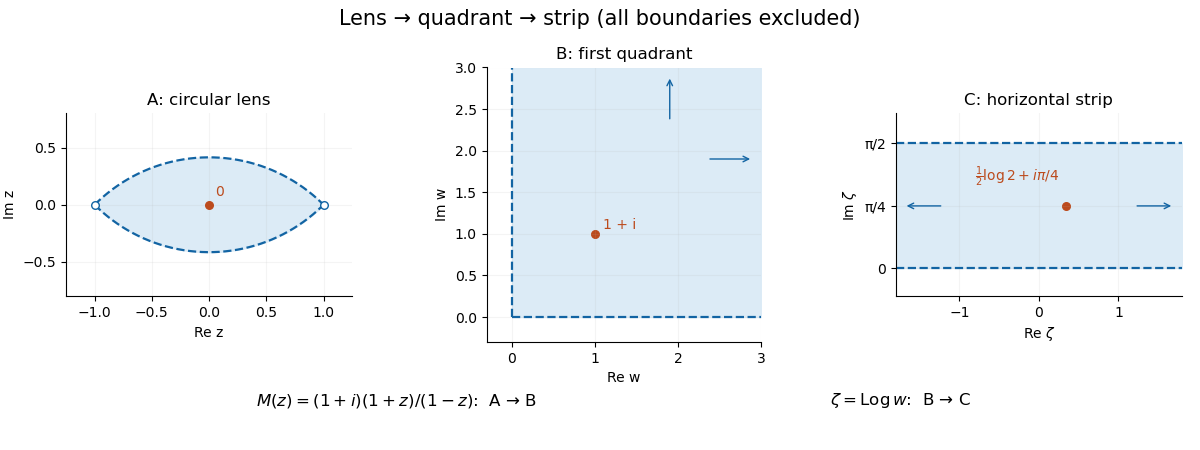
Compose the lens-to-quadrant Möbius map with the logarithm having argument in on the first quadrant. Polar coordinates show that the latter maps bijectively to the horizontal strip . Its inverse is the exponential function, so the combined inverse is . Both derivatives are nonzero, proving conformality. The logarithm's branch fixes the strip's vertical position; adding shifts that position without changing the exponential inverse.
If a nonconstant holomorphic function has its first nonzero local Taylor coefficient at order , small rays from have image arguments to leading order. Their oriented angles are therefore multiplied by modulo . The case is locally conformal; gives a critical point, and the local inverse has branches. For the Joukowski map at , , so .
An orientation-reversing local conformal map of planar domains. Equivalently, its complex conjugation is a holomorphic function with nonzero derivative. Complex conjugation is the basic example. The metric pullback uses the modulus of its local scale factor, just as for an orientation-preserving conformal map.
The rational function is a conformal bijection from onto . For a proof, the Cayley transform between the half-plane and disk maps the source onto the right half of the unit disc. Squaring maps this half-disc bijectively onto . Finally maps the disc to the upper half-plane and to the excluded ray. The composition simplifies to . Each factor is holomorphic with nonzero derivative and bijective on its indicated domain.
A conformal map from the complex upper half-plane to a polygonal domain with finite prevertices and interior angles has the displayed derivative, with upper-half-plane branches of the powers. Integrating supplies the map, up to translation and nonzero scaling. For a slit boundary, repeated geometric vertices are treated as distinct boundary approaches: the two sides at the slit base have their respective angles, and a slit tip has angle , hence exponent one.
The principal square root maps the upper half-plane bijectively onto with the ray removed. The prevertex zero is the slit tip, and represent the two ends at infinity. The inverse is the unique root with positive imaginary part. Pulling back gives the bounded harmonic function with value one on the slit banks and zero on the imaginary axis. The harmonic function has zero finite boundary values but grows at infinity, explaining the role of boundedness.
The upper half-plane joined to the downward strip has reentrant corners at . The Schwarz-Christoffel formula gives , with at upper infinity. Since , integration gives the displayed map. The inverse trigonometric function is continued analytically in the upper half-plane so its corner values are . The origin is the lower channel end and infinity the upper open end. The complex potentials and respectively normalize unit horizontal velocity in the upper region and unit upward velocity in the channel.
With the square root positive for on the positive imaginary axis, the displayed conformal map takes the upper half-plane bijectively to . Squaring, subtracting from one, taking the positive-real-part square root, and reciprocating identifies each intermediate slit domain. The boundary prevertices correspond to the lower infinite end, the slit tip at one, and the upper infinite end. The inverse is with positive imaginary part.
A boundary point of the source half-plane that maps to a polygon vertex. If that corner has angle , the Schwarz-Christoffel mapping has local behavior at its prevertex, so the derivative has exponent . Infinity may also be a prevertex, expressed in the local coordinate .
For , principal upper-half-plane branches give a conformal map onto the upper half-plane cut along , where . Its derivative is . The two prevertices map to the slit base, and maps to its tip. Boundary traversal goes out along the slit and back, while at infinity. The argument principle gives one preimage of every point off the slit.
For the lens and , the Möbius transformation maps its real boundary segment to the positive real axis and its circular boundary arc to the ray with argument . Its interior maps bijectively to . The fourth power therefore maps this lens conformally onto the upper half-plane. Composing with maps it onto the unit disc. The endpoints are boundary points, so the pole and zero introduce no interior singularity or branching.
The conformal group of a metric manifold consists of diffeomorphisms with for a positive function . Its infinitesimal generators are Conformal Killing vector fields. The choice of manifold matters: in flat Euclidean dimension greater than two, special conformal transformations can be regular on the conformal compactification of Euclidean space while having finite poles in the uncompactified space.
If is rescaled to , a null geodesic retains its unparametrized path. For its original affine tangent , the changed connection gives . Rescaling the tangent by cancels this term and proves the displayed affine-parameter relation, up to a constant multiplier. A conformal boundary may therefore be reached at finite unphysical affine parameter while physical affine parameter is infinite.
The local angle-preservation property of a conformal map. At a regular point its derivative is a positive scaling times an orthogonal linear map. Consequently composition multiplies gradient lengths by that scaling, as follows directly from the chain rule.
Two intersecting circles bound a lens. A Möbius transformation sending their intersection points to zero and infinity sends the two boundary arcs to rays, and the lens to a sector. A suitable power straightens the sector to a half-plane. The chosen sector and its branch must be identified by an interior test point; merely squaring an arbitrary boundary-straightening map need not be injective on the intended domain. A Cayley transform then gives a conformal bijection to a disc.
The intersection of the unit disks centered at has endpoints zero and one. The Möbius transformation maps it onto the sector : the two disk conditions become . Cubing gives the right half-plane, and the Cayley transform between the half-plane and disk gives the displayed holomorphic bijection to the unit disk. The sector width ensures that cubing is injective.
For the upper half disk slit along , , squaring maps onto minus . After scaling the radius-four disc, the disk automorphism sends this slit to . Its square root with argument in maps onto the upper half unit disc. There maps bijectively onto the lower half-plane: its imaginary part is , and the two roots of its inverse equation are reciprocal, with exactly one inside the unit circle. The final Möbius map gives the displayed conformal disk bijection.
In the explicit slit map, right-side approach to gives the positive root, and left-side approach gives the negative root. The corresponding lower-half-plane boundary values are , so the two unit-circle image values are distinct. Every other conformal bijection onto the disk differs by a disk automorphism, which extends bijectively to the unit circle. Thus a sequence approaching that slit point has exactly one or both of two boundary cluster values, according to which sides occur infinitely often.
On , take the principal square root with positive real part. The Möbius transformation has image . The principal square root therefore maps to the right half-plane with omitted, and the final Möbius transformation gives exactly . The inverse is . Adding to the source on the Riemann sphere fills the missing value and gives a conformal map onto the full disk. Without , a loop surrounding the segment has nonzero winding number, so the source is not a simply connected space and cannot be conformally equivalent to a disk.
For the crescent inside and outside , inversion gives the horizontal strip . The affine map sends it to , and maps it bijectively onto the upper half-plane. A Cayley transform then maps it onto the unit disc. Tangency, rather than a separate enclosed hole, is why this domain is simply connected.
The sine maps bijectively onto the upper half-plane: its imaginary part is , and the equality of two sine values forces either equal arguments modulo or arguments summing to an odd multiple of . Only equality is possible in this domain. For surjectivity, solve for . When , exactly one root has modulus below one and it has positive real part. The inverse therefore belongs to the half-strip. Composing with gives a conformal map onto the unit disc.
Conformal geometry studies a metric tensor only up to multiplication by a nowhere-zero positive scalar function on a real slice. A conformal class determines angles in Riemannian signature and null directions in Lorentzian signature. The complexified flat four-dimensional conformal geometry is encoded by the Klein quadric, whose incidence relation describes null separation.
An equivalence class of Riemannian metrics under multiplication by positive smooth functions. Such rescalings preserve angles. On an oriented smooth surface, a conformal structure is equivalent to a complex structure, with local holomorphic coordinates in which its metrics are positive multiples of .
A conformal compactification realizes a noncompact metric space as a dense open subset of a compact space whose metric on that subset is conformally related to the original one. Its smoothness and boundary interpretation depend on the example. Conformal compactification of Euclidean space adds one point to four-space; Projective Minkowski compactification adds a null cone. A regular null-boundary conformal completion and a projective compactification need not have the same global topology or causal covering convention.
A boundary obtained by extending the rescaled metric smoothly and nondegenerately to a hypersurface on which vanishes with nonzero derivative. Its causal character is measured using the extended Lorentzian metric, not the divergent physical metric. In signature , a timelike normal makes the boundary spacelike, a spacelike normal makes it timelike, and a null normal makes it null. These cases lead to different causal and initial-value properties. The conformal cylinder of two-dimensional de Sitter spacetime has spacelike past/future boundaries; the conformal strip of two-dimensional anti-de Sitter spacetime has two timelike boundaries.
Inverse stereographic projection identifies Euclidean four-space with a sphere minus one point. Multiplying its flat metric by gives the round metric, which extends smoothly over the added point. In the Klein quadric description, the compact space is the projectivized real null cone of signature . It differs topologically from Minkowski conformal compactification.
The Projective Minkowski compactification has infinite cyclic fundamental group, while the conformal compactification of Euclidean space is and simply connected. Thus the affine substitution cannot extend to an invertible smooth identification of these real compactifications. Both are real slices of the same complex Klein quadric, which permits local analytic continuation without equating their global real topologies.
In affine cone coordinates with and , the substitution is represented on the complex quadric by the rational map . It preserves the quadric equation but is indeterminate at some infinity points, including . This is a direct algebraic manifestation of the obstruction to a global regular Wick map.
For , the conformal map takes bijectively onto the upper half-plane. The exponential maps this half-strip onto the upper half-plane exterior to the unit circle; then is a scaled Joukowski map. All critical points of the entire map are , mapping alternately to and .
The map sends the open second quadrant inside the unit circle bijectively to the open first quadrant outside it. Radius becomes and argument becomes . Its derivative is nonzero on the source, so it is a conformal map. Rotation combined with reciprocal inversion similarly maps other quarter-disc regions.
The map is a conformal map from onto the unit disc. A principal square root first maps the slit parabolic region to a vertical strip, and a scaled tangent followed by squaring maps the strip to a slit disc. Evenness in the square-root variable gives a holomorphic extension across the removed axis, filling the target slit.
A prime end describes an approach to the boundary of a simply connected domain through a nested sequence of crosscuts. A conformal map induces a correspondence between prime ends, even when the Euclidean boundary does not have a continuous one-to-one parametrization. This is the natural boundary interpretation of the endpoints and growing tip of a Loewner chain.
Choose a conformal map from a proper simply connected domain to the unit disc and pull back the topology of the closed disc. The resulting compactification is independent of the chosen map, since disc automorphisms extend to its boundary. Its intrinsic boundary distinguishes different approaches to a slit. Every conformal map between such domains extends to their intrinsic compactifications. This boundary agrees with the prime-end description in the simply connected setting.
For a simply connected domain and , the conformal radius is , where maps the unit disc conformally onto with . Disc automorphisms fixing zero are rotations, so the value is independent of the chosen map.
Before the Loewner swallowing time of , set and . Since the conformal radius of the complex upper half-plane at is , the transformation rule gives . The Koebe quarter theorem and the interior-disc comparison give . Differentiating the Chordal Loewner equation gives . Thus this quantity decreases as the remaining domain shrinks.
Two plane domains are conformally equivalent when there is a bijective holomorphic map between them whose inverse is holomorphic.
A conformal map from into the punctured unit disc would be bounded near its isolated singularity at zero, hence extend to a bounded entire function. The Liouville theorem would make it constant.
Composing a hypothetical conformal equivalence with a Cayley transform would give a nonconstant bounded entire function, contradicting the Liouville theorem.
The radial map is a homeomorphism from to the unit disc, with inverse . A conformal equivalence in that direction would be a nonconstant bounded entire function, contradicting the Liouville theorem.
The mapmaps conformally onto the upper half-plane. The Möbius transformation maps the half-disc onto the first quadrant, and squaring maps that quadrant onto the upper half-plane.
If a holomorphic function satisfies , then it has a holomorphic local inverse near and is conformal there. Its possible failures of local conformality are therefore its critical points.
Articles by others on the same topic


A **conformal map** is a function between two shapes or spaces that preserves angles locally but may change sizes. In more technical terms, a conformal mapping is a function \( f \) that is holomorphic (complex differentiable) and has a non-zero derivative in a domain of the complex plane. ### Key Properties of Conformal Maps: 1. **Angle Preservation**: Conformal maps preserve the angle between curves at their intersections, which means the local geometric structure is maintained.