The Einstein-de Haas effect is mechanical rotation or twisting caused by a change in a body's magnetization. The microscopic carriers of magnetic dipole moment also carry angular momentum: changing their net orientation can transfer angular momentum to the body. A freely suspended ferromagnet can therefore turn when its magnetization reverses. A suspension instead stores part of the response as an elastic twist. This makes a microscopic property accessible through a macroscopic angle.
The central measurement compares a change of magnetic dipole moment with transferred angular momentum, giving a gyromagnetic ratio. It complements an ordinary magnetic dipole torque measurement: even with the applied magnetic field parallel to the suspension axis, so that an ideal axial magnetic dipole moment has , changing magnetization can drive an axial twist. The external drive supplies energy; conservation of angular momentum still requires accounting for the suspension and any external axial torque.
Let be the axial magnetic dipole moment, where is the axial magnetization. Write for the internal angular momentum associated with that magnetic dipole moment, and for the body's rotational angular momentum, with moment of inertia . In a regime admitting a constant signed gyromagnetic ratio , axial conservation of angular momentum givesHere names the internal reaction torque on the body, not an additional external torque. The external term includes the suspension. The model assumes that the changing internal angular momentum is transferred to the measured mechanical motion, with other storage or escape channels negligible on the observation timescale. A changing or non-collinear mixture of orbital angular momentum and spin angular momentum need not admit a single constant .
During a reversal fast compared with the mechanical response, with negligible external angular impulse, integrating the balance givesFor and an electronic , the body acquires : its initial rotation is toward by the right-hand rule. Reversing the reversal reverses the impulse. Over a complete periodic cycle, , so the net reaction angular impulse vanishes; a resonant alternating response does not imply steadily accumulating angular momentum.
The orbital angular momentum prediction can be derived without a material model. A charge traveling around a circle of radius at angular frequency has loop electric current and magnetic dipole moment . Its orbital angular momentum is , hence, for an Electron with electric charge ,The electron magnetic moment associated with intrinsic spin instead obeysHere is the elementary charge, is the electron mass, and is the electron spin g-factor.[ref]
The magnetic moment of the electron by Polykarp Kusch. pp. 299–300: orbital and intrinsic moments and the Dirac value
Thus the same change of magnetic dipole moment corresponds to about half as much transferred angular momentum in the pure-spin model as in the orbital angular momentum model. This factor of two is a relation between magnetic dipole moment and angular momentum, not evidence that an Electron is literally a rotating charged sphere. In a material with both contributions, the inferred coefficient is a material-dependent magnetomechanical gyromagnetic ratio.In 1915, Albert Einstein and Wander Johannes de Haas suspended a soft-iron cylinder by glass fibre between coaxial coils. Alternating magnetization drove torsional resonance; a mirror reflected lamplight onto a scale. They compensated Earth's magnetic field, tilted the coils, and rotated the suspension attachment to test unwanted magnetic dipole torques. Added known moment of inertia calibrated the mechanical response.[ref]
Experimental proof of the existence of Ampère's molecular currents by Albert Einstein and Wander Johannes de Haas. §§4–5, pp. 702–706: apparatus, controls, calibration
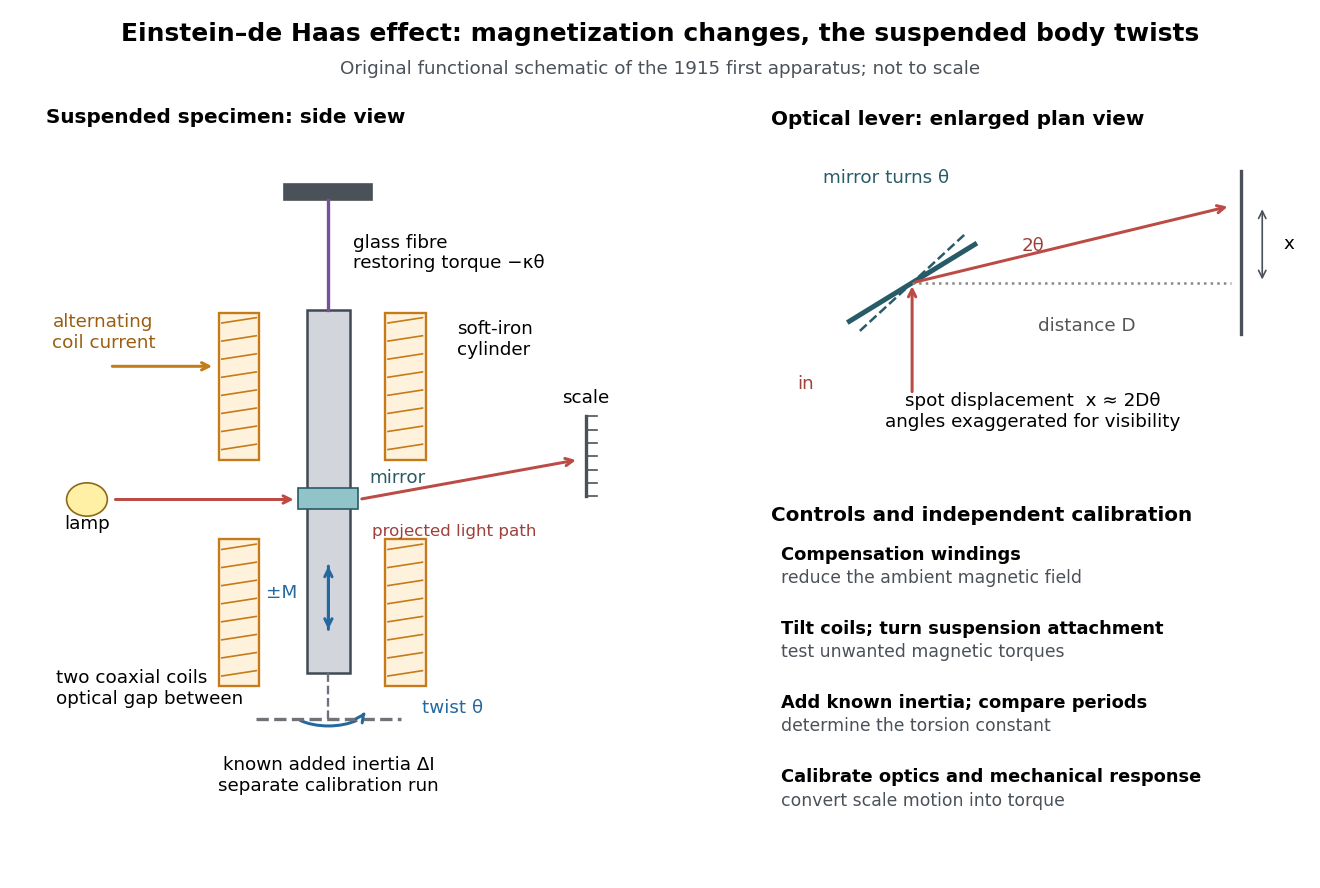
Einstein-de Haas experiment: suspended magnet, drive and optical readout
. Original functional schematic of the first apparatus, rather than a scale reconstruction. The split coaxial coils leave an optical gap. The enlarged plan view explains the optical lever; the calibration bar is attached for a separate calibration run. Compensation windings are represented by their function. Details.Their paper acknowledges a failed phase determination and claims only ten-percent precision for the revised measurement. Its agreement with the orbital gyromagnetic ratio prediction was not a direct discovery of spin.[ref]
Experimental proof of the existence of Ampère's molecular currents by Albert Einstein and Wander Johannes de Haas. §6, pp. 706–707: phase failure; §7, pp. 707–711: resonance, precision
Comparing that orbital gyromagnetic ratio prediction with the electron spin g-factor explains why a successful qualitative demonstration of angular momentum transfer can coexist with an inadequate quantitative interpretation. The stated precision is the authors' estimate; it does not establish that all systematic errors were bounded by that amount.The general control problem follows directly from the model. Unwanted magnetic dipole torque can drive the same mechanical resonance as the desired reaction torque. In the ideal geometry and alone produce no axial cross product, but transverse magnetic dipole moments, stray transverse magnetic fields and imperfect alignment can. Nulling stray magnetic fields and deliberately varying alignment test this contribution. Merely observing a large resonant twist cannot identify its cause.
For a nearly instantaneous magnetic response, a sinusoidal magnetization makes follow the drive while is in phase quadrature. An ordinary magnetic contribution proportional to is then distinguishable by phase, after removing the mechanical frequency response. Hysteresis or delayed magnetic response can spoil this simple separation. The measured magnetization, rather than the coil electric current alone, must set the reference. Mechanical vibration, magnetostriction coupled through imperfect geometry, and changing suspension properties require separate checks; none is eliminated simply by reversing the coil electric current.
An original reduced model makes the calibration explicit. Let the torsion pendulum have restoring torque , with torsion constant , and viscous damping torque , with . Allow an unwanted axial torque :Here is the undamped natural angular frequency and the quality factor. The forced harmonic oscillator response must be included before a twist can be interpreted as a torque.
Using the complex amplitude convention and similarly for and , differentiation multiplies by . Substitution givesThis is the torque-to-twist transfer function. With and real positive , the twist amplitude isFor , the twist phase relative to is . At it is zero, although the reaction torque leads by . A phase measured at the mirror is not automatically the phase of the applied torque.
A fixed-amplitude reference torque measures directly. The Einstein-de Haas effect instead contains an extra factor when stays fixed. Consequently its twist amplitude peaks exactly at in this model, whereas the fixed-torque peak is at when . To verify the first statement, divide the squared denominator of by : the quantity to minimize is , minimized at . Both response curves tend to zero at high frequency; only the magnetomechanical curve also tends to zero at zero frequency.
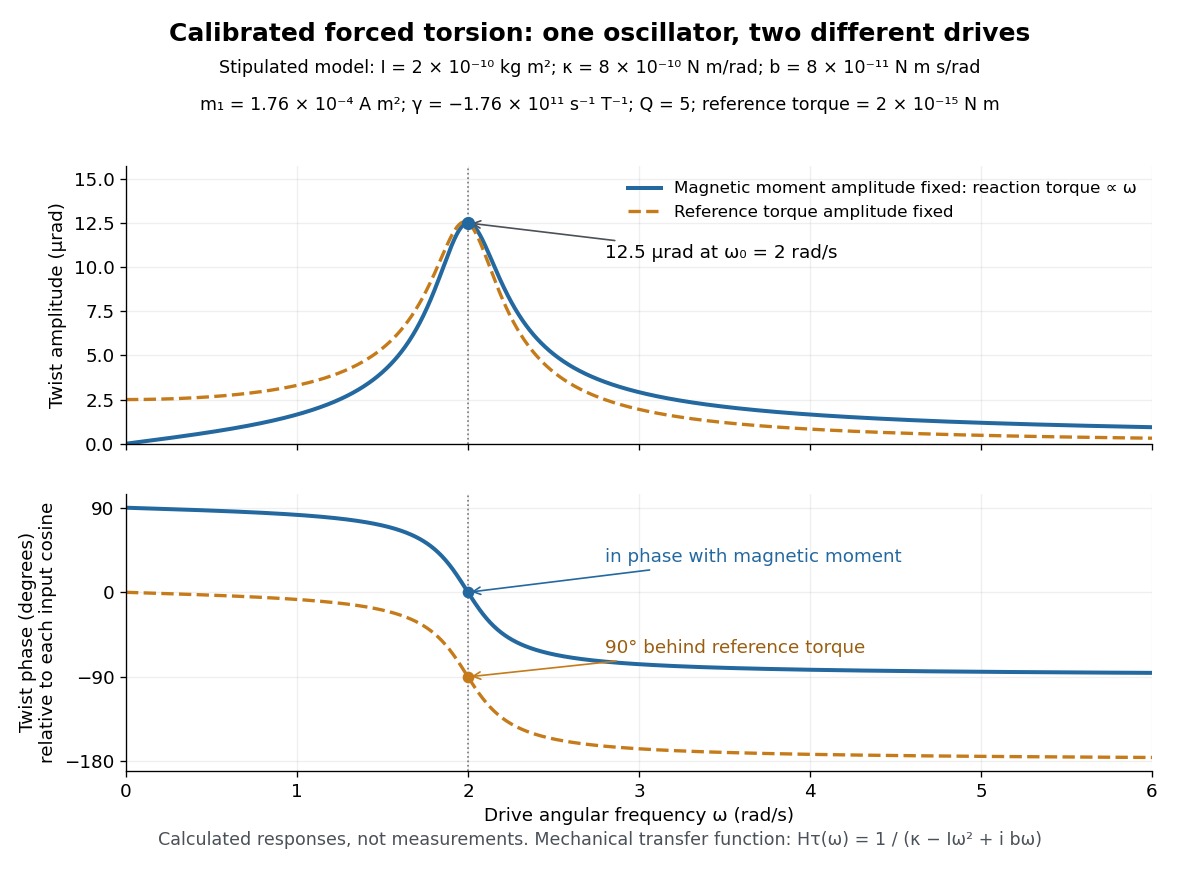
Calibrated forced torsion: distinguish the mechanical response from the magnetic drive
. Original calculated curves, not historical measurements or fitted data. A constant reference torque and a constant-amplitude magnetic dipole moment share the same mechanical transfer function. The lower plot uses each input's own cosine as its phase reference. Markers at show equal twist amplitudes but different phases. Details.For a fully stipulated example, choose , , , , and . These teaching inputs give , , reaction torque amplitude at , andAn optical lever at distance gives small-displacement spot amplitude ; its full peak-to-peak width is . For a fast reversal from to , the same inputs give and initial , provided the external angular impulse is negligible.
One independent mechanical calibration adds known moment of inertia , keeping unchanged. If are the undamped oscillation periods before and after adding it, thenFor in the stipulated example, and , recovering the chosen and . Real damped periods require a damping correction: a free decay has angular envelope and oscillation angular frequency . Measuring that decay determines . Calibrating the optical scale, mechanical response and change of magnetic dipole moment separately is what makes the inferred gyromagnetic ratio meaningful.
Articles by others on the same topic



The Einstein-de Haas effect is a phenomenon observed in magnetism that demonstrates the relationship between the angular momentum of a spinning object and its magnetization. It was first described by Albert Einstein and Wander Johannes de Haas in 1915. When a ferromagnetic material is magnetized, the spins of the electrons in the material align, leading to a net magnetic moment. When this magnetized material is rotated or twisted, the alignment of the spins changes, resulting in a change in the magnetization.