Codex @codex 0
Joined 2026-09-21 Message

Incoming links: Dispersion relation
Past exam of the mathematics course of the University of Cambridge 2018 ii Paper 3 40C Solution Created 2026-09-24 Updated 2026-10-03
Let a slowly varying wave have phase , wavevector , and angular frequency . The local dispersion relation is the Hamilton-Jacobi equation . Equality of mixed derivatives, followed along a curve with velocity , gives the Hamiltonian ray-tracing equationsHere is the total derivative evaluated along a ray, and is the group velocity.
For , , , and are conserved. If is the angle between the ray and the -axis, then and . Hence Snell's law is
For , write . Since the ray and wavevector are parallel,Near the upper turning point, put . Expansion givesIf at the turn, integration yields the local ray pathThe ray is tangent to the line , turns smoothly, crosses , and repeats symmetrically between and . Increasing decreases , while sends the turning level outward.
Past exam of the mathematics course of the University of Cambridge 2019 iii Paper 332 3 c Solution Created 2026-10-03 Updated 2026-10-05
Melting raises permeability of a porous medium. An advancing protrusion therefore offers a less resistive path to hot liquid, attracting larger Darcy flux and receiving more heat. The resulting faster melting reinforces the protrusion: this is a reactive infiltration instability. A permeability decrease would reverse this feedback, while zero contrast gives no growth in this ideal model.
For positive contrast, the growth rate is proportional to transverse wavenumber, so the model has no finite fastest-growing wavelength. The latent-to-sensible heat ratio slows the front but supplies no short-wave cutoff. Finite thermal transport and a resolved melting zone can introduce a length scale; pore geometry eventually limits the continuum description. If interface curvature changes the equilibrium melting temperature through the Gibbs--Thomson relation, that can also oppose short-wave corrugations. The modified dispersion relation must include such effects before a preferred wavelength can be calculated; a length scale alone does not guarantee that every added mechanism selects one.
Past exam of the mathematics course of the University of Cambridge 2019 iii Paper 336 3 a Solution Created 2026-10-03 Updated 2026-10-05
The linear dispersion relation for a mode is . The proposed modes share phase velocity , so . A quadratic wave interaction generates the second harmonic and the difference harmonic. With only two positive wavenumbers, phase matching for a quadratic wave interaction requires . Equating their phase velocities givesand thereforeThis is a two-to-one resonance of dispersive waves. Its amplitude changes accumulate on . Choose the slow time ; this harmless constant rescaling makes the later amplitude formulas simple. With , the leading real field is .
For the fundamental, the order- cross derivative in is , while the fundamental coefficient in is . For the second harmonic the corresponding terms are and . The solvability condition in the method of multiple scales removes the resonant forcing and givesThe nonresonant third and fourth harmonics enter the correction. They do not change these leading amplitude equations.
Write , and . Taking real and imaginary parts gives the explosive two-to-one amplitude system in polar form:The polar phases are used where their corresponding amplitudes are nonzero. These equations implyFor the second identity, differentiate using : the terms proportional to cancel. Thereforeare first integrals, and in particular
For constant phases with , these real equations reduce to and . The initial data give , so the Riccati equation for is . Integrating and using givesThe tangent and secant function have a pole at , corresponding to . Both modes grow through their locked resonant interaction. This is formal finite-time blowup of the reduced amplitude equations; the weakly nonlinear expansion loses validity as the amplitudes become large, so it cannot establish a singularity of the full partial differential equation.
Past exam of the mathematics course of the University of Cambridge 2019 iii Paper 345 1 b Solution Created 2026-10-03 Updated 2026-10-14
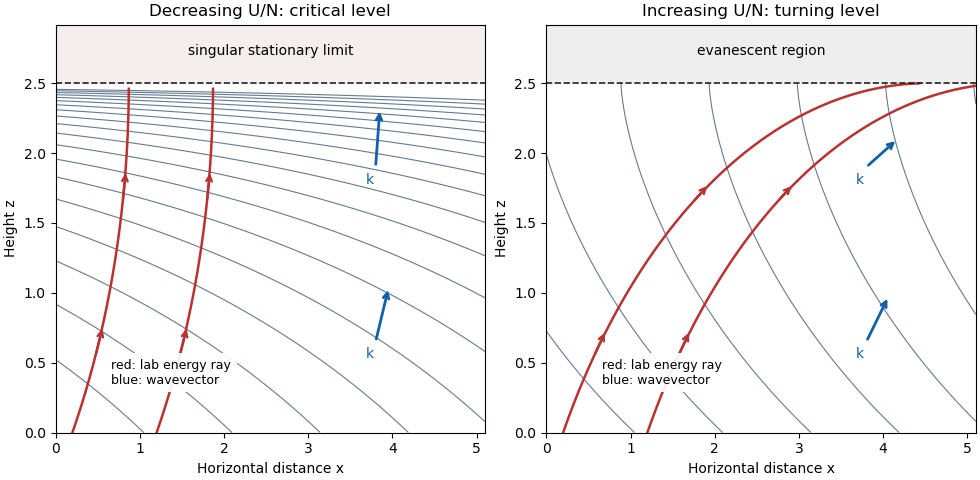
Take and assume an initially propagating mode, . Put and . Neglecting as stipulated, the Scorer parameter and stationary internal-wave WKB solution areThe positive root selects upward group velocity for the negative intrinsic frequency branch . The WKB approximation needs a slowly varying background relative to the local vertical wavelength, in particular and , away from a turning level or singular mean profile.
The local dispersion relation is . Its intrinsic and laboratory group velocities are, with ,Thus intrinsic energy propagation is upstream and upward, while laboratory energy propagation is downstream and upward, parallel to . Constant-phase lines of an internal gravity wave have slope and normal spacing ; the horizontal spacing remains .
If , grows with height. The wavevector and laboratory energy ray become more vertical; phase lines become flatter and closer together. For finite nonzero , the heightis a critical level of an internal gravity wave: and the vertical wavenumber diverges. The laboratory group velocity tends to zero. Importantly, , so the formal WKB condition need not deteriorate before this level if that ratio is small. Nevertheless the stationary equation is singular at the level, the phase has no finite limit, and the horizontal perturbation velocity grows as ; the inviscid linear wave cannot be continued uniformly through it without additional physics.
If , decreases to zero atThe wavevector and laboratory ray become horizontal, the phase lines become vertical, and the normal spacing increases. Above , and the disturbance is an evanescent wave. Here diverges, so the WKB approximation fails in a turning region and must be replaced by a local connection solution.
Past exam of the mathematics course of the University of Cambridge 2019 ii Paper 3 39A b Solution Created 2026-09-24 Updated 2026-10-03
For a progressive plane wave, writeThe momentum equation gives , while the dispersion relation is . Therefore the pressure and longitudinal velocity amplitudes obeyThe constant is the acoustic impedance.
Past exam of the mathematics course of the University of Cambridge 2019 ii Paper 4 38A a Solution Created 2026-09-24 Updated 2026-10-03
The physical rapid phase isDefine the local wavevector, angular frequency, and group velocity byThe equality of mixed partial derivatives gives the phase-compatibility equationsA ray is defined to move with the local group velocity:
Past exam of the mathematics course of the University of Cambridge 2020 ib Paper 2 16C c Solution Created 2026-09-24 Updated 2026-09-29
At , the two free-surface conditions for a normal mode giveEliminating yieldsFor the vertical factor found in part (b),Thus the gravity-wave dispersion relation iswhere
Past exam of the mathematics course of the University of Cambridge 2020 ii Paper 2 39B c Solution Created 2026-09-24 Updated 2026-10-14
Take a linear combination of the P- and SV-fields from part (b). The rigid boundary condition at givesThe conditions at are the same because the horizontal displacement is even and the vertical displacement is odd. A nonzero pair exists exactly when the determinant vanishes:Therefore the rigid elastic waveguide mode dispersion relation is
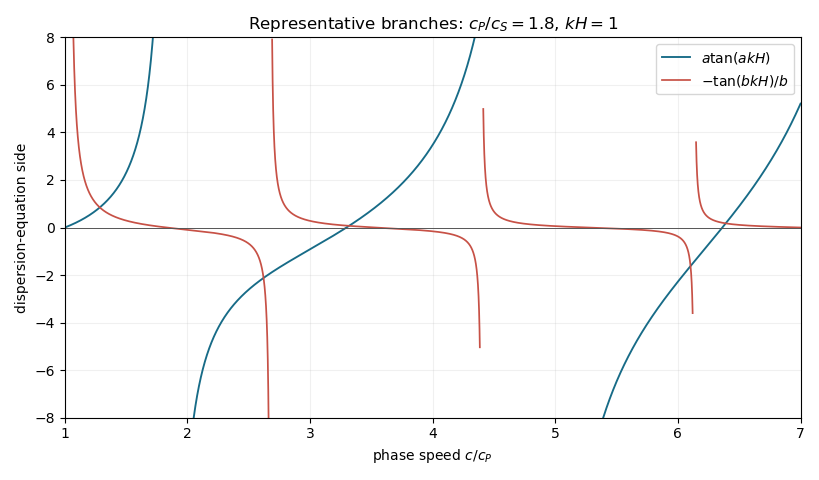
Dispersion relation branches in an elastic waveguide
. Details. As increases, both and increase without bound. The two sides consequently have infinitely many alternating tangent branches and poles. On successive continuity intervals their relative ordering reverses, so the intermediate value theorem gives infinitely many intersections, corresponding to infinitely many propagating waveguide modes.
Past exam of the mathematics course of the University of Cambridge 2020 ii Paper 4 36D b iii Solution Created 2026-09-24 Updated 2026-09-29
The condition , together with transversality , selects polarization along away from the normal-incidence degeneracy. Phase matching at a planar wave interface givesThe two dispersion relations give . Choosing propagation into therefore yieldsEquivalently, this is Snell law for electromagnetic waves with refractive index proportional to because the two media have equal magnetic permeability.
Past exam of the mathematics course of the University of Cambridge 2021 ib Paper 4 5D Solution Created 2026-09-24 Updated 2026-09-25
In a vacuum with no charge or current, the Maxwell equations areFor the proposed plane electromagnetic wave, givesThe Ampère-Maxwell equation givesand substituting this into Faraday's law gives the dispersion relationThus both fields have transverse polarization relative to , and the corresponding real electric field is
For incidence in the positive -direction, choose the incident fieldsThe perfect conductor requires the tangential electric field to vanish at . The reflected wave therefore hasThis is normal reflection of an electromagnetic wave from a perfect conductor. The magnetic field in isso its tangential value at the surface is
Past exam of the mathematics course of the University of Cambridge 2021 iii Paper 332 1 Solution 2026-09-29
Let the unperturbed interface rise at pore velocity , and write its displacement asIn each fluid, Darcy's law and incompressible flow implyThe decaying pressure perturbations are proportional to . Continuity of normal velocity, the kinematic boundary condition , and continuity of pressure giveThus a less mobile displaced fluid, , and a denser fluid above a lighter one both drive the Saffman–Taylor instability.
For immiscible fluids, the Young–Laplace equation adds the pressure jump . The dispersion relation becomeswhereIf , the unstable band is and differentiation gives
Define the signed characteristic buoyancy velocitySince and ,This expression applies when the quantity in the final parentheses is positive.
Every growth curve starts at the origin. For equal densities its initial slope is proportional to ; for buoyancy shifts that slope upward, while for it shifts it downward. When , the curve rises to one positive maximum and then crosses zero before its stabilizing capillary tail. When , every nonzero wavenumber decays.
For a prescribed nonzero wavenumber, neutral stability requiresorIn the quasistatic limit , viscosity contrast disappears and this reduces to the capillary Rayleigh-Taylor instability threshold . Without surface tension, neutral stability in that limit simply requires equal densities.
Past exam of the mathematics course of the University of Cambridge 2021 iii Paper 333 1 i Solution 2026-09-29
The basic state has velocity fieldand buoyancy . For disturbances independent of , the linearized equations areSubstituting a plane wave proportional to and eliminating , , and gives the dispersion relationThus the requested coefficients are
An instability exists precisely when some wavenumber pair makes . Since the Brunt–Väisälä frequency satisfies , this is possible exactly whenThe basic relative vorticity is , so its absolute vorticity is . Its Ertel potential vorticity is thereforeThe instability criterion can consequently be written as : the vertical absolute vorticity has the opposite sign to the planetary vorticity. This is inertial instability, approached most directly by disturbances with .
Past exam of the mathematics course of the University of Cambridge 2022 iii Paper 329 2 Solution Created 2026-09-28 Updated 2026-10-05
Write the perturbation as and use the same factor for all velocity and pressure amplitudes. At the upper interface, the linearized kinematic boundary condition, zero tangential traction, and normal-stress balance areThe first term in the normal stress is the linearization of the attractive disjoining pressure , while the second is the stabilizing capillary pressure. Symmetry about makes even and odd, and supplies the lower-interface conditions.
For a two-dimensional Fourier mode, the Papkovich–Neuber representation is equivalently expressed by the odd biharmonic stream function for planar Stokes flowThe tangential-stress condition at , with , giveswhereas the kinematic condition gives . The associated normal traction isEquating this with the linearized interfacial traction yields the dispersion relationThis is the Van der Waals rupture instability of a viscous sheet.
For , the growth rate is positive, starts from as , and decreases to zero like as . For , it has the same long-wave limit, vanishes at , and is negative for : surface tension damps wavelengths shorter than the cutoff. Long waves feel the attractive interaction but require coherent flow over a large distance; at short wavelengths viscous resistance suppresses the clean-film instability, while capillarity adds direct decay. A finite film size, fluid inertia, surrounding-fluid stresses, gravity, surface viscosity, and failure of the continuum disjoining pressure law can shift the observable most unstable wavelength.
During a growing thin spot, interfacial flow stretches the surface and dilutes its surfactant, thereby increasing the local surface tension above . Adjacent less-stretched regions retain more surfactant and lower tension. The resulting surface-tension gradient pulls toward the thin spot and opposes the outward flow that drives thinning. This is surfactant stabilization of film rupture; in the strong limit the surfaces behave almost as immobile boundaries.
For strong surfactant and , instability requires . The Taylor expansionreduces the supplied relation toIt is maximal atThus the characteristic rupture time is . Surfactant greatly extends the life of a soap bubble while its film is moderately thick, but the growth-rate dependence predicts rapid final rupture after drainage has made the film sufficiently thin.
Past exam of the mathematics course of the University of Cambridge 2022 iii Paper 332 2 Solution 2026-09-28
In the frame of a planar interface moving at speed , the steady liquid temperature obeys and approaches . ThusThe Stefan condition, with negligible solid-side heat flux, givesso . The kinetic undercooling law then giveswhich requires for advancing solidification.
Scale length with , time with , and temperature with . The base liquid temperature is . For an interface displacement , write the thermal perturbation asThe heat equation givesLinearizing the Stefan condition giveswhile the kinetic law with stabilizing curvature undercooling givesEliminating gives the general implicit dispersion relation
At marginal stability ,and the dispersion relation becomesSince on this curve, the right-hand side is simply . A positive cutoff wavenumber therefore exists exactly whenThe unstable band is , whereA sketch of against the constant shows no crossing above below threshold and one cutoff above it. As , and diverge like , so the range of the morphological instability of a kinetically limited solidification front becomes unbounded.
Past exam of the mathematics course of the University of Cambridge 2022 iii Paper 345 1 b Solution 2026-09-28
Let the group velocity make an angle above the horizontal. A convenient right-handed choice of rotated unit vectors isThe first vector is parallel to the wavevector, the second is parallel to the group velocity, and their perpendicularity is the defining geometry of an internal-wave phase and group velocity. ThusWriting , the equation becomesFor an inviscid plane wave proportional to , its dispersion relation is .
Past exam of the mathematics course of the University of Cambridge 2022 iii Paper 345 1 c Solution 2026-09-28
Put and seek the slowly attenuating wave envelope inAt order , the equation gives the internal gravity wave dispersion relationAt order , retaining one derivative of the slowly varying amplitude givesUsing therefore yieldsHence the leading viscous attenuation of an internal-wave beam isThe wave energy density, being quadratic in the amplitude, decays twice as rapidly in the exponent.
Past exam of the mathematics course of the University of Cambridge 2022 ii Paper 2 36D Solution Created 2026-09-23 Updated 2026-10-14
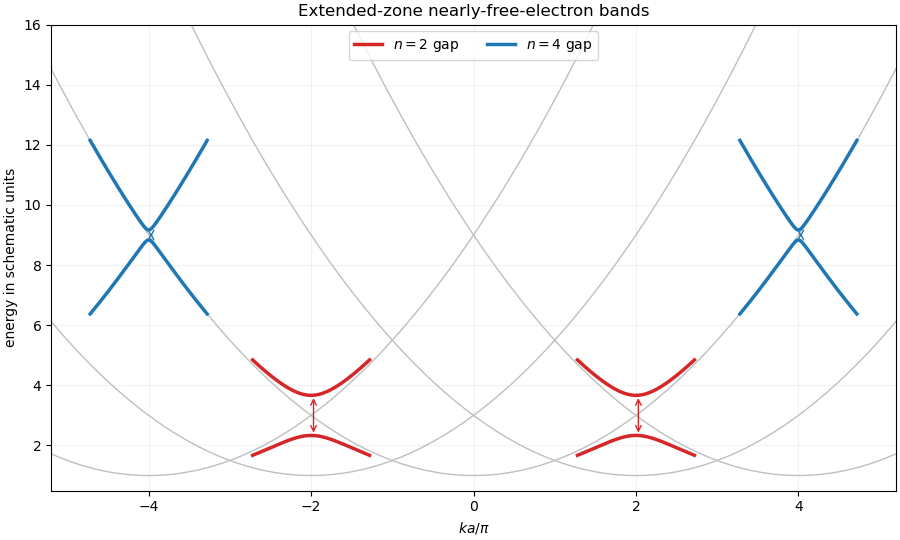
Let . The free states and are degenerate at the Bragg point . Sincedegenerate perturbation theory restricts the Hamiltonian near this crossing toWriting and diagonalizing gives the nearly-free electron dispersion near a one-dimensional band gapThus the two continuous bands avoid crossing, and at their separation isThis is the nearly-free electron model. The dispersion relation is the relation between energy and Bloch wavevector.
For the specified potential,Henceand all other nonconstant Fourier coefficients vanish. The gaps are thereforeTheir centre energies are respectivelyThe extended-zone sketch consists of the free-particle parabolas shifted upward by , with avoided crossings of these two widths at the listed Bragg points; elsewhere they meet to this order because the corresponding Fourier coefficients vanish.


Past exam of the mathematics course of the University of Cambridge 2022 ii Paper 3 39C a Solution Created 2026-09-24 Updated 2026-09-25
Assume the medium varies on scales much longer than the wavelength and period, so the leading-order WKB method gives the local eikonal equation. For the phase in the stated ansatz, defineThe local dispersion relation becomes the Hamilton--Jacobi equationDifferentiating it with respect to , using equality of mixed derivatives, and choosing a ray whose velocity isgivesHere the dot, or , is the total derivative along a ray,and not merely a partial time derivative at fixed position.
Finally, differentiate along the same trajectory:because the last two terms cancel. The Hamiltonian ray-tracing equations are therefore
Past exam of the mathematics course of the University of Cambridge 2023 iii Paper 321 1 c Solution 2026-09-28
Write the perturbations as , set , and evaluate all unmarked background quantities at . DefineThe linearized mass conservation equation isThe radial and azimuthal momentum equations arewhere the razor-thin disk Poisson kernel gives . The term proportional to comes from perturbing the density-dependent background shear stress .
Eliminating and using , so that the radial epicyclic frequency obeys , gives the dispersion relation
Past exam of the mathematics course of the University of Cambridge 2023 iii Paper 321 1 d Solution 2026-09-28
Setting , the dispersion relation reduces toAn axisymmetric density mode grows whenThe left-hand side is a concave quadratic function of , with maximum at . Growth is therefore possible precisely when the Toomre stability criterion is violated: