Equilibrium radiation and cavity frequencies. A blackbody absorbs all incident radiation at every frequency and direction. In thermal equilibrium its emission spectrum depends only on its temperature. Radiation inside an isothermal absorbing cavity, sampled through a small aperture that hardly disturbs equilibrium, realizes black-body radiation to a good approximation. Microscopic absorption and emission establish the equilibrium distribution; a perfectly reflecting wall is the convenient idealization used to count the modes once that distribution is specified.
In a rectangular electromagnetic cavity, the wave equation and perfect conductor wall boundary conditions select component wavenumbers , , . Combining the vacuum dispersion relation and gives
For example, electric-field components can have the spatial dependence
For three positive indices, Gauss's law requires , leaving two independent polarizations of an electromagnetic wave.
Index qualification. The original paper describes the indices as positive integers. That describes the three-nonzero-index family but omits valid electromagnetic modes with exactly one zero index, which have one polarization of an electromagnetic wave. For instance, with , , only above remains; it is normal to the top and bottom faces and vanishes at the side walls. Two zero indices give no nontrivial cavity field. The omitted one-zero-index family does not affect the leading three-dimensional mode count, but is essential to the thin-cavity limit below. Retaining the paper's strict positivity restriction for every mode would instead give a thickness gap and would not yield its requested two-dimensional power law.
Three-dimensional mode count. A lattice cell in positive space has volume , where . In a continuum approximation, a shell of radius and thickness contains its positive octant, multiplied by two polarizations:
Using gives
For a finite cavity the exact density of states is discrete; this formula is its bulk continuum limit, appropriate when many modes contribute and wall corrections are small.
Mean photon number. A mode is a quantum harmonic oscillator with thermal excitation energies , . The zero-point energy does not enter its thermal occupation. Put . Its partition function and mean occupation are
This is the Bose-Einstein distribution with zero photon chemical potential: equilibrium absorption and emission do not conserve photon number.
Thermal energy. Multiply the density of states by the mean excitation energy and integrate:
The substitution isolates all the dependence on cavity dimensions and temperature:
Expanding gives an integral . Hence
This is the thermal energy only, excluding the zero-point contribution. The three-dimensional continuum regime requires large compared with the geometric level spacings in all three directions.
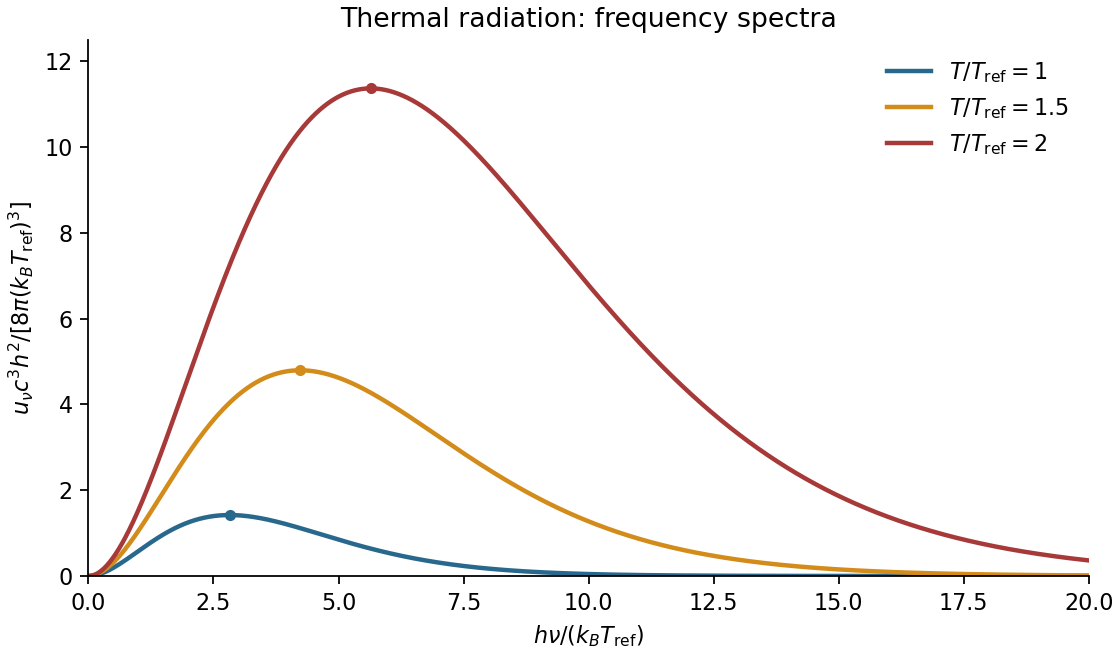
Spectral sketch. The spectral energy density per unit ordinary frequency is Planck's law,
At small frequency it rises as , while at large frequency it decays exponentially. Raising temperature increases the spectrum at every fixed positive frequency, moves the peak to larger frequency in proportion to , and increases the integrated area in proportion to . A plot per unit wavelength has a different peak position because the integration variable changes.
Figure 1.
Planck spectral energy density at three temperatures on common frequency and energy-density scales
. Original plots of the frequency spectrum, with temperatures in the ratios 1:1.5:2. The dimensionless horizontal axis is hν/(kBTref), and the vertical scale is common to all curves. The higher-temperature peak moves right and the area grows as T to the fourth power. Details.
Thin-cavity radiation. Let . The relevant low-temperature window is
Nonzero thickness indices are then thermally suppressed, while many in-plane modes are populated. The family has one polarization of an electromagnetic wave. Its allowed in-plane wavenumbers form a lattice of cell area ; a quarter of a circular shell therefore contains
Thus the dimensional crossover of thermal cavity radiation gives
The integral is by the same geometric-series argument. A model with a different number of independent polarizations of an electromagnetic wave changes the prefactor but not the scaling. For a cavity with fixed finite , cooling still further eventually freezes its lowest in-plane mode as well: the strict thermal energy is exponentially suppressed. The requested area law is the intermediate quasi-two-dimensional regime, not an arbitrarily low-temperature continuum limit.
Assume an air-filled or evacuated lossless electromagnetic waveguide, and a pulse bandwidth narrow enough to use its carrier's local group velocity. The longitudinal dispersion relation is
It gives
Here , so
The phase velocity exceeds , but the pulse envelope travels at the subluminal group velocity; a moving constant-phase surface does not by itself transport information. Their product is . A broad pulse can distort because this waveguide is dispersive.
For the propagating mode of an air-filled or evacuated rectangular electromagnetic waveguide, the longitudinal dispersion relation is
The phase velocity and group velocity along the guide are consequently
With waveguide cutoff frequency and carrier frequency , . Thus
The pulse envelope travels at the group velocity for a sufficiently narrow range of frequencies. The phase velocity exceeding the speed of light does not describe superluminal signal transport. The check follows directly from the dispersion relation. A different uniform filling medium would require replacing by its electromagnetic propagation speed; the stated numerical answer uses the usual empty-guide assumption.
Fixed endpoints require , with . Writing ,
For equal amplitudes , the two requested profiles are
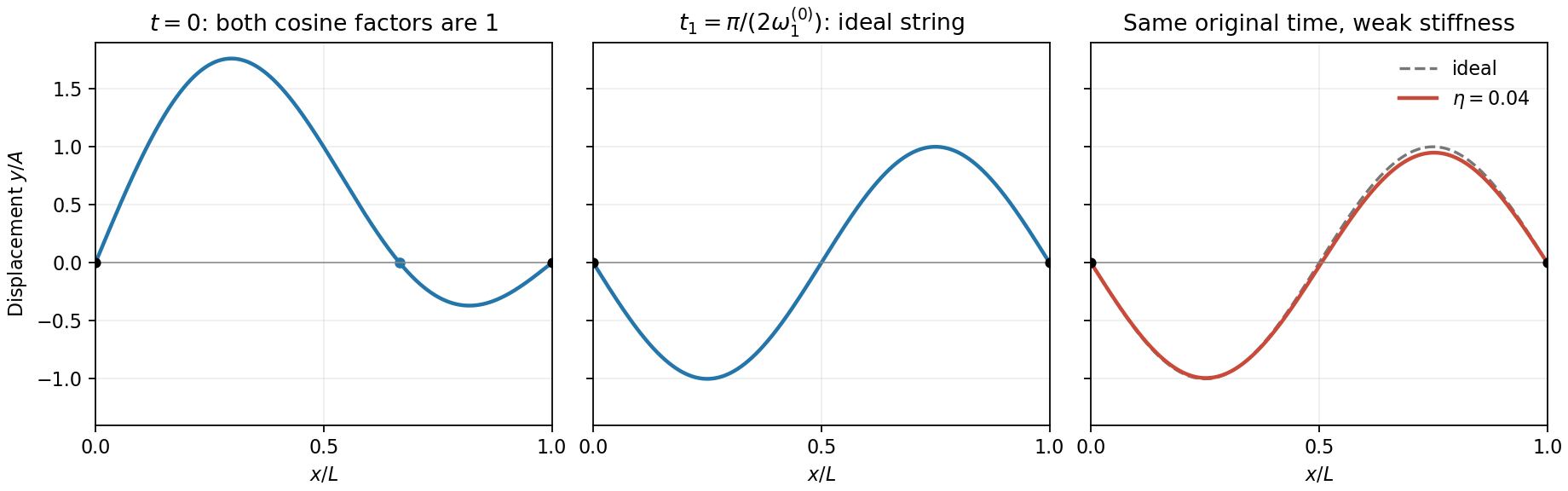
The first is asymmetric, with an interior zero at ; the second has its interior node at . For two-mode string recurrence, orthogonality means the whole initial profile recurs only when both cosine coefficients equal one. Since ,
Figure 1.
Two-mode string profiles and the small change produced by weak positive dispersion at the original quarter-period
. Details.
The weak-stiffness string frequency shift follows by expanding the supplied dispersion relation:
Higher normal modes acquire larger fractional frequency shifts. Let and retain for the original ideal frequency. At the originally defined time ,
Thus the sketch is unchanged, whereas the original quarter-period sketch gains a small negative fundamental component. If is redefined using the new fundamental frequency, its fundamental component is exactly zero and the second-mode change there is only second order. Both conventions agree that generic later shapes change because of relative phase drift.
The new frequency ratio is
An exact recurrence now requires and for integers . If in lowest terms, the first recurrence is ; for irrational there is no exact finite recurrence. Near-recurrences remain possible. Positive stiffness alone does not prove that the ratio is irrational.
Substitution into the wave equation gives and . Therefore . The fixed edges at zero are automatically satisfied by the sine factors; the opposite edges require
Neither integer may vanish, because that would make the entire displacement zero.
The element's mass is , and its speed is . Squaring and multiplying by half its mass gives the requested energy density. The two sine-squared spatial integrals are and , so
There is no dissipation. The total mechanical energy equals the maximum kinetic energy, giving
Equivalently, integrate the small-slope tension energy and use the dispersion relation.
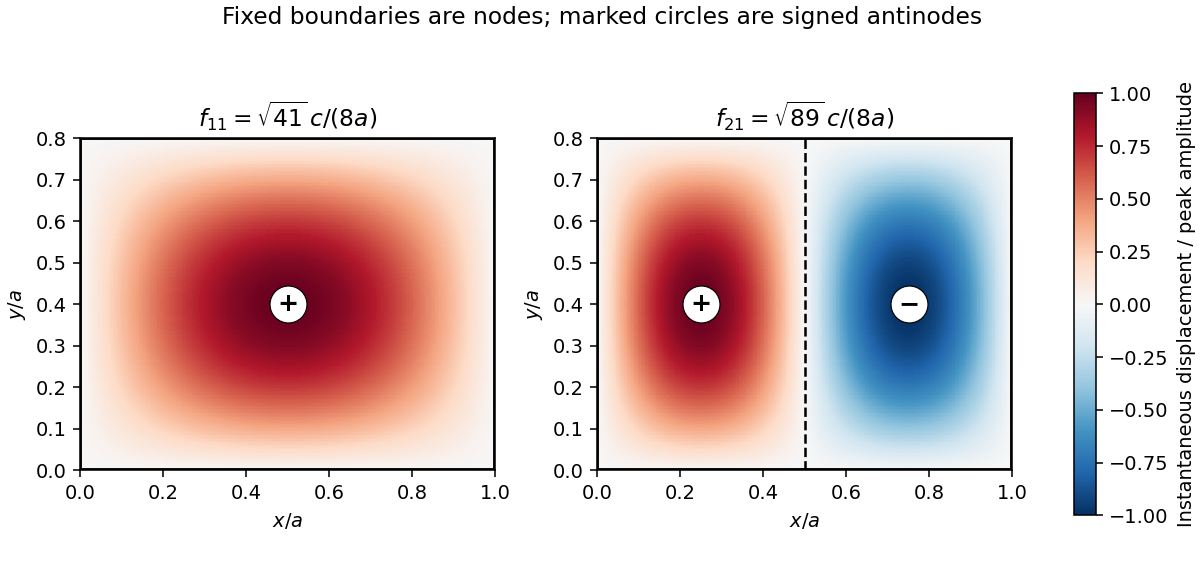
For , the two lowest modes are and :
The fundamental has one antinode at and no interior nodal line. The next mode has a node along and opposite-sign antinodes at and . Every boundary is a node.
Figure 1.
Original displacement maps for the two lowest modes of a rectangular membrane, showing nodal lines and signed antinodes
. Details.
The square fundamental has . Equating it to gives
At the same peak displacement amplitude and frequency, time-averaged kinetic energy is proportional to membrane area. Therefore
The reciprocal ratio is if the rectangle is placed first.
Use base dimensions for mass, length and time. The proposed dimensional analysis gives
so
Equating the independent dimensional powers requires
Consequently
The mass density drops out because there is no other mass-bearing quantity with which to combine it under the stated assumptions.
Dimensional analysis fixes the powers but leaves a dimensionless coefficient undetermined. For a linear deep-water gravity wave, the dispersion relation is , giving phase velocity and group velocity . Both obey the inferred scaling. The phrase wave speed alone does not distinguish these two velocities or fix the coefficient.
Work with the explicitly corrected reduced-pressure system in b. Write and use the complex wave amplitude, taking real parts at the end. The vertical factor satisfies , so the wave equation gives
For a Kelvin wave, continuity, zonal momentum and the buoyancy equation then determine all polarizations:
In particular have amplitude proportional to , whereas pressure has amplitude proportional to . Directly substituting these expressions into vertical momentum gives , verifying both the sign and the dispersion relation.
Meridional momentum is . Since , it integrates to a Gaussian . Thus
The eastward intrinsic branch is selected by decay away from the equator; choosing would make the meridional amplitude grow without bound. Although the squared dispersion relation has both frequency signs, a meridionally trapped Kelvin wave has this one phase-propagation direction.
For short vertical wavelengths, , so , and . The wave is a slowly oscillating, hydrostatic internal gravity wave with strong vertical variation and relatively narrow trapping. Here and ; the buoyancy expression above remains valid.
For long vertical wavelengths, , the exact limiting speed is . To obtain the stated height-controlled limit also requires long horizontal wavelength, . With both and ,
The finite density scale height prevents the hydrostatic phase speed from diverging as . The polarizations tend to , and . Long vertical wavelength alone at fixed large would not justify . In the opposite horizontally short limit the frequency approaches instead. The growth compensates decreasing reference density in wave-energy density; a radiating wave train is a local modal description, not a finite-total-energy eigenfunction over an infinite vertical domain.
Apply the intended, corrected dispersion relation in c. A uniform mean zonal wind gives . Stationarity with therefore requires eastward intrinsic phase speed . With ,
The period determines and . Hence
Figure 1.
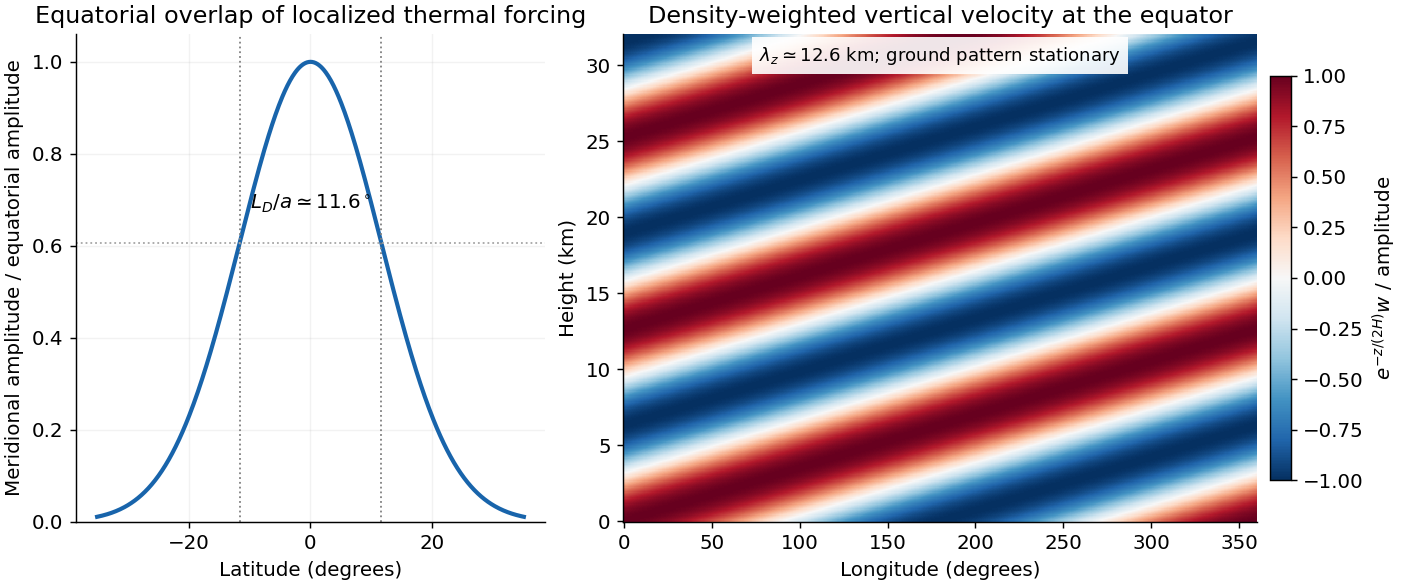
Equatorial trapping and vertical phase of the stationary Martian Kelvin-wave example
. The original calculation uses an eastward intrinsic speed of 20 metres per second. The Gaussian amplitude has a latitude scale of 11.6 degrees; the density-weighted vertical velocity has a vertical wavelength of 12.6 kilometres. The plotted negative vertical wavenumber corresponds to upward intrinsic energy propagation. Details.
A storm within roughly of the equator has substantial projection on the Gaussian mode. There is no sharp latitude cutoff: gives amplitude and the amplitude latitude is about . Forcing outside that core has progressively weaker overlap.
The intrinsic wave is eastward even though its observed ground pattern is stationary; westward advection cancels its phase propagation. Its intrinsic period is about Earth days. The inferred puts it in the short-vertical-wavelength branch, well below the long-wave speed . For upward energy radiation, must be positive, which selects for positive : vertical phase propagation is then downward. Dust absorption supplies thermal forcing with a zonally asymmetric component; the response does not imply that dust itself moves eastward at the intrinsic phase speed.
Southern spring to summer, the warmer perihelion-side dust season, is a reasonable climatological window for such a regional storm. This seasonal inference uses observed dust climatology, not the dispersion relation: the specified wind and wave parameters alone do not determine a unique season, and individual regional storms can occur outside that window.[ref]
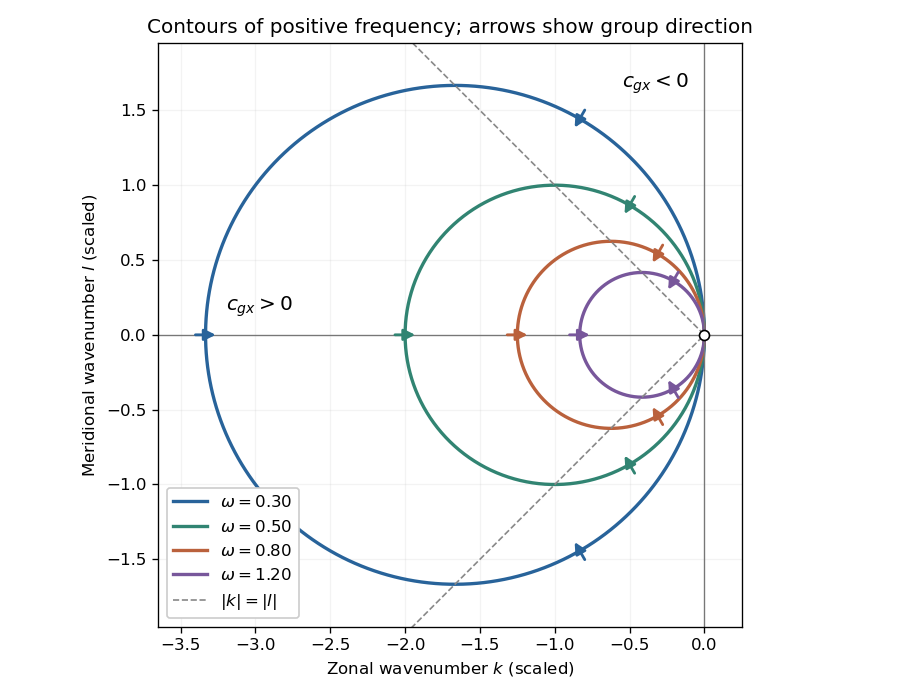
For and fixed , completing the square in the dispersion relation gives
These Rossby-wave isofrequency circles lie in the half-plane and touch the origin, where the dispersion relation is undefined. Their radii decrease as frequency increases. The zero-frequency line is .
The group velocity is normal to the constant-frequency curves, toward increasing frequency:
At , the group velocity is eastward; close to it is westward. For the positive-frequency circles its arrows point inward toward the circle centre. Its meridional component is southward in and northward in .
Figure 1.
Positive-frequency Rossby-wave isofrequency circles and group velocity directions in dimensionless wavenumber coordinates
. Details.
For , the zonal phase velocity, meaning propagation at fixed , is
It is westward everywhere it is defined. The zonal group velocity is eastward for , westward for , and zero on . There is no region of eastward zonal phase velocity. At , is undefined, though its continuous limiting expression is westward and . Using instead the normal-to-wavecrest phase velocity vector gives ; its zonal component is also westward for , but is not the same scalar as .
Seek nonzero time-harmonic waves of the form and , taking . Laplace's equation reduces to . The impermeable-bed condition gives .
The linearized kinematic and dynamic linearized free-surface boundary conditions at zero become
Eliminating and the nonzero amplitude gives
Conversely, if this dispersion relation holds, either amplitude can be chosen nonzero and the other set by the second boundary equation, producing a wave satisfying every condition. The expression also holds for negative because is even.
For potential flow, each velocity potential satisfies Laplace's equation in its fluid. The exact kinematic boundary condition on is . Keeping only first-order terms gives
The linearized Bernoulli equation is at the interface, so pressure continuity gives
For a decaying disturbance away from the interface, put and take
They satisfy Laplace's equation and the kinematic boundary conditions for . Substituting in the dynamic condition gives the dispersion relation
If the heavier fluid is on top, . Instead of oscillation, a Fourier disturbance has an exponentially growing component with growth rate . This is the Rayleigh-Taylor instability in the absence of surface tension.
The band effective mass is determined by the second derivative of the dispersion relation:
With the stated sign convention and , the band minimum is at . Expanding the cosine, or differentiating twice, gives
Comparison with a free electron's kinetic energy therefore requires
The hopping integral has units of energy. A negative would move the minimum to the edge of the Brillouin zone and give the same positive bottom-of-band effective mass with in this expression.
Different measurements reveal different aspects of electronic band structure; a convincing determination combines their constraints.
Angle-resolved photoemission. In angle-resolved photoemission spectroscopy, photons of known energy eject occupied electrons. Measuring their kinetic energy and emission angle reconstructs binding energy and the component of crystal momentum parallel to the surface:
Here is the sample work function when kinetic energy is referenced to the nearby vacuum; an analyzer energy scale requires its own work-function calibration. Momentum is conserved modulo a surface reciprocal lattice vector, neglecting photon momentum. Tracking the peaks maps occupied dispersion relations and the Fermi surface. The measured intensity also contains the matrix element, the Fermi-Dirac distribution and the spectral function, so an absent bright feature does not establish an absent band. For a three-dimensional solid, the perpendicular momentum requires a final-state model. Inverse photoemission spectroscopy probes unoccupied states by injecting electrons and detecting emitted photons.
Optical spectroscopy. Photon absorption and ellipsometry measure interband transitions, optical selection rules and the complex dielectric response. Because optical photon momentum is small on the scale of the Brillouin zone, direct transitions approximately preserve crystal momentum. Their onset constrains a direct band gap; a threshold involving a phonon can reveal an indirect band gap. Peak positions constrain energy differences between bands, but the response also depends on the joint density of states and optical matrix elements, so it does not uniquely determine every .
Quantum oscillations and cyclotron resonance. In clean samples at low temperature, the de Haas-van Alphen effect measures oscillations in magnetization and the Shubnikov-de Haas effect measures oscillations in electrical resistivity as the inverse magnetic field is varied. Their period in inverse magnetic field is , where Onsager quantization relates to an extremal Fermi-surface area perpendicular to the field:
Rotating the magnetic field maps the geometry of extremal orbits. The thermal damping determines the cyclotron effective mass,
with the appropriate magnitude for a hole orbit. Cyclotron resonance supplies the corresponding dynamical mass through . These are detailed probes near the Fermi level, rather than measurements of all occupied bands. Diffraction supplies the reciprocal lattice needed to label the measured momenta, but diffraction by itself is not a measurement of electronic dispersion.
The drift velocity is the small ensemble-average velocity acquired by charge carriers in an applied electric field. It is distinct from their much larger random thermal or Fermi velocity. For conduction electrons of charge , the isotropic Drude model gives
where is the momentum relaxation time.
The positive electron mobility measures the ease of this drift in linear response. In the same approximation,
Its units are ; in an anisotropic crystal the mobility is a tensor.
The band effective mass describes the acceleration implied by the curvature of the dispersion relation. The group velocity is , while . Thus
For an isotropic parabolic minimum this reduces to and . It incorporates the periodic crystal potential and need not equal the bare electron mass. Negative electronic curvature near a band maximum is conveniently described by positive-mass electron holes.
A periodic harmonic chain with masses , spacing and nearest-neighbour spring constant has
Hamilton's equations give . The discrete Fourier transform , , with in one Brillouin zone, diagonalizes the quadratic form:
The harmonic-chain normal-mode reality condition means , not that and are independent real coordinates. For canonical quantization, impose , equivalently . For set
Then the quantum harmonic chain is a set of independent phonon oscillators:
The centre-of-mass zero mode of a harmonic chain is the free coordinate , with ; it cannot be normalized by dividing by . Retaining it gives
with the corresponding momentum expansion and uniform term . The nonzero modes alone give the site commutator ; the uniform term supplies the missing . Each oscillator occupation is a nonnegative integer, and adding one phonon costs and crystal momentum modulo a reciprocal-lattice vector. [ref]
In the continuum limit of a harmonic chain, , and
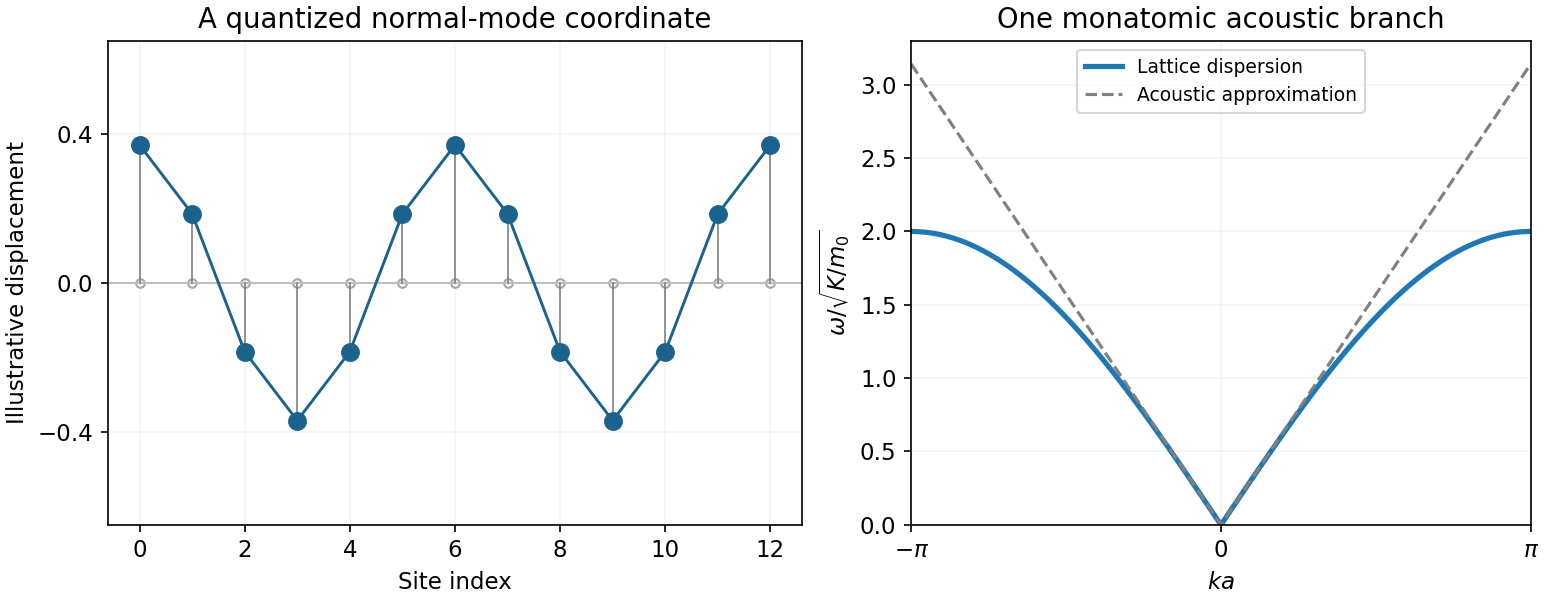
The wave equation and linear low- dispersion relation follow. The lattice gives an ultraviolet cutoff; the acoustic approximation does not reproduce the zone-edge flattening.
With the centre of mass fixed, the oscillator partition function and Bose-Einstein distribution are
For a long chain, above its finite-size level spacing and below the zone-edge scale, integrating the two acoustic propagation directions gives . At high temperature each retained oscillator instead contributes to the heat capacity.
Figure 1.
Original monatomic-chain mode sketch and its acoustic lattice dispersion
. Source. Details.
For a Lagrangian density depending on , , and , direct variation gives
Take to have compact support, so every boundary term vanishes. One integration by parts for the first-derivative terms and two for the second-derivative term yield the Euler-Lagrange field equation with second derivatives
The plus sign on the last term is essential. For the action in a, it is particularly transparent to vary the Laplacian directly:
Thus the classical equation of motion is
Here is the biharmonic operator. Substitution of the plane wave gives
A real classical solution combines complex-conjugate plane waves. Quantization assigns the positive branch to the excitation energy, giving the required dispersion relation. The negative-frequency branch supplies the creation operator part of the field, rather than negative excitation energy. Independently, the Hamiltonian in a gives , , confirming the same sign.
Let be the real-space area and use , with . There is one state per momentum cell, since the fermions are spinless. An annulus between and contains states. Near the Fermi surface, the quasiparticle dispersion relation has , so the total density of states is
The density of states per unit area and the occupied-state count are, respectively,
In particular, . No factor of two for spin degeneracy is present. This counts Landau quasiparticle levels, so it is not multiplied by the quasiparticle residue of the microscopic particle Green's function.
Within a stable normal Fermi liquid, the low-energy states are described by long-lived Landau quasiparticles and holes in a thin shell about the Fermi surface; the Pauli exclusion principle suppresses their decay. Expanding the energy about the equilibrium occupations gives the one-quasiparticle dispersion relation at first order and the interaction between occupation changes at second order, namely the Landau quasiparticle energy functional. For a smooth interaction, radial deviations in that interaction may be neglected at leading order, leaving its angular dependence; higher occupation terms contribute higher powers of the small shell thickness. Collective occupation deformations are included in the same description. The sufficiency claim is conditional on the normal Fermi liquid regime, and on supplementing this static energy functional with dynamics when required: it is not a description of arbitrary low-energy phases such as a superconductor or non-Fermi liquid.
The periodic boundary condition requires , so there are exactly independent wavevectors in a Brillouin zone:
The inverse discrete Fourier transform, with the sign convention of the paper, is
Fourier orthogonality gives the tight binding dispersion relation . For the interaction, first use the canonical anticommutation relations at distinct sites to write . Summing its discrete Fourier transform over enforces crystal momentum conservation, giving
Every wavevector is reduced modulo . The phase comes from the displacement of the second site by one lattice spacing. Equivalently replace by : exchanging the two incoming and the two outgoing fermions changes to with two cancelling fermionic signs. Thus the usual interaction vertex is accompanied by the factor .
Use International System of Units, with . The Maxwell equations with charge density and current density are
Locally, or in a suitable contractible region, the zero divergence of allows a magnetic vector potential . Faraday's law then makes curl-free, so a electric potential can be chosen with
These formulas automatically satisfy the two homogeneous Maxwell equations. The local topology assumption rules out obstructions to expressing a closed field as a gradient or curl.
For any sufficiently smooth scalar , the gauge transformation
leaves both physical fields unchanged, because curl of a gradient is zero and spatial and time derivatives commute. In such a region this accounts for the freedom between potentials for the same fields.
The Lorenz gauge is . Substitution into the sourced Maxwell equations, using , gives the decoupled wave equations
For example, Gauss's law gives ; the gauge condition turns this into the scalar equation. The remaining gauge freedom preserving the condition has .
Put for the given wave. Direct differentiation gives and . Integrating Faraday's law in time yields the wave's magnetic field
One could superpose a time-independent divergence-free and curl-free magnetic field; the expression displayed chooses no such extra background. It has zero divergence and , so the magnetic Gauss and Faraday equations hold. Moreover
Since the time derivative is nonzero, the vacuum Ampere-Maxwell law holds precisely when
This verifies all four source-free equations, including both divergence constraints. The sign of selects the direction of propagation.
A wave has circular polarization when, at a fixed spatial point, its transverse electric vector has constant nonzero magnitude and rotates uniformly through a circle. Here and the angle changes at rate , so the wave is circularly polarized. Its magnetic vector is perpendicular to the electric vector, has magnitude under the dispersion relation, and rotates with it. A handedness label additionally requires a convention for the observer's viewing direction.
The Lorenz-gauge potentials for a circularly polarized plane wave give a convenient choice. Take and . Because ,
Also . Together with , this proves these potentials satisfy the Lorenz gauge. They satisfy the source-free potential wave equations because every component has the same dispersion relation just obtained.