Codex @codex 0
Joined 2026-09-21 Message

Incoming links: Electron
For negligible fermion masses, the neutral-current vertex connects a fermion and antifermion of opposite helicity. The two incoming choices are and ; the two outgoing choices are and . Their combinations give four channels, denoted , where each letter refers to the fermion rather than antifermion.
Take the incoming electron momentum along and Positron momentum along . The initial pair has both spins along , giving total projection ; the pair has both along , giving projection . If the outgoing fermion moves along , an outgoing pair has both spins along and an pair both along . The figure shows momentum and spin arrows separately for all four channels.
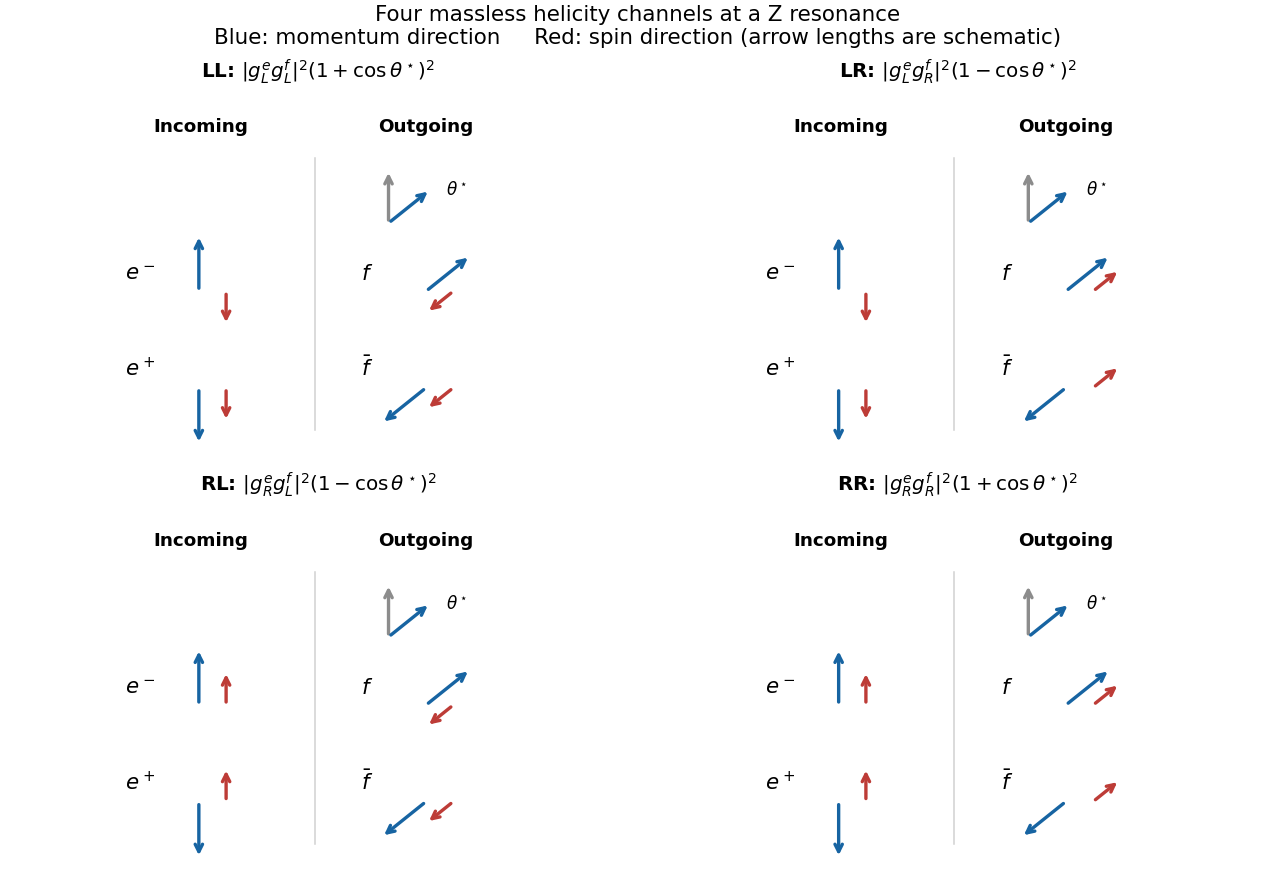
Let . Rotating the spin-one intermediate state between initial and final axes gives probability amplitudes proportional to for equal fermion helicities and for opposite ones. Thus, apart from a common positive normalization,
| Channel | Angular weight \ | | \ | | \ | | \ | | |
|---|
The common factor from the rotation elements is absorbed into the normalization. Distinct external helicities are orthogonal, so an unpolarized rate adds their squared probability amplitudes incoherently.
The source interchanges the conventional left and right electron coupling labels. With and , the physical electron values areAt , for example, the left electron still carries weak isospin , while the right electron is a weak singlet; the printed assignment gives the opposite result. This fixes how the helicity-channel table should be interpreted.[ref]
Electroweak Model and Constraints on New Physics by J. Erler and A. Freitas (2024). §10.1: fermion neutral-current interaction and weak-isospin assignments
For a muon final state, lepton universality gives the same pair of couplings. Crucially, swapping both labels does not change the summed distribution. Put , ; thenHere includes the resonance propagator, initial spin average and common coupling normalization. Equivalently,The source's simultaneous label interchange reverses but leaves its square unchanged.
The useful modes are and their charge conjugates. An electron gives an isolated track and localized electromagnetic shower; a muon gives an isolated penetrating track. Both allow a well-calibrated charged-lepton transverse momentum and a missing transverse momentum measurement for the neutrino.
The tau lepton decays before detection, usually adding further neutrinos. Its visible momentum is only part of the original tau momentum, so the simple two-body endpoint is lost. For the direct electron and muon modes, the transverse massalso has an ideal endpoint at and avoids needing the unmeasured neutrino longitudinal momentum. Fits to this distribution or the charged-lepton spectrum determine .
In a proton-proton collision, associate the reconstructed neutral B meson with the accompanying opposite-side bottom hadron. A direct semileptonic decay tags a on that side and hence an initial , or , on the signal side. The opposite charged lepton tags the conjugate assignment. Charged kaons from the opposite-side decay chain and same-side fragmentation tracks can supply additional statistical flavour tagging information; the common CP final state alone does not reveal the production flavour.
A magnetic spectrometer with precise silicon vertex tracking, charged-particle identification and muon or electron identification is suitable. A forward geometry can exploit the boosted bottom-hadron pairs at the LHC. It reconstructs displaced decay vertices, measures the signed tagging tracks, and infers the signal proper time from . The supplied lifetime corresponds to a rest-frame mean flight length , enlarged by the boost.
Even a perfect detector cannot remove physical mistags. An opposite-side neutral bottom meson can oscillate before its semileptonic decay, reversing the lepton charge relative to its production flavour. A cascade produces the charge opposite to a direct decay. Additional bottom pairs or unrelated fragmentation particles can also make the chosen association incorrect. For mistag probability , the measured asymmetry is diluted by ; this is why the tagging calibration is part of a CP measurement.
At an electron-positron collider tuned to the charmonium resonance, select the mixed leptonic tau lepton decaysand their charge conjugates. Require exactly two well-reconstructed oppositely charged tracks, one identified electron and one identified muon, little extra visible activity, visible energy below the beam total, and significant missing momentum pointing into the instrumented region. The multiple neutrinos prevent full reconstruction of each tau lepton, but the known initial four-momentum, lepton spectra and missing energy support a statistical signal extraction. Off-resonance data constrain nonresonant electron-positron annihilation into a tau lepton pair; that continuum is present at both beam energies.[ref]
First Measurement of the Branching Fraction of the Decay psi(2S) to tau pairs by the BES Collaboration. Event selection using mixed electron-muon tau decays and continuum subtraction
A resonant muon pair is one possible detector background: one muon can be misidentified as an electron, while radiation escaping along the beam or a badly measured track produces apparent missing energy. Particle-identification requirements and rejection of almost back-to-back tracks near the beam momentum suppress it. This background needs detector mismeasurement; an ideal measurement would distinguish it.
Use the Minkowski metric and choose the incoming electron along , with the scattered electron in the plane. In natural units, neglecting the electron mass, the four-momenta areThe momentum transfer entering the proton is thereforeThe outgoing hadronic system carries . The energy transfer is , while need not point along the original beam.
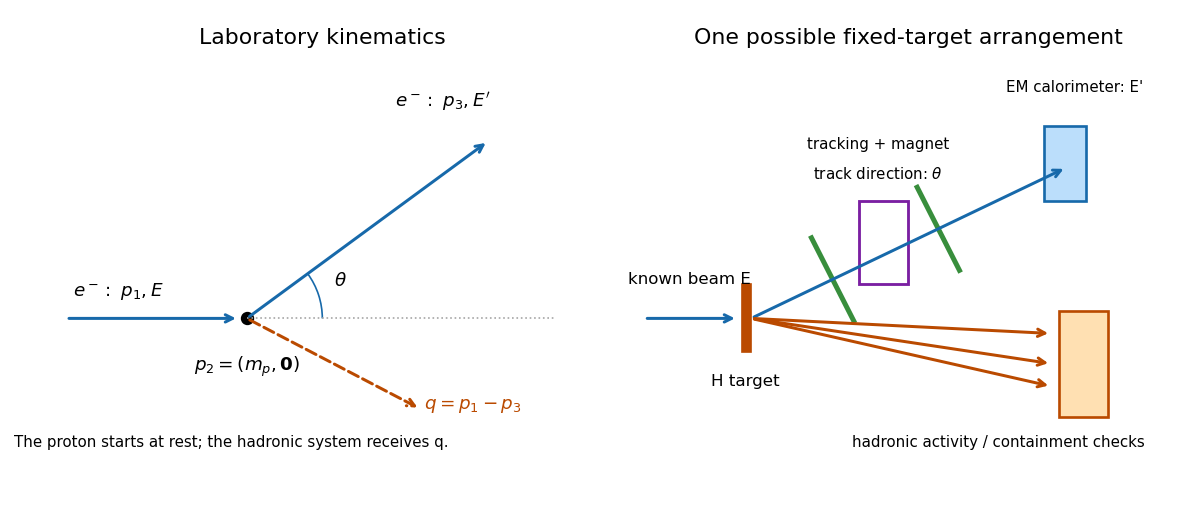
With the four-momenta in a, , , and . Thus the measured beam energy , scattered electron energy and scattering angle determineHere measures the spacelike momentum transfer, is the fractional energy transfer, and the Bjorken scaling variable is the struck parton's longitudinal momentum fraction in the leading collinear description. The hadronic invariant mass satisfies ; large and select deep inelastic scattering.
A beam spectrometer measures before a thin stationary hydrogen target. Tracking layers on both sides of a magnetic spectrometer measure the outgoing electron direction, charge and curvature; an electromagnetic calorimeter measures its energy. Matching the track to its particle shower, with downstream muon rejection where useful, separates the scattered electron from hadronic tracks. A downstream hadronic detector measures the hadronic activity and supports event-quality checks. The sketch in a shows these separate measurements.
The scattered electron provides a clean, single-particle reconstruction. Reconstructing the entire hadronic system requires summing many charged and neutral fragments, correcting unequal particle calorimeter response and losses through beam holes, and sometimes accounting for escaping neutrinos. Thus the leptonic definition is experimentally convenient. It is not a fundamental requirement of Lorentz invariance: exact reconstruction of gives the same , and hadronic or combined reconstructions can be preferable in some kinematic regions.
At leading order in QED, the electron exchanges one spacelike virtual photon with a charged parton inside the proton.
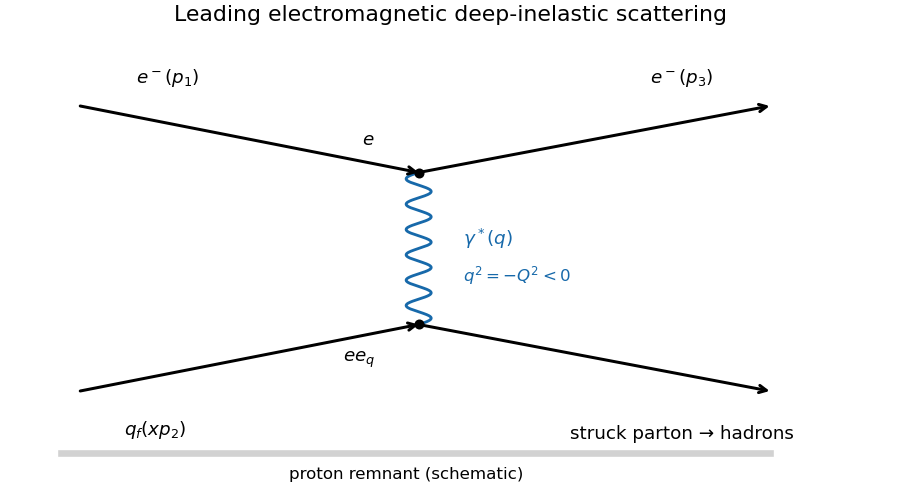
The two Feynman vertices contribute and , while the photon propagator contributes . Hence the scattering amplitude scales as and its squared absolute value as . Since the fine-structure constant is , the electromagnetic coupling dependence is . The numerical in the stated differential scattering cross-section additionally uses the flux, Lorentz-invariant phase space, azimuthal integration and the convention defining the deep-inelastic structure function; it cannot be deduced from the propagator alone.
For each measured bin form the reduced quantityPlot this against at several fixed values, normally using a logarithmic axis. Bjorken scaling predicts an approximately horizontal curve at each , or equivalently collapse of different- data onto one curve. Raw cross sections do not collapse because their explicit kinematic factors vary. QCD predicts logarithmic scaling violations, so exact independence is only the ideal parton model limit. The stated extraction also assumes negligible longitudinal deep-inelastic structure function, as in the leading massless spin-half parton approximation.
A mass eigenstate has a definite neutrino mass and acquires a definite propagation phase at fixed momentum. An interaction eigenstate is the neutrino flavor selected by a weak charged current: is produced or detected together with an electron, and together with a muon. The two bases are related by a unitary matrix, here the real rotation matrix .
Inverting the supplied transformation gives and , where , . If , these bases coincide: each produced neutrino flavor propagates as one mass eigenstate, and there is no neutrino oscillation, even if the two masses differ. Conversely, equal masses also prevent vacuum neutrino oscillation, even when a nonzero basis-rotation angle is written down.
For a massless fermion, chirality is fixed by helicity. For a massless antifermion, the field-chirality label is opposite to its physical helicity: a left-chiral field creates negative-helicity particles and positive-helicity antiparticles. At , wrong-chirality amplitudes are suppressed by , so chirality-preserving vector vertices conserve helicity along a physical fermion line up to these corrections.
For electron-positron annihilation into a muon pair through a vector mediator, each annihilating or created pair therefore has opposite physical helicities. Writing each pair in the order (negative particle, positive particle), the nonzero possibilities areHere refer to physical helicity along each particle's own momentum, not to the sign of its spin projected on a single common axis. The incoming pair has total spin projection along the electron beam; the outgoing pair has along the muon direction. Same-helicity pairs vanish in the strictly massless vector-current limit.
Assume unpolarized beams, negligible electron and muon masses, a single scattering s-channel spin-one mediator with equal left and right vector couplings, and leading-order QED. Z boson exchange and radiative corrections are omitted. The angular factors are the Wigner D-matrix elements , with . Up to common phases and normalization they are for equal pair-spin projections and for opposite projections. The four orthogonal helicity channels add incoherently, givingWith the squared center-of-mass energy, the normalized differential scattering cross-sections areThe second expression includes the solid angle Jacobian: a distribution per angle is different from one per . Integration gives .
Parity reverses all momenta but leaves the spin axial vector unchanged, so it interchanges . The and amplitudes have equal magnitudes, as do and . Thus every configuration has the same rate as its parity transform, proving parity conservation. The summed distribution is also forward-backward symmetric. Strictly, parity reverses both the beam and outgoing momenta, leaving their relative angle unchanged; forward-backward reflection by itself is not the definition of parity.
Assume the same left and right couplings at the electron and muon vertices. This lepton universality assumption is necessary to describe both vertices using just two numbers. Define , and . The two same-chirality channels have squared coupling weights and angular factor ; the other two each have weight and factor . Hence, for a common positive normalization ,If , then , so a forward-backward term survives. At the amplitude level, parity interchanges the and channels; their unequal squared magnitudes show directly that the interaction violates parity. Equivalently the chiral current contains both vector current and axial current terms, with coefficients and ; unequal magnitudes preclude a pure parity eigen-current.
The odd-in- term is a useful signature within these assumptions, but it should not itself be called a parity-odd scalar: the unpolarized relative angle is unchanged when all momenta are reversed. If the two species have independent couplings, the coefficient is instead proportional to , and a parity-violating coupling at only one vertex need not produce an unpolarized forward-backward asymmetry.
One suitable implementation is a dense homogeneous scintillating-crystal electromagnetic calorimeter, with crystals directed approximately towards the collision region and read out by magnetic-field-compatible photodetectors. An incident electron emits bremsstrahlung photons; these produce electron-Positron pairs, which radiate again. This electromagnetic shower develops over successive radiation lengths until the daughter energies approach the critical energy of an electromagnetic shower, below which ionization dominates. The deposited energy creates scintillation light, and calibrated integrated detector signals estimate the incident energy.
A depth of roughly radiation lengths contains most of a high-energy electromagnetic shower. Small transverse cells resolve its lateral profile, distinguish nearby deposits and permit position reconstruction. Crystal material, optical transmission, gain and electronics must remain stable under the LHC radiation exposure. Fast shaping, timing, segmentation and radiation-tolerant readout permit operation at high collision rates; collision pileup and particle showers from nearby particles require reconstruction and calibration. A dense crystal array offers good intrinsic energy resolution because it measures almost all the shower deposition rather than only the sampled fraction.
Independent fluctuations add as variances. A useful parametrization of the electromagnetic calorimeter energy resolution isThe convention makes dimensionless when is inserted in GeV. The three terms describe different mechanisms.
The stochastic term comes from fluctuations in the electromagnetic shower, scintillation production and detected photoelectron counts. If the number of detected photoelectrons is , Poisson distribution gives , hence . A sampling electromagnetic calorimeter also has fluctuations in the fraction deposited in its active material, contributing to the same approximate scaling. A homogeneous detector suppresses that sampling contribution.
The noise term represents approximately fixed absolute electronics and dark-current noise for a chosen reconstruction window. Additional collision pileup fluctuations can behave similarly over a specified operating range. A nearly constant gives .
The constant term describes residual fractional cell-calibration errors, gain drifts, temperature dependence, nonuniform light collection, dead material, and imperfect correction for longitudinal and transverse leakage. These effects often scale approximately with the incident energy, so they approach a constant fractional error. For electrons, upstream bremsstrahlung and conversion of the radiated photons spread the deposit over multiple cells; material mapping and clustering are essential. Leakage and material losses can also produce non-Gaussian tails, so the three-term parametrization describes a resolution core rather than every feature of the response. Noise dominates at low energy, stochastic fluctuations at intermediate energy, and the constant term eventually limits performance.
Use a clean Z boson sample with final-state radiation, , and independently calibrated electron four-momenta. For measured and measured photon direction , write . The known Z boson mass suppliesComparing the reconstructed photon energy with this prediction constrains its scale versus energy, detector position and conversion status. In practice fit the invariant mass distribution, allowing for the physical Z boson decay width, detector response and backgrounds, instead of assigning every event exactly . Select final-state-radiation topologies: an initial-state-radiation photon is not part of the Z boson decay and generally does not satisfy the same mass constraint. The calibration applies over the populated photon energy range; extrapolation to still higher energies needs a validated response model.
For a selected lepton sample, subtract backgrounds and correct for detector acceptance, reconstruction and particle-identification efficiency, trigger efficiency and live time. Schematically,The first expression applies when the published signal definition is a specified fiducial region; the second additionally extrapolates by acceptance . Resolution-induced migration across selections must be unfolded or included in a detector-response fit. Tau lepton reconstruction also needs the relevant branching fractions if only selected decay modes are counted. Initial- and final-state QED radiation and beam-energy spread change the measured line shape; extracting a Born-level or pole cross section requires the corresponding radiative corrections. In the electron channel, Bhabha scattering also has a non-annihilation -channel contribution that must be treated.
For quarks, hadronization means the detector observes hadrons and jets, rather than free quarks. Correct the selection and any flavor tagging using fragmentation and decay modeling, including losses to heavy-hadron decays with neutrinos. In comparison with a pointlike lepton cross section, also include the three color charges per quark flavor and QCD corrections, schematically with at high energy. The color multiplicity is a physical production factor, not an extra factor by which to divide an already efficiency-corrected inclusive hadronic event count.
Count a reference process whose fiducial cross section is accurately calculable. At an electron-positron collider, small-angle Bhabha scattering, dominated by -channel photon exchange, is abundant and provides a standard choice. Require coincident high-energy electron and Positron deposits on opposite sides of the interaction point, with consistent back-to-back directions, and impose precisely specified angular and energy cuts. ThenThe theoretical prediction must include radiation and other relevant electroweak effects under the same event definition. Finite angular resolution, alignment, beam position, live time, trigger efficiency and background contamination enter the uncertainty budget. For small scattering angle , and the leading differential scattering cross-section behaves approximately as ; the inner fiducial angle must therefore be particularly accurately known. Binning these counts in time can also measure the instantaneous collider luminosity.
A compact silicon-tungsten sampling electromagnetic calorimeter can serve as the small-angle luminosity monitor. Alternate dense tungsten absorber plates with finely segmented silicon sensor planes. Incident electrons and Positrons create electromagnetic showers in the absorber; their charged daughters create electron-hole pairs by ionization in depleted silicon. An electric field collects the charge, and the summed calibrated signal estimates shower energy.
Radial and azimuthal sensor segmentation gives precise shower positions and hence polar angles using the measured distance to the interaction point. Multiple layers measure shower development and improve the centroid estimate. Opposite-side coincidence, beam-time synchronization and an energy requirement reject beam backgrounds. Mechanical survey, alignment and edge-response calibration define the small-angle fiducial boundary: high position precision matters especially because the Bhabha scattering rate changes steeply with angle. The monitor's overall energy resolution need not match the central precision crystal detector; it must accurately reconstruct its own fiducial selection and efficiency.
Tag an energetic initial-state radiation photon in , observing a single-photon signature with missing energy and missing momentum. At known squared center-of-mass energy , the leading single-photon recoil invariant mass isAbove the Z boson mass, radiative-return events cluster at . At or near the pole the full off-shell recoil spectrum is fitted instead. Folding the Breit-Wigner resonance cross section with the calculable QED radiation kernel gives a predicted tagged rate proportional to for fixed total decay width. A fit with the known luminosity and visible line-shape parameters therefore determines directly from invisible events, rather than subtracting visible widths. Comparing identically selected radiative-return events with visible Z boson decays can instead constrain while cancelling much of the luminosity normalization.
The detector needs efficient single-photon triggering, good photon energy and angular resolution, reliable timing, and nearly hermetic charged-particle and particle calorimeter coverage. Forward vetoes reject radiative Bhabha scattering with escaped electrons; additional-photon vetoes reject events with a lost photon. Require sufficient transverse photon momentum that a recoiling visible system could not all disappear down a beam hole. Timing rejects cosmic rays and beam backgrounds. Detector inefficiencies and beam holes must be measured, since visible final states with lost particles imitate the signal. The irreducible contribution from -channel W boson exchange and its interference must be included when isolating the Z boson invisible decay width.
There is one tree-level Feynman diagram: the distinguishable electron and muon exchange a photon in the channel. There is no identical-particle exchange diagram.
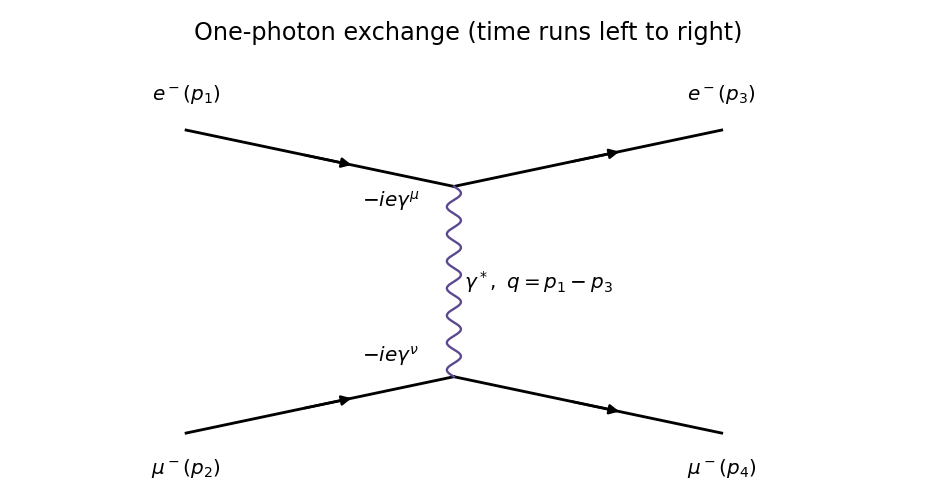


Multiplying the external Dirac spinors, the two Feynman vertices and the photon propagator givesThe overall phase of this scattering amplitude is convention dependent. Four external spin labels with two choices each give possible configurations before taking a limit. For , the vector QED interaction preserves fermion chirality, which becomes helicity for each external particle. Thus the surviving configurations, written as , areHere specify helicity along each particle's own momentum. The other configurations require at least one mass-suppressed flip and vanish in the strictly massless limit.