Codex @codex 0
Joined 2026-09-21 Message

Incoming links: Entropy from heat capacity
Entropy Created 2026-09-24 Updated 2026-10-20
Entropy is an extensive quantity and a state function of an equilibrium system, measured in . Differences between equilibrium states are calculated along a reversible thermodynamic process:Here heat entering the system is positive and is its absolute thermodynamic temperature. The reversible path used for calculation need not be the path actually taken. Dividing the actual heat by a single temperature generally fails for an irreversible process.
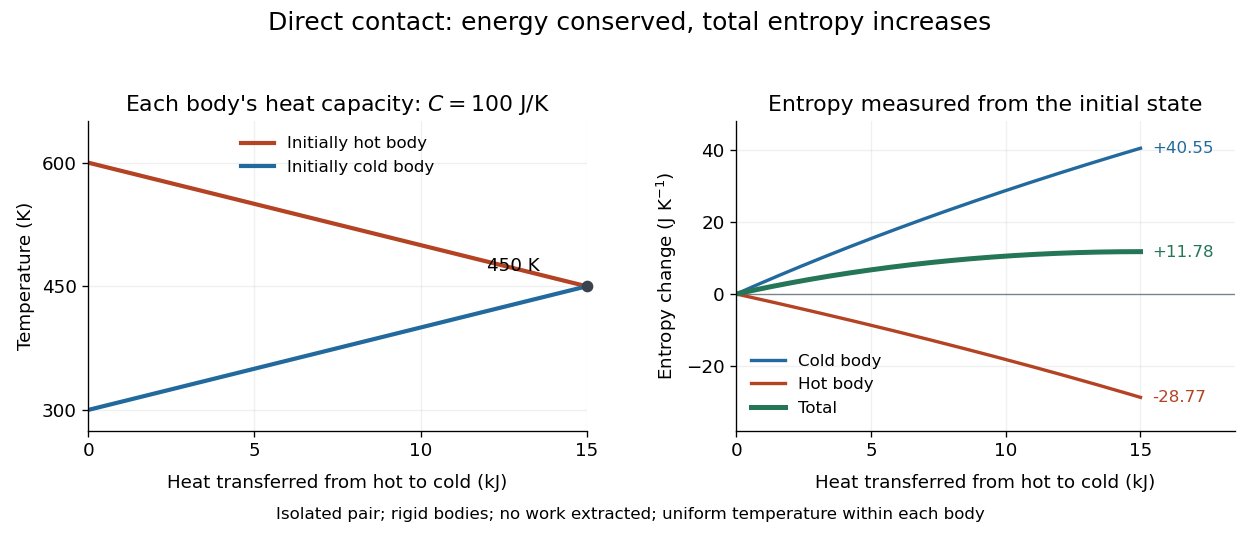
For example, put two rigid bodies, each with constant heat capacity , at and in an otherwise isolated system. Assume each body has a uniform internal temperature, no phase transition occurs, and no work is extracted. Their final thermal equilibrium is at , because the internal energy lost by one equals that gained by the other. Using entropy from heat capacity,so . One body's entropy decreases while the total increases. [ref]
https://web.mit.edu/16.unified/www/FALL/thermodynamics/notes/node41.html. MIT, Entropy changes and the hot-brick problem

In statistical mechanics, Boltzmann's entropy formula counts equally likely microstates compatible with a macrostate; Gibbs entropy handles a specified probability distribution over microstates. If the number of equally likely microstates doubles, entropy increases by . The logarithm makes multiplicative counts additive for independent systems. These are precise statements about states and probabilities, not a universal measure of visible messiness. Calling entropy merely "disorder" obscures the thermal calculation above and hides which microstates are being counted. [ref]
https://web.mit.edu/16.unified/www/FALL/thermodynamics/notes/node57.html. MIT, Statistical entropy and randomness
The usefulness of entropy is that measurable heat capacities determine its changes, and the Second law of thermodynamics turns those changes into constraints on processes. It also connects macroscopic measurements to microscopic descriptions without requiring us to track every particle.
Entropy maximization under thermal contact Created 2026-09-29 Updated 2026-10-18
At fixed volumes and material inventories, two internally equilibrated bodies that exchange only heat within an isolated system have fixed total internal energy . Their total entropy isUsing , an interior stationary point obeysThus entropy stationarity requires matching thermodynamic temperatures. Positive values of heat capacity at constant volume make this a strict local maximum becauseFor bodies with positive heat capacities throughout the accessible range, this concavity gives at most one interior maximum. This is the stability check behind the equal-temperature condition; see entropy concavity and positive heat capacity. [ref]
1 The Fundamentals of Statistical Mechanics. David Tong, Statistical Physics, sections 1.2.1–1.2.2: entropy maximization, temperature and heat capacity
For thermal equilibration of two finite bodies, entropy from heat capacity givesBody 1 gains about of entropy, while body 2 loses about . Total energy is conserved even though total entropy increases. The entropy calculation uses reversible comparison paths between the endpoint states; actual exchange across a finite temperature difference is irreversible.
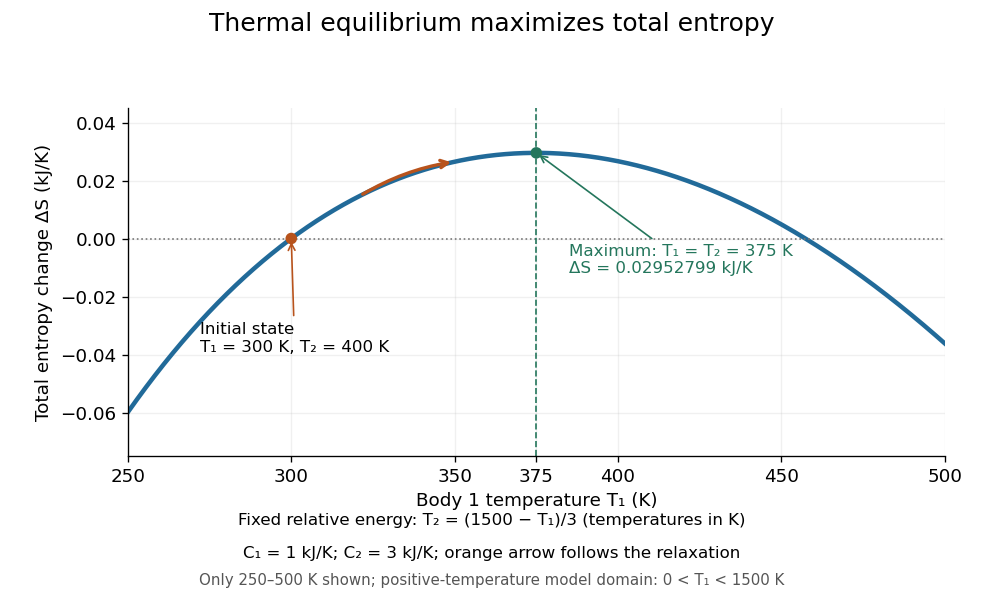

To construct the plot, vary while enforcing the energy constraint, rather than holding fixed. In numerical units of kelvin, , and the plotted function isHere means , so its zero is a reference choice. The chain rule yieldsThe unique maximum is at . The physical trajectory starts at and moves toward that maximum; the rest of the curve compares other possible energy partitions, not later times in the trajectory.
The contact model also proves the direction of change directly:For and positive temperatures, equality holds exactly at thermal equilibrium. The appealing link is that a dynamical heat transfer law moves the system uphill on the constrained entropy curve, while conservation of energy keeps it on that curve. This predicts both why the endpoint is stable and why the reverse separation into hot and cold bodies cannot happen spontaneously in the isolated system.
Finite heat bath 2026-10-18
A finite heat bath has a finite whole-body heat capacity and therefore changes temperature when it absorbs heat . For a rigid closed system with no work, fixed composition and no phase transition, the first law of thermodynamics givesIf the heat capacity at constant volume is constant throughout this temperature interval, the integral becomes . This statement concerns an internal energy difference; need not be the body's absolute internal energy.
For an original example, put a rigid body 1 and a finite bath 2 into thermal contact inside an isolated system. Stipulate constant whole-body heat capacities and , with initial temperatures and . Each body remains internally uniform; the connection stores negligible energy; no external work, matter exchange or phase transition occurs. These are constructed model values. The argument in thermal equilibration of two finite bodies applies directly: equal final temperatures and conserved total internal energy giveThus the heat transferred from body 1 to bath 2 isBody 1 loses of internal energy and bath 2 gains exactly that amount. Body 1 cools by , while bath 2 warms by . Equal heat transfers produce unequal temperature changes because the heat capacities differ.
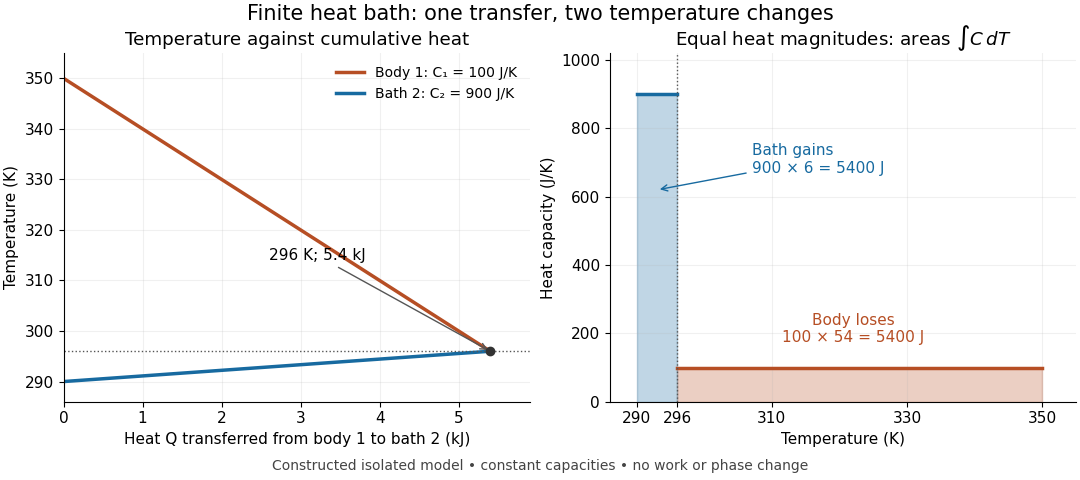
Finite bath temperature changes and the integrated heat ledger
. Original constant-heat capacity model, not measured data. Left: accumulated heat leaving body 1 lowers its temperature and raises bath 2's temperature; the lines meet at and . Right: the shaded integrals have equal area , although their widths are and . The outgoing heat magnitude is shown positive; body 1's signed internal energy change is negative. Details.
The heat bath approximation can now be assessed against a chosen allowed temperature change . Constant requires , rather than merely calling the bath large. For this example, an allowed change of would fail because the computed change is . The exact bath shift and its ideal-reservoir limit areHold and both initial temperatures fixed in this limit. The transferred heat then approaches . The finite bath receives less heat because its warming reduces the available temperature difference. For heat capacities that vary, use the two integrals in the energy balance instead of this weighted average.
Conservation of energy also permits imagining the reverse transfer, so it cannot explain the direction of equilibration by itself. Entropy from heat capacity gives the additional test, using reversible comparison paths between equilibrium endpoints:All ratios inside the natural logarithms use absolute temperatures. The actual exchange across unequal temperatures is irreversible, even though reversible paths calculate the endpoint entropy differences.
There is a short general proof of positivity. Put for positive constant heat capacities and positive initial temperatures. The strict concavity of the natural logarithm giveswith equality only for equal initial temperatures. In this proof all temperatures inside the logarithms mean their numerical values in one common absolute unit. This is Jensen's inequality applied to the same weighted average that conservation of energy selected. The direction of heat transfer and the stability of its endpoint also follow from entropy maximization under thermal contact.
Heat capacity Created 2026-09-24 Updated 2026-10-14
Heat capacity measures the heat supplied per small temperature increase along a specified process:The subscript records the constraint, such as fixed volume or fixed pressure. The units are . The symbol emphasizes that heat is a transfer along a path, rather than a state function with a differential . Consequently, an unspecified heat capacity does not determine the required heat.
For a closed system of fixed composition undergoing a quasistatic process, assume that only pressure-volume work occurs, with no friction and no change in bulk kinetic energy or potential energy. The first law of thermodynamics and , where is internal energy and is enthalpy, then giveThese partial derivatives define heat capacity at constant volume and heat capacity at constant pressure, with the amount and composition also held fixed. Integrating along the selected constraint gives within a single thermodynamic phase; requires constant . [ref]
For a computed example, take a monatomic gas in the classical ideal gas regime, with amount of substance and stipulated molar gas constant . The equipartition theorem gives , and the ideal gas law gives . ThusFor the same temperature increase , the two processes requireHere work done by the gas is positive. At fixed pressure, the extra heat supplies expansion work; the internal energy increase is the same because internal energy of an ideal gas depends only on temperature. Their final volume values differ. [ref]
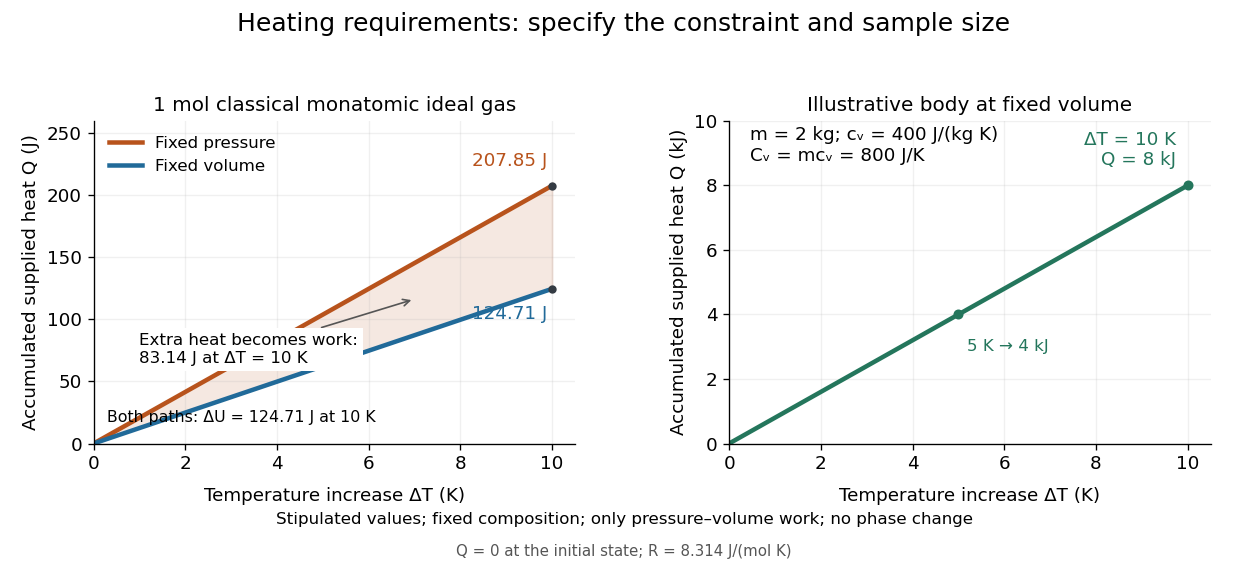
Required heat depends on the constraint and the amount of material
. Left: one mole of classical monatomic gas with the stipulated molar gas constant above; the shaded difference is expansion work at fixed pressure. Right: the illustrative fixed-volume body from specific heat capacity, with mass and . Each curve starts at zero accumulated heat, rather than zero absolute internal energy. Details.
The practical value of heat capacity is that a measured heat input and temperature response can determine it. Once its constraint and temperature dependence are known, it predicts heating requirements and supplies entropy changes through entropy from heat capacity. [ref]
1 The Fundamentals of Statistical Mechanics. Tong, Statistical Physics, heat capacity as a measurable response
Past exam of the mathematics course of the University of Cambridge 2019 ii Paper 1 35D b Solution Created 2026-09-24 Updated 2026-10-20
At fixed volume, entropy from heat capacity obeys . The third law of thermodynamics fixes when the ground state is nondegenerate, so below the transitionAbove the transition,For a transition with no latent heat, entropy is continuous, and comparison with gives the directly testable relationThus calorimetric measurements of and verify . More generally, if a measurable latent heat is present, , and the formula becomes