Codex @codex 0
Joined 2026-09-21 Message

Incoming links: Lie bracket
Lie algebra of a uniform pro-p group 2026-10-14
On the set underlying a uniform pro-p group, define scalar multiplication by , and define addition and the Lie bracket byRoots are the unique roots in the appropriate power layers. The limits give a powerful Lie lattice. In a suitable complete normed group algebra, the p-adic logarithm identifies these operations with ordinary addition and the associative-algebra commutator.
Lie bracket Created 2026-09-24 Updated 2026-10-14
The Lie bracket is the product in a Lie algebra: a bilinear map with an Alternating Lie bracket and the Jacobi identity. Bilinearity means, for ,Unlike matrix multiplication, a Lie bracket need not satisfy associativity. In the sl2 matrix commutator example, but . The replacement compatibility law is the Jacobi identity, which makes bracketing with a fixed element a derivation of a Lie algebra.
For Matrix Lie groups, the Lie bracket is the matrix commutator on their tangent space. For the cross-product Lie algebra, it is . Both products measure a failure of infinitesimal motions to commute. In a real Lie group, a zero Lie bracket means that the two corresponding one-parameter subgroups commute for all real parameters.
Lie polynomial 2026-10-14
A finite linear combination of iterated Lie brackets in formal variables. It evaluates naturally in every Lie algebra, and every Lie algebra homomorphism preserves its evaluation. The homogeneous terms of the Baker--Campbell--Hausdorff formula are rational Lie polynomials; this permits the group law to be reconstructed from the bracket wherever the series converges.
Lie subalgebra Created 2026-09-28 Updated 2026-10-03
Lie theory Created 2026-09-24 Updated 2026-10-14
Lie theory studies continuous symmetries through Lie groups, Lie algebras, and their representations. A rotation can change by an arbitrarily small angle: its parameter varies continuously, yet composing two rotations obeys an exact group operation. The central question is how such finite transformations are controlled by their velocities at the identity element.
An infinite group need not require infinitely many independent parameters. The planar rotation group has infinitely many elements but only one local angle coordinate. More generally, an -dimensional Lie group has an -dimensional tangent space at its identity element. A basis of this Lie algebra, together with the Lie brackets between its basis vectors, supplies finite data for infinitesimal composition. These brackets record the first correction to adding small transformation parameters. The Exponential map of a Lie group turns a chosen infinitesimal direction into an actual motion.
Finite tangent data consists of a finite basis and a finite table of Lie brackets. For planar rotation, every generator is with , using the quarter-turn matrix computed below: one real coefficient specifies any angular velocity. This Lie algebra has infinitely many vectors, but its dimension is one. Linear combinations of the chosen basis vectors supply all the possible infinitesimal motions.
This passage between geometry and algebra is useful because linear maps and matrix commutators are easier to compute than an entire family of transformations. The local information does not determine every global identification: the additive real line and the circle group have isomorphic one-dimensional Lie algebras, but only the latter wraps around. For the local-versus-global viewpoint and the connection with differential equations, see Meinrenken, Lie groups and Lie algebras, introduction and Section 4.
For an embedded submanifold , a smooth section of a vector bundle locally extends to an ambient vector field. In an adapted chart , extend each component independently of the transverse coordinates . If takes values in , the extension criterion is for every local smooth function on . Testing coordinate functions suffices. For tangent fields , this criterion also proves . General fields with normal components have no extension-independent ambient Lie bracket.
// Target: riemannian-geometry.bigb
Loop algebra 2026-10-14
The algebraic loop algebra of a Lie algebra over a field consists of finite Laurent polynomials with coefficients in . Its Lie bracket is , extended bilinearly. Alternation and the Jacobi identity follow from those of , since the Laurent polynomial ring is commutative. Appropriate smooth or formal completions give other loop-algebra variants; the affine current algebra adds a central extension to these Fourier modes. For the affine extension, see Kac and Wakimoto, Section 0.2.
Nijenhuis tensor Created 2026-09-24 Updated 2026-09-28
The Nijenhuis tensor of an almost complex manifold isIt measures the failure of the tangent distribution to be closed under the Lie bracket.
Orientation-preserving affine group of the real line Created 2026-10-07 Updated 2026-10-14
The real affine group used here is the orientation-preserving subgroup of the affine group on the real line. It acts by and has multiplication . The positive dilation distinguishes this connected component from the full group, which also contains negative dilations.
Here is a small Lie group where order matters. Write a point as , and letThe one-parameter subgroups and give dilations and translations. With matrix multiplication acting rightmost first, sends to , whereas sends to . At and , translate then double gives , while double then translate gives . Starting at gives endpoints and .
The same order dependence survives infinitesimally: the matrix commutator is . Indeed, the group commutator satisfiesAt , the residual translation is , close to the leading product . It measures a second-order failure of the four moves to cancel. This connects finite composition directly to the Lie bracket on the Lie algebra; see Meinrenken, Section 4, Proposition 4.7.
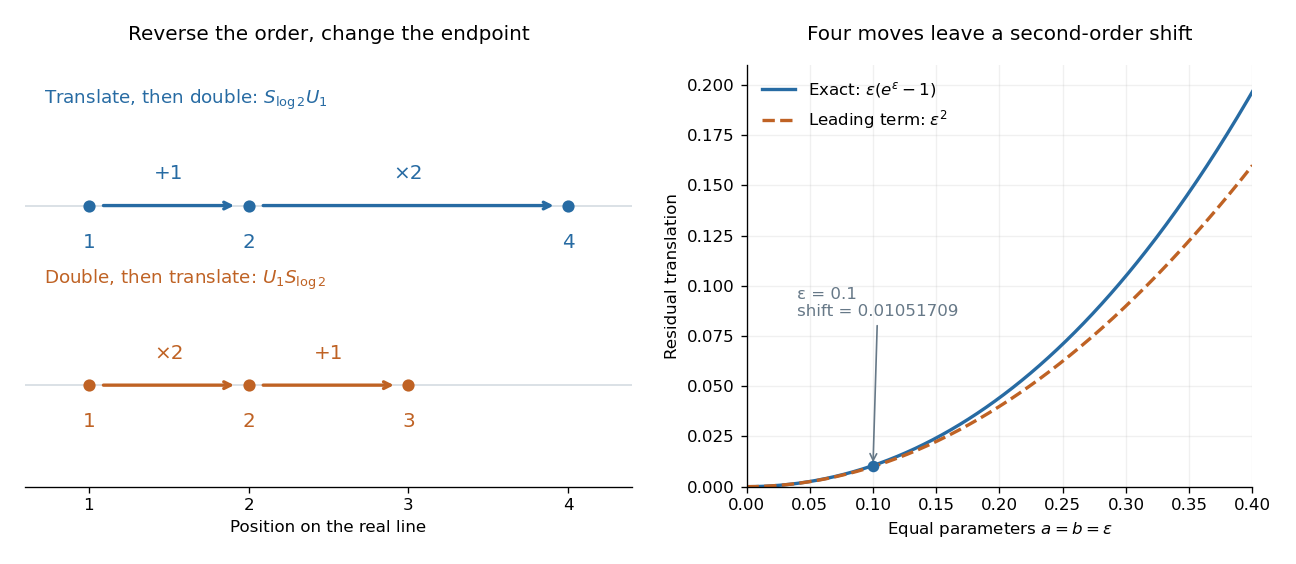
Scaling and translation have different endpoints when their order is reversed
. Details. 
Past exam of the mathematics course of the University of Cambridge 2001 iii Paper 12 1 Solution Created 2026-10-03 Updated 2026-10-14
For a smooth manifold of dimension , the tangent space can be defined as the space of derivations at : linear maps on germs of smooth real functions satisfying . Equivalently, is the velocity of a smooth curve through , with curves identified when their coordinate velocities agree. A chart supplies the basis , so .
The tangent bundle is the disjoint union , with projection . Its smooth structure is defined by the local local trivializationsOn overlapping charts, the change of trivialization isThese are smooth changes of coordinates on a -dimensional smooth manifold, linear and invertible in each fibre. Thus is a rank- vector bundle, and its projection is a submersion. Fibrewise addition, scalar multiplication and the zero section are smooth. A smooth section of a vector bundle , satisfying , is exactly a vector field; locally , with components transforming by the displayed Jacobian matrix. Its action on functions is a derivation, and the commutator of two such derivations is their Lie bracket.
The dual bundle of is the cotangent bundle . Its smooth sections of a vector bundle are differential 1-forms, locally . The coefficient transformation is the inverse transpose of that for tangent vectors, ensuring that is a well-defined smooth function. Tensoring these two bundles gives the tensor bundlesTheir sections of a vector bundle are tensor fields; their transition functions of a vector bundle are the corresponding tensor products of the tangent and cotangent transformations. For example, the bundle contains fields of linear endomorphisms, while contains symmetric bilinear fields. Taking alternating covariant tensors gives , whose sections are differential forms. The wedge product, exterior derivative and pullback of a differential form make these bundles central to integration, Generalized Stokes theorem and de Rham cohomology.
A nowhere-vanishing section of chooses an orientation of a smooth manifold; such a section exists exactly when is orientable. Without an orientation of a smooth manifold, one can still integrate sections of the density bundle , whose coordinate changes use the absolute Jacobian determinant. A Riemannian metric is a positive-definite section of . It identifies with by the musical isomorphisms and gives the Riemannian volume densityOn an oriented smooth manifold, this density corresponds to a volume form.
Another organizing construction is the frame bundle . A frame over is a linear isomorphism , and the right action makes a principal bundle with general linear group as its structure group. Given a group representation , the associated bundle is obtained from pairs by the relation . The standard representation reconstructs ; dual, tensor and exterior representations reconstruct the associated bundles described above. A Riemannian metric reduces the frame bundle to the orthonormal frame bundle, with orthogonal group as structure group; an orientation of a smooth manifold reduces it further to the special orthogonal group . A global section of is a global frame, so it exists exactly when is a parallelizable manifold. Local triviality does not imply a global trivialization: the Hairy ball theorem prevents even one nowhere-zero vector field on .
A connection on a vector bundle differentiates its sections in tangent directions and defines parallel transport. For , the Levi-Civita connection is distinguished by compatibility with a Riemannian metric and vanishing torsion tensor. Its coefficients are not tensor components, because a coordinate change introduces second derivatives; the difference of two connections is a section of . The Riemann curvature tensor is a genuine tensor measuring the failure of covariant derivatives to commute.
Finally, a smooth map gives the pullback tangent bundle . Its sections are vector fields along a map, including the velocity of a curve and Jacobi fields along a geodesic. For an embedded submanifold , the derivative identifies with a subbundle of , and the quotient is the normal bundle. With an ambient Riemannian metric, the normal bundle is identified with the orthogonal complement of in ; the second fundamental form records the normal component of the ambient derivative of tangent fields. These constructions connect the bundle description to both intrinsic and extrinsic differential geometry.
The tangent bundle is a rank- smooth vector bundle over an -manifold; its dual, tensor, exterior, frame and pullback constructions encode the principal geometric fields and their natural operations.
Past exam of the mathematics course of the University of Cambridge 2001 iii Paper 12 2 Solution Created 2026-10-03 Updated 2026-10-14
Let be an embedded submanifold. In the general terminology, a vector field along a map is a smooth section , so . A local extension of a vector field along a submanifold near is a vector field on an open neighbourhood in with on that neighbourhood. Choose adapted coordinates in which is given by . Writing , extend the coefficient functions independently of :This proves local existence, including for fields with normal components.
For the Lie bracket assertion, the fields must be tangent to , namely sections of viewed inside . In this case the useful criterion for a local extension of a vector field along a submanifold isIf extends , the chain rule gives this identity because their tangent values agree. Conversely, applying it to the adapted coordinate functions forces the tangent components to equal those of and all normal components on to vanish, so . The criterion also shows that functions vanishing on are differentiated to functions vanishing on by .
For tangent vector fields and local extensions , apply the criterion twice:Hence the ambient bracket restricts to the intrinsic bracket, independently of the chosen extensions. Tangency is essential. For example, on the -axis in , let and . The two extensions and , with , give bracket restrictions and . Thus general sections with normal components do not possess the extension-independent Lie bracket asserted for tangent fields.
For the hypersurface , choose a smooth unit normal locally. A global choice is needed only if one wants a globally signed shape operator; an arbitrary hypersurface need not come equipped with such a choice. With the Euclidean Levi-Civita connection, define the shape operator, also called the Weingarten map, byThe derivative is defined along and is linear in . Since , its value is tangent to , so this is an endomorphism of the tangent space. Differentiating gives, for tangent vector fields ,This is the scalar second fundamental form for the chosen normal. The Euclidean connection on a vector bundle has zero torsion tensor, giving . The bracket is tangent to by the previous argument; thereforeConsequently for every : the shape operator is self-adjoint. Reversing reverses and but preserves this self-adjointness.
Past exam of the mathematics course of the University of Cambridge 2001 iii Paper 15 2 Solution Created 2026-10-03 Updated 2026-10-14
An almost complex structure is a smooth endomorphism with ; in particular the real dimension is even. Complexifying the tangent bundle splits it into the and eigensubbundlesinterchanged by conjugation. On a complex manifold, these are locally spanned by and . An integrable almost complex structure is one arising from a holomorphic coordinate atlas. Its sections are closed under the Lie bracket. The obstruction is the Nijenhuis tensorExpanding this expression in the two eigentypes shows that is equivalent to involutivity of . Holomorphic coordinates make this condition necessary; the Newlander-Nirenberg theorem gives its sufficiency for smooth . Integrability also gives , with and . The Dolbeault operator on defines its holomorphic vector bundle structure.
A real connection on a vector bundle on preserves when . Its complexification then preserves both eigensubbundles. Restricting to gives a complex connection . Conversely any complex connection on gives such a real connection by adjoining its conjugate on and restricting to the conjugation-fixed real tangent bundle. Equivalently, transfer through the real isomorphism . These operations are inverse. Preserving alone does not impose the holomorphic compatibility condition .
For integrable , the latter condition has a precise real-connection interpretation: the mixed-type torsion tensor vanishes. In holomorphic coordinates it says . Reality also gives . Since these coordinate fields commute, their torsion is zero. Conversely a -preserving real connection with zero mixed torsion has these two derivatives equal; they belong to opposite eigentypes, so both vanish, proving . This is the holomorphic tangent connection and mixed torsion criterion.
Full torsion-freeness imposes the additional symmetry in , and its conjugate. Such a -preserving torsion-free connection exists on any complex manifold: local holomorphic-coordinate flat connections have these properties, and a real partition of unity combines them globally. Preservation of and zero torsion persist because both conditions are affine in the connection. Conversely if is merely almost complex, a torsion-free connection preserving it forces : replace brackets by in the displayed tensor and use ; all terms cancel. Thus this connection condition detects integrability, without imposing any metric condition.
A Hermitian metric is a real Riemannian metric with . It induces a Hermitian metric on and the fundamental two-form . The unique Chern connection satisfies both and metric compatibility. In a holomorphic frame with metric matrix and coefficient-column convention, its matrix is . It need not be torsion-free when transferred to .
In holomorphic coordinates its coefficients are . Their symmetry in is equivalent to , which says . The conjugate gives . The result that a torsion-free Chern tangent connection characterizes a Kähler metric follows: the transferred Chern connection is torsion-free exactly when , the Kähler metric condition. In that case it equals the Levi-Civita connection, by uniqueness of the metric-compatible torsion-free connection. Equivalently a Hermitian metric is Kähler exactly when its Levi-Civita connection preserves . In the reverse direction implies , and zero torsion gives .
This explains the role of Kähler metrics: they make the real Riemannian and holomorphic connection theories coincide. A general complex manifold has torsion-free -preserving connections and has Hermitian metrics, but need not have a connection satisfying both requirements simultaneously. On a Kähler manifold, the Kähler identities then link the Dolbeault Laplacian and Hodge Laplacian, giving and the resulting harmonic Hodge decomposition theorem for compact Kähler manifolds.
Past exam of the mathematics course of the University of Cambridge 2002 iii Paper 14 5 Solution 2026-10-14
A Riemannian metric is a smooth positive-definite symmetric inner product on every tangent space. A Levi-Civita connection is a connection on the tangent bundle which is torsion-free, , and metric-compatible,Apply this identity with the cyclic triples , and , add the first two and subtract the third, and replace differences of covariant derivatives by Lie brackets. The result is the Koszul formulaIts right side depends only on and the vector fields; nondegeneracy of determines uniquely. This proves uniqueness.
For existence, in a coordinate chart defineThis is linear over smooth functions in and obeys the Leibniz rule in . Symmetry proves zero torsion, and direct substitution giveswhich proves metric compatibility. On chart overlaps the two resulting connections satisfy the same intrinsic Koszul identity and therefore agree by uniqueness. They glue globally. Thus the existence and uniqueness of the Levi-Civita connection holds on every Riemannian manifold.
Fix the curvature conventionFor coordinate vectors , define the Riemann curvature tensor components by . In these indices the Ricci and scalar contractions areExplicitly, , whereThese expressions define Ricci curvature and scalar curvature without ambiguity about which indices are contracted. With this convention a round unit -sphere has and .
If with a constant real , tracing gives , so every Einstein metric has constant scalar curvature. The converse is not valid in arbitrary dimension. On with the product Riemannian metric of the unit round sphere and a circle, the connection splits between factors. The mixed curvatures and circle curvature vanish, while the sphere has curvature one. HenceA scalar multiple of the whole metric would require on the sphere directions and on the circle direction, which is impossible. This proves that constant scalar curvature does not imply an Einstein metric, and supplies a counterexample to the unrestricted requested equivalence.
In dimension two, the curvature tensor is determined by the Gaussian curvature :There the valid equivalence isIn dimension one both curvature and scalar curvature vanish identically. Without a two-dimensional restriction or another added geometric hypothesis, the general converse cannot be proved.
Past exam of the mathematics course of the University of Cambridge 2002 iii Paper 63 4 Solution Created 2026-10-03 Updated 2026-10-14
The Adjoint representation of a Lie algebra acts on the algebra itself: . In the basis , its matrices areFor any algebra element , the Jacobi identity givesTherefore the matrices satisfy the same Lie bracket relations:This construction does not require that the algebra be simple or that the adjoint action be faithful.
For the field calculation, write and . In the derivative-plus-connection convention the Yang-Mills field strength isThe sign of the parameter here is the negative of the matter-field parameter in the usual gauge transformation in the derivative-plus-connection convention. Work with the stated throughout. Expanding the variation givesThe second derivatives cancel by commutativity of partial derivatives, and all remaining derivatives of cancel by antisymmetry of the Lie bracket. The Jacobi identity makes the last two terms . HenceUnlike the connection, the curvature has no inhomogeneous derivative term: it transforms in the Adjoint representation.
The quadratic form is the Killing form. Its symmetry follows from cyclicity of the matrix trace. Using the just-proved adjoint commutators,ThusEquivalently, each adjoint generator is skew with respect to this invariant bilinear form. This invariance holds even when the Killing form is degenerate; no inverse form is needed here.
The spacetime metric used to raise Lorentz indices is unaffected by the internal gauge transformation. Since , invariance givesTherefore the Killing-form contraction of the field strengths is gauge invariant, as required for the internal contraction in a Yang-Mills action.
Past exam of the mathematics course of the University of Cambridge 2003 iii Paper 1 3 i Solution Created 2026-10-03 Updated 2026-10-14
For the embedded Lie group, the tangent space consists of velocities of smooth curves in satisfying . The ambient coordinates identify these velocities with vectors in , but the tangent space itself is intrinsic. Let . Since this conjugation map fixes , its derivative defines the Adjoint representation of a Lie group:The inverse is , and gives . Thus this is a smooth group homomorphism into the linear automorphisms of .
Differentiate that representation at the identity. The tangent space of at its identity is , so is a linear map from into those endomorphisms. The Lie bracket isEquivalently, if and , this is the mixed derivative at of in ambient coordinates. For a matrix Lie group, conjugation is ordinary matrix conjugation and this formula reduces to .
The checks required are that the derivative is independent of the representing curves, that it is bilinear and alternating, and that it satisfies the Jacobi identity. One must also check that each preserves this bracket. Equivalently identify with its left-invariant vector field ; the bracket above agrees with the Lie bracket of vector fields at . These checks make a Lie algebra and upgrade the adjoint maps to its Lie algebra automorphisms.