The central pair potential is invariant under simultaneous spatial translations, simultaneous rotations and time translations. The corresponding time-independent Noether charges are total momentum , total angular momentum about a fixed origin, and total energy .
In one dimension this supplies and : two charges. In two dimensions it supplies : four charges. In three dimensions it supplies three momentum components, three angular-momentum components and : seven charges. For generic states these listed charges are independent in those dimensions. Galilean boosts can also be expressed by explicitly time-dependent conserved combinations, but are not part of the requested translation-rotation-energy count.
A white dwarf is a compact stellar remnant supported primarily by electron degeneracy pressure, radiating stored thermal energy rather than sustained main-sequence fusion. At zero-temperature leading order, filling electron momentum states gives and . Fully ionized hydrogen mass fraction , with other nuclei approximately one electron per two nucleons, implies . Therefore
This is an polytrope. Solving hydrostatic structure with a zero-pressure surface gives ; the numerical factor uses and of that Lane-Emden solution. Thus . For , , is about km. A uniform-density scaling gives the same mass dependence but a different order-one coefficient and should be identified as such.
Independently, , or about km. Agreement is good at this level; relativistic degeneracy becomes relevant for accurate modeling near one solar mass and eventually invalidates an unlimited nonrelativistic mass-radius law.
Newton's first law identifies a class of inertial frames in which isolated bodies move uniformly, while the second relates changes of momentum to resultant force. Both have definition-like roles: the first helps characterize an inertial frame, and the second can be used to calibrate force given independently measured mass and acceleration. That does not make the whole scheme an empty set of definitions.
If force meant nothing except whatever product happens to be observed, the second law alone would have little independent predictive content. Actual mechanics also specifies gravitational, elastic and other interactions with independently constrained parameters, superposition rules and reaction relations. The combined framework predicts the accelerations of new arrangements. One cannot arbitrarily change one body's mass or redefine every unexplained acceleration as a different force without affecting those cross-system comparisons.
Likewise, an inertial frame cannot be separately tailored to make each trajectory straight while retaining a common interaction account. A rotating frame introduces coordinated velocity-dependent accelerations for different freely moving bodies. The empirical claim is that a common family of frames exists with the prescribed relations, at least over the applicable domain. Tests involve judgments about isolation, clocks, geometry and interaction laws, so they are not independent of all auxiliary assumptions.
Thus definitions organize the theory but do not exhaust its content. Whether one calls a definition or a dynamical postulate depends partly on how the remaining force concepts are introduced. What is testable is the consistent package that connects independently characterized interactions, mass ratios and motion. Relativity and gravitation show how that package can be revised when its domain is exceeded.[ref]
Approximate helium mass by kg. Nonrelativistic momentum is , giving . A transverse width of one micrometre implies a characteristic position uncertainty of that order and a minimum momentum uncertainty of order kg m s, with factors depending on profile convention. For a uniform interval , but an exactly abrupt rectangular wavefunction actually has infinite rms momentum spread. Width alone does not uniquely specify both rms uncertainties; a smooth near-minimum-uncertainty beam is needed for a finite order-of-magnitude estimate.
For an aligned narrower slit placed immediately after the first, uniform illumination gives transmission probability . Conditional on passage the same normalized formula applies with replaced by and central-lobe momentum scale . Position rms is , while the exact hard-edge rms is infinite. Thus the source's finite “uncertainty” can only mean a characteristic diffraction width; the rigorous Heisenberg inequality is not violated, and smoothing the edges restores finite rms moments satisfying it.
A 10 keV X-ray has nm. The ideal position-filter probability and momentum formula at fixed aperture widths are unchanged, since the Fourier transform involves and the aperture geometry. Its larger total momentum makes the angular diffraction width smaller, approximately . Real slit-material transmission and absorption are additional experimental issues.
To distinguish equal transverse bins across width , . Six bits gives one-nanometre pixels; ten gives 0.0625 nm, below the helium wavelength. In the stipulated fixed-energy freely propagating beam, the latter entails transverse diffraction momenta comparable to or exceeding the available total momentum and lies outside the paraxial aperture model. Six-bit localization is less demanding, although fine detector resolution and losses remain practical constraints. This is not a universal theorem that an atom can carry at most six bits in every encoding: accessible modes, energy, aperture, measurements and success probabilities define the channel.
A Pelton wheel splits and turns a free jet through nearly 180 degrees in moving buckets, transferring momentum to the runner. For ideal bucket speed , the absolute exit speed is and force is . Power is maximized at , giving . If the same inflow must now pass a slit of height , continuity gives . Using the preceding flow rate with ,
The head must actually be sufficient to supply this jet speed: cannot exceed the available hydraulic drop. An arbitrarily small slit cannot produce infinite power from a fixed-height reservoir; it would reduce discharge or raise water until another outlet, including overtopping, operates. The printed scaling presupposes compatible head and fixed-flow conditions.
Lossless Hamiltonian focusing can reduce a beam's transverse position width at the expense of momentum spread, but cannot reduce its occupied canonical phase volume. Coupling to the longitudinal direction can redistribute projected emittance without reducing total emittance. True cooling requires exporting entropy to additional degrees of freedom or discarding particles: stochastic feedback, electron cooling or radiative damping coupled to an external environment provide possible mechanisms, with very different efficiency for high-energy protons. Collimation shrinks the accepted distribution at the cost of intensity. Acceleration also reduces angular divergence at fixed normalized emittance, an apparent geometrical cooling rather than a violation of Liouville's theorem. The apparatus and radiation cannot be omitted from the accounting when the bunch is no longer an isolated Hamiltonian subsystem.
For fixed quadrupole fields and fractional momentum offset , . Differentiate at zero to obtain . Thus
Both transverse planes have the same natural result; the ring value is times this. It vanishes only in the zero-focusing limit, outside robust stable operation. Additional correcting elements, such as sextupoles where dispersion is nonzero, are required for zero corrected chromaticity.
Equilibrium emittance obeys , with , . Thus reduce both bend angles and the dispersion invariant inside bends, rather than merely focusing to a small beam size elsewhere. The damping partition can also be adjusted within stability constraints.
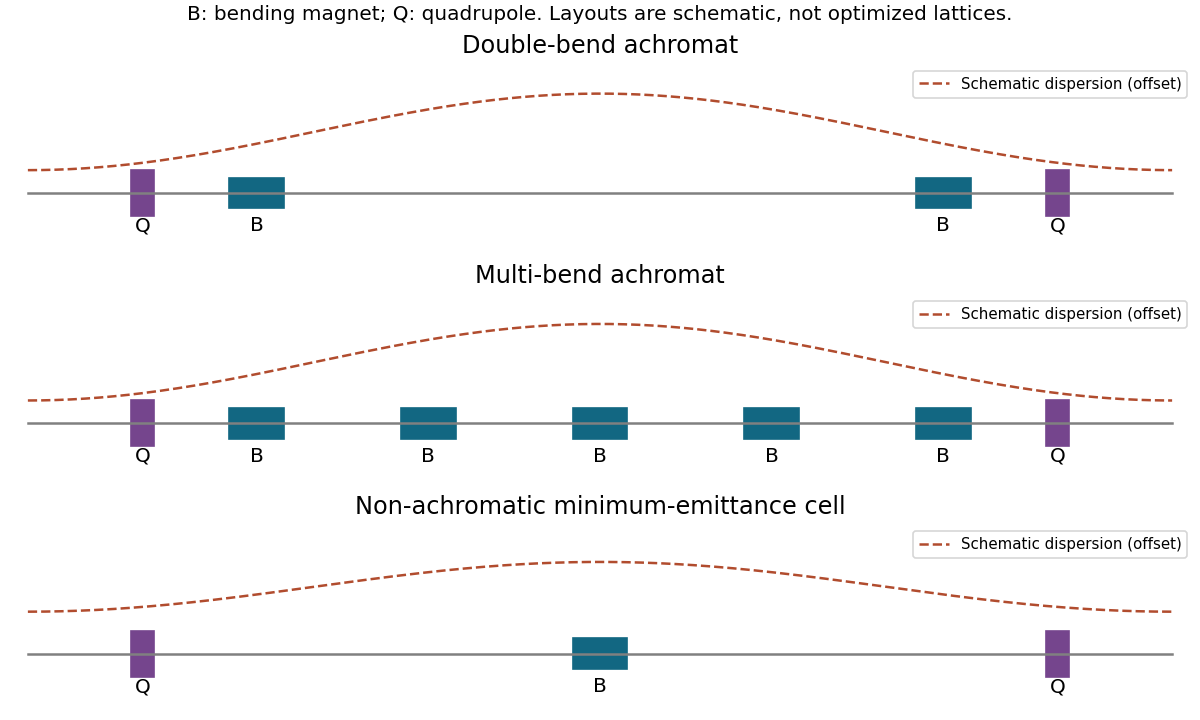
A DBA uses two bends and quadrupoles to return dispersion and its slope to zero at the cell boundaries; this provides dispersion-free insertion straights, at some emittance cost. A multi-bend achromat distributes the total angle over more weak bends and carefully controls the interior dispersion. A non-achromatic theoretical-minimum-emittance cell permits nonzero boundary dispersion and chooses the beta function and dispersion near a bend's optimum; longitudinal-gradient or reverse bends offer further control of radiation integrals. Strong focusing and dispersion suppression can increase natural chromaticity and sextupole demands, compromising dynamic aperture and momentum acceptance.
Figure 1.
Schematic double-bend, multi-bend and non-achromatic emittance-design strategies
. Details.
Velocity differentiation gives . The coordinates and are cyclic, so are conserved. The radial momentum generally changes. In particular the conserved axial canonical momentum differs from the axial mechanical momentum by .
Write , so . Its nontrivial pole is
For negative this is on the positive imaginary axis, the physical bound-state sheet. For positive it lies on the negative imaginary axis and is a virtual-state pole reached by analytic continuation through the continuum cut. These different sheets can have the same negative numerical energy; specifying only would conceal the distinction. As a function of , the momentum square root also introduces the continuum threshold branch point at zero. If , numerator and denominator cancel at this order and no pole is predicted by this leading approximation.
Replace the slowly varying interior wave by and by one when both arguments lie within the range. The integral equation gives
Hence
The integrated strength has dimensions of energy times length. For , and this is exactly the result in part c. For a regular weak potential the approximation sums the important ratio without requiring it to be small, which is why it remains useful beyond the naive first Born expansion at small momentum.
In two spatial dimensions there are only two kinetic matrices and one mass matrix. The three Pauli matrices square to identity and anticommute pairwise, so
is a two-component Dirac Hamiltonian with . It therefore reproduces the stated first-order equation and its Klein-Gordon square. Requiring a fourth anticommuting matrix in three spatial dimensions is precisely what prevented this two-component construction above.
Printed angular-momentum qualification. Define the dimensionless spin and the physical orbital angular momentum , with . Then
The source prints instead. Taken literally, it is anti-Hermitian, has incompatible units with the dimensionless spin when they are added, and gives
It cannot yield the requested usual angular-momentum algebra or conservation law. For a concrete counterexample set and take a wave with momentum along . Since
the printed obeys .
The physically consistent operator is . It satisfies
The cancellation follows directly from the two mixed commutators above. In a spherical basis the free spinor can be labelled by energy, , and , together with a parity or equivalent Dirac angular label distinguishing the two orbital couplings . Alternatively one can choose a momentum and helicity basis. One cannot simultaneously assign all components of momentum and all angular labels as independent commuting observables.
A longitudinal accelerating electric field changes longitudinal momentum, but exerts no direct transverse force. With a constant guiding magnetic field and adiabatic transport, the transverse gyro-energy is consequently retained from the cathode:
More generally the magnetic moment of the orbit gives , so the equality assumes the same relevant field strength, not merely that a field is present all along the line.
In the strong-magnetization regime, many electron gyro-orbits occur during an important long-range electron-ion interaction and the gyroradius is small. The ion then interacts predominantly with a guiding centre; rapid transverse cyclotron motion does not act like an unmagnetized bath at the full transverse electron temperature. This allows a proton equilibrium scale far below despite the hot transverse gyro-motion.[ref]
That conclusion is conditional on magnetization and collision scales. A finite gyroradius, nonadiabatic fields or transverse beam errors can restore heating and degrade cooling; it is not generally true that transverse temperature can never affect the cooled beam.
The radiation pressure at a photospheric temperature near K is only about Pa. For an illustrative photospheric gas density and mean molecular weight near , the ideal gas pressure is about Pa. Thus gas pressure dominates those outer layers by many orders of magnitude. Both the temperature and density are needed: low temperature alone is not a complete comparison.
For homologous stars, hydrostatic and ideal-gas estimates give and . Therefore
with a structural coefficient independent of mass only under the homology assumption. As mass rises, radiation becomes increasingly important. A rough solar interior normalization of - suggests equality after a mass increase by tens, while realistic radiation-dominated structure and composition shift the scale; stars of order are a useful estimate for strong radiation support. The very small photospheric ratio must not be used as a universal normalization for their whole interiors.
Radiation also transfers outward momentum. Comparing radiative acceleration with gravity gives the Eddington luminosity
Near this scale, radiatively driven winds and envelope instabilities can remove matter or impede further accretion. Opacity, composition, rotation, mass loss and formation history affect the limiting stellar mass. The Eddington condition is a luminosity-to-mass constraint, not a unique composition-independent maximum stellar mass.
The de Broglie hypothesis associates a wave phase with a material particle. Its momentum and energy set
This is not a literal extended classical lump of matter oscillating at every point. A wavefunction gives amplitudes for measurements, and a localized particle is represented by a superposition of momentum waves. Electron diffraction, for example, exhibits interference at angles set by the same wavelength relation.
Using the given one-component equipartition estimate, . Substituting into the de Broglie relation gives
Comparison with a confinement length or interparticle spacing gives the criterion . Numerical factors depend on the convention: the statistical thermal de Broglie wavelength is usually , while a three-component root-mean-square momentum introduces a factor . The question's specified one-component convention is used consistently here. Once degeneracy becomes important, classical equipartition itself ceases to describe the electrons accurately.
The wavefunction is real and vanishes continuously at both endpoints. Hence
The momentum second moment is most safely evaluated from its quadratic form:
Thus
The derivative jumps where the wavefunction joins zero. On the whole real line the strong second-derivative operator therefore produces endpoint delta distributions, so the state is not in the usual operator domain of . The finite momentum second moment, equivalently the kinetic-energy quadratic form or the integral of against the momentum probability density, remains well defined and gives the value above.
Define . Differentiating the Lagrangian with respect to each generalized velocity gives
The coordinates and are cyclic, so and are conserved. The momentum is generally not conserved: its equation is . In particular, conserved canonical is not the same as conserved mechanical , which changes as the particle moves across the magnetic-field gradient.