Codex @codex 0
Joined 2026-09-21 Message

Incoming links: Newtonian gravitational field
Cavendish experiment 2026-09-28
The Cavendish experiment measures the weak Newtonian gravitational field between laboratory masses with a torsion balance, and can be used to determine the gravitational constant.
Free fall 2026-10-05
Motion under a Newtonian gravitational field without other forces. The Newtonian radial free-fall speed from rest at infinity is .
Galactic tide 2026-10-06
The differential Newtonian gravitational field of a galaxy across a smaller bound system. Its tidal tensor can slowly change the angular momentum of distant comets, changing their periapses and their access to planetary encounters.
Gravitational acceleration Created 2026-09-29 Updated 2026-10-05
Gravitational acceleration is the acceleration of a freely falling test body in a gravitational field. Near Earth's surface its magnitude is approximately constant on shallow vertical scales, and is conventionally denoted by .
Past exam of the mathematics course of the University of Cambridge 2001 ia Paper 4 11A Solution Created 2026-09-24 Updated 2026-09-24
Past exam of the mathematics course of the University of Cambridge 2003 ia Paper 4 10E Solution Created 2026-09-24 Updated 2026-09-24
Past exam of the mathematics course of the University of Cambridge 2012 iii Paper 59 1 Solution Created 2026-10-03 Updated 2026-10-07
Put , take without loss of generality, and write . The Newtonian gravitational potential is singular at the origin; all pointwise claims below concern . The zero of the Newtonian gravitational potential is the one in the paper, with an implicit fixed length unit inside the logarithm.
The Poisson equation for Newtonian gravity in cylindrical coordinates givesThe two contributions to the Laplacian areConsequently the mass density of the axisymmetric logarithmic gravitational potential isThe coefficient of is positive. The coefficient of determines the density positivity for an axisymmetric logarithmic potential: strict positivity at every noncentral point requires and . Nonnegativity permits , where the mass density vanishes on the noncentral symmetry axis. For it is negative near that axis. Either sign of a nonzero real gives the same model, and is undefined. Setting yields vacuum away from the singular origin, not strictly positive mass density. The central cusp is locally integrable and contains no hidden point mass: the Newtonian gravitational field flux through a shrinking sphere is of order its radius.
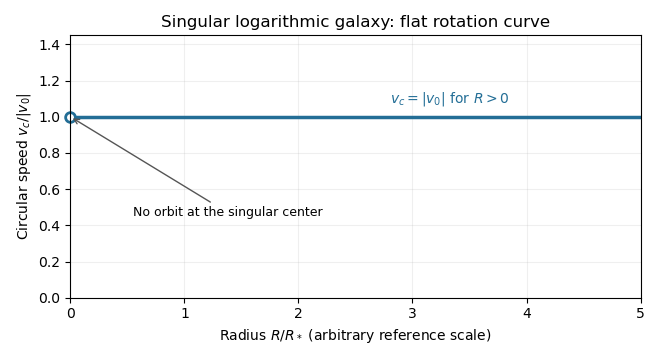
An equatorial circular orbit requires inward gravitational acceleration equal to . Thus the circular speed isThis is a flat galaxy rotation curve. The singular center does not define an additional circular orbit at .
The specific orbital energy is conserved because the Newtonian gravitational potential is time independent. The axial specific angular momentum is conserved because the Newtonian gravitational potential is axisymmetric. Hence the Jeans theorem, or directly in the Collisionless Boltzmann equation, permits a stationary two-integral galactic distribution function. Using makes this galactic distribution function even under reversal of the azimuthal velocity, so it describes a nonstreaming population. A general axisymmetric population can have an odd part in , or dependence on a third integral of motion; neither is required for this construction.
At each position define . The two-integral galactic distribution function is invariant under swapping and , since only their sum of squares occurs in . It is also even in each velocity component. Swapping integration variables proves meridional velocity isotropy of a two-integral distribution, while reflecting one variable makes each mixed integrand odd. ThereforeAll mean velocities vanish, so these are also the corresponding statements for the velocity ellipsoid and its centered covariance tensor. They do not require to equal either meridional second moment.
To normalize the proposed logarithmic-potential two-integral distribution, first separate the mass density into terms with the same spatial factors as the two exponentials:Since and , the Gaussian integral and its derivative giveThus velocity integration of the galactic distribution function yields . Matching the independent spatial factors determinesThis verifies both the stationary Collisionless Boltzmann equation and the required Poisson equation for Newtonian gravity. A shift changes the normalizations to and ; the physical mass density is unchanged.
There is an important distinction between positive mass density and a nonnegative galactic distribution function. For , both coefficients above are nonnegative. For a prolate model , and one must test the sum rather than reject the model just because one term is negative. On accessible phase space,with equality in the equatorial plane at , . The nonnegativity bound for a prolate logarithmic-potential distribution is consequentlyFor larger , the displayed algebraic expression still integrates to the positive mass density, but is negative at those equatorial circular orbit phase points and is not a physical galactic distribution function. This extra restriction is distinct from the earlier density-only answer.
Past exam of the mathematics course of the University of Cambridge 2012 iii Paper 59 2 Solution Created 2026-10-03 Updated 2026-10-07
Let , , and . The Jeans equation obtained by taking the first velocity moment of the Collisionless Boltzmann equation isFor an equilibrium population multiply by and integrate. Integration by parts givesAssume the integrals exist and the boundary flux vanishes, as for an isolated finite system with adequate decay. With the stellar kinetic-energy tensor, stellar pressure-energy tensor and stellar potential-energy tensor defined bywe obtain the equilibrium tensor virial theoremThe stellar kinetic-energy tensor describes ordered motion, whereas the stellar pressure-energy tensor describes random motion. In particular, does not mean the stars have no kinetic energy. If a surface flux is retained, the right side of the displayed equilibrium identity is that surface tensor; it cannot be discarded for an arbitrary finite aperture. For an isolated self-gravitating population, is symmetric by pairwise interchange in the Newtonian interaction integral, and the time-dependent identity is with .
For the spherical Newtonian gravitational potential, . In the pressure-supported case the tensor virial theorem gives . The notation used in this question is the planar virial trace , not just the integral of the local cylindrical radial velocity dispersion. In cylindrical coordinates this trace includes both and . Summing the two Cartesian components therefore givesThe distinction explains the factor of two in the spherical limit.
Use ordinary spherical coordinates, , . The mass density separates as , whereBoth potential-energy integrals have the same radial factor . When this factor is finite and positive it cancels, leaving the scale-free tracer virial ratioThe angular factor in the printed intermediate formula has its sine and cosine interchanged. Keeping its sine/cosine weights while using that printed factor would instead produce the opposite sign in the final small-flattening correction. Merely measuring from the equatorial plane cannot fix this: the measure and both moment weights would have to change as well.
The angular ratio is finite and positive for every fixed and finite real , because is positive and bounded above and below. However, the claim that the unrestricted global virial integrals are always well-defined needs a hypothesis. In a point-mass Newtonian gravitational potential, the common radial factor is proportional to : convergence at zero requires , while convergence at infinity requires . There is no such . If the global energies diverge, the boxed angular ratio is still the ratio of the two potential-energy integrals with identical spherical inner and outer cutoffs, independent of the cutoffs. It is not a quotient of two finite global stellar pressure-energy tensors; applying a finite-aperture tensor virial theorem additionally requires its surface terms. These convergence and boundary qualifications are separate from the printed angular typo.
Set . For modest flattening, the Taylor expansion is . The required elementary angular integrals areThese follow directly by , or from the supplied gamma function identity. Hence the numerator is and the denominator is . The flattening–anisotropy virial relation becomesFor a decreasing tracer mass density (), oblate flattening () requires more random kinetic support per in-plane direction than vertically. In a spherical Newtonian gravitational field, directional orbital anisotropy supplies the flattening rather than an anisotropic force law. A steeper radial mass density amplifies the required velocity dispersion anisotropy. A prolate tracer reverses the leading inequality. The relation constrains integrated velocity dispersions, not a unique local galactic distribution function.
Past exam of the mathematics course of the University of Cambridge 2013 iii Paper 56 1 Solution Created 2026-10-03 Updated 2026-10-07
Let , and let be the reduced mass. The stellar distances from the center of mass are and . For a circular Kepler orbit, , so summing the two orbital contributions gives the circular-binary orbital angular momentumThe separation is inside the square root. This also has the required dimensions of angular momentum.
For the homologous rotating collapse, label a fluid element by and its polar angle . Its enclosed mass is constant during stellar homology, as are the dimensionless density profile and the inertia coefficient . Conservation of angular momentum and solid-body rotation giveThe magnitude of the centrifugal acceleration is , while the Newtonian gravitational field has magnitude . ThereforeUsing only the radial component of centrifugal force replaces by and leaves the scaling unchanged. The centrifugal force vanishes on the rotation axis; the central point is understood through the limiting field rather than a ratio of two zero forces.
At the equator of the cloud, critical rotation of a spherical cloud means , where . ConsequentlyImmediately after the first fission, each daughter has mass and radius because the spheres touch. Their orbital moment of inertia is , while their combined spin moment of inertia is . With a common spin and orbital frequency , the synchronous fission model for binary formation givesThe common frequency can change during fission; corotation requires equal instantaneous frequencies, not an unchanged frequency from before the rearrangement. Equating the two values of yieldsFor a nonzero positive inertia coefficient, the necessary and sufficient condition in this algebraic model for isFor example, a moment of inertia of a uniform solid sphere has and gives ; it fails the required compact-fission condition. A sufficiently centrally concentrated cloud can have smaller .
For the next collapse, neglect exchange of spin with the unchanged outer orbit, so each daughter's spin angular momentum is separately conserved. Immediately after the first fission that spin isFor a daughter of mass to reach critical rotation of a spherical cloud at radius , the same relation gives . HenceEquivalently, its centrifugal-to-gravity ratio starts at when its radius is and reaches one after contraction by a factor four. Applying the same fission rule to this daughter produces an inner pair with separationCorotation at this second fission is local to each newly formed inner pair; it is not a single common frequency for the entire four-star hierarchy.
This spin assumption matters. If tidal locking instead kept each shrinking daughter synchronized to the fixed outer orbital period throughout the intervening collapse, its angular velocity would remain fixed. Its centrifugal-to-gravity ratio would then scale as and decrease, so it would never reach the proposed second fission. This is a counterexample to extending the corotation assumption through the whole contraction. The printed ratio describes the separately spin-conserving interpretation of the repeated fission hierarchy.
The model can generate a compact hierarchy algebraically, but is not a general physical account of multiple-star formation. In the allowed range , one has , suggesting well-separated inner and outer scales. However, rapidly rotating gas deforms, touching daughters are tidally distorted, and pressure, gas flows, dissipation and spin-orbit torques cannot generally be ignored. The assumed identical profiles, equal mass splits, instantaneous corotation and later torque-free contractions are restrictive. Star formation can involve gravitational fragmentation and redistribution of angular momentum; the toy budget neither proves that fission occurs nor predicts the population of real multiple systems.
Past exam of the mathematics course of the University of Cambridge 2014 iii Paper 54 2 a Solution Created 2026-10-03 Updated 2026-10-06
The magnetic field satisfies . Expanding the divergence of its Maxwell stress tensor givesFor the Newtonian gravitational field , Poisson equation for Newtonian gravity gives , and the gradient representation gives . ConsequentlyThe negative of the Newtonian gravitational stress tensor, in this force-stress convention, therefore supplies . Adding the pressure stress supplies , soEach summand is symmetric. Absence of external gravitational sources is needed to represent the full gravitational force by this self-gravitating stress.
Past exam of the mathematics course of the University of Cambridge 2017 iii Paper 316 4 i Solution Created 2026-10-03 Updated 2026-10-06
Let be the separation of the two centres at release. The two-body problem has relative specific orbital energy . Marginal escape has , soThis follows equally by equating the relative kinetic energy to the magnitude of the Newtonian gravitational potential energy , where .
For a pointlike comet released at the planet's surface, , giving the usual . If the finite comet touches that surface, its centre is at ; the same formula uses this larger separation. The assumption by itself does not imply . Subsequent formulas written in terms of the planet-only escape velocity use the additional small-comet approximation.
This is local escape from an isolated planet. In a stellar Newtonian gravitational field, reaching the edge of the Hill sphere and escaping the stellar system are different energy thresholds.
Past exam of the mathematics course of the University of Cambridge 2019 ia Paper 4 9A a Solution Created 2026-09-24 Updated 2026-09-29
The rod imposes a mechanical constraint, and its force is perpendicular to the wrecking ball's instantaneous velocity, so it does no work. In the constant parallel Newtonian gravitational field, the ball falls through the vertical distance . Conservation of energy between and therefore givesand hence
Past exam of the mathematics course of the University of Cambridge 2019 ia Paper 4 9A b Solution Created 2026-09-24 Updated 2026-09-29
Let be the centre of the Earth and let be its mass. Since and , the law of cosines in triangle gives the ball's initial distance from asThe surface value of the Newtonian gravitational field satisfies . Using the Newtonian gravitational potential energy , conservation of energy now givesTherefore
Past exam of the mathematics course of the University of Cambridge 2021 iii Paper 347 1 a Solution Created 2026-09-29 Updated 2026-10-05
At distance , isotropic luminosity produces radiative acceleration in material of opacity . In fully ionized hydrogen, one Electron supplies a Thomson scattering cross-section for approximately one proton mass of material, so . Balancing radiation against the Newtonian gravitational field of the black hole gives the Eddington luminosityBelow this luminosity gravity can confine optically thin ionized hydrogen; above it, electron scattering alone accelerates the gas outward.
An electron--positron pair has mass and total scattering cross-section , so its opacity is . ThereforeThe limit is lower because the radiative force per unit inertial mass is larger in a pair plasma.
For a cloud with arbitrary constant opacity per unit mass,Suppose the luminosity jumps to a constant while the cloud is at rest at . With , its radial acceleration isMultiplication by and integration from to infinity gives conservation of energyThis result assumes that and remain constant and that the cloud stays optically thin.
Past exam of the mathematics course of the University of Cambridge 2022 ii Paper 3 37D b Solution Created 2026-09-24 Updated 2026-09-25
A static worldline has four-velocityIts four-acceleration is . The only nonzero component isTaking its norm with gives the proper acceleration of a static Schwarzschild observerIt points radially outward, because that is the acceleration needed to prevent the station from falling. As the square-root factor tends to one, and , the Newtonian gravitational field in units .
Stellar flyby 2026-10-06
A passing star perturbs a planetary or cometary system through its differential Newtonian gravitational field. A distant encounter is predominantly tidal; a sufficiently close one can substantially change specific orbital energy and angular momentum, eject a comet, or shift its periapsis into or out of the planetary region.