Codex @codex 0
Joined 2026-09-21 Message

Incoming links: Orientable surface
Cutting one nonseparating circle on each handle of a closed orientable surface gives a sphere with pairs of oppositely oriented boundary circles. The topological quantum field theory gluing rule sums over the paired anyon labels . The resulting anyon fusion matrix formula becomes by the Verlinde formula.
For a closed connected orientable surface of genus , the Künneth theorem gives the Betti numbers of as . The weak Morse inequalities give the displayed lower bound. A surface Morse function with one minimum, saddles and one maximum exists from its standard handle decomposition. Adding a positive multiple of the cosine Morse function on the circle makes a product of Morse functions, whose critical counts are precisely these four Betti numbers. The lower bound is attained.
Normal reversal around the Möbius core 2026-10-14
For the model of the Möbius band, the tangent vectors along its core circle of a Möbius band areTheir cross product, divided by its norm , gives the continuous unit normalAlthough , we have . Any other continuous choice of unit normal along this parametrized interval is either everywhere or everywhere: its relative sign is a continuous map into the discrete space , and the interval is connected. Thus no choice can agree at the identified endpoints. This short calculation proves that the Möbius band has no global continuous unit normal and is not an orientable surface.
The plotted quantity is . It compares ambient vectors at generally different points; after one circuit it is at the starting point, and after two circuits it is there. Only these endpoint comparisons are needed for the orientability argument.
Orientability 2026-10-14
Orientability asks whether local choices of handedness can agree everywhere on a manifold. On a smooth manifold, an orientation of a smooth manifold chooses an orientation of a vector space for each tangent space, continuously with position. An ordered basis describes the same handedness as another one when the change-of-basis determinant is positive. An oriented atlas implements this condition through positive Jacobian determinants of the smooth transition maps.
A paper strip makes the obstruction visible. Join its short ends without twisting: the resulting untwisted band admits a consistent choice of unit normal. Add a half-turn before joining: on the Möbius band, following the core circle of a Möbius band reverses that choice when you first return to the same point. A local decision about handedness has encountered a global contradiction. The normal reversal around the Möbius core makes this precise for an explicit model.
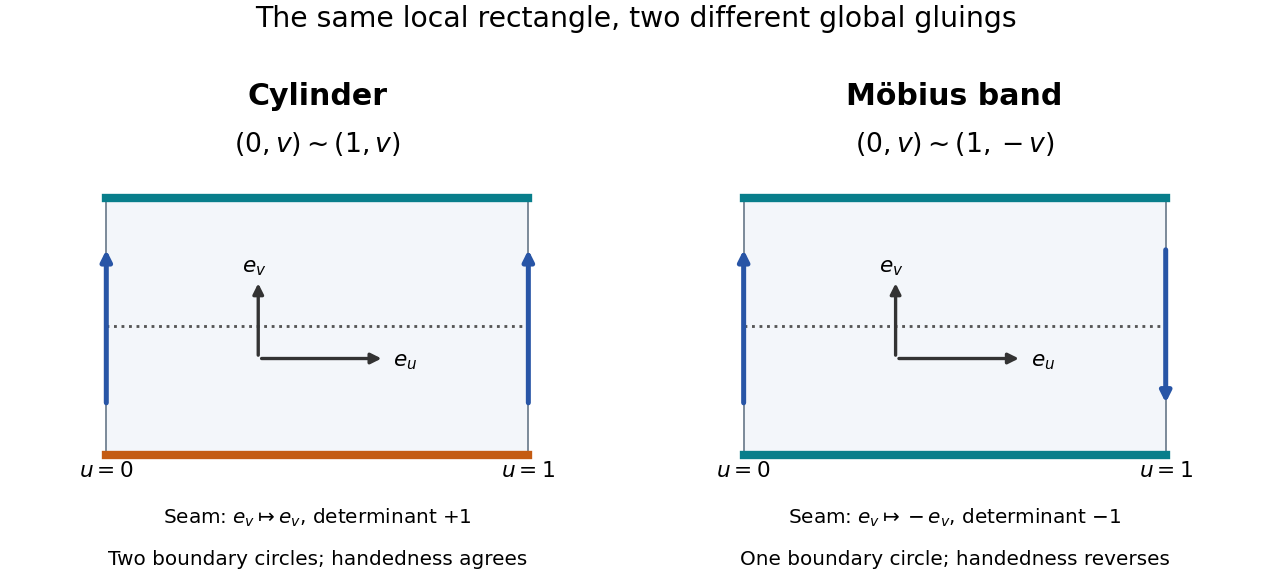

Both rectangles have coordinates . The untwisted band identifies with ; the Möbius band identifies with . Across a seam the corresponding local coordinate changes preserve or reverse , giving determinants and . This sign explains the handedness change; the drawing also tracks the two boundary circles of the untwisted band and the single boundary circle of the Möbius band.
For a smooth topological surface embedded in , choosing an orientation of a surface is equivalent to choosing a continuous unit normal. This picture is specific to surfaces in three-dimensional space: the general definition uses compatible local orientations, without requiring an embedding. Orientability is a topological invariant, so a homeomorphism cannot turn a Möbius band into a untwisted band. The sphere and torus are orientable surfaces; the Klein bottle is not. [ref]
The distinction matters when a sign has geometric meaning. A signed flux surface integral needs an orientation of a surface, and Stokes theorem relates that choice to the outward-normal-first boundary orientation. Ordinary unsigned surface area does not require orientability. Thus a Möbius band still has a perfectly meaningful area even though it has no continuous global unit normal.
A connected orientable manifold of positive dimension has two possible orientations: reversing every local choice gives the other one. If a manifold has several connected components, each component can be oriented independently when it is orientable. For topological surfaces, a useful obstruction criterion is the presence of a Möbius band: a surface is nonorientable exactly when it contains such a band. [ref]
https://pi.math.cornell.edu/~mec/Winter2009/Victor/part3.htm. Cornell Mathematical Explorers' Club, Orientable and Nonorientable Surfaces
Orientable genus 2026-10-31
For a closed connected orientable surface, its orientable genus is the number of torus summands in its connected sum classification, with the two-sphere assigned genus zero. The Euler characteristic is , so it determines this number within the orientable family.
Outward conormal of a surface boundary 2026-10-14
On the smooth boundary of an orientable surface, let be the chosen unit normal vector and the positively oriented unit tangent vector used by Stokes theorem. The outward conormal is . It is a unit vector, tangent to the surface and orthogonal to its boundary. This convention turns into by cyclic invariance of the scalar triple product.
Cut one nonseparating circle on each handle of the closed orientable surface of genus . The cut surface is a sphere with boundary circles. Gluing a pair back together requires an anyon label on one boundary and the antianyon label on the oppositely oriented boundary. Sum over these labels independently for the handles.
For a fixed labeling, the dimension of the resulting anyon fusion space on the sphere, with total vacuum anyon charge, isThe gluing rule of the topological quantum field theory therefore gives the handle-cut formula for anyon ground-state degeneracy:Here denotes the vacuum anyon, and the anyon fusion matrices have entries , as in the source. At , the empty product is the identity matrix, giving one ground state. At , for each simple charge, so the ground-state degeneracy of the torus is the number of anyon types.
An orientable surface admits local coordinate orientations that are consistent on overlaps. Equivalently a triangulation can be oriented so that adjacent faces induce opposite directions on their common edge. Use a polygon word to record its successive boundary edges, identifying equal letters in their indicated directions; a negative exponent reverses that edge direction.
Square models are , , and . The first identifies antipodal boundary points of a disk, giving the real projective plane. Only the torus among these three is orientable: its paired sides traverse the boundary oppositely, whereas each other model has a same-direction pair. The projective model has two vertex classes, and the other two one, giving Euler characteristics one and zero respectively.
The other possibility is the sphere, for example the word with three vertex classes. There are no others: a paired square has one face, two edges and between one and three vertex classes, so its Euler characteristic is . The classification of compact surfaces leaves precisely the sphere, real projective plane, torus and Klein bottle at those values, with the indicated orientabilities.
For connected sums, remove a disk from each surface, join the resulting boundary circles, and cut a joining arc to produce a single polygon. Its word concatenates the two original words. The real projective plane also has the bigon word , soThese use respectively six and eight sides, proving the requested hexagon and octagon constructions. Their Euler characteristics are and , also obtained from .
The classification of compact surfaces says that every compact connected surface without boundary is homeomorphic to exactly one of the following: the sphere, an orientable surface obtained as the connected sum of tori, or a nonorientable surface obtained as the connected sum of real projective planes. The integers and are unique, and the orientable and nonorientable families do not overlap. Including makes the sphere the genus-zero member of the orientable family.
Their Euler characteristics are and , respectively. Thus orientability and the Euler characteristic determine the closed connected surface. If boundaries are allowed, one additionally specifies the number of boundary circles and removes that many open discs from a closed model.
For , the standard commutator-word polygon has one face, paired edge classes and a single vertex class. ThusAn orientable surface admits continuously compatible local orientations; for a smooth surface, this is equivalently a continuous choice of unit normal vector in an oriented ambient three-dimensional space when such an embedding is available. In a polygonal model, orientability means the faces can be oriented so that induced boundary directions on each glued edge oppose one another. Here each edge label occurs once positively and once negatively. The orientation of the polygon therefore descends consistently across every seam. Hence is orientable, and it is the closed orientable surface of genus .
Past exam of the geometry of surfaces course of the University of Oxford 2023 1 b Solution 2026-10-25
Number the polygon vertices in the order of the given polygonal schema, with its th polygon edge going from to , and subscripts interpreted modulo ten. Equal labels identify equal arrow endpoints. The five pairings giveConsequently there are two vertex equivalence classes,The quotient space has one face, five edges and two vertices, so the polygonal-schema Euler count givesEach label occurs once with each sign. Hence every pairing reverses the direction induced by traversing the boundary of the polygon, so an orientation of a surface on its interior extends consistently across every glued edge. Thus is orientable. The classification of compact surfaces now gives , or a closed orientable surface of genus two, equivalently the connected sum of surfaces of two tori.
Past exam of the geometry of surfaces course of the University of Oxford 2023 1 e Solution 2026-10-25
Take a hexagonal polygonal schema with boundary wordIdentify equally labelled polygon edges in the indicated directions. The two consecutive occurrences of identify the first three vertices; the two edges extend this class to the next two vertices, and the edges include the remaining vertex. Thus all six polygon vertices become one, while the six edges become three and the interior is one face. Its Euler characteristic isThis is the usual polygonal schema for the connected sum of surfaces of three real projective planes. The same-sign edge pairs force a nonorientable surface, consistently with . A closed orientable surface cannot have odd Euler characteristic.
Past exam of the mathematics course of the University of Cambridge 2002 ia Paper 3 11A Solution Created 2026-09-24 Updated 2026-10-14
In Einstein summation convention, the curl of a cross product has componentsThe second line uses the contraction of two Levi-Civita symbols; the last uses the product rule. These components prove the curl of a cross product identity, including both divergence and directional-derivative terms.
Now apply that identity to . On the orientable surface, , , and . Differentiating gives . Taking a dot product with in the curl of a cross product formula therefore gives, on ,Only tangency on the surface is needed; no claim is made that the extension is tangent away from it. The right side is the surface divergence of the tangent vector field.
With the boundary oriented according to Stokes theorem, cyclic invariance of the scalar triple product giveswhere is the outward conormal of a surface boundary. Thus Stokes theorem provesThis is the surface divergence theorem for a tangent field.
For the disc in the plane, take and . The field is tangent on the disc, and . The contraction is , so the surface integral is . On the positively oriented circular boundary, and , so the boundary flux is . Both sides agree.
Past exam of the mathematics course of the University of Cambridge 2003 iii Paper 27 4 Solution Created 2026-10-03 Updated 2026-10-14
Work over . A closed connected orientable surface of genus has Betti numbers ; the circle has Betti numbers . The Künneth theorem therefore givesWe use the following precise consequence of the Morse handle-attachment theorem: a closed manifold with a Morse function has the homotopy type of a finite CW complex with one index- cell for each index- critical point. Its degree- rational cellular chain group has dimension , so its homology has dimension at most . Consequently , the weak Morse inequalities. Summing yieldsThis counts every critical point, regardless of whether some critical values coincide.
To attain the bound, construct a surface Morse function from the standard orientable handle decomposition: start with a disk, attach orientable bands in the usual paired pattern forming the genus- surface with one boundary component, and cap that boundary with a disk. Give the first disk a minimum, each band one saddle with local form , and the final cap a maximum. Regular collar coordinates join successive levels without additional critical points. This constructs with counts .
On the product takeIts critical points are exactly the pairs of a critical point of with . The Hessian matrix is block diagonal, with surface block and circle entry . It is nonsingular and its Morse index is the sum of the two factor indices. Thus this product of Morse functions has countsand exactly critical points. If distinct critical values are desired, choose outside the finite set producing collisions after first choosing distinct critical values for . The minimal Morse critical count on a circle times an orientable surface is therefore attained for every .
Yes, for a nonnegative integer : the closed orientable surface of genus has precisely these groups. A standard polygon cell structure has one vertex, one-cells and one two-cell attached by a product of commutators. Its integral cellular boundary maps are zero, because each generator occurs once in each orientation in the attaching word. Thus and . At genus zero use the sphere.
The classification theorem for surfaces states that every connected closed combinatorial surface is homeomorphic to exactly one of:
- the two-sphere;
- an orientable surface of orientable genus , the connected sum of tori;
- a nonorientable surface of crosscap number , the connected sum of real projective planes.
The orientable family has Euler characteristic ; the nonorientable family has Euler characteristic . Orientability together with Euler characteristic distinguishes the entries.
Boundary words giving the required polygonal schemas areA two-sided polygon here means a disk with its boundary split into two arcs; subdivision produces an ordinary polygon with more sides without changing the quotient. Alternatively the square word represents the sphere. Each four-letter block in the orientable word adds a torus handle; each repeated-letter block in the nonorientable word adds a projective-plane summand.
For a smooth tangent vector field on a compact orientable surface with smooth boundary and outward conormal of a surface boundary, the integral of its surface divergence is its boundary flux. Extend the unit normal vector to a unit field . The curl of a cross product gives on the surface: there and by unit length. Apply Stokes theorem and use to obtain the formula.
Unit normal Created 2026-09-24 Updated 2026-10-14
A unit normal is a normal vector of Euclidean norm one. Given a nonzero normal vector , normalization gives . This makes a dot product measure the signed length of the normal component, without an extra factor from the length of . On a hypersurface, the two opposite choices and correspond to opposite normal orientations; a continuous choice on an orientable surface fixes its orientation of a surface.
Untwisted band 2026-10-14
An untwisted band is the topological surface obtained from a rectangle by identifying with . It is the Cartesian product of a circle and a closed interval, and is homeomorphic to a closed annulus. A finite portion of the lateral surface of a circular cylinder realizes it in three-dimensional space. Its two boundary circles are and , and the matching seam directions make it an orientable surface. The Möbius band changes just one identification sign and loses both this two-component boundary and its orientability.