Original solutions to all nine questions and all fifteen terminal parts. Source: released Mathematics examination papers, archive
FOI 20210708 1 Data.zip, examination of 22 June 2006.Yes. The matrix is a cyclic shift operator on three coordinates. Since are the three standard basis vectors, no polynomial of degree below three annihilates . Also , so its minimal polynomial is . Over the complex numbers this has the distinct roots , where . The minimal polynomial criterion for diagonalizability therefore proves diagonalizability.
Explicitly, satisfies when . These three eigenvectors form an eigenbasis. This is a special case of diagonalization of a cyclic shift over a field.
No. The same cyclic-vector argument gives minimal polynomial over the finite field . The quadratic has no root in : its value is one at both zero and one. Thus the minimal polynomial does not split into linear factors over the specified field, violating the minimal polynomial criterion for diagonalizability. It becomes diagonalizable over a suitable larger finite field, but that is a different question.
No. In characteristic three, . This is still the minimal polynomial, because the three cyclic basis vectors remain independent. Its repeated factor violates the minimal polynomial criterion for diagonalizability. Equivalently, the only possible eigenvalue is one; a diagonalizable matrix with that sole eigenvalue would be the identity matrix, whereas this matrix is not the identity.
Yes. In , the minimal polynomial splits asThe three factors are distinct, so the minimal polynomial criterion for diagonalizability applies. For example the eigenvectors for give an eigenbasis over this finite field. The contrast with characteristic three is that the shift polynomial now splits without repeated roots.
Construct the vectors inductively by the Gram-Schmidt process, proving its needed properties directly. Suppose form an orthonormal basis of , and putFor every , taking an inner product with gives . Also , because otherwise would lie in the linear span of its predecessors, contrary to linear independence. DefineIt lies in , has unit norm, and is orthogonal to every with , since those vectors lie in . Writing gives . The same identity shows that span , completing the induction, including the empty sum at .
For uniqueness, any candidate expands in the basis . Orthogonality to every earlier , hence to every earlier , makes its first coefficients zero. Thus . Unit norm forces , and forces the positive sign. This proves uniqueness in the Gram-Schmidt process with positive normalization without assuming a projection theorem or any other major orthogonalization result.
The evaluation homomorphism , , is surjective and has kernel of a ring homomorphism . Hence is an ideal, and the first isomorphism theorem for rings gives . Since this quotient is a field, .
It is not an ideal. The constant polynomial one belongs to , but its product with does not: the derivative of at zero is one. Thus fails closure under multiplication by arbitrary elements of , a required ideal property. Closure under addition alone would not suffice.
The conditions set the constant and linear coefficients to zero, so . This is a principal ideal, but it is not maximal: there is a strict chain . In the quotient ring, the nonzero class of has square zero, so the quotient is not a field.
Here is a principal ideal. The evaluation homomorphism from onto has this kernel of a ring homomorphism: division by leaves a remainder , and with real forces both to vanish. Surjectivity follows because every complex number is . ConsequentlyEquivalently, is an irreducible polynomial over the real numbers.
A closed curve has . A simple curve has no repeated points apart from the permitted equality of its two endpoints when it is closed. A smooth curve, in the regular contour-integration convention, has a continuous nonzero tangent ; piecewise smooth contours are treated by adding the integrals over their smooth pieces. For a continuous integrand, its contour integral is defined byFor the positively oriented circle, and . Direct parameter integration therefore givesFor , an elementary antiderivative is and its endpoint values agree because is an integer. For , the integrand of the parameter integral is the constant . No integral theorem is needed.
Apply the residue theorem to on the upper semicircle of radius , traversed counterclockwise. Its sole enclosed pole is the double pole at , andOn the semicircular arc, , so the ML inequality bounds its contribution by . The real integral is absolutely convergent, since its integrand is at infinity. Taking in the contour identity yields
A holomorphic function with at every point is locally a conformal map. Write . Since and , , andThus the specified Möbius transformation is conformal throughout the disk. Expanding the two squared absolute values givesso maps the open unit disk into itself. Solving gives . Equivalently . Hence is its own inverse, proving both injectivity and surjectivity on the disk. Nonvanishing derivative establishes the local angle-preserving property; the explicit inverse supplies the separate global bijection claim.
The fundamental theorem of calculus first gives . Integrating again, or differentiating the proposed expression twice and checking its initial values, yields the Volterra integral equationFor , the initial value problem is solved by . Its Picard iteration constructs the sine series directly. The base approximation is . Ifthen elementary integration givesSubstituting this finite sum in the next update, then shifting its index, proves the same formula with in place of . This is the required mathematical induction. The resulting partial sums converge to for every real , and uniformly on every bounded interval: the absolute terms on are bounded by the convergent series .
The printed update lists , which would leave unspecified if read literally. The usual Picard iteration, and the requested induction from , use the update starting at ; that intended convention is used here.
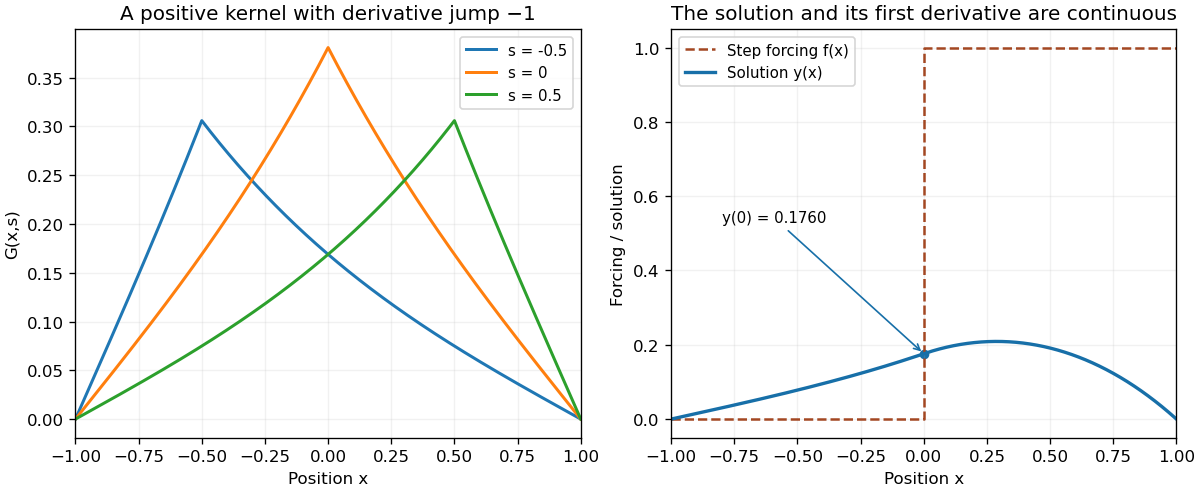
Write the equation as with . Homogeneous solutions vanishing at the left and right endpoints are and . Their Wronskian is . The Dirichlet Green kernel for minus second derivative plus one is thereforeIt vanishes at , is continuous at , and its first derivative has jump . Thus in the distributional derivative sense, with the sign appropriate to . Integration against gives the required boundary-value solution. The kernel is positive and symmetric, as is also apparent in the figure.
For the specified step forcing only contributes at , givingThe discontinuity in gives a piecewise twice-differentiable solution with continuous value and first derivative, rather than a jump in itself.

The characteristic equation of a partial differential equation for is . Thus the two characteristic curve families are . Set and . The chain rule gives and , reducing the equation toIntegrating in the two independent characteristic coordinates gives , or . At , the value condition gives , while the derivative condition gives . Hence and , soDirect differentiation gives , and , verifying both the equation and the two data. The additive constants cancel in , so they do not create different solutions.
Articles by others on the same topic
There are currently no matching articles.