The large drop from carbon to silicon is the main trend; the smaller reversals at Ge and Pb reflect changes in shielding and valence-electron binding. Allen electronegativity is based on the mean binding energy of valence electrons in free ground-state atoms, rather than an arbitrary charge-transfer count. Moving to larger principal shells generally makes the valence electrons more diffuse and more shielded, reducing their attraction to the nucleus. carbon's compact second-shell valence orbitals therefore give particularly high electronegativity.
The intervening filled 3d shell shields imperfectly, increasing effective nuclear attraction in germanium relative to a simple smooth extrapolation from silicon. This helps explain Ge being slightly above Si rather than below it. Increased size then lowers Sn relative to Ge. The filled inner d and f shells and relativistic stabilization of lead's 6s electrons modify the next step; contraction and stronger binding of the 6s contribution help Pb lie slightly above Sn. The small reversals should not obscure the much larger C-to-Si change. The spectroscopic definition includes both occupied s and p valence contributions, so the relativistic s effect can influence the Allen average even though not every electron participates equally in every bond.[ref]
Electronegativity is the average one-electron energy of the valence-shell electrons in ground-state free atoms by Leland C. Allen. Definition of the valence-shell spectroscopic average
The valence configurations are , , and . Their full closed-shell cores are respectively , , and . The filled 4f and 5d subshells of lead are not the outer valence configuration requested.
carbon uses strong 2s/2p-derived covalent bonding, whereas retention or involvement of the low-energy Pb 6s pair distinguishes the two lead oxides. In CO, carbon has an approximately triple-bonded description with one carbon lone pair; the latter has substantial 2s character, while the sigma and two pi bonding combinations involve the valence shell, particularly carbon 2p orbitals for the pi bonds. In CO, carbon is formally in oxidation state +4 and its four valence electrons participate in two strongly covalent C=O double-bond frameworks. A localized account uses sp hybrids for sigma bonding and two p orbitals for the pi systems. oxidation states are bookkeeping devices here: neither molecule contains a bare C or C ion.
In PbO, the Pb(II) description removes or employs mainly the two 6p electrons, retaining a relatively low-energy 6s pair. In PbO, the Pb(IV) description additionally involves those two 6s electrons. The stabilization and poor availability of that pair underlie the inert-pair effect and the relative preference for Pb(II) chemistry. “Inert” does not mean that the 6s electrons have zero influence on bonding or shape: mixing with oxygen states and empty Pb states can make the Pb(II) lone pair stereochemically active. The more ionic formal electron counts in the lead oxides and the covalent molecular-orbital description of the carbon oxides are complementary models, not literal assignments of individual electrons to immutable atomic orbitals.[ref]
CO and CO are discrete molecules, whereas the other oxides gain stability from extended bonding or ionic lattices. carbon's compact 2p orbitals overlap effectively with oxygen 2p orbitals, allowing strong multiple bonds that satisfy the valence requirements within small molecules. Intermolecular forces between CO or CO molecules are much weaker than those internal bonds, so low condensation temperatures and gaseous states at room conditions are unsurprising. CO is nonpolar overall but still has London dispersion forces and interactions between electric quadrupoles; “nonpolar” does not mean no attraction.
For larger Group 14 atoms, overlap with oxygen 2p orbitals is less effective for strong localized multiple bonding. SiO instead forms an extended network of SiO tetrahedra with each oxygen bridging two silicon atoms. Breaking or melting the network involves much more than separating intact SiO molecules. The Si–O electronegativity difference is , so these are strongly polar covalent bonds rather than evidence for a molecular solid.
For Pb–O the difference is , and ionic Pb/O or Pb/O descriptions provide useful starting points, with appreciable covalent contributions. PbO has layered structures with asymmetric oxygen coordination consistent with a stereochemically active 6s pair. A common PbO structure is rutile-like, with PbO octahedra linked through oxygen. Extended lattice interactions account for their solid states.[ref]
https://doi.org/10.1103/PhysRevLett.107.246402. Geometry and Electronic Structure: rutile PbO2, six-coordinate Pb and three-coordinate O
The similar Si–O and Pb–O electronegativity differences show why a single difference threshold cannot determine the entire bonding type, coordination number or structure.A suitable representative structure is a three-dimensional network of corner-sharing CO tetrahedra, with C–O single bonds. Each carbon is four-coordinate; every bridging oxygen is bonded to two carbons. Sharing four oxygens between two tetrahedra gives oxygens per carbon, so the network retains empirical formula CO without containing separate O=C=O molecules.
High pressure favours a compact, highly coordinated network through its smaller molar volume: at fixed temperature, increasing pressure changes relative Gibbs energies according to . Heating helps overcome the large reconstructive barrier to breaking and redistributing molecular pi bonding and establishing an extended single-bond network. It should not be argued that high temperature by itself favours the lower-entropy network. Nor is merely freezing molecular CO sufficient: dry ice remains a molecular solid.
The sketch shows connectivity and local tetrahedral coordination, not a unique predicted crystal structure. Real amorphous carbonia need not have perfect periodic order or exclusively one coordination environment. The original carbonia experiments combined high-pressure preparation with infrared, Raman and diffraction evidence for loss of molecular character and formation of an amorphous network.[ref]
Amorphous silica-like carbon dioxide by Mario Santoro and others. Abstract: spectroscopy and diffraction evidence for amorphous nonmolecular CO2
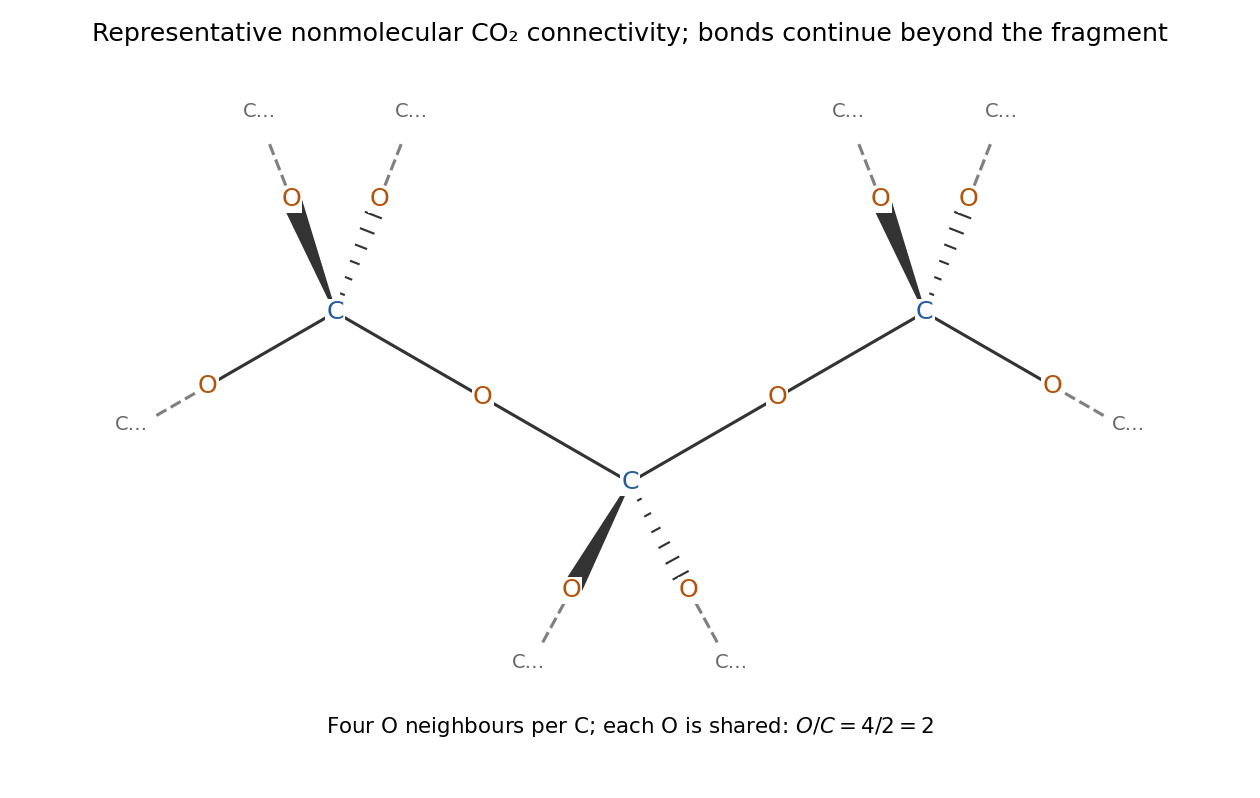
Original representative corner-sharing tetrahedral CO2 network fragment; terminal bonds continue into the solid
. Details. 
Amine nitrogen binds the carbon end of CO; Mg binds through oxygen. The polarized C=O bonds make carbon electrophilic and oxygen electron rich. An amine nitrogen lone pair therefore donates toward carbon, potentially giving a carbamate-like adduct after proton transfer. The hard Lewis acid Mg accepts an oxygen lone pair, either from coordinated CO or from an oxygen of a captured carbamate species. Simply reversing these assignments because nitrogen and oxygen both have lone pairs would put two electron-pair donors together without accounting for the electrophilic site.
The local binding pattern does not by itself determine the full proton-transfer state or whether cooperative chains form; those depend on the framework and amine arrangement. A documented diamine-appended framework shows cooperative carbon-dioxide insertion and ammonium carbamate chain formation, illustrating one possible implementation.[ref]
To regenerate the material, lower the CO chemical potential using reduced pressure or a CO-free purge, and, where binding is exothermic, heat the framework to favour desorption. The temperature must remain compatible with framework stability. This reverses adsorption or reversible chemisorption; it does not require permanently destroying the metal–organic framework.
Articles by others on the same topic
There are currently no matching articles.