Original public paper: Physical PDF pages 578–580. All three questions and all listed interactions are covered.
Use natural units and the Minkowski metric . Varying the Proca action with respect to gives and . The Euler-Lagrange equation is thereforeTaking a divergence annihilates the antisymmetric field strength, since commuting derivatives are symmetric in their indices. For this gives the Lorenz constraint in Proca theory , and hence . The constraint follows from dynamics; it is not an additional gauge fixing condition for this massive theory.
For four-momentum , longitudinal polarization of a massive vector boson lies in the time– plane, has and is normalized by . Takingsatisfies both requirements because . It can also be obtained by boosting the rest-frame unit spatial polarization along the direction of motion. Together with two transverse polarizations it gives the three physical spin states of a massive spin one particle.
In the Higgs boson rest frame, choose and , with and . Consistent normalized longitudinal polarization vectors areTheir Lorentz contraction is . The Higgs boson coupling to W bosons consequently givesUsing the two-body Lorentz-invariant phase space, and yields the longitudinal partial decay widthThe charged W bosons are distinguishable, so there is no identical-particle factor of . This expression includes the entire angular phase space but only the specified longitudinal final polarizations. The Higgs decay to two W bosons summed over all polarizations instead has the factor ; the additional transverse contribution is . At the longitudinal channel dominates and the leading width grows as .
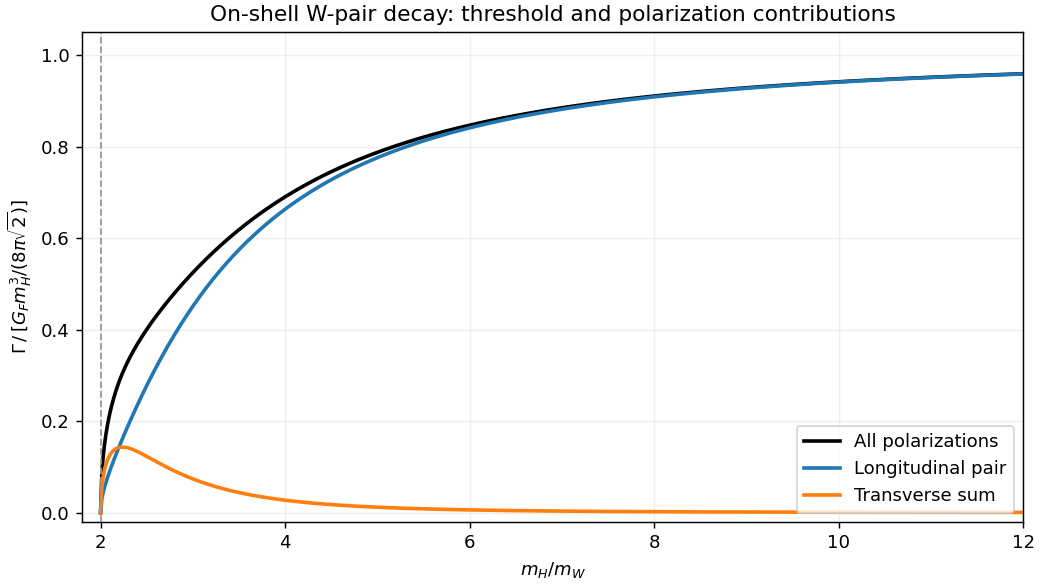

Below , the on-shell two-body decay channel is kinematically closed. An imaginary in the preceding formula is therefore a sign that this formula no longer applies. Slightly below threshold, the physical process can instead contain an on-shell W boson and an off-shell one, , followed by decay of the remaining W boson. Its rate requires the virtual-vector propagator, its allowed fermionic decay channels and the corresponding multiparticle Lorentz-invariant phase space. The nonzero decay width of the W boson smooths the idealized threshold. A polarization-resolved rate for two on-shell longitudinal vectors must not be analytically continued and treated as that multiparticle rate.
In the stronger limit , both intermediate W bosons must be virtual. Their heavy propagators suppress the four-fermion decay amplitude, while the small available phase space suppresses its rate further. At energies small compared with , integrating out the two vectors gives a local interaction proportional to . Its dimension-seven coefficient implies a rate of order when all four final fermions can be treated as massless, with channel-dependent constants. This is a low-energy scaling statement, not the on-shell longitudinal-width formula. Other accessible Higgs boson decay channels, such as a pair of fermions or loop-induced two-photon decay, must then be compared using their actual masses and couplings.
The Standard Model uses the local gauge group . Its Higgs field is a complex Higgs doublet of hypercharge . A bare mass term for a weak gauge boson, or for a charged fermion joining inequivalent left- and right-handed gauge representations, would not respect the unbroken electroweak construction. Instead introduce a gauge-invariant Higgs potentialIts minima satisfy , . Choosing a representative leaves unbroken. In this description electroweak symmetry breaking is ; the underlying local gauge symmetry remains a redundancy of the theory. A vacuum representative is not a physical explicit violation of gauge invariance.
In unitary gauge, write . The gauge-covariant kinetic term produceswith and . Three angular scalar directions supply the longitudinal gauge-boson polarizations of , while one real radial Higgs boson survives with . Counting physical degrees of freedom checks the Higgs mechanism: the electroweak gauge sector and scalar doublet have before the rearrangement and afterwards.
The Higgs potential also fixes the scalar self-interactions:The color gauge group is unbroken, so gluons remain massless. The same electroweak kinetic term fixesGauge-invariant Yukawa couplings such as give and the physical coupling . These relations predict stronger Higgs couplings to heavier massive particles; they do not determine the Yukawa parameters themselves. The minimal Standard Model does not supply observed neutrino masses. The surviving Higgs boson is neutral and has spin zero; its mass and self-coupling are tied to the curvature of the Higgs potential, not fixed by the gauge couplings alone. Higgs exchange also provides the Higgs cancellation in longitudinal vector scattering, maintaining the required high-energy behavior of weak amplitudes.
At a proton collider, important production mechanisms are gluon-fusion Higgs production through a heavy-quark loop, vector-boson fusion with two outgoing quark jets, associated or production, and production with a top quark pair. At an electron–positron collider, Higgsstrahlung is a clean example. Tree-level decays include Higgs decay to a fermion pair and, when allowed, Higgs decay to two W bosons or Higgs decay to two Z bosons. Below an on-shell vector-pair threshold, one or both vectors can be virtual. The and channels arise through loops; neutral colorless has no corresponding direct tree-level gauge coupling. Rates and branching fractions depend on both couplings and kinematics, so “heaviest available particle” is a guide rather than a complete rule.
The Higgs boson discovery in 2012 supplied an experimental test. The ATLAS experiment and CMS experiment reconstructed two-photon and four-lepton invariant masses in Large Hadron Collider proton collisions. Electromagnetic calorimeters measure photon energies, while tracking and muon systems identify charged leptons; narrow reconstructed peaks can be distinguished from smooth backgrounds with control samples and a likelihood analysis. The ATLAS discovery paper reported a new resonance near . An observed mass peak supports the existence of a new state; production channels, decay rates and angular distributions test whether it has the particular Higgs couplings and quantum numbers.[ref]
Finally, the hierarchy problem asks why the electroweak scalar mass scale remains much smaller than a putative heavy physical scale without delicate cancellations. A cutoff estimate suggests corrections times couplings, but the quadratic cutoff term itself depends on the regularization convention. The physical concern persists when a heavy state of mass couples to the Higgs field and produces threshold corrections of order its coupling times . Matching a much smaller Higgs mass may then require cancellation between independent parameters. Supersymmetry, compositeness and other protective structures propose different resolutions; renormalizability of the Standard Model does not by itself resolve this sensitivity or establish that new particles must occur at one particular mass.
Interactions produce Feynman diagrams with internal lines whose independent loop momenta are integrated without an upper bound. Their large-momentum contributions can have an ultraviolet divergence. Two explicit examples in a scalar quartic theory are a one-loop tadpole diagram contributing to the two-point function and a one-loop four-point bubble diagram. After a Wick rotation, a spherical cutoff gives the representative integralsCombinatorial factors and couplings multiply these integrals in a particular diagram. The first is quadratically divergent by cutoff power counting; the second is logarithmically divergent. Other schemes package the divergent pieces differently.
In renormalization, introduce a regularization, separate bare parameters into renormalized parameters and counterterms, and fix the latter by stated normalization conditions. Local divergent pieces of the scalar two- and four-point functions are absorbed into mass, field normalization and quartic-coupling counterterms, with all other operators allowed by the chosen symmetries included as needed. A perturbatively renormalizable quantum field theory requires this finite counterterm family to remain closed at all orders. It does not require every individual bare diagram to be finite. For gauge theories, identities expressing gauge symmetry and absence of a gauge anomaly are essential in addition to superficial counting.
The action is dimensionless in natural units, so in four spacetime dimensions and . The engineering dimensions of relativistic fields follow from matching the free kinetic terms:and henceFor a local operator of mass dimension , its coupling has dimension . Operators with dimension at most four are candidates for ordinary perturbative power-counting renormalizability. This test presupposes consistent kinetic terms, symmetries and the full set of induced counterterms; it is not a proof of physical consistency for an arbitrary vector interaction.
The operator has mass dimension four, so . It is a power-counting renormalizable scalar quartic interaction. It describes scalar self-interactions, including the quartic term in the Higgs potential for the appropriate scalar representation. Its sign in the potential must be chosen for a stable large-field theory; dimension counting alone does not ensure stability.
The operator has mass dimension , so . It is a power-counting renormalizable Yukawa interaction between a real scalar combination and a fermion bilinear. A scalar vacuum expectation value contributes to a Dirac mass term; its fluctuations couple to the fermion pair. This is a schematic scalar–fermion theory. In a chiral gauge theory, representations must be combined gauge-invariantly, as in the Standard Model Higgs–fermion interactions. Without additional protecting symmetries, all allowed scalar counterterms must be included as well.
The operator has mass dimension , giving . It is not power-counting renormalizable as a fundamental interaction treated to arbitrary energy. It is a perfectly usable dimension-five effective operator below its suppression scale. Successive orders in that effective field theory require a derivative and operator expansion rather than one finite set of parameters valid at every order.
The operator has mass dimension , so . It is the renormalizable electromagnetic current coupling when completed as quantum electrodynamics: a massless Abelian gauge field couples minimally to the conserved Dirac current, with consistent gauge fixing and Ward identities. Indeed, replacing by a gauge covariant derivative in the Dirac equation produces this interaction. The gauge structure, rather than dimension counting alone, ensures the necessary cancellations.[ref]
The operator has mass dimension , so . It is not power-counting renormalizable. Hermiticity may require a suitable conjugate or a symmetrized derivative, and electromagnetic gauge invariance would require a further consistent completion; neither repair changes its engineering dimension. Such derivative interactions can occur in an effective field theory, subject to its symmetries and operator redundancies.
Each Dirac current has mass dimension three, so their product has dimension six. Its coefficient therefore has dimension :The Fermi interaction is not power-counting renormalizable, but its success at low energies is explained by effective field theory. Exchange of a heavy W boson between the appropriate chiral weak currents has a propagator that expands as . The leading term is a local four-fermion interaction and further terms are suppressed by powers of . The complete spontaneously broken electroweak gauge theory resolves the pointlike approximation at higher energies. The source's vector-current product illustrates the operator dimension; the actual weak interaction also has its specific flavors and chiral structure.
Articles by others on the same topic
There are currently no matching articles.