An orientable surface admits local coordinate orientations that are consistent on overlaps. Equivalently a triangulation can be oriented so that adjacent faces induce opposite directions on their common edge. Use a polygon word to record its successive boundary edges, identifying equal letters in their indicated directions; a negative exponent reverses that edge direction.
Square models are , , and . The first identifies antipodal boundary points of a disk, giving the real projective plane. Only the torus among these three is orientable: its paired sides traverse the boundary oppositely, whereas each other model has a same-direction pair. The projective model has two vertex classes, and the other two one, giving Euler characteristics one and zero respectively.
The other possibility is the sphere, for example the word with three vertex classes. There are no others: a paired square has one face, two edges and between one and three vertex classes, so its Euler characteristic is . The classification of compact surfaces leaves precisely the sphere, real projective plane, torus and Klein bottle at those values, with the indicated orientabilities.
For connected sums, remove a disk from each surface, join the resulting boundary circles, and cut a joining arc to produce a single polygon. Its word concatenates the two original words. The real projective plane also has the bigon word , soThese use respectively six and eight sides, proving the requested hexagon and octagon constructions. Their Euler characteristics are and , also obtained from .
For a nonconstant holomorphic map of degree between compact connected Riemann surfaces,where the analytic ramification index is the exponent in local coordinates after coordinate changes. A meromorphic function maps its poles to infinity; the target coordinate is then holomorphic and vanishes at a pole, so this defines a holomorphic map to the Riemann sphere. A pole of order has local degree .
Let be the period lattice. The induced function has just one pole, of order two, so its degree is two. The Riemann-Hurwitz formula gives total ramification four. The pole contributes one; every analytic ramification index is at most two, so there are exactly three further ramification points, each simple. Evenness of , obtained by reindexing its lattice sum, identifies them with the three nonzero half-periods. Their values are distinct: two points of local degree two cannot lie in one degree-two fiber.
The functions and have double zeros at these same three points and a pole of order six at zero. Their ratio is a holomorphic nowhere-zero function on the compact torus, hence constant. From and its value is four. ThereforeThe printed additional assertion that all are nonzero is false. The square-lattice Weierstrass function has a zero branch value: for , reindexing gives . At the half-period , one has , so periodicity gives and hence . Thus one branch value is zero, while the three remain distinct.
The derivative has a single triple pole, so , and the Riemann-Hurwitz formula gives total ramification . The number of distinct ramification points requires a further distinction. The absent constant term in the Laurent expansion gives , so write . Differentiation yields . If , each of the two values has two distinct preimages under and none is a branch value, since a common zero of the cubic and its derivative would be a repeated cubic root. Thus there are four simple finite ramification points of and its triple pole, giving five distinct points. If , the nonsingularity of the cubic forces . The two simple zeros of make vanish to order two, so each has analytic ramification index three for . Together with its triple pole there are three distinct points. This second case occurs for a hexagonal lattice: its sixth-root rotational symmetry forces the Laurent coefficient, and hence , to vanish. The weighted count is six in both cases.
A critical point satisfies ; it is nondegenerate when the Hessian on its two-dimensional tangent space is nonsingular. For a smooth function with only nondegenerate critical points on a compact surface, the Morse theory formula iswhere counts the critical points whose Hessian has negative eigenvalues.
For , differentiation in a tangent direction gives . This vanishes for all exactly when the position vector is perpendicular to that tangent plane, equivalently the normal line at contains the origin. This includes , if it is on the surface. On a torus , while a minimum and a maximum give . Thus and the total is at least four. Hence at least four surface normals pass through the origin under the stated nondegeneracy assumption.
Write the generating circle as center and radius , with . A parametrization and unit normal areTake . If , its first coordinate gives . The alternative would force the radial distance of from the axis to be , contrary to . Thus . The remaining equations and the nonzero radial distance of force or . Each of the two choices of and two of works, giving exactly four distinct points. Take instead. All points on each of the circles and have radial normals through , giving infinitely many.
Parametrize a nonconstant hyperbolic geodesic by unit speed. Its energy is , and the Euler-Lagrange equation in the cyclic coordinate gives . Unit speed gives . If the curve is vertical. Otherwise, on either side of a possible highest point,The two branches join smoothly at the top. Conversely these curves with their unit-speed parametrizations satisfy the energy equations. Thus the unparametrized complete geodesics are vertical half-lines and upper semicircles centered on the real axis.
Let the tractrix point have positive height . Its tangent segment to the axis has length one and makes angle , so . Since its slope is , for its axial coordinate. Rotating gives orthogonal coordinate vectors with squared lengths and . Hence the stated first fundamental form follows.
Now put , . Direct substitution givesOn the specified intervals this coordinate map is a diffeomorphism onto the stated rectangle, so is an isometry there and a local isometry on the tractoid.
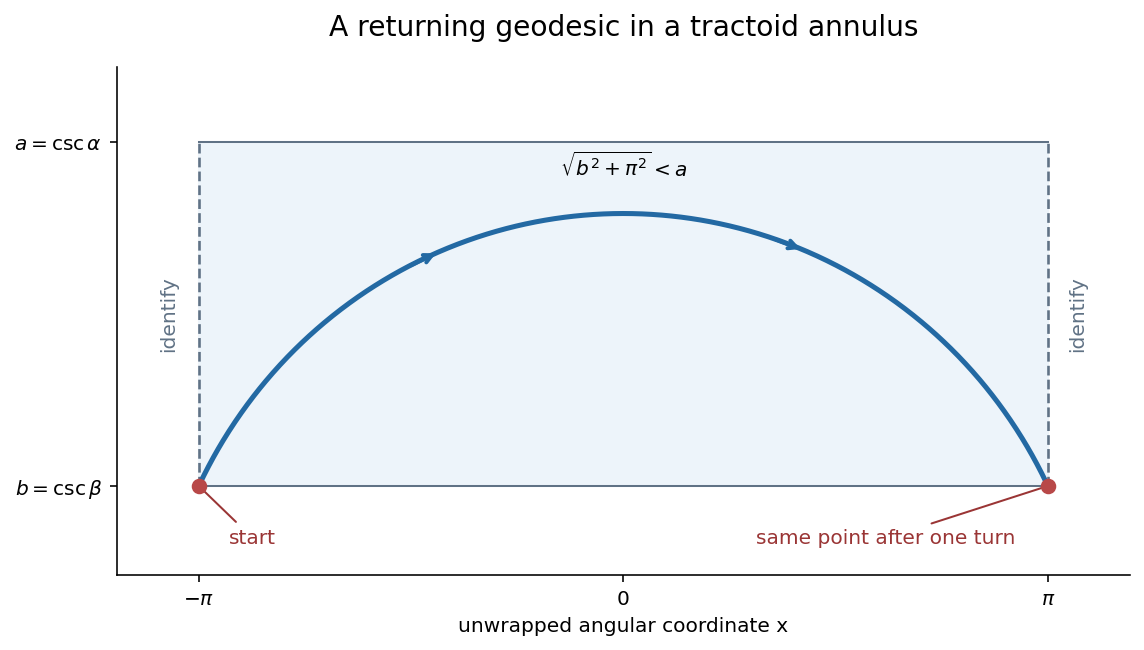
Set , . In the unwrapped coordinate, connect to along the semicircle centered at of radius . Its height lies between and that radius. The hypothesis puts the whole arc in the closed height strip . Projecting the angular coordinate modulo therefore gives a geodesic segment in the closed tractoid annulus which winds once and returns to its starting point. Taking to represent any chosen angular position proves the assertion for every point of its boundary. The returned tangent need not equal the starting tangent, so this proves the claimed returning segment without asserting a periodically smooth closed geodesic.

Choose representative vectors of the first points; they form a basis. Write a representative of the last point as . General position forces each , since otherwise of the points would lie in a hyperplane. Rescale the basis vectors to . The tuple is then projectively equivalent to the standard frameApply the same normalization to the second tuple and compose the two transformations to obtain existence. An automorphism fixing the coordinate points is represented by a diagonal matrix. Fixing their sum forces all its diagonal entries to agree, so its projective action is the identity. This proves existence and uniqueness. At it says the Möbius group acts sharply triply transitively on the projective line: any ordered triple of distinct points can be sent to any other in exactly one way.
By the preceding frame result take the four points to be . The conics through them have equationsCoefficient vectors differing by a common nonzero scalar define the same conic. Their parameter space is the projectivization of a two-dimensional vector space, hence a projective line.
Each partition of the four points into two unordered pairs gives a reducible conic formed by the two joining lines. There are three pairings. Conversely a reducible conic is a union of two lines, possibly repeated. General position prevents any one line from carrying three of the points, so the lines must be distinct and carry exactly one of these pairings. Thus there are exactly three reducible members. In these coordinates they are the parameters , , , giving respectively , , and .
Write in the same normalized coordinates. Its coordinates are all nonzero, because the coordinate lines join pairs of the first three points. Evaluation at gives the additional linear equation on the two-dimensional coefficient plane . It is not identically zero there: that would imply , hence and , contradicting the hypothesis. Its kernel is therefore one-dimensional. Thus there is exactly one projective conic through all five points. If it were reducible, would lie on a line joining two of the other points, contrary to no three being collinear. Hence the unique conic is irreducible.
For a plane affine curve given by a reduced equation , a point is singular when there. For a projective curve given by a homogeneous equation , a point is singular when on a nonzero representative. These conditions are invariant under projective rescaling. In characteristic zero, Euler's identity makes the equation follow from vanishing of the partials when in the field. Over an arbitrary field one should retain the equation itself, particularly if the characteristic divides the degree.
Bézout's theorem says that two projective plane curves over of degrees with no common irreducible component have total intersection multiplicity , so at most distinct intersection points. Let the irreducible curve have reduced homogeneous equation of positive degree . In characteristic zero some partial derivative is nonzero. For this derivative has degree and cannot share a component with the irreducible degree- polynomial . Every singular point belongs to their intersection. Bézout bounds their number by , proving there are finitely many singular points. For a partial is a nonzero constant and there are none.
Put . Its partials areAt infinity , the curve equation forces , giving , where . In the chart , the derivative equations give and . Only lies on the curve and also makes . Thus the only singular point is . As a check, the affine equation factors as , whose quadratic tangent cone there is , giving two distinct tangent lines.
For , the partials are and . If their simultaneous vanishing forces , and that point lies on the curve exactly when . In characteristic two, the equations force and then , so . In characteristic three they force and then , so . Consequentlyand there are no singular points for any other prime.
With local indices , the required specialization isOnly the finitely many points of index greater than one contribute. Their images are the branch points on the target.
For , the map has local index at zero and at infinity; at infinity use coordinates in source and target, giving again . At every nonzero finite point its derivative is nonzero, so there are no further ramification points. Thus the ramification sum is and the formula gives , as required for the sphere. For the map is the identity and has no ramification, giving the same equality separately.
For a smooth complex projective plane curve of degree ,Project generically from a point outside the curve to a projective line. Its degree is , by intersection with a generic line through the center. Ramification occurs when such a line is tangent. In coordinates for projection , these points satisfy . The polar has degree , and Bézout gives total ramification ; generic projection makes the ramification simple, or the intersection multiplicities can be read as the corresponding ramification orders. The Riemann-Hurwitz formula yields and hence the formula. The smoothness qualification is essential for geometric genus: singular plane curves have the same arithmetic degree-genus expression, while the genus of their normalization can be smaller.
The ramification sum equals . Since and , it is at least . Thus some point has analytic ramification index greater than one.
For a degree-one map, the sum of local degrees in every fiber is one. Therefore each fiber contains exactly one point and its local degree is one. There is no ramification, and the Riemann-Hurwitz formula gives , so . The map is a continuous bijection from compact onto the Hausdorff sphere and hence a homeomorphism. In fact its local degree-one coordinate inverses are holomorphic, so it is biholomorphic as well.
For degree two every ramification point has index two, so contributes exactly one. The formula gives ramification points. No two can share an image: that would give a fiber of total local degree at least four. Hence there are also distinct branch points on the sphere.
A Riemann surface is a connected Hausdorff second-countable topological surface equipped with coordinate charts to open subsets of whose transition maps are holomorphic. This is a complex manifold of complex dimension one. The atlas makes holomorphic functions, meromorphic functions and holomorphic differentials coordinate-independent notions.
Choose so the closed disk centered at of radius lies in . The Cauchy integral formula givesParametrize ; then and the denominator cancels. Thus
Choose a disk on which . If the assertion is immediate. Otherwise multiply by a fixed unit scalar so that its value at is the positive real number . The mean-value identity shows the average of on every sufficiently small circle is . Since there, continuity forces equality at every point on each circle. Equality of real part to together with modulus at most forces the imaginary part to vanish. Varying the radius covers a neighborhood of . Thus both and are constant near , proving the local maximum-modulus assertion.
Compactness makes the continuous function attain a maximum. Apply the preceding argument in a chart at a maximizing point to make constant on a neighborhood. The permitted identity theorem and connectedness then make it constant on all of . Hence every holomorphic function from a compact connected Riemann surface to is constant.
A divisor on an algebraic curve is a finite integer sum ; its degree is . For a meromorphic function its principal divisor records its zero and pole orders, andLet be the divisor of a nonzero meromorphic differential, called a canonical divisor. The Riemann-Roch theorem statesMultiplication by that differential identifies with the space of holomorphic differentials. By the preceding result consists exactly of constants, so . Applying the formula at gives , hence .
Apply Riemann-Roch at and use and :Rearranging gives . This holds for every canonical divisor, since any two differ by a principal divisor of degree zero.
Articles by others on the same topic
There are currently no matching articles.